Strings
Violin or viola for a beginner?
Every school orchestra has too many violinists and not enough violists, and that imbalance is the most useful fact in this comparison.
By Sawyer V. · Published · Last updated
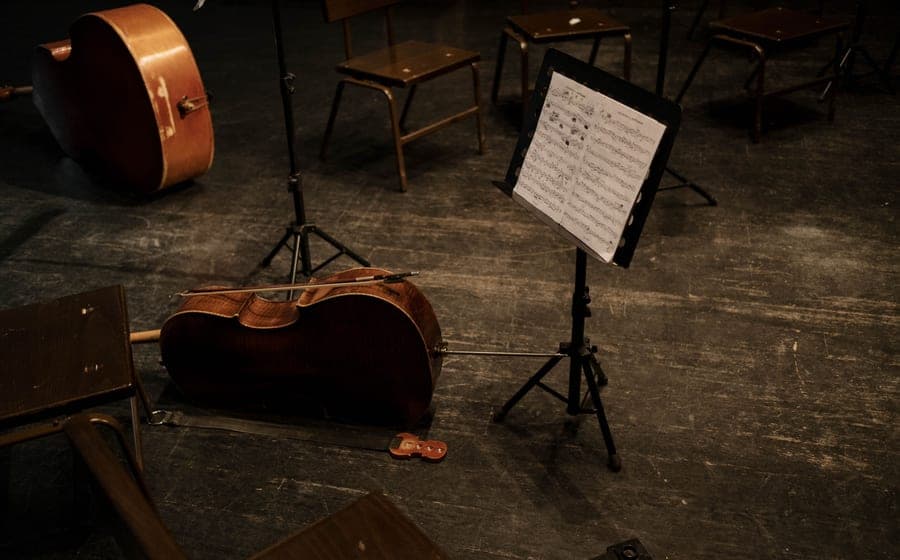
The viola gets treated as the violin’s slightly awkward relative, which is unfair and also strategically useful, because the resulting shortage of violists is the single most practical thing a beginner can exploit.
The viola is larger, tuned a fifth lower, and reads a clef nothing else uses. It is also in permanent short supply in every school orchestra and amateur ensemble. If the player is physically big enough, viola gets them playing with other people sooner than violin does.
The differences
| Violin | Viola | |
|---|---|---|
| Tuning | G, D, A, E | C, G, D, A |
| Size | Smaller, lighter | Larger body, heavier, wider string spacing |
| Clef | Treble — shared with most instruments | Alto — essentially unique to viola |
| Sound | Bright, carrying, sits on top | Darker, warmer, sits in the middle |
| Usual role | Melody | Inner harmony |
| Players available | Many — competitive | Few — always wanted |
The size question
Violas are measured in inches of body length rather than in fractions, and a full-size viola is a noticeably bigger object than a full-size violin. It is heavier under the chin and the strings are further apart, which asks for a slightly wider left-hand reach.
For a small child, that is a genuine constraint and it is usually why teachers steer younger beginners toward violin first. Smaller violas exist and a fractional violin can be strung as a viola in some programs, but the practical answer for a young child is frequently to start on violin and switch later.
The measuring principle is the same one that governs violin sizing — arm length rather than age — and it is set out in violin sizes by age. An instrument one size too big is not merely awkward; it is unplayable, and the player concludes they are bad at it.
The clef, which sounds worse than it is
The viola reads alto clef, where middle C sits on the center line of the staff. Almost nothing else uses it, which means viola sheet music looks unfamiliar to every other musician in the room.
For a genuine beginner this is close to a non-issue. You are learning to read music from scratch anyway, and alto clef is no harder than treble — it is simply different, and being different is only a problem if you already knew the other one.
For a violinist switching across, it is a real short-term irritation that resolves in a few weeks of reading practice.
The demand argument
This is the part worth weighing heavily.
Every school orchestra, community orchestra and amateur string group has more violinists than it needs and fewer violists than it wants. That is not a local quirk; it is consistent, because violin is what beginners are handed by default.
The consequence for a student is direct. A competent beginner violist gets invited into ensembles considerably sooner than an equivalent violinist, who is joining a queue. And playing with other people is the strongest single predictor of anyone continuing with an instrument — it is the same reason we make the case for bass in guitar or bass for beginners.
Sound and role
A violin plays melody. It sits on top of the texture and it is heard.
A viola usually plays the inner harmony — the part that makes a chord a chord rather than the part anyone hums. Its voice is darker and less penetrating, and players who love it tend to talk about it in those terms rather than in terms of virtuosity.
Which suits you is a real question. Some people want the tune; some prefer being the reason the ensemble sounds full. Neither is the wrong answer.
What to buy
For year one on either instrument, rent rather than buy. Both are sized to the player, both need periodic size changes for a growing child, and a rental program handles the maintenance that a beginner cannot diagnose. The reasoning is in rent or buy.
When buying, the shape of the decision is the same on both: an outfit rather than a bare instrument. A Stentor Student II Violin Outfit#ad violin outfit is our standard first-violin recommendation and includes the bow, case and rosin you cannot play without — what a complete package should contain is in what comes with a violin outfit.
The one thing to buy regardless of instrument is a Snark clip-on chromatic tuner#ad. A fretless instrument played out of tune trains the ear toward wrong intervals, which is a genuinely expensive habit — the method is in how to tune a violin and applies to viola with the string names shifted.
And if neither fits
The cello is the third option and the one that suits players who find the chin-and-shoulder hold uncomfortable. It is held between the knees with both arms in a natural position, and a Cecilio CCO-100 cello outfit#ad outfit is the entry point. That comparison is in violin or cello.
If bowed strings as a family are still an open question, start at bowed versus fretted strings.
What we would buy
Stentor Student II Violin Outfit
StentorBest for: First violin, every size
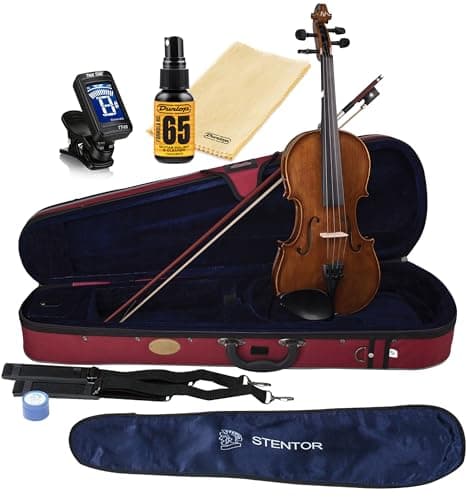
Solid carved spruce and maple with an ebony fingerboard, set up in a workshop before shipping, and made in five fractional sizes. The workshop setup is the specification that matters most on a beginner violin.
Published specifications
- Top:
- Solid carved spruce
- Back / sides:
- Solid figured maple
- Fingerboard:
- Ebony
- Pegs:
- Ebony or rosewood
- Sizes:
- 4/4, 3/4, 1/2, 1/4, 1/8
- Strings:
- Steel core, factory fitted
- Outfit:
- Wooden bow with ebony frog and natural horsehair, rosin, shaped lightweight case with music pocket and rucksack straps
What it gets right
- Ebony fingerboard and pegs, not stained hardwood — a stained fingerboard wears through and a soft peg will not hold a tuning
- Individually set up in a workshop before it ships, which is the single biggest variable on a cheap violin
- Available in five fractional sizes, so the same instrument family covers a child from about age five to adult
Where it gives ground
- The supplied steel-core strings are the first upgrade most teachers suggest
- The bow is functional rather than good; it is the second upgrade
What it is not good at
Being bought without measuring. Violin size is set by the player's arm length, not their age, and a violin one size too big is genuinely unplayable rather than merely awkward. Measure first.
How the specs score against a beginner’s needs
Scores are our reading of the published specifications above against what a beginner physically needs. They are not test results — we have not played this instrument.
Specifications from Stentor Music — Student II violin outfit.
Cecilio CCO-100 cello outfit
CecilioBest for: First cello, complete outfit
A spruce-top, maple-body cello that arrives with a hard case, a soft case, a bow, a stand, rosin and a spare string set. Cellos are expensive to complete, and this one is complete.
Published specifications
- Top:
- Spruce
- Back / neck / sides:
- Maple
- Bow:
- Brazilwood with unbleached horsehair
- In the outfit:
- Hard case, soft case, bow, cello stand, rosin, spare string set
- Sizes:
- Available in full and fractional sizes
- Warranty:
- 1 year against manufacturer defects
What it gets right
- Genuinely complete — a cello needs a bow, rosin, a stand and a case to be usable, and buying those separately costs more than the instrument
- Both a hard and a soft case, which for an instrument this size is a real convenience rather than a gimmick
- Available in fractional sizes, so a growing child stays within one family
Where it gives ground
- The supplied bow and strings are the first two things a teacher will suggest upgrading
- Set-up quality is the variable at this tier — budget for a shop check before the first lesson
What it is not good at
Arriving ready. A cello needs its bridge fitted and its soundpost checked, and at this price that work has not been done to the standard a teacher expects. Factor a setup in.
How the specs score against a beginner’s needs
Scores are our reading of the published specifications above against what a beginner physically needs. They are not test results — we have not played this instrument.
Specifications from Cecilio Music — CCO-100 cello outfit.
Snark clip-on chromatic tuner
SnarkBest for: Tuning anything with strings
Clips to the headstock and reads pitch from the vibration of the wood, so it works in a noisy room and an adult who plays nothing can tune the instrument in twenty seconds.
Published specifications
- Type:
- Clip-on chromatic
- Sensing:
- Vibration through the headstock, not the microphone
- Fits:
- Guitar, bass, ukulele, violin, mandolin
- Display:
- Full-color rotating screen
What it gets right
- Vibration sensing means it works in a room with a television on, which a microphone tuner does not
- Chromatic, so one tuner covers every instrument in the house
- The rotating display means it reads correctly whichever way the instrument is held
Where it gives ground
- The clip is plastic and it is the part that eventually breaks
- Battery-powered, and it will be flat the one time you need it in a hurry
What it is not good at
Wind and brass instruments. It reads vibration through a solid body, so there is nothing for it to clip to on a flute or a trumpet.
How the specs score against a beginner’s needs
Scores are our reading of the published specifications above against what a beginner physically needs. They are not test results — we have not played this instrument.
Specifications from Snark tuners (retail listing with published feature set).
Questions people actually ask
Is viola harder than violin?
Slightly, in two specific ways: it is larger and heavier so it takes more physical effort to hold, and it reads alto clef, which almost no other instrument uses. Neither is a serious barrier for a beginner starting fresh.
What is the difference between a violin and a viola?
A viola is larger and tuned a fifth lower — C, G, D, A against the violin’s G, D, A, E. It shares three of its four strings with the violin, which is why switching between them is straightforward.
Should a beginner start on viola?
It is a perfectly good starting instrument and an unusually strategic one. Violists are in demand in every ensemble, so a competent beginner gets asked to play far sooner than an equivalent violinist.
Can a violinist switch to viola?
Easily, and many do. The bowing technique is identical and three strings are shared. The two adjustments are the wider spacing and reading alto clef, both of which take weeks rather than years.
Sources
Still deciding?
Every recommendation on this site is built the same way, and the method is published in full — including what we do not do and what would get a pick dropped.
Read next
- Best beginner violins: measure first, then buy
Arm-length sizing chart, why workshop setup is the spec that matters most, and one pick available in five sizes.
- Violin or cello for a beginner?
Posture, early tone, transport, cost and orchestral demand, compared for a beginner choosing between the two.
- Violin sizes by age and arm length
The full fractional chart by arm length, how to measure, and why a violin one size too big cannot be played correctly.
- Bowed or fretted strings for a beginner?
What frets actually do for a beginner, why bowing is a second instrument, and which family suits a child, an adult or a self-teacher.
- Choosing a school band instrument
Which instrument suits which child, what school rental covers, and the honest case for not buying in year one.