Strings
Violin sizes by age and arm length
Eight fractional sizes, selected by one measurement. Get it wrong upward and the instrument is not awkward, it is unplayable.
By Sawyer V. · Published · Last updated

Violin size is set by arm length. Measure from the side of the neck to the middle of the palm with the left arm extended straight out to the side: 17.5 to 20 inches is a 1/4, 20 to 22 inches is a 1/2, 22 to 23.5 inches is a 3/4, and 23.5 inches or more is full size. Age is a weak proxy for that measurement.
The full chart
| Size | Arm measurement | Typical age | Approx. body length |
|---|---|---|---|
| 1/16 | 14–16.5" | 3–4 | About 9" |
| 1/10 | 16.5–17" | 3–5 | — |
| 1/8 | 17–17.5" | 4–5 | — |
| 1/4 | 17.5–20" | 5–6 | About 10" |
| 1/2 | 20–22" | 7–8 | About 11" |
| 3/4 | 22–23.5" | 9–11 | — |
| 4/4 (full) | 23.5" and up | 12 and up | — |
Not every maker offers every size. The Stentor Student II covers 4/4, 3/4, 1/2, 1/4 and 1/8, which spans roughly age five to adult — useful, because it means a family can stay with one instrument family through the whole growth run and know what they are getting each time.
How to measure, properly
Thirty seconds and a tape measure.
Stand the player upright, relaxed. Have them extend their left arm straight out to the side at shoulder height, palm facing up. Measure from the point where the neck meets the shoulder, along the arm, to the middle of the palm — not the fingertips, and not the wrist.
Fingertips is the most common error and it overshoots by two to three inches, which is a whole size. The reason the measurement stops at mid-palm is that the hand has to curl around the neck of the instrument, so the fingers are not part of the reach.
Why oversizing fails here specifically
On a guitar, an oversized instrument is uncomfortable and technically playable. On a violin it is neither.
The left hand has to reach around the neck with the fingers curved over the fingerboard and the wrist neutral. That position is what allows the fingers to drop onto the string vertically, which is what produces a clean note on a fretless instrument. There is no fret to catch a slightly misplaced finger.
If the arm is too short for the instrument, the player has three options and all three are bad. They rotate the shoulder forward, which strains it and pulls the violin off the collarbone. They collapse the wrist inward, which flattens the fingers so they land at an angle rather than vertically. Or they hold the instrument further forward, which puts the bow at the wrong angle to the strings.
Any of those becomes the habit within weeks. Undoing it later is harder than learning it correctly would have been, and a teacher will spend months on it.
When to size up
When the measurement says so, and not before. Practically: re-measure every six months, and always before a new school year or a new term of lessons.
There is also a real cost to being too small, which people forget. On an undersized violin the fingers crowd each other, the string spacing is tight, and intonation becomes harder than it should be because the margin for error shrinks. When the measurement crosses into the next band, move.
When it falls between two sizes, size down. A slightly small violin is cramped and entirely playable. A slightly large one is not.
Rent or buy through the growth years
A child starting at five will pass through three or four sizes before reaching full size around twelve. That is the argument for renting, and it is a good one — many shops apply rental payments toward an eventual purchase, and the rental covers the maintenance that a growing instrument needs.
Buying makes more sense in two situations: the player is an adult, and will stay on 4/4 permanently; or the child has reached 3/4 or full size, which is where they will stay. At that point a bought instrument is cheaper than continued rental and holds its value.
Either way, the specification that matters most on an inexpensive violin is whether it was set up in a workshop before it shipped — that is covered in our beginner violin picks, and what a complete outfit should contain is in what comes with a violin outfit.
What we would buy
Stentor Student II Violin Outfit
StentorBest for: First violin, every size
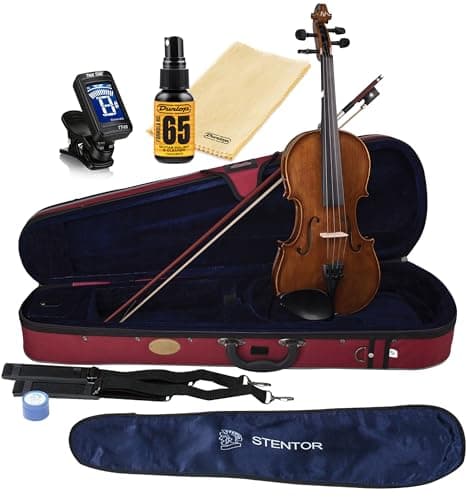
Solid carved spruce and maple with an ebony fingerboard, set up in a workshop before shipping, and made in five fractional sizes. The workshop setup is the specification that matters most on a beginner violin.
Published specifications
- Top:
- Solid carved spruce
- Back / sides:
- Solid figured maple
- Fingerboard:
- Ebony
- Pegs:
- Ebony or rosewood
- Sizes:
- 4/4, 3/4, 1/2, 1/4, 1/8
- Strings:
- Steel core, factory fitted
- Outfit:
- Wooden bow with ebony frog and natural horsehair, rosin, shaped lightweight case with music pocket and rucksack straps
What it gets right
- Ebony fingerboard and pegs, not stained hardwood — a stained fingerboard wears through and a soft peg will not hold a tuning
- Individually set up in a workshop before it ships, which is the single biggest variable on a cheap violin
- Available in five fractional sizes, so the same instrument family covers a child from about age five to adult
Where it gives ground
- The supplied steel-core strings are the first upgrade most teachers suggest
- The bow is functional rather than good; it is the second upgrade
What it is not good at
Being bought without measuring. Violin size is set by the player's arm length, not their age, and a violin one size too big is genuinely unplayable rather than merely awkward. Measure first.
How the specs score against a beginner’s needs
Scores are our reading of the published specifications above against what a beginner physically needs. They are not test results — we have not played this instrument.
Specifications from Stentor Music — Student II violin outfit.
Questions people actually ask
How do I measure for a violin?
Have the player extend their left arm straight out to the side, palm up. Measure from where the neck meets the shoulder to the middle of the palm. That single number selects the size — not their age, and not their overall height.
What size violin for a 7 year old?
Usually a 1/2, which corresponds to an arm measurement of about 20 to 22 inches. A small seven-year-old may still be on a 1/4 and a tall one may already suit a 3/4. Measure rather than assume.
Should I size up so it lasts longer?
No, and on a violin this is worse than on any other instrument. If the arm cannot reach the correct hand position, the player compensates by rotating the shoulder and collapsing the wrist — and that becomes the habit. It has to be dismantled later, which is harder than learning it right.
How often will a child change size?
Three or four times between starting at five and reaching full size around twelve. That is why renting is genuinely reasonable for a growing child, and why many shops apply rental payments toward an eventual purchase.
Sources
Still deciding?
Every recommendation on this site is built the same way, and the method is published in full — including what we do not do and what would get a pick dropped.
Read next
- Best beginner violins: measure first, then buy
Arm-length sizing chart, why workshop setup is the spec that matters most, and one pick available in five sizes.
- What comes with a violin outfit, and what doesn't
What an outfit contains, what each part is worth bought separately, and the two items nearly everyone still needs.
- What size guitar does a child need?
Age and height chart with real scale lengths, the ten-second fit check, and why height beats age every time.
- Drum set sizes by age
Bass drum diameter by age with a reach test, and the throne-height problem that no chart can capture.
- The best first instrument for a child
Instrument by instrument, the real starting age set by hand size and reach, with a pick for each and the noise column filled in.