Start Here
The best first instrument for a child
Children fail at instruments for physical reasons far more often than musical ones. Here is the comparison done on hand size, reach and strength.
By Sawyer V. · Published · Last updated

Children stop playing instruments for physical reasons far more often than musical ones. A hand that cannot span a chord shape, an arm that cannot reach a pedal, fingers that cannot press a steel string hard enough to make a note — these are the actual failure modes, and none of them are about aptitude.
So this comparison is done on physical fit. Every pick states its Starter Path band, and we have not played these instruments — our method is on how we pick.
By starting age
| Instrument | Realistic start | Hand strength needed | Can be practiced quietly? |
|---|---|---|---|
| Ukulele | 4–5 | Almost none | Fairly — genuinely quiet |
| Keyboard | 5 | None, if unweighted | Yes — headphones |
| 3-string guitar | 6 | Low | Fairly |
| Guitar (sized) | 6–7 | Moderate to high | Electric yes, acoustic no |
| Drums (junior) | 3–4 | None | Electronic mostly, acoustic no |
| Violin | 4–5, measured | Low, but demanding posture | No |
Ukulele: the default answer under eight
Three things line up and no other instrument has all three.
Nylon strings under low tension need almost no finger strength, so a four-year-old can press them. A soprano body is about 21 inches long and can be held on a lap without help. And several usable chords need one finger, which means a real, recognizable song within the first week.
That last point is the important one. The strongest predictor of a young child continuing is whether they made something that sounded like music early. A ukulele delivers that in days. A guitar delivers it in weeks, and the weeks in between are when children decide they are bad at it. Our kids ukulele picks cover the durability question too, which matters more than tone at this age.
Keyboard: the most transferable
A keyboard’s advantage is that the note is right there. Press a key, hear the correct pitch. There is no intonation to get wrong, no string to fret cleanly, no bow angle to manage. The mechanical barrier between intention and sound is lower than on any other instrument.
It is also the best foundation for reading music, because the layout makes pitch visible — left is lower, right is higher, and the pattern repeats. Children who start on keys and move to something else carry that with them.
The costs are that it requires sitting still at a fixed station, which some children find much harder than others, and that touch response is non-negotiable — a keyboard that plays every note at the same volume cannot teach dynamics at all. Our keyboard picks all have it.
Guitar: popular, and the hardest first month
Guitar is what most children ask for, and that counts for a great deal. It is also the one with the highest early friction: steel strings hurt for two to three weeks, chord shapes need three fingers placed accurately, and hand size is a genuine limit.
Two things make it work. Buy the right size, which for a child under about twelve means a 3/4 or smaller. And consider a 3-string instrument for a child under about eight — a Loog uses standard guitar strings and standard tuning on a 20.4 inch scale, so a major chord is one finger and everything learned transfers to a six-string later.
Drums: the most immediately satisfying
Drums have a genuine and underrated advantage for young children: nothing to tune, no intonation, no finger strength, and a satisfying sound on the first hit. A five-year-old can play something that sounds like drumming within minutes.
Two obstacles. The kit has to be sized so the pedals are reachable — an adult kit is not something a child grows into, it is one they cannot operate. And an acoustic kit is loud enough that hearing protection is required every session. An electronic kit with headphones solves the second problem entirely and is why our kids drum picks lean that way.
What we would not start a child on
A full-size anything. Covered throughout. Buying big to grow into is the single most common mistake in this whole category and it reliably ends the hobby before the growing happens.
Instruments from the toy aisle. A ukulele-shaped object that cannot be tuned to pitch is not a cheap ukulele. The child plays something that is not music and cannot be made into music.
Violin without measuring. Violin size is set by arm length and a violin one size too big is genuinely unplayable rather than merely awkward. It is a fine first instrument, and the measurement comes before the purchase — see beginner violins.
The thing that matters more than the instrument
Where it lives. An instrument on a stand in the corner of the living room gets picked up on the way past, several times a day, for two minutes at a time. An instrument in a case under a bed gets played on lesson day.
This is not a small effect and it costs $15 to arrange. Whatever you buy, buy the stand.
What we would buy
Kala KA-15S
Kala Brand MusicBest for: The honest floor, soprano
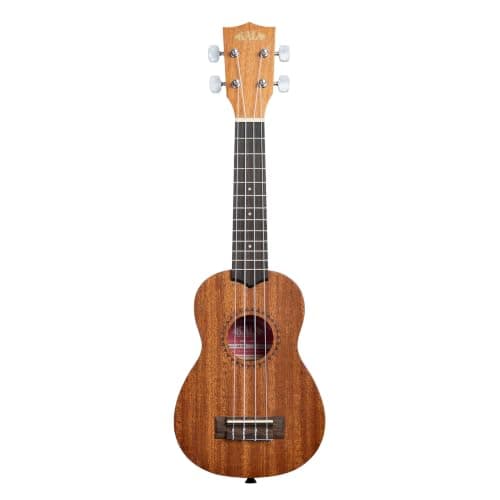
Mahogany throughout, a GraphTech NuBone nut and saddle, and Aquila strings fitted from the factory. The nut material is the spec that separates this from the pile of look-alikes.
Published specifications
- Size:
- Soprano
- Top / back / sides:
- Mahogany
- Neck / fretboard:
- Mahogany neck, rosewood fretboard
- Nut and saddle:
- GraphTech NuBone
- Scale length:
- 13.625"
- Frets:
- 12
- Nut width:
- 1.375"
- Overall length:
- 21.062"
- Strings:
- Aquila Super Nylgut
What it gets right
- NuBone nut and saddle rather than molded plastic — this is what decides whether the instrument plays in tune up the neck
- Aquila strings fitted at the factory, so the first thing you would otherwise replace is already done
- 21 inches overall and light enough for a small child to hold unsupported
Where it gives ground
- 12 frets only, and the body joint stops you well short of the high notes
- Soprano scale means less room between frets — adult fingers with wide fingertips will find it cramped
What it is not good at
Adult hands, sometimes. A 13.625 inch scale is genuinely tight. If the player is a grown-up with large hands, read our soprano-versus-concert comparison before buying this size.
How the specs score against a beginner’s needs
Scores are our reading of the published specifications above against what a beginner physically needs. They are not test results — we have not played this instrument.
Specifications from Kala Brand Music — KA-15S specifications.
Loog Pro Acoustic
LoogBest for: Ages 6-9, first chords fast
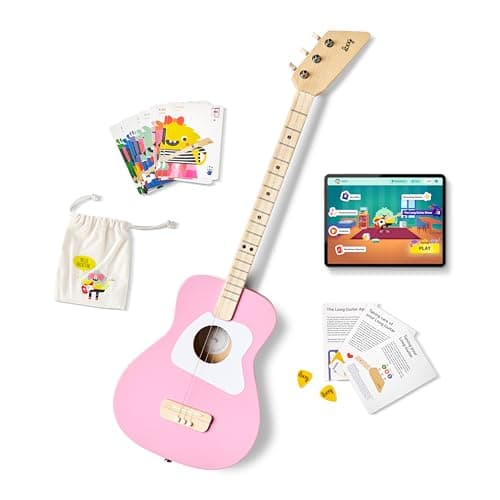
Three strings, a 20.4 inch scale and two pounds. It uses standard guitar strings and standard tuning, so everything learned on it transfers directly to a six-string.
Published specifications
- Strings:
- 3, standard guitar strings and tuning
- Scale length:
- 20.4" (520 mm)
- Dimensions:
- 29.2" long, 8.8" wide, 2.6" deep
- Weight:
- 2.0 lb (0.9 kg)
- Body / neck:
- Basswood body, maple neck and fingerboard
- Frets:
- 18
- Age guidance:
- Manufacturer states from age 6
What it gets right
- Three strings means a real chord on the first day, which is the single biggest predictor of a child continuing
- Standard tuning and standard strings — this is not a proprietary instrument that teaches a dead end
- Two pounds and 29 inches long; a six-year-old can pick it up unaided
Where it gives ground
- Three strings, so full six-string chord shapes are not available
- Basswood and a short scale mean a quiet, thin voice compared with any full acoustic
What it is not good at
Being the guitar for long. It is a deliberate bridge to a six-string, and if the child is already 9 or 10 you should probably skip straight to a 3/4 six-string instead.
How the specs score against a beginner’s needs
Scores are our reading of the published specifications above against what a beginner physically needs. They are not test results — we have not played this instrument.
Specifications from Loog Guitars — Pro Acoustic specifications.
Yamaha PSR-E383
YamahaBest for: Learning tools, 61 keys
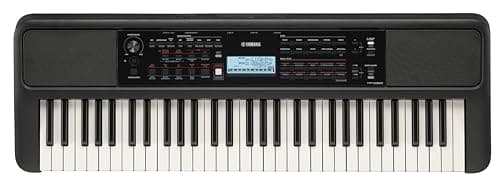
61 touch-sensitive keys and 125 lesson songs with hand-separate practice and scoring. The touch response is the spec that matters; the 650 tones are the spec that sells it.
Published specifications
- Keys:
- 61, organ-style (unweighted), touch-sensitive
- Touch response:
- Soft / medium / hard / off
- Polyphony:
- 48 notes
- Tones:
- 650 (258 panel, 25 drum/SFX, 20 arpeggio, 347 XGlite)
- Lessons:
- 125 lesson songs, right/left/both-hand practice with evaluation
- In the box:
- Music rest, PA130 power adapter
What it gets right
- Touch-sensitive keys — playing harder makes it louder, which is the thing a beginner has to learn early and a non-touch keyboard cannot teach
- The lesson mode with hand-separate practice and scoring is genuinely useful, not a gimmick
- Power adapter included, which is not a given at this tier
Where it gives ground
- Unweighted organ-style keys — this will not build the finger strength a piano needs
- 61 keys, so a method book that assumes 88 will eventually run out of instrument
What it is not good at
Preparing anyone for an acoustic piano. If there is a real piano in the child's future, the unweighted action is a habit to unlearn later. Read our 61-versus-88 comparison before deciding.
How the specs score against a beginner’s needs
Scores are our reading of the published specifications above against what a beginner physically needs. They are not test results — we have not played this instrument.
Specifications from Yamaha — PSR-E383 specifications.
Alesis Debut Kit
AlesisBest for: Ages roughly 5-9
Four 6 inch mesh pads sized and spaced for a small child, with headphones, a throne and sticks in the box. Alesis states it is designed for ages 5 to 9 and the geometry backs that up.
Published specifications
- Pads:
- Four 6" mesh pads (snare and three toms)
- Cymbals:
- Three 10" pads — hi-hat, crash, ride
- Pedals:
- Hi-hat and bass drum pedals included
- Module:
- DM-Lite: 120 sounds, 10 kits, 30 play-along tracks, drum coach
- Age guidance:
- Manufacturer states ages 5-9
- In the box:
- Metal rack, height-adjustable throne, sticks, headphones, cables, Melodics lessons
What it gets right
- Purpose-built small geometry — the pads are within a small child's reach rather than an adult kit with the legs shortened
- Headphones included, which for a kids' drum kit is the difference between practicing and being asked to stop
- Height-adjustable throne, so it tracks a growing child for a couple of years
Where it gives ground
- 6 inch pads are small enough that an older child will feel boxed in quickly
- The DM-Lite module is basic; 120 sounds and no real editing
What it is not good at
Lasting. Alesis's own 5-to-9 guidance is honest, and a 10-year-old should start on the Nitro Max instead. Buying this for an older child to save money buys a kit they will resent in a year.
How the specs score against a beginner’s needs
Scores are our reading of the published specifications above against what a beginner physically needs. They are not test results — we have not played this instrument.
Specifications from Alesis Drums — Debut Kit.
Questions people actually ask
What instrument should a child learn first?
Under about seven, a ukulele or a 3-string guitar, because both can be held and played by a small child with almost no hand strength. From about seven, add keyboard and a correctly sized guitar. Drums work at any age given a kit sized so the pedals are reachable.
What is the best first instrument for a child to learn?
Ukulele, for most children under about eight. Nylon strings need almost no finger strength, the body is small enough to hold unaided, and several chords need one finger, which means a real song in the first week. That early win is the strongest predictor of continuing.
What is a good instrument for a 7 year old to learn?
A soprano ukulele, a 1/2-size guitar, a 3-string Loog, or a 61-key touch-sensitive keyboard. All four are within a seven-year-old’s physical reach. A full-size guitar and a full-size drum kit are not.
What age should a child start an instrument?
It depends on the instrument rather than the child. Ukulele from about four, keyboard from about five, guitar from about six with a correctly sized instrument, junior drums from about three. Starting earlier than the instrument allows produces frustration, not a head start.
Sources
Still deciding?
Every recommendation on this site is built the same way, and the method is published in full — including what we do not do and what would get a pick dropped.
Read next
- What size guitar does a child need?
Age and height chart with real scale lengths, the ten-second fit check, and why height beats age every time.
- Drum set sizes by age
Bass drum diameter by age with a reach test, and the throne-height problem that no chart can capture.
- Best ukuleles for kids
Wood or composite, with the humidity problem that kills cheap wooden ukuleles in dry houses stated plainly.
- Best guitars for kids: sized by reach, not by age
Segmented by age band with real scale lengths and body dimensions, plus why buying big to grow into reliably backfires.
- The easiest instruments to learn
Ranked by time to a first real song, with the ceiling each one trades away, and a pick for the top three.