Start Here
The easiest instruments to learn
Ranked by time to a real song. Every one of them trades something for that speed, and the trade is stated.
By Sawyer V. · Published · Last updated
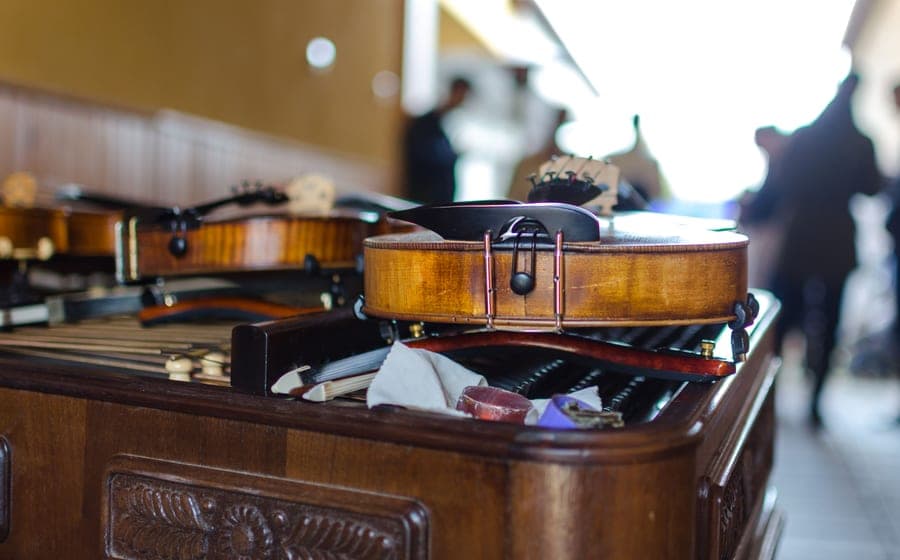
Ranked by time to a real song: ukulele first, then keyboard, then a 3-string guitar, then drums, then six-string guitar, then violin. Each one trades something for that speed — usually range, or transferability, or noise — and the trades are set out below.
The ranking
1. Ukulele
Time to a real song: the first sitting.
Four advantages compound. Nylon strings under low tension need almost no finger strength. Four strings rather than six means less to fret and less to mute accidentally. A 13.6 inch soprano scale puts everything within easy reach. And crucially, C major is one finger and F is two.
The trade: range. Four strings and 12 to 18 frets is a genuinely limited instrument compared to a guitar or a piano. For strumming and singing that ceiling is high enough for a lifetime; for anything melodic it arrives.
2. Keyboard
Time to a real song: the first week.
Press a key, get the correct note. No intonation, no fretting, no bowing, no embouchure. The barrier between intention and correct sound is lower than on any other instrument, and the layout makes music theory visible in a way nothing else does.
The trade: two hands doing different things arrives quickly and is genuinely hard. It is easy to start and the difficulty curve steepens sooner than the ukulele’s does.
3. Three-string guitar
Time to a real song: the first sitting, for a child.
A Loog uses standard guitar strings and tuning on a 20.4 inch scale, so a major chord is one finger across one fret. Everything learned transfers to a six-string, which makes it a genuine stepping stone rather than a dead end.
The trade: it is explicitly transitional. A player will move to six strings, and if they are already ten or older they should skip straight there.
4. Drums
Time to something satisfying: minutes. Time to a real groove: weeks.
Nothing to tune, no intonation, no finger strength. A satisfying sound on the first hit, which is unique among the instruments here.
The trade: two of them. Limb independence — four limbs doing different things simultaneously — is genuinely hard and arrives immediately after the easy part. And an acoustic kit is very loud, which for many households rules it out entirely.
5. Six-string guitar
Time to a real song: three to six weeks.
The most popular first instrument and not among the easiest. Steel strings hurt for two to three weeks, chord shapes need three fingers placed accurately, and the F chord traditionally requires a barre that takes weeks of hand strength to build.
The trade, in its favor: it has the largest repertoire, the most learning material, and the most social utility of anything on this list. The hard first month buys a great deal.
6. Violin
Time to a real song: months.
The honest outlier. A violin has no frets, so every note’s pitch depends on finger placement to within a millimeter or two, and there is nothing to tell you when you are wrong except your own ear — which is not developed yet. On top of that, bowing is a separate skill with its own learning curve, and the two have to be combined.
The trade, in its favor: the ear training is unmatched, because the instrument forces it. And the beginning being hard does not make the instrument bad — it makes it a poor choice for someone who needs an early win. Sizing comes first regardless; see beginner violins.
What easiest actually buys you
Time to a first song, and that is worth more than it sounds.
The reason beginners stop is that the early period is unrewarding. An instrument that gets someone to a recognizable song in week one has removed the main risk. An instrument that takes six weeks has to be carried through those weeks by wanting it badly enough.
Which is why “easiest” is the right criterion in some situations and the wrong one in others. If someone specifically wants to play guitar, the hard first month is fine because the wanting carries them. If someone is not sure, or is buying for a child, or has quit an instrument before, the easiest option is the one most likely to still be being played next year.
If you are still deciding, our four-question guide works through the practical constraints, and the ukulele versus guitar comparison covers the most common version of this decision in detail.
What we would buy
Kala KA-15S
Kala Brand MusicBest for: The honest floor, soprano
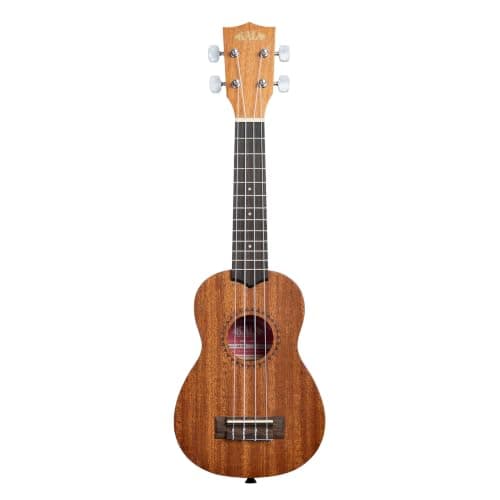
Mahogany throughout, a GraphTech NuBone nut and saddle, and Aquila strings fitted from the factory. The nut material is the spec that separates this from the pile of look-alikes.
Published specifications
- Size:
- Soprano
- Top / back / sides:
- Mahogany
- Neck / fretboard:
- Mahogany neck, rosewood fretboard
- Nut and saddle:
- GraphTech NuBone
- Scale length:
- 13.625"
- Frets:
- 12
- Nut width:
- 1.375"
- Overall length:
- 21.062"
- Strings:
- Aquila Super Nylgut
What it gets right
- NuBone nut and saddle rather than molded plastic — this is what decides whether the instrument plays in tune up the neck
- Aquila strings fitted at the factory, so the first thing you would otherwise replace is already done
- 21 inches overall and light enough for a small child to hold unsupported
Where it gives ground
- 12 frets only, and the body joint stops you well short of the high notes
- Soprano scale means less room between frets — adult fingers with wide fingertips will find it cramped
What it is not good at
Adult hands, sometimes. A 13.625 inch scale is genuinely tight. If the player is a grown-up with large hands, read our soprano-versus-concert comparison before buying this size.
How the specs score against a beginner’s needs
Scores are our reading of the published specifications above against what a beginner physically needs. They are not test results — we have not played this instrument.
Specifications from Kala Brand Music — KA-15S specifications.
Yamaha PSR-E383
YamahaBest for: Learning tools, 61 keys
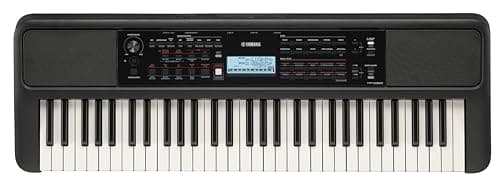
61 touch-sensitive keys and 125 lesson songs with hand-separate practice and scoring. The touch response is the spec that matters; the 650 tones are the spec that sells it.
Published specifications
- Keys:
- 61, organ-style (unweighted), touch-sensitive
- Touch response:
- Soft / medium / hard / off
- Polyphony:
- 48 notes
- Tones:
- 650 (258 panel, 25 drum/SFX, 20 arpeggio, 347 XGlite)
- Lessons:
- 125 lesson songs, right/left/both-hand practice with evaluation
- In the box:
- Music rest, PA130 power adapter
What it gets right
- Touch-sensitive keys — playing harder makes it louder, which is the thing a beginner has to learn early and a non-touch keyboard cannot teach
- The lesson mode with hand-separate practice and scoring is genuinely useful, not a gimmick
- Power adapter included, which is not a given at this tier
Where it gives ground
- Unweighted organ-style keys — this will not build the finger strength a piano needs
- 61 keys, so a method book that assumes 88 will eventually run out of instrument
What it is not good at
Preparing anyone for an acoustic piano. If there is a real piano in the child's future, the unweighted action is a habit to unlearn later. Read our 61-versus-88 comparison before deciding.
How the specs score against a beginner’s needs
Scores are our reading of the published specifications above against what a beginner physically needs. They are not test results — we have not played this instrument.
Specifications from Yamaha — PSR-E383 specifications.
Loog Pro Acoustic
LoogBest for: Ages 6-9, first chords fast
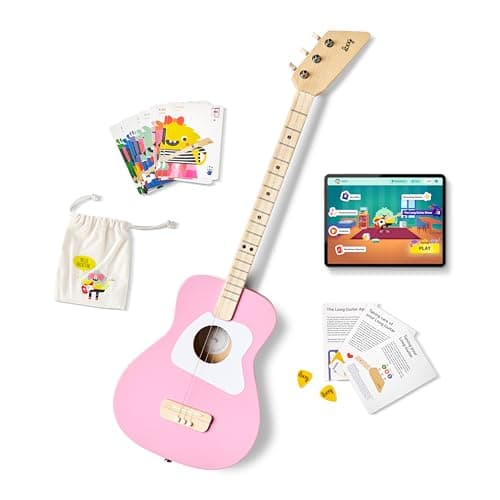
Three strings, a 20.4 inch scale and two pounds. It uses standard guitar strings and standard tuning, so everything learned on it transfers directly to a six-string.
Published specifications
- Strings:
- 3, standard guitar strings and tuning
- Scale length:
- 20.4" (520 mm)
- Dimensions:
- 29.2" long, 8.8" wide, 2.6" deep
- Weight:
- 2.0 lb (0.9 kg)
- Body / neck:
- Basswood body, maple neck and fingerboard
- Frets:
- 18
- Age guidance:
- Manufacturer states from age 6
What it gets right
- Three strings means a real chord on the first day, which is the single biggest predictor of a child continuing
- Standard tuning and standard strings — this is not a proprietary instrument that teaches a dead end
- Two pounds and 29 inches long; a six-year-old can pick it up unaided
Where it gives ground
- Three strings, so full six-string chord shapes are not available
- Basswood and a short scale mean a quiet, thin voice compared with any full acoustic
What it is not good at
Being the guitar for long. It is a deliberate bridge to a six-string, and if the child is already 9 or 10 you should probably skip straight to a 3/4 six-string instead.
How the specs score against a beginner’s needs
Scores are our reading of the published specifications above against what a beginner physically needs. They are not test results — we have not played this instrument.
Specifications from Loog Guitars — Pro Acoustic specifications.
Questions people actually ask
What is the easiest instrument to learn?
The ukulele. Four nylon strings under low tension, a short scale, and several chords that need one finger, which means a recognizable song in the first sitting. Nothing else combines all four advantages.
What is the easiest instrument to learn for adults?
Ukulele, then keyboard. Both get an adult to something that sounds like music quickly, which matters more for adults than children because adults tolerate sounding bad much less well.
Is piano or guitar easier to learn?
Piano is easier at the very start — press a key, get the right note, with no fretting technique and no intonation. Guitar is easier to get to a simple song with, because three chords cover an enormous amount of popular music. Piano is easier to be a complete beginner on; guitar is easier to be a mediocre one on.
Does easiest mean best?
No, and the difference is usually the ceiling. The ukulele is easiest and has the smallest range of the instruments here. That is a real trade and worth making if the alternative is not starting at all.
Sources
Still deciding?
Every recommendation on this site is built the same way, and the method is published in full — including what we do not do and what would get a pick dropped.
Read next
- What instrument should I learn?
Four practical constraints instead of a personality quiz, each one routing straight to the instrument that fits.
- Ukulele vs guitar for beginners
Why the ukulele is genuinely easier, exactly which skills transfer to guitar, and when the stepping-stone plan is a detour.
- The best first instrument for a child
Instrument by instrument, the real starting age set by hand size and reach, with a pick for each and the noise column filled in.
- Learning an instrument as an adult
What genuinely changes for an adult starter, which instruments suit it, and the three mistakes that end most attempts.
- Best beginner ukuleles: what's worth it from $60 to $120
Segmented by hand size rather than price, with the nut-material spec that separates a real ukulele from a decoration.