Keys
How much should a beginner keyboard cost?
Keys are the instrument where the specification-to-price relationship is clearest, and where the accessories most reliably blow the budget.
By Sawyer V. · Published · Last updated
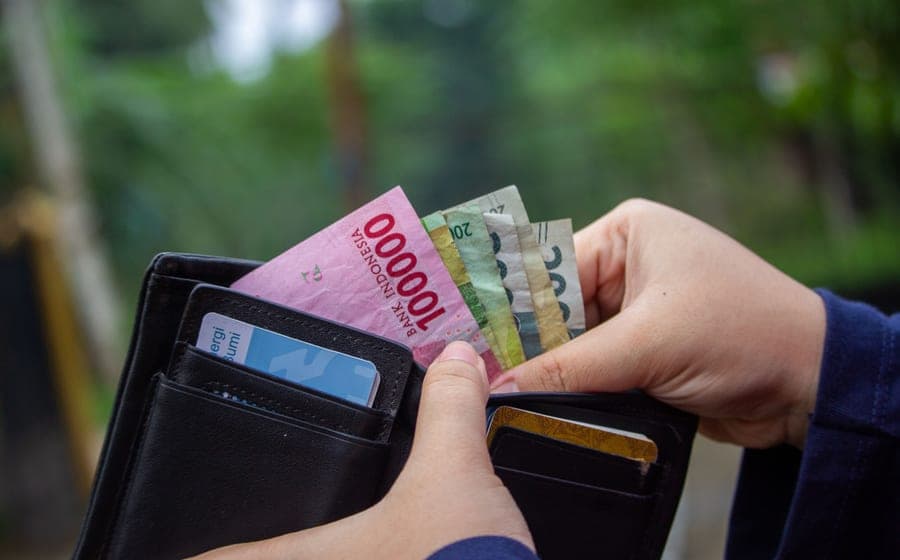
A 61-key touch-sensitive keyboard should cost roughly $150 to $250. An 88-key weighted digital piano costs meaningfully more, and that step buys key action rather than features. Below about $120 you lose touch response or full-size keys. Budget separately for a stand, a bench and a sustain pedal.
As on every price page here, the bands are defined by what the instrument can do rather than by a dollar figure. Prices drift; the capability list does not. Live prices on our picks are fetched from the retailer and stamped with the date they were checked.
The four bands
Below the floor
Roughly under $120. The failures here are specific: keys narrower than standard, or no touch response, or fewer than 61 keys, or often all three.
Mini keys teach a hand span that is wrong everywhere else. No touch response means the instrument cannot teach dynamics at all — the student practices something the instrument will not respond to. Neither is a cost-saving version of a keyboard; both are a different, worse thing.
The honest floor
Roughly $150 to $200. The checkable list: 61 full-size keys, touch response with adjustable sensitivity, a headphone socket, and a power adapter in the box. A Yamaha PSR-E383 or Casio CT-S1 sits here.
This is where most first-time buyers should land, especially for a child, and especially when commitment is unknown.
Enough
88 weighted keys. This is the buy-once tier for anyone doing piano specifically, and the step up is entirely about action rather than features — a Yamaha P-145 has dramatically fewer sounds than a keyboard a third of its price.
A student will not outgrow a graded-hammer 88 for many years, and plenty of people never replace theirs.
Where overspending starts
Above the entry hammer-action tier. What more money buys: better piano samples with more velocity layers, more polyphony, better speakers, escapement simulation, more connectivity, and furniture cabinets.
All real. None of it changes whether someone learns to play. A student who has been working for three years will appreciate every one of those things, and on day one they are money that would do more good as lessons.
The costs that are not the keyboard
Keys are the instrument where accessories most reliably blow the budget, because the instrument is genuinely unusable without several of them.
A stand, $30 to $60. A keyboard on a dining table is too high; on a coffee table it is too low. Either sets a wrist angle that has to be unlearned. An X-stand is adjustable and cheap.
A bench, $40 to $80. Adjustable, so the forearm sits level with the keys. A dining chair is too low for nearly every adult and dramatically too low for a child. This is the cheapest item on the list with a lasting effect on how the player’s hands develop.
A sustain pedal, $20 to $40. Method books ask for one within a few months. Many instruments include a small plastic footswitch that works and feels nothing like a piano pedal; a proper piano-style pedal is a worthwhile early upgrade.
Headphones, $30 up. This is what makes evening practice possible in a shared house, and therefore what makes practice happen at all on some schedules.
A power adapter, $15 to $25, if not included. Some keyboards ship without one and run on batteries. Check before buying.
The realistic total is that a $180 keyboard is a $300 purchase. That is not a hidden cost so much as an unmentioned one, and knowing it up front is the difference between a comfortable purchase and a compromised one. The same four bands apply across the site — guitars, ukuleles and drums follow the same shape.
What we would buy
Yamaha PSR-E383
YamahaBest for: Learning tools, 61 keys
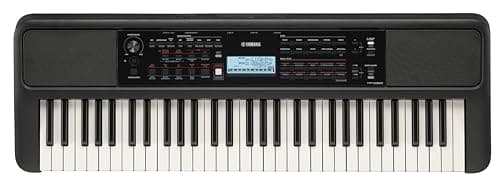
61 touch-sensitive keys and 125 lesson songs with hand-separate practice and scoring. The touch response is the spec that matters; the 650 tones are the spec that sells it.
Published specifications
- Keys:
- 61, organ-style (unweighted), touch-sensitive
- Touch response:
- Soft / medium / hard / off
- Polyphony:
- 48 notes
- Tones:
- 650 (258 panel, 25 drum/SFX, 20 arpeggio, 347 XGlite)
- Lessons:
- 125 lesson songs, right/left/both-hand practice with evaluation
- In the box:
- Music rest, PA130 power adapter
What it gets right
- Touch-sensitive keys — playing harder makes it louder, which is the thing a beginner has to learn early and a non-touch keyboard cannot teach
- The lesson mode with hand-separate practice and scoring is genuinely useful, not a gimmick
- Power adapter included, which is not a given at this tier
Where it gives ground
- Unweighted organ-style keys — this will not build the finger strength a piano needs
- 61 keys, so a method book that assumes 88 will eventually run out of instrument
What it is not good at
Preparing anyone for an acoustic piano. If there is a real piano in the child's future, the unweighted action is a habit to unlearn later. Read our 61-versus-88 comparison before deciding.
How the specs score against a beginner’s needs
Scores are our reading of the published specifications above against what a beginner physically needs. They are not test results — we have not played this instrument.
Specifications from Yamaha — PSR-E383 specifications.
Casio Casiotone CT-S1
CasioBest for: 61 keys, piano sound first
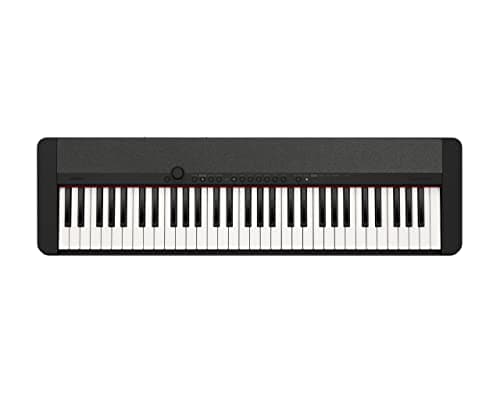
61 full-size touch-sensitive keys, 61 tones and no arranger clutter. It is the 61-key board for someone who wants to play piano rather than operate a keyboard.
Published specifications
- Keys:
- 61, full-size, touch-sensitive
- Polyphony:
- 64 notes
- Tones:
- 61, including a stereo grand piano
- Weight:
- 9.9 lb
- Dimensions:
- 36.61" W x 10.15" D x 3.30" H
- Connectivity:
- USB-MIDI
What it gets right
- Deliberately few sounds and a clean panel, which removes the single biggest distraction from actual practice
- 9.9 pounds and 3.3 inches tall — it can live on a shelf between sessions, and an instrument that lives out of the way gets played less
- 64-note polyphony, higher than the PSR-E383's 48
Where it gives ground
- No lesson mode at all, unlike the PSR-E383
- Unweighted keys, same fundamental limit as any 61-key board
What it is not good at
Entertaining a young child. There is no light-up key guidance, no play-along scoring and only 61 sounds. That restraint is the point for an adult beginner and a drawback for a seven-year-old.
How the specs score against a beginner’s needs
Scores are our reading of the published specifications above against what a beginner physically needs. They are not test results — we have not played this instrument.
Specifications from Casio — CT-S1 product page.
Yamaha P-145
YamahaBest for: Buy once, 88 weighted keys
88 graded hammer keys, a concert grand sample and 24 pounds. If the plan is piano lessons rather than keyboard playing, this is where the shopping actually starts.
Published specifications
- Keys:
- 88, GHC (Graded Hammer Compact), fully weighted and graded
- Polyphony:
- 64 notes
- Sound:
- Yamaha CFIIIS concert grand sample, damper resonance DSP
- Speakers:
- 7 W built-in
- Dimensions:
- 1,326 x 268 x 129 mm (52-3/16" x 10-9/16" x 5-1/16")
- Weight:
- 11.1 kg (24 lb 8 oz)
- In the box:
- Music rest, sustain foot switch
What it gets right
- Graded hammer action — the low keys are heavier than the high ones, which is the thing an unweighted keyboard cannot teach
- All 88 keys, so no method book ever runs off the end of the instrument
- Genuinely portable at 24 pounds and 268 mm deep; it fits on a desk
Where it gives ground
- 64-note polyphony is the entry-tier number; heavy sustain-pedal passages will drop notes eventually
- A single sustain footswitch, not a proper piano-style pedal — most players replace it
What it is not good at
Anything other than piano. There are only a handful of voices and no arranger features, so if the player wants to make beats or layer sounds, a PSR-E383 will make them happier for less money.
How the specs score against a beginner’s needs
Scores are our reading of the published specifications above against what a beginner physically needs. They are not test results — we have not played this instrument.
Specifications from Yamaha USA — P-145 specifications.
Questions people actually ask
How much should a beginner keyboard cost?
For a 61-key touch-sensitive board, roughly $150 to $250 is the working range. For an 88-key weighted digital piano, meaningfully more. Below about $120 you start losing touch response or full-size keys, and both of those are things the instrument cannot teach without.
Why are weighted keyboards so much more expensive?
Because a hammer action is 88 small mechanical assemblies, one per key, each with a physical weighted lever. That is manufacturing cost rather than branding, which is why the price step from unweighted to weighted is large and consistent across every manufacturer.
Do I need to buy a stand and a bench?
Yes, and budget for them from the start. Playing at the wrong height sets a posture that has to be unlearned, and a dining chair puts nearly every adult and every child too low. This is the most commonly skipped and most quietly harmful saving in the category.
Is an expensive keyboard worth it for a beginner?
Up to the point where you have touch response, full-size keys and the right action for your goal, absolutely. Past that you are buying more sounds, better speakers and nicer connectivity, none of which affects whether someone learns to play.
Sources
Still deciding?
Every recommendation on this site is built the same way, and the method is published in full — including what we do not do and what would get a pick dropped.
Read next
- Are cheap keyboards worth it?
Why cheap keyboards fail invisibly rather than mechanically, and the three specs that separate a cheap board from a too-cheap one.
- How much should a beginner guitar cost?
Four price bands defined by specification rather than by number, plus the hidden costs that turn a $200 budget into a $270 purchase.
- How much should a beginner ukulele cost?
Four bands from $30 to $200, defined by nut material and tuner type rather than by brand, with the accessory list included.
- How much should a beginner drum set cost?
Four bands defined by completeness and hardware quality, with the shells-only trap and the real running costs.
- What you actually need to start piano
The complete accessory list in priority order, with what each one is for and which ones can genuinely wait.