Guitars
How much should a beginner guitar cost?
Four bands, defined by what the instrument can do rather than by a number. The prices follow from the specs, and they drift.
By Sawyer V. · Published · Last updated

A first full-size acoustic guitar should cost about $180 at the honest floor and $200 to $350 for a buy-once instrument. Below roughly $120 the tuning hardware and setup stop being reliable. Above roughly $500 you are paying for refinements a beginner cannot yet hear. Electrics need an amplifier on top.
Every price on this site is fetched live from the retailer, and the bands below are defined by specification rather than by a dollar figure — because prices drift and specs do not. When the price of a solid-top acoustic moves, the band moves with it. What stays constant is the list of things the instrument has to be able to do.
The four bands
Below the floor
Roughly under $120 on a full-size guitar. The specific failures, in order of how often they end the hobby: tuning machines that will not hold a setting, a soft plastic nut that binds the string so tuning happens in jumps, and action so high the player needs real hand strength for a single note.
This is not a cheaper version of a guitar. It is an instrument that teaches a beginner that they cannot play, which is both false and expensive to undo.
The honest floor
Roughly $150 to $200. The checkable list: sealed-gear tuning machines, a synthetic bone or graphite nut, an adjustable truss rod, and a full-size scale length for a full-size player. A Squier Sonic Stratocaster or a similar entry acoustic sits here.
Nothing spare and nothing missing. Most first-time buyers should land here and spend the difference on lessons.
Enough
Roughly $200 to $350. This is where a solid top appears on acoustics — the one spec that changes over a decade — and where electrics get better fretwire and hardware. A Yamaha FG800 or Fender CD-60S is the canonical example.
Buy-once. A beginner will not outgrow an instrument from this band inside several years, and many people never replace theirs at all.
Where overspending starts
Above roughly $500 on a first guitar. What the extra money buys is real: a nicer top wood, a more carefully finished fretboard, tighter factory setup, a better-sorted neck.
None of it is something a beginner can hear or feel yet. A player who has been going for two years absolutely can, and at that point the upgrade is worth making with knowledge of what they want. On day one it is money that would do more good as six months of lessons.
The costs that are not the guitar
Almost every over-budget guitar purchase happens the same way: the buyer budgets for the instrument and not for the things that make the instrument usable. Here is the actual list.
A setup, $40 to $60. This is the highest-return money in the whole purchase and it is almost never mentioned. A setup adjusts neck relief and string height so the strings sit as low as they can without buzzing. Every guitar at this price leaves the factory at a safe average and then travels through a warehouse and a climate change to reach you. A well-set-up $200 guitar plays better than a badly-set-up $500 one, and it is not close.
A clip-on tuner, $10 to $20. Non-negotiable. A beginner cannot tune by ear, and an untuned instrument makes everything they play sound wrong.
An amplifier and cable, electric only. The single most forgotten cost in the category. An unplugged electric is a quiet plank. Work out the budget for the complete setup and then divide it, rather than spending it all on the guitar.
Spare strings, $8 to $15 a set. A beginner will break a string, usually while tuning, usually in the first month.
A stand, $15 to $25. Not strictly necessary and quietly one of the highest-impact purchases on the list. An instrument on a stand in the corner of the room gets picked up many times more often than one in a case under a bed. If the budget is genuinely tight, buy the stand before the strap.
What we are not going to tell you
We are not going to tell you a specific number and call it the right answer, because the number changes and the reasoning does not. And we are not going to argue that more is always better — the fourth band exists precisely because almost every other page in this category only ever argues upward.
The same four-band framework applies to the other instruments we cover, so a parent who reads this page already knows how to read the keyboard, ukulele and drum versions.
What we would buy
Squier Sonic Stratocaster
Squier by FenderBest for: The honest floor, electric
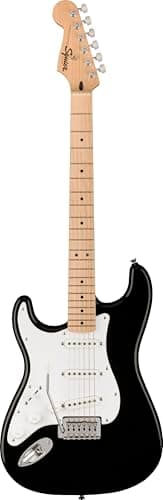
The cheapest electric that still has full-scale geometry, sealed tuners and a real 9.5 inch fingerboard radius. Nothing about it will make a beginner's first year harder.
Published specifications
- Scale length:
- 25.5" (647.7 mm) — full size
- Body / neck:
- Poplar body, maple neck, "C" profile
- Fingerboard:
- Maple or Indian laurel, 9.5" (241 mm) radius
- Frets:
- 21, narrow tall
- Nut width:
- 1.650" (42 mm), synthetic bone
- Pickups:
- Three ceramic single-coils (SSS)
- Bridge:
- 6-saddle vintage-style synchronized tremolo
What it gets right
- Full 25.5 inch scale, so nothing learned here has to be relearned later
- Synthetic bone nut rather than a soft plastic one — the part that decides whether a cheap guitar stays in tune
- Sealed-gear tuners, which is the single most important spec on a first electric
Where it gives ground
- Poplar body and ceramic pickups are exactly what you would expect at this tier
- The tremolo bridge will pull the guitar out of tune if a beginner uses it, and beginners always use it
What it is not good at
Staying in tune if you use the whammy bar. If that matters, buy the hardtail (HT) version of the same guitar instead — it is the identical instrument with the tremolo deleted.
How the specs score against a beginner’s needs
Scores are our reading of the published specifications above against what a beginner physically needs. They are not test results — we have not played this instrument.
Specifications from Squier Wiki — Sonic Stratocaster specifications.
Yamaha FG800
YamahaBest for: Buy once, acoustic
A solid Sitka spruce top with scalloped bracing at the entry price. Solid-versus-laminate is the one acoustic spec that changes what the instrument does over years, and this is the cheapest place to get it done right.
Published specifications
- Top:
- Solid Sitka spruce
- Back / sides:
- Nato / okume
- Neck / fingerboard:
- Nato neck, rosewood fingerboard, R400 mm (23-5/8") radius
- Scale length:
- 650 mm (25-9/16")
- Nut width:
- 43 mm (1-11/16")
- Bracing:
- Scalloped
- Body:
- Traditional Western (dreadnought), 412 mm (16-1/4") wide, 100-118 mm deep
- Hardware:
- Die-cast chrome tuners, urea nut and saddle
What it gets right
- A solid top, not a laminate — the only acoustic spec at this price that genuinely changes over time
- Scalloped bracing and die-cast tuners are specifications you normally pay considerably more for
- Yamaha's most-copied entry acoustic; parts, setups and advice are everywhere
Where it gives ground
- A full dreadnought body is a big box — 412 mm across and up to 118 mm deep
- Nato and okume back and sides are the cost saving; the top is where the money went
What it is not good at
Fitting a smaller player. The dreadnought body is wide and deep enough that a young teenager can struggle to get their arm over it comfortably. If that is the buyer, look at the JR1 or a concert-size body instead.
How the specs score against a beginner’s needs
Scores are our reading of the published specifications above against what a beginner physically needs. They are not test results — we have not played this instrument.
Specifications from Yamaha Europe — FG/FS800 series specifications.
Squier Affinity Series Stratocaster
Squier by FenderBest for: Buy once, adult starter
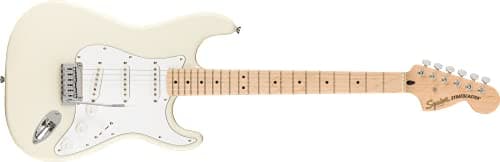
Same geometry as the Sonic with medium jumbo frets and better hardware. This is the tier where a beginner stops having a reason to upgrade.
Published specifications
- Scale length:
- 25.5" (648 mm) — full size
- Body / neck:
- Poplar body, maple neck, "C" profile
- Fingerboard:
- Maple, 9.5" (241 mm) radius
- Frets:
- 21, medium jumbo
- Nut width:
- 1.650" (42 mm), synthetic bone
What it gets right
- Medium jumbo frets are noticeably easier to fret cleanly than narrow tall wire, which is the physical thing a beginner struggles with
- Identical scale, radius and nut width to the Sonic, so the step up is hardware, not geometry
- Widely serviced — any shop can set one up without ordering parts
Where it gives ground
- The jump from the Sonic buys hardware and fretwire, not tone
- Still a poplar body; if you are chasing a specific sound this is not the guitar that delivers it
What it is not good at
Justifying itself over the Sonic on paper. The difference is real but it is felt, not read — if the budget is tight, the Sonic is not a compromise.
How the specs score against a beginner’s needs
Scores are our reading of the published specifications above against what a beginner physically needs. They are not test results — we have not played this instrument.
Specifications from Reverb — Squier Affinity Series Stratocaster specs.
Questions people actually ask
How much should a beginner guitar cost?
For a full-size acoustic, roughly $180 is the honest floor and $200 to $350 is the buy-once tier. For an electric, budget the amplifier as part of the purchase rather than as an extra — a complete electric setup lands meaningfully higher than the guitar’s sticker price. Above about $500 on a first guitar you are paying for capability a beginner cannot use yet.
How much does a good beginner guitar cost?
“Good” in the sense of buy-once is roughly $200 to $350 for either type. That band is where solid tops, sealed tuners, bone-substitute nuts and adjustable truss rods all appear together. Below it you get some of those; above it you get refinements that need a developed ear to notice.
How much should a starter guitar cost for a child?
Less, because the instrument is smaller and because they will outgrow it. A genuine 3/4 instrument from a named manufacturer is where to aim; the sub-$70 unbranded “kids guitar” is the specific thing to avoid, for reasons we set out in best guitars for kids.
How much should a beginner electric guitar cost?
The guitar alone sits in the same bands as an acoustic, but the total is higher because an electric needs a cable and an amplifier to make a useful sound. Work out your budget for the complete setup first, then split it — do not spend the whole thing on the guitar and discover the amplifier afterward.
Sources
Still deciding?
Every recommendation on this site is built the same way, and the method is published in full — including what we do not do and what would get a pick dropped.
Read next
- Are cheap guitars worth it?
The line between cheap and too cheap, named part by part, with what each failure does to a beginner who cannot diagnose it.
- How much should a beginner keyboard cost?
Four bands from touch response to hammer action, plus the stand, bench and pedal costs that turn a keyboard budget into a bigger one.
- How much should a beginner ukulele cost?
Four bands from $30 to $200, defined by nut material and tuner type rather than by brand, with the accessory list included.
- How much should a beginner drum set cost?
Four bands defined by completeness and hardware quality, with the shells-only trap and the real running costs.
- Best beginner guitars: one pick each for adults, teens and kids
Acoustic and electric in one place, segmented by player rather than price, with a single clear pick for each situation.