Guitars
Are cheap guitars worth it?
There is a real line here, and it is not where snobbery puts it. Below it, specific parts fail in specific ways that a beginner cannot diagnose.
By Sawyer V. · Published · Last updated
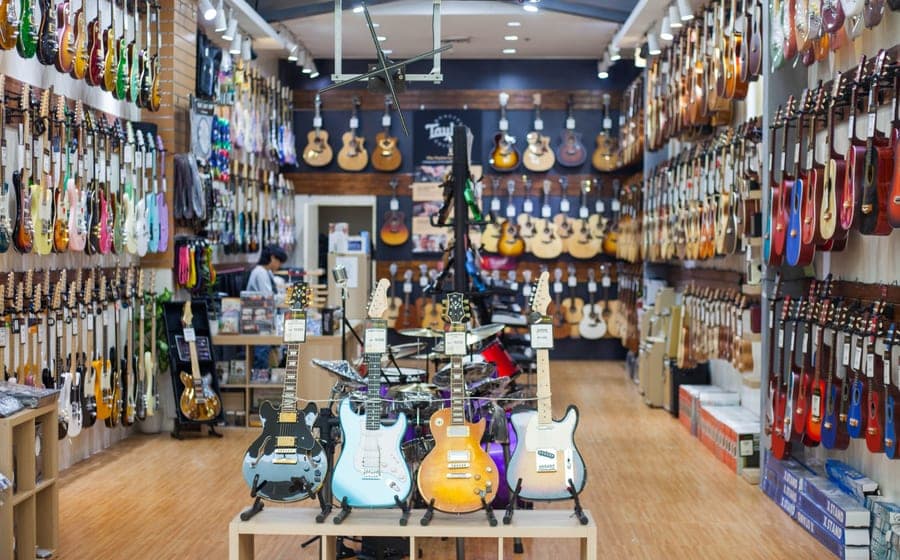
Cheap guitars are worth it; too-cheap guitars are not. The line sits at about $120 to $150 for a full-size instrument, and it is defined by three parts: sealed tuning machines, a synthetic bone or graphite nut, and an adjustable truss rod. Below the line at least one is missing, and each one has a specific consequence.
The usual version of this question gets answered by someone who plays well and owns expensive guitars, and the answer is some variant of “you get what you pay for.” That is unhelpful because it does not say where the line is or what happens at it.
So here is the version with the parts named. This is the mechanism behind the “below the floor” band on what a first guitar should cost.
What actually fails, in order
1. The tuning machines
A sealed-gear tuner has its worm gear enclosed in a housing packed with grease. An open, unsealed one does not, and its gear mesh has more play. The consequence is that the string tension slowly walks the tuner backward, and the guitar drifts flat over a practice session.
What that does to a beginner is worse than it sounds. They cannot yet tell the difference between an out-of-tune instrument and their own bad fretting. So every time a chord sounds wrong, they conclude they played it wrong. They have no way to discover otherwise. The instrument teaches them, over weeks, that they have no ear and no aptitude — both false, both fatal to the hobby.
2. The nut
The nut is the slotted piece at the top of the fingerboard that spaces the strings and sets their height at that end. On a cheap guitar it is molded plastic with slots that are often too narrow or cut at the wrong angle.
A string binds in a badly cut plastic slot. You turn the tuner, nothing happens, you turn it further, and the string suddenly releases and jumps past the note. The guitar can be tuned but not tuned precisely, and it goes out again the moment anyone bends a string. A synthetic bone or graphite nut is slippery enough that this does not happen, and it costs the manufacturer very little.
Both Squier models on our electric roundup specify a synthetic bone nut, which at that price is genuinely the spec to look for.
3. The truss rod
A truss rod is a steel rod running the length of the neck. Adjusting it changes the neck’s bow, which changes how high the strings sit above the frets in the middle of the neck.
This is the part that makes a guitar correctable. A guitar with an adjustable truss rod that plays badly can be fixed by a setup. A guitar without one — and unbranded budget instruments frequently have a plain non-adjustable neck — plays however it plays, forever, and if that is badly then no amount of money spent afterward will help.
This is why we define the floor by the presence of a truss rod rather than by a price. A correctable guitar has a route to being good. An uncorrectable one does not.
4. Fret ends
Frets are pressed into a slot in the fingerboard and their ends are then filed flush and rounded. On a cheap instrument that filing is rushed, and the fret ends stand slightly proud of the fingerboard edge.
The result is small sharp edges exactly where a hand slides. It is not dangerous and it is deeply unpleasant, and it caps how long anyone will practice. It is also fixable, but the work costs $60 to $100 — more than the saving that caused it.
What the extra eighty dollars buys
Concretely, going from an $80 unbranded full-size guitar to a $160 entry instrument from a named manufacturer buys: sealed tuners that hold, a nut that does not bind, a neck that can be adjusted, fret ends that are finished, and a scale length that is actually the one advertised.
It does not buy better tone. It does not buy nicer wood. It buys the instrument being able to work, which is a different category of thing.
Where cheap is genuinely fine
Plenty of things about a budget guitar do not matter and are not worth paying to fix.
Body wood. Poplar, agathis, basswood — on a solid-body electric the difference in what a listener hears is small and heavily disputed even among people who care a great deal. It is not a beginner’s problem.
Pickups. Entry-level ceramic pickups are perfectly serviceable and are the single easiest thing to upgrade later, if the player ever wants to. Nobody has ever quit guitar because of a pickup.
Finish quality. Cosmetic, entirely.
Brand. Within the group of manufacturers that publish real specifications, brand is close to irrelevant at this tier. Squier, Yamaha and Epiphone all build to a similar standard for similar money, as we set out in the brand comparison.
The one-line test
If a listing does not publish a scale length, a nut material and whether the neck has an adjustable truss rod, that is not an oversight in the copywriting. Those are the three specifications a manufacturer omits when the answers are bad. A listing that leads with the color, the free picks and the included bag has told you what it is proud of.
What we would buy
Squier Sonic Stratocaster
Squier by FenderBest for: The honest floor, electric
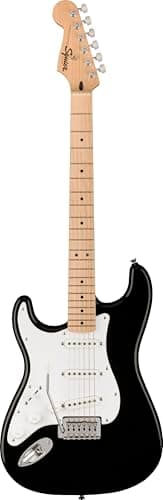
The cheapest electric that still has full-scale geometry, sealed tuners and a real 9.5 inch fingerboard radius. Nothing about it will make a beginner's first year harder.
Published specifications
- Scale length:
- 25.5" (647.7 mm) — full size
- Body / neck:
- Poplar body, maple neck, "C" profile
- Fingerboard:
- Maple or Indian laurel, 9.5" (241 mm) radius
- Frets:
- 21, narrow tall
- Nut width:
- 1.650" (42 mm), synthetic bone
- Pickups:
- Three ceramic single-coils (SSS)
- Bridge:
- 6-saddle vintage-style synchronized tremolo
What it gets right
- Full 25.5 inch scale, so nothing learned here has to be relearned later
- Synthetic bone nut rather than a soft plastic one — the part that decides whether a cheap guitar stays in tune
- Sealed-gear tuners, which is the single most important spec on a first electric
Where it gives ground
- Poplar body and ceramic pickups are exactly what you would expect at this tier
- The tremolo bridge will pull the guitar out of tune if a beginner uses it, and beginners always use it
What it is not good at
Staying in tune if you use the whammy bar. If that matters, buy the hardtail (HT) version of the same guitar instead — it is the identical instrument with the tremolo deleted.
How the specs score against a beginner’s needs
Scores are our reading of the published specifications above against what a beginner physically needs. They are not test results — we have not played this instrument.
Specifications from Squier Wiki — Sonic Stratocaster specifications.
Yamaha FG800
YamahaBest for: Buy once, acoustic
A solid Sitka spruce top with scalloped bracing at the entry price. Solid-versus-laminate is the one acoustic spec that changes what the instrument does over years, and this is the cheapest place to get it done right.
Published specifications
- Top:
- Solid Sitka spruce
- Back / sides:
- Nato / okume
- Neck / fingerboard:
- Nato neck, rosewood fingerboard, R400 mm (23-5/8") radius
- Scale length:
- 650 mm (25-9/16")
- Nut width:
- 43 mm (1-11/16")
- Bracing:
- Scalloped
- Body:
- Traditional Western (dreadnought), 412 mm (16-1/4") wide, 100-118 mm deep
- Hardware:
- Die-cast chrome tuners, urea nut and saddle
What it gets right
- A solid top, not a laminate — the only acoustic spec at this price that genuinely changes over time
- Scalloped bracing and die-cast tuners are specifications you normally pay considerably more for
- Yamaha's most-copied entry acoustic; parts, setups and advice are everywhere
Where it gives ground
- A full dreadnought body is a big box — 412 mm across and up to 118 mm deep
- Nato and okume back and sides are the cost saving; the top is where the money went
What it is not good at
Fitting a smaller player. The dreadnought body is wide and deep enough that a young teenager can struggle to get their arm over it comfortably. If that is the buyer, look at the JR1 or a concert-size body instead.
How the specs score against a beginner’s needs
Scores are our reading of the published specifications above against what a beginner physically needs. They are not test results — we have not played this instrument.
Specifications from Yamaha Europe — FG/FS800 series specifications.
Questions people actually ask
Are cheap guitars worth it?
Cheap is fine; too cheap is not, and the line is mechanical rather than snobbish. Above roughly $150 you reliably get sealed tuners, a bone-substitute nut and an adjustable truss rod, and those three things are what make a guitar stay in tune and be correctable. Below about $120 on a full-size instrument, at least one of them is usually missing.
Are cheap guitars harder to play?
Often yes, and for a specific reason: action height. Cheaper instruments are set up higher at the factory as a safety margin against fret buzz, and if the neck has no adjustable truss rod that height cannot be corrected. High action means more finger force per note, which for a beginner is the difference between practicing for forty minutes and stopping at ten.
Are cheap electric guitars worth it?
More so than cheap acoustics, because an electric’s action is adjustable in more places — at the bridge saddles as well as the truss rod. A cheap electric can usually be made to play well by a setup. A cheap acoustic with an unadjustable neck often cannot.
Are cheap acoustic guitars worth buying?
Above roughly $180, yes — that is where solid tops start appearing. Between about $120 and $180 you get a playable laminate-top instrument. Below that on a full-size acoustic, high unadjustable action is common and it is the single most reliable way to make a beginner give up.
Will a setup fix a cheap guitar?
Usually, and it is the best money in the purchase. The exception is a guitar with no adjustable truss rod, or one where the fret ends are badly finished — those need work that costs more than the instrument. Which is why the floor is defined by the presence of an adjustable truss rod rather than by a price.
Sources
Still deciding?
Every recommendation on this site is built the same way, and the method is published in full — including what we do not do and what would get a pick dropped.
Read next
- How much should a beginner guitar cost?
Four price bands defined by specification rather than by number, plus the hidden costs that turn a $200 budget into a $270 purchase.
- Best beginner guitars: one pick each for adults, teens and kids
Acoustic and electric in one place, segmented by player rather than price, with a single clear pick for each situation.
- Are cheap keyboards worth it?
Why cheap keyboards fail invisibly rather than mechanically, and the three specs that separate a cheap board from a too-cheap one.
- Are cheap ukuleles worth it?
The intonation failure that cannot be repaired, what causes it, and the two specs that tell you whether an instrument has it.
- Best beginner electric guitars: what's worth it from $150 to $400
Segmented by player and price band, with the three specs that actually decide whether a first electric survives its first year.