Drums
How much should a beginner drum set cost?
The sticker price of a drum kit tells you very little, because half the listings are for shells with no way to play them.
By Sawyer V. · Published · Last updated

A first drum set should be a complete one: shells, hi-hat stand, cymbal stand, snare stand, bass pedal, throne and cymbals. Compare complete kits against complete kits. A shells-only listing at half the price is not half the price, because the hardware to finish it costs more than the shells did.
The trap, first
Drums are the only instrument on this site where a listing can honestly describe itself as a complete product and arrive as something you cannot play.
“5-piece drum set” means five drums. Not five drums and the stands that hold them. Not the pedal that operates the bass drum. Not the cymbals. A box containing five shells is accurately a 5-piece drum set, and a beginner who buys one has bought furniture.
So the first question about any drum kit price is not whether it is good value. It is what is actually in the box. Our roundup lists the full contents for every pick for exactly this reason.
The four bands
Below the floor
Full-size acoustic kits at the very bottom of the market, and any electronic kit with rubber pads.
On the acoustic side the failures are all hardware: cymbal stands that sink under the weight of a cymbal, a bass pedal with a sloppy return that will not play evenly, and lugs that strip their threads the first time the drum is tuned properly. Everything on a drum kit is being hit thousands of times a session, so cheap parts do not underperform quietly — they break.
On the electronic side, rubber pads are louder in the room than mesh and have almost no rebound, which teaches a stroke that does not work on a real drum.
The honest floor
The checkable list: a complete acoustic kit with four stands, a pedal, a throne and cymbals in the box, on shells with real bearing edges and triple-flanged hoops — or a mesh-head electronic kit with a headphone socket and a proper kick pedal.
A Pearl Roadshow or an Alesis Nitro Max sits here. This is where most first-time buyers should land.
Enough
The same completeness with better hardware: heavier double-braced stands, a pedal with a proper adjustable cam, and cymbals that are bronze rather than brass.
The cymbal upgrade is the one that changes the experience most, because the included cymbals on any entry kit are the component drummers replace first. Buying cymbals separately and shells from the floor band is a genuinely sensible way to spend at this level.
Where overspending starts
Where the money buys shells in maple or birch rather than poplar, better lugs, and cymbals from the mid-range series.
All real. None of it is what a beginner is limited by, and the shells matter least of anything on a drum kit — a well-tuned poplar drum with a good head sounds considerably better than a badly-tuned maple one. Spend the difference on lessons and, if anything, on cymbals.
The costs that are not the kit
Hearing protection, on an acoustic kit. Musicians’ earplugs attenuate evenly across frequencies so the kit still sounds like a kit. Cheap, and the only item on this page protecting something that does not heal. See how loud are drums.
A practice pad. Where a large share of early technique work happens, and playable at any hour.
Sticks. Consumable. Beginners break them regularly, and buying several pairs at once is cheaper.
A rug, on an acoustic kit. Bass drums and hi-hat stands walk forward across a hard floor. Any rug fixes it.
A noise-isolation mat, on an electronic kit above a neighbor. The pads are quiet; the kick pedal thumps through the structure and headphones do nothing about it.
Drum heads, eventually. The batter heads on an acoustic kit wear out and factory heads are the cheapest available. A head change is a cheap and dramatic improvement.
Cymbals, eventually. The largest post-purchase cost by a wide margin, and worth knowing about at purchase time rather than discovering.
The four-band framework here is the same one used across the site — guitars, keys and ukuleles follow the same shape.
What we would buy
Mendini by Cecilio 16" Junior Kit
Mendini by CecilioBest for: Ages roughly 3-6, acoustic
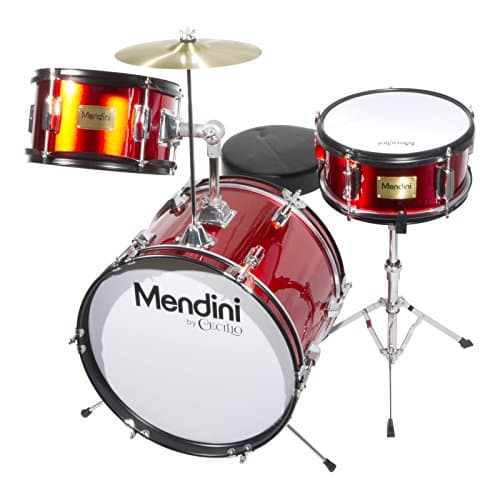
A three-piece with an 11x16 bass drum, real hardwood shells and triple-flanged hoops. It is the smallest acoustic kit where the pedal is actually where a small child's foot is.
Published specifications
- Configuration:
- 3-piece: 11"x16" bass with pedal, 6"x10" mounted tom, 5"x10" snare
- Cymbal:
- 9.5" with mounting arm
- Shells:
- Hardwood, triple-flanged hoops
- In the box:
- Wooden sticks, round padded adjustable throne
What it gets right
- A 16 inch bass drum puts the pedal within reach of a three- or four-year-old's leg, which no full-size kit does
- Triple-flanged hoops and hardwood shells, so it can genuinely be tuned rather than just hit
- Adjustable throne included, and at this age that is the part that has to move most
Where it gives ground
- Three pieces and one cymbal — this is a starting point, not a kit
- The included cymbal and pedal are the cheapest components and behave like it
What it is not good at
Anyone over about seven. Growth out of this kit is measured in a couple of years, and paying for it twice is worse than starting a six-year-old on a proper junior five-piece.
How the specs score against a beginner’s needs
Scores are our reading of the published specifications above against what a beginner physically needs. They are not test results — we have not played this instrument.
Specifications from Cecilio Music — Mendini kids drum set, 3-piece 16".
Alesis Debut Kit
AlesisBest for: Ages roughly 5-9
Four 6 inch mesh pads sized and spaced for a small child, with headphones, a throne and sticks in the box. Alesis states it is designed for ages 5 to 9 and the geometry backs that up.
Published specifications
- Pads:
- Four 6" mesh pads (snare and three toms)
- Cymbals:
- Three 10" pads — hi-hat, crash, ride
- Pedals:
- Hi-hat and bass drum pedals included
- Module:
- DM-Lite: 120 sounds, 10 kits, 30 play-along tracks, drum coach
- Age guidance:
- Manufacturer states ages 5-9
- In the box:
- Metal rack, height-adjustable throne, sticks, headphones, cables, Melodics lessons
What it gets right
- Purpose-built small geometry — the pads are within a small child's reach rather than an adult kit with the legs shortened
- Headphones included, which for a kids' drum kit is the difference between practicing and being asked to stop
- Height-adjustable throne, so it tracks a growing child for a couple of years
Where it gives ground
- 6 inch pads are small enough that an older child will feel boxed in quickly
- The DM-Lite module is basic; 120 sounds and no real editing
What it is not good at
Lasting. Alesis's own 5-to-9 guidance is honest, and a 10-year-old should start on the Nitro Max instead. Buying this for an older child to save money buys a kit they will resent in a year.
How the specs score against a beginner’s needs
Scores are our reading of the published specifications above against what a beginner physically needs. They are not test results — we have not played this instrument.
Specifications from Alesis Drums — Debut Kit.
Pearl Roadshow RS525SC
PearlBest for: Complete acoustic kit, teen and up
A full 22 inch kick, five drums, four stands, a pedal, a throne and cymbals, on 9-ply poplar shells with hand-cut bearing edges. Nothing else needs buying to play it.
Published specifications
- Configuration:
- 5-piece: 22x16 bass, 14x5.5 snare, 10x8 and 12x9 rack toms, 16x16 floor tom
- Shells:
- 9-ply poplar, 7 mm, hand-cut 45-degree bearing edges
- Hoops:
- 1.6 mm triple-flanged steel
- Hardware included:
- H-50 hi-hat, C-50 cymbal, S-50 snare stand, P-50 pedal, D-50 throne
- Cymbals included:
- 16" brass crash/ride, 14" hybrid hi-hats
- Also included:
- Two pairs of maple sticks, stick bag
What it gets right
- Genuinely complete — stands, pedal, throne, cymbals and sticks are all in the box, which almost never happens at this price
- Hand-cut 45-degree bearing edges on poplar shells; the edge is what lets a drum be tuned at all
- Triple-flanged steel hoops rather than the pressed hoops on the tier below
Where it gives ground
- The included brass cymbals are the weak point and the first thing anyone replaces
- A 22 inch kick is a full-size kit and needs the floor space of one
What it is not good at
Being quiet, or fitting a child. This is a loud acoustic kit at adult dimensions — a 22 inch bass drum puts the pedal where an eight-year-old's leg does not reach. For that buyer, see the kids' kits and the electronic options.
How the specs score against a beginner’s needs
Scores are our reading of the published specifications above against what a beginner physically needs. They are not test results — we have not played this instrument.
Specifications from Pearl Roadshow RS525SC published specifications (Percussion Source).
Alesis Nitro Max Kit
AlesisBest for: Apartments and shared walls
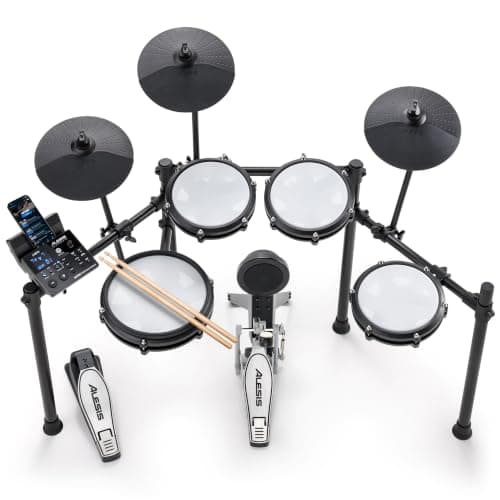
Mesh heads on every pad, a dual-zone snare and Bluetooth audio for playing along. Mesh is the spec that makes an electronic kit tolerable to sit at for an hour.
Published specifications
- Pads:
- 10" dual-zone mesh snare, three 8" mesh toms
- Cymbals:
- Three 10" pads — hi-hat, crash, ride
- Module:
- 440 sounds, 32 kits, 60 play-along songs, performance recorder
- Connectivity:
- Bluetooth audio, USB-MIDI
- Mounting:
- Included four-post rack
- Weight:
- Under 15 kg complete
What it gets right
- Mesh heads on every drum pad — quieter and far closer to a real rebound than the rubber pads a tier down
- Bluetooth audio means playing along to a phone with no cable and no extra mixer
- USB-MIDI, so it doubles as a controller for recording software later
Where it gives ground
- Mesh heads are quiet in the room but the kick pedal thumps through a floor; downstairs neighbors still hear it
- Single-zone toms — no rimshot on anything except the snare
What it is not good at
Teaching cymbal technique. Three 10 inch pads cannot reproduce how a real hi-hat or a crash responds, and a drummer moving to an acoustic kit later has that to learn from scratch.
How the specs score against a beginner’s needs
Scores are our reading of the published specifications above against what a beginner physically needs. They are not test results — we have not played this instrument.
Specifications from Alesis Drums — Nitro Max Kit.
Questions people actually ask
How much is a beginner drum set?
A genuinely complete acoustic kit — shells, four stands, pedal, throne and cymbals — or an entry mesh-head electronic kit both land in a similar range. The trap is comparing a complete kit’s price against a shells-only listing, which looks cheaper and is not.
Why are some drum sets so much cheaper?
Usually because they are shell packs with no hardware or cymbals. A shell pack is a legitimate product for a drummer who already owns stands; bought by a beginner it produces a set of drums with no way to play them, and completing it costs more than the shells did.
Are cheap drum sets worth it?
Drums are one of the few instruments where the cheap version genuinely breaks rather than merely underperforming, because every part is being struck. The failures land in the hardware: stands that will not hold height, sloppy pedals, and lugs that strip when the drum is tuned.
What are the ongoing costs of a drum kit?
Sticks, which are consumable and break regularly. Drum heads, which wear out on an acoustic kit. And for most drummers, replacing the included brass cymbals within a year or two, which is the single largest post-purchase cost.
Sources
Still deciding?
Every recommendation on this site is built the same way, and the method is published in full — including what we do not do and what would get a pick dropped.
Read next
- Best beginner drum sets: complete kits for teens and adults
Complete acoustic and electronic kits for adult players, with the total-purchase problem and the noise question both addressed.
- Acoustic vs electronic drums for beginners
Feel against practice hours, what transfers in each direction, and the building question that settles it. Buy paths for both.
- How much should a beginner guitar cost?
Four price bands defined by specification rather than by number, plus the hidden costs that turn a $200 budget into a $270 purchase.
- How much should a beginner keyboard cost?
Four bands from touch response to hammer action, plus the stand, bench and pedal costs that turn a keyboard budget into a bigger one.
- How much should a beginner ukulele cost?
Four bands from $30 to $200, defined by nut material and tuner type rather than by brand, with the accessory list included.
- How to buy your first drum set
The order to decide in, why the room comes before the player, and the parts that are missing from a kit that says it is complete.