Strings
How to tune a violin
A violin has two tuning systems and using the wrong one is how beginners break strings and drop soundposts.
By Sawyer V. · Published · Last updated
Tuning is where beginner violinists do most of their accidental damage, and the reason is that a violin has two entirely separate tuning mechanisms with different jobs. Using the wrong one is not a mistake of degree — it is how strings snap and bridges fall over.
Use the fine tuners at the tailpiece for everyday tuning. Only use the pegs when a string is a long way out, and when you do, push the peg inward into the pegbox as you turn. Tune A first, then D, G and E. Always tune upward to the note, never down to it.
The two systems
Pegs sit in the scroll and make large changes. They are friction fittings — there is no gearing on a standard violin peg, so it holds purely by being wedged into a tapered hole. That makes them powerful and imprecise, and it is why they slip.
Fine tuners are small screws at the tailpiece that make tiny adjustments to string length. They are precise, they cannot slip, and they are what a beginner should be using nearly all the time.
A student outfit like the Stentor Student II Violin Outfit#ad is normally supplied with fine tuners fitted, and if it has four of them, one per string, treat that as a feature rather than a compromise. Some instruments only carry a fine tuner on the E string, which is the one most likely to snap; on those, the other three do need peg work and the technique below matters more.
Which notes, and in which order
From thickest to thinnest, a violin is tuned G, D, A, E.
Tune A first. That is the convention, it is what an orchestra tunes to, and it gives you a fixed reference for everything else. Then D, then G, then E.
There is a practical reason for that order beyond tradition. All four strings pull on the bridge together, so changing one alters the tension on the others. Working outward from A and then going round again is how you converge rather than chase.
Expect to do two full passes. After the first, the earlier strings will have drifted slightly. That is normal and it is not a fault.
Using a tuner
A beginner should tune with a device rather than by ear, and should keep doing so for a long time. Playing on an out-of-tune instrument actively trains the ear toward wrong intervals, and on a fretless instrument, where every note is placed by feel and listening, that is a genuinely expensive habit to acquire.
The Snark clip-on chromatic tuner#ad clips to the scroll or the body and reads vibration through the wood rather than through a microphone, which means it works in a room with a television on or in a group lesson where four other people are also tuning. That is the main reason to prefer a clip-on over a phone app.
Bow the string steadily and evenly while reading the display. Short scratchy strokes give the tuner an unstable pitch to read, and the resulting jumping display is why some beginners conclude their tuner is broken.
The fine tuner method
Bow the string, read the tuner, and turn the fine tuner screw clockwise to raise the pitch or anticlockwise to lower it. Small movements — a quarter turn does more than you expect.
If a fine tuner reaches the end of its travel and the string is still flat, do not force it. Screwed all the way down, the tuner can contact the top of the violin and damage the varnish. Instead, wind the fine tuner most of the way back out and make up the difference at the peg.
The peg method, carefully
Pegs hold by friction, so the technique is push and turn at the same time.
Hold the violin securely — on your lap, scroll away from you, is easiest for a beginner. Grip the peg and turn it while pressing inward toward the pegbox. The inward pressure is not optional; it is what wedges the peg so it holds when you let go.
Turn in very small increments and bow between each one. A peg has no gearing, so a small rotation is a large pitch change, and it is easy to go from flat to snapped in one movement.
Always approach the note from below. If you overshoot sharp, come back down well below the note and come up again. A string tuned downward to pitch will drift flat, because the slack has not been taken up evenly along its length.
Watch the bridge. As you tune upward the strings pull the top of the bridge toward the fingerboard, and over several tunings it leans. A leaning bridge eventually warps or falls, and a fallen bridge can drop the soundpost inside the instrument — which is a trip to a luthier rather than a home repair. Check every so often that the back face of the bridge is at right angles to the top, and ease it upright with the string tension slackened slightly.
When pegs will not hold
Slipping. Almost always insufficient inward pressure while turning. Dry air makes it worse, because the peg and the pegbox both shrink. Peg compound — a waxy stick applied to the bearing surfaces — is the standard fix and it is inexpensive.
Sticking, or turning in jumps. Usually too much friction, sometimes a humid spell. The same compound helps, and a peg that is genuinely seized should go to a luthier rather than be forced.
Everything slipping in winter. That is a humidity problem rather than a peg problem, and it is a warning about the instrument as a whole — see how to care for a violin.
The two disasters to avoid
Snapping the E string. The thinnest string under the highest tension, and the one that goes when someone turns a peg too far too fast. Bow between every small adjustment and it will not happen. Keep a spare E in the case regardless.
Dropping the bridge. If all four strings are slackened at once the bridge is held by nothing and falls, and the soundpost inside — which is also held only by tension — can drop with it. Never take all the strings off together. Change strings one at a time.
How long tuning should take
For an experienced player with fine tuners, under a minute. For a beginner in the first few months, five minutes is normal and not a sign of anything wrong.
What is worth knowing is that a violin that will not hold a tuning at all, on settled strings with correctly functioning pegs, usually has a mechanical cause rather than a technique one — and on very cheap instruments the cause is frequently the fittings themselves. That is exactly the line we draw in best beginner violins, and what should be in the box is set out in what comes with a violin outfit.
What we would buy
Snark clip-on chromatic tuner
SnarkBest for: Tuning anything with strings
Clips to the headstock and reads pitch from the vibration of the wood, so it works in a noisy room and an adult who plays nothing can tune the instrument in twenty seconds.
Published specifications
- Type:
- Clip-on chromatic
- Sensing:
- Vibration through the headstock, not the microphone
- Fits:
- Guitar, bass, ukulele, violin, mandolin
- Display:
- Full-color rotating screen
What it gets right
- Vibration sensing means it works in a room with a television on, which a microphone tuner does not
- Chromatic, so one tuner covers every instrument in the house
- The rotating display means it reads correctly whichever way the instrument is held
Where it gives ground
- The clip is plastic and it is the part that eventually breaks
- Battery-powered, and it will be flat the one time you need it in a hurry
What it is not good at
Wind and brass instruments. It reads vibration through a solid body, so there is nothing for it to clip to on a flute or a trumpet.
How the specs score against a beginner’s needs
Scores are our reading of the published specifications above against what a beginner physically needs. They are not test results — we have not played this instrument.
Specifications from Snark tuners (retail listing with published feature set).
Stentor Student II Violin Outfit
StentorBest for: First violin, every size
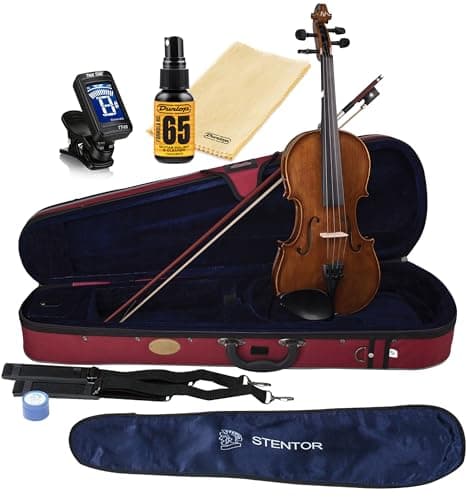
Solid carved spruce and maple with an ebony fingerboard, set up in a workshop before shipping, and made in five fractional sizes. The workshop setup is the specification that matters most on a beginner violin.
Published specifications
- Top:
- Solid carved spruce
- Back / sides:
- Solid figured maple
- Fingerboard:
- Ebony
- Pegs:
- Ebony or rosewood
- Sizes:
- 4/4, 3/4, 1/2, 1/4, 1/8
- Strings:
- Steel core, factory fitted
- Outfit:
- Wooden bow with ebony frog and natural horsehair, rosin, shaped lightweight case with music pocket and rucksack straps
What it gets right
- Ebony fingerboard and pegs, not stained hardwood — a stained fingerboard wears through and a soft peg will not hold a tuning
- Individually set up in a workshop before it ships, which is the single biggest variable on a cheap violin
- Available in five fractional sizes, so the same instrument family covers a child from about age five to adult
Where it gives ground
- The supplied steel-core strings are the first upgrade most teachers suggest
- The bow is functional rather than good; it is the second upgrade
What it is not good at
Being bought without measuring. Violin size is set by the player's arm length, not their age, and a violin one size too big is genuinely unplayable rather than merely awkward. Measure first.
How the specs score against a beginner’s needs
Scores are our reading of the published specifications above against what a beginner physically needs. They are not test results — we have not played this instrument.
Specifications from Stentor Music — Student II violin outfit.
Questions people actually ask
What notes is a violin tuned to?
G, D, A and E, from the thickest string to the thinnest. The A string is tuned first because everything else is traditionally tuned in relation to it, and because an orchestra tunes to A.
Should a beginner use the pegs or the fine tuners?
Fine tuners for everyday tuning, almost always. Pegs are for large corrections and they are the part beginners get wrong — a slipping peg drops a string suddenly, and an over-tightened one can snap it.
Why do my violin pegs keep slipping?
Usually because the peg was not pushed into the pegbox while turning. Friction pegs hold by being wedged, so the inward pressure is part of the technique. Dry weather makes it worse, and peg compound fixes persistent cases.
How often should a violin be tuned?
Every time you play it. Gut and synthetic-core strings move with temperature and humidity, and a violin that sat overnight in a cool room will not be where you left it.
Sources
Still deciding?
Every recommendation on this site is built the same way, and the method is published in full — including what we do not do and what would get a pick dropped.
Read next
- Violin accessories you actually need
The shoulder rest and tuner that outfits leave out, what to upgrade first, and which popular accessories to skip.
- How to look after a violin
The after-playing routine, why bow hair must be loosened, how much rosin is too much, and the bridge check nobody is taught.
- Best beginner violins: measure first, then buy
Arm-length sizing chart, why workshop setup is the spec that matters most, and one pick available in five sizes.
- What comes with a violin outfit, and what doesn't
What an outfit contains, what each part is worth bought separately, and the two items nearly everyone still needs.
- How to tune a ukulele
GCEA explained, using a clip-on tuner, why new strings drift for a week, and when tuning is not the problem.