Start Here
Should you rent or buy a first instrument?
The answer is genuinely different per instrument family, and the deciding factor is almost never the money.
By Sawyer V. · Published · Last updated

The rent-or-buy question gets answered as though it were about money. It mostly is not. It is about whether the instrument in front of you is going to stop fitting.
Rent when the instrument will be outgrown or the player might be reassigned: violins and cellos for a growing child, and school band instruments in year one. Buy when the instrument stays the same size for years, which covers guitars, keyboards, ukuleles and drums for most players.
The two questions that decide it
1. Will this instrument physically stop fitting? Some instruments are sized to the player and some are not. A violin comes in eight fractional sizes selected by arm length; a child starting at five will pass through three or four of them. A guitar has fractional sizes too, but far fewer steps. A keyboard has none at all — a 61-key board fits a five-year-old and a fifty-year-old identically.
2. Might the instrument itself change? This is the school band case and it is specific to that setting. Directors reassign students between sections in the first months based on physical fit and ensemble balance, and a family who bought a trumpet has turned a routine, sensible decision into a financial argument.
If the answer to either is yes, rent. If both are no, buy.
By instrument family
| Instrument | Sizes to grow through | Reassignment risk | Verdict |
|---|---|---|---|
| Keyboard / piano | None | None | Buy |
| Ukulele | None in practice | None | Buy — cheap enough that renting makes no sense |
| Guitar | 1–2 for a child, none for an adult | None | Buy, and resell |
| Drums | 1–2 for a child | None | Buy — renting a kit is uncommon |
| Violin / viola | 3–4 for a child | None | Rent while growing, buy at 3/4 or full |
| Cello | 3–4 for a child | None | Rent — expensive and bulky to own repeatedly |
| School band | Usually none | High in year one | Rent year one, buy year two or three |
The maintenance argument people miss
The strongest case for renting is not the instrument. It is what a rental program includes.
Woodwind instruments seal with pads and corks, and both are consumable. They do not fail suddenly — they leak slightly more each month, and a student never reports it because there is no moment when it breaks. They simply find the low notes getting harder and conclude they are getting worse. By the time anyone investigates, months of practice have been spent fighting a mechanical problem.
Bowed strings have a version of this too: bridges warp, soundposts shift, and pegs stop holding. A rental program handles all of it as routine. An owned instrument means noticing the problem first, which is precisely what a beginner cannot do.
Guitars, keyboards and ukuleles have almost none of this, which is a large part of why they land on the buy side.
Where buying is obviously right
Any adult, on any instrument. An adult will not outgrow anything. Renting an instrument you will still fit in ten years is money spent on nothing.
Ukulele, always. A good soprano ukulele#ad costs less than a few months of rental on anything. There is no version of the arithmetic where renting one makes sense.
Keyboards. A 61-key touch-sensitive board#ad fits every player forever. Nobody outgrows a keyboard physically; they outgrow its feature set, which is a replacement decision rather than a sizing one.
Guitars, with resale in mind. A child moves through perhaps one or two sizes, and used 3/4 guitars sell quickly because every family arrives at the same problem two years later. Buy a decent instrument#ad, sell it on, buy the next one. That is cheaper than renting and you keep the option of stopping.
Questions to ask before signing a rental
What maintenance is covered? On woodwind it should include pads and corks. If it does not, the rental is worth considerably less than it appears.
Do payments apply toward a purchase? Most school-affiliated programs apply at least part. Ask what proportion, and whether there is a time limit.
What happens if the size changes, or the director reassigns? A good program swaps without penalty. That is the entire reason to rent, so confirm it explicitly.
What is the notice period if we stop?
For the school band case specifically, the detail is in renting vs buying a band instrument. For violin sizing, which is the other main rental case, see violin sizes by age.
The honest caveat about renting
One thing rental does badly: it makes stopping easy. That cuts both ways. It is the right answer for genuine uncertainty, and it also means a student who hits a hard fortnight has an obvious exit that an owned instrument does not present quite so readily.
Not a reason to buy something that will not fit in a year. Worth knowing about, and worth deciding deliberately rather than by default.
What we would buy
Kala KA-15S
Kala Brand MusicBest for: The honest floor, soprano
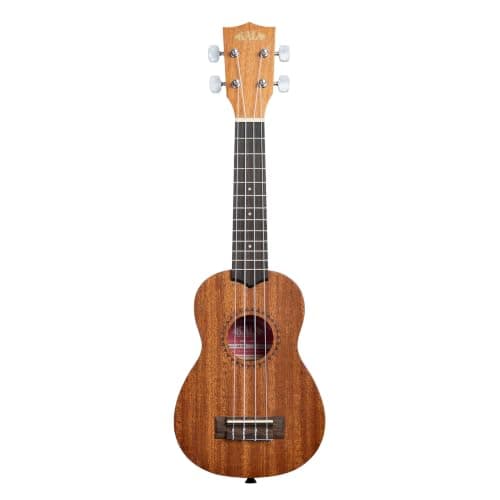
Mahogany throughout, a GraphTech NuBone nut and saddle, and Aquila strings fitted from the factory. The nut material is the spec that separates this from the pile of look-alikes.
Published specifications
- Size:
- Soprano
- Top / back / sides:
- Mahogany
- Neck / fretboard:
- Mahogany neck, rosewood fretboard
- Nut and saddle:
- GraphTech NuBone
- Scale length:
- 13.625"
- Frets:
- 12
- Nut width:
- 1.375"
- Overall length:
- 21.062"
- Strings:
- Aquila Super Nylgut
What it gets right
- NuBone nut and saddle rather than molded plastic — this is what decides whether the instrument plays in tune up the neck
- Aquila strings fitted at the factory, so the first thing you would otherwise replace is already done
- 21 inches overall and light enough for a small child to hold unsupported
Where it gives ground
- 12 frets only, and the body joint stops you well short of the high notes
- Soprano scale means less room between frets — adult fingers with wide fingertips will find it cramped
What it is not good at
Adult hands, sometimes. A 13.625 inch scale is genuinely tight. If the player is a grown-up with large hands, read our soprano-versus-concert comparison before buying this size.
How the specs score against a beginner’s needs
Scores are our reading of the published specifications above against what a beginner physically needs. They are not test results — we have not played this instrument.
Specifications from Kala Brand Music — KA-15S specifications.
Yamaha PSR-E383
YamahaBest for: Learning tools, 61 keys
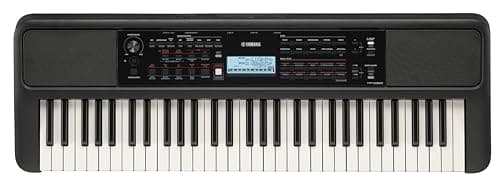
61 touch-sensitive keys and 125 lesson songs with hand-separate practice and scoring. The touch response is the spec that matters; the 650 tones are the spec that sells it.
Published specifications
- Keys:
- 61, organ-style (unweighted), touch-sensitive
- Touch response:
- Soft / medium / hard / off
- Polyphony:
- 48 notes
- Tones:
- 650 (258 panel, 25 drum/SFX, 20 arpeggio, 347 XGlite)
- Lessons:
- 125 lesson songs, right/left/both-hand practice with evaluation
- In the box:
- Music rest, PA130 power adapter
What it gets right
- Touch-sensitive keys — playing harder makes it louder, which is the thing a beginner has to learn early and a non-touch keyboard cannot teach
- The lesson mode with hand-separate practice and scoring is genuinely useful, not a gimmick
- Power adapter included, which is not a given at this tier
Where it gives ground
- Unweighted organ-style keys — this will not build the finger strength a piano needs
- 61 keys, so a method book that assumes 88 will eventually run out of instrument
What it is not good at
Preparing anyone for an acoustic piano. If there is a real piano in the child's future, the unweighted action is a habit to unlearn later. Read our 61-versus-88 comparison before deciding.
How the specs score against a beginner’s needs
Scores are our reading of the published specifications above against what a beginner physically needs. They are not test results — we have not played this instrument.
Specifications from Yamaha — PSR-E383 specifications.
Squier Sonic Stratocaster
Squier by FenderBest for: The honest floor, electric
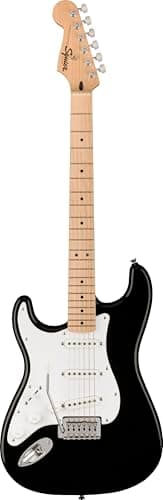
The cheapest electric that still has full-scale geometry, sealed tuners and a real 9.5 inch fingerboard radius. Nothing about it will make a beginner's first year harder.
Published specifications
- Scale length:
- 25.5" (647.7 mm) — full size
- Body / neck:
- Poplar body, maple neck, "C" profile
- Fingerboard:
- Maple or Indian laurel, 9.5" (241 mm) radius
- Frets:
- 21, narrow tall
- Nut width:
- 1.650" (42 mm), synthetic bone
- Pickups:
- Three ceramic single-coils (SSS)
- Bridge:
- 6-saddle vintage-style synchronized tremolo
What it gets right
- Full 25.5 inch scale, so nothing learned here has to be relearned later
- Synthetic bone nut rather than a soft plastic one — the part that decides whether a cheap guitar stays in tune
- Sealed-gear tuners, which is the single most important spec on a first electric
Where it gives ground
- Poplar body and ceramic pickups are exactly what you would expect at this tier
- The tremolo bridge will pull the guitar out of tune if a beginner uses it, and beginners always use it
What it is not good at
Staying in tune if you use the whammy bar. If that matters, buy the hardtail (HT) version of the same guitar instead — it is the identical instrument with the tremolo deleted.
How the specs score against a beginner’s needs
Scores are our reading of the published specifications above against what a beginner physically needs. They are not test results — we have not played this instrument.
Specifications from Squier Wiki — Sonic Stratocaster specifications.
Questions people actually ask
Is it better to rent or buy an instrument?
Rent if the instrument will change size or the player might be reassigned — which means violins and cellos for a growing child, and school band instruments in year one. Buy if the instrument stays the same size for years, which covers guitars, keyboards, ukuleles and drums for most players.
Do rental payments go toward buying?
On most school-affiliated and music-shop programs, at least in part. It is the single most useful question to ask before signing, alongside what maintenance is covered.
Is renting a waste of money?
Not when the instrument is going to be outgrown. A child who starts violin at five moves through three or four sizes before reaching full size — buying each one costs far more than renting through the same period, and you are left with instruments nobody wants.
Can you rent a guitar or a keyboard?
Some shops will, and it is rarely worth it. Neither changes size, both hold their resale value reasonably, and the rental economics only make sense for instruments a player physically outgrows.
Sources
Still deciding?
Every recommendation on this site is built the same way, and the method is published in full — including what we do not do and what would get a pick dropped.
Read next
- What instrument should I learn?
Four practical constraints instead of a personality quiz, each one routing straight to the instrument that fits.
- Renting vs buying a school band instrument
Why year one is a rental year, what programs cover, the maintenance nobody warns you about, and when buying starts to win.
- Violin sizes by age and arm length
The full fractional chart by arm length, how to measure, and why a violin one size too big cannot be played correctly.
- What age should a child start an instrument?
Realistic starting ages set by each instrument's physical demands, why starting early backfires, and what to do while waiting.
- The best first instrument for a child
Instrument by instrument, the real starting age set by hand size and reach, with a pick for each and the noise column filled in.