Start Here
Learning an instrument as an adult
Adults have better attention, better reasoning and worse patience with sounding bad. All three change what you should buy and how you should start.
By Sawyer V. · Published · Last updated
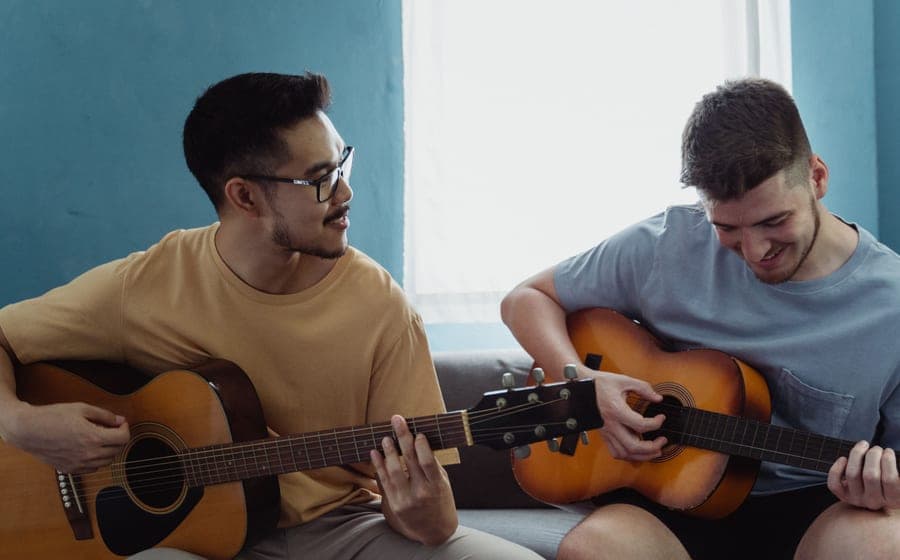
The idea that adults cannot learn instruments is folklore. What is true is that adults learn differently, and the differences change what you should buy and how you should start.
What is genuinely better as an adult
Sustained attention. An adult can practice one difficult bar for fifteen minutes. A child cannot, and that ability is worth an enormous amount, because deliberate practice on the specific hard part is what produces progress.
Pattern recognition and reasoning. An adult can understand why a chord progression works and generalize it. A child learns by pattern and repetition without the framework. Adults frequently progress faster in the first year for exactly this reason.
Choosing the material. An adult can decide to learn the song they actually want to play, which is a motivational advantage children rarely get.
What is genuinely harder
Tolerance for sounding bad. This is the real obstacle and it is worth naming precisely. A seven-year-old plays badly and finds it fine, because being incompetent at things is their normal condition. An adult who is competent at their job and their hobbies finds thirty minutes of sounding terrible genuinely uncomfortable. Most adult attempts end here, in the first three weeks, and not because of anything physical.
Time, and its unpredictability. An adult’s practice happens in whatever gap appears. This is why the noise question matters more for adults than for anyone — an instrument playable at 10pm gets several times the practice of one that does not.
Hand flexibility, slightly. Real and small. It affects the ceiling for virtuosic technique decades out, and has essentially no bearing on learning to play well.
What this means for the purchase
Three consequences follow directly.
Buy an instrument that sounds good sooner. The sounding-bad problem is the main risk, so shorten the phase. This is the strongest argument for a ukulele as an adult’s first instrument even when the long-term goal is guitar: a week to a real song instead of a month.
Buy something you can play at any hour. Practice happens in gaps and the gaps are often late. A keyboard with headphones or an electric guitar with headphones is playable at 11pm; an acoustic guitar or an acoustic drum kit is not. Weigh this heavily.
Buy at the honest floor, not below it. An adult can tell when an instrument is fighting them and will — correctly — blame the instrument and stop. The floor band on each of our cost pages is the point where the instrument stops being the problem.
Which instruments suit an adult starter
Ukulele if you want the fastest route to sounding like music. A concert size, because a soprano’s 13.6 inch scale is genuinely cramped for adult fingers.
Keyboard or digital piano if you want the most complete musical foundation and the quietest practice. If real piano is the destination, buy weighted keys from the start.
Acoustic guitar if that is specifically what you want. Expect three hard weeks of sore fingertips followed by it getting much easier, and buy a solid-top instrument at the enough band rather than economizing.
Electric guitar if you want easier fretting and silent practice, and budget for the amplifier as part of the purchase.
The three mistakes
1. Buying too cheap “in case I quit.” The cheapest instruments are the ones most likely to cause the quitting, because they will not stay in tune and a beginner cannot tell an out-of-tune instrument from their own mistake. Our cheap guitars page walks through the specific mechanism.
2. Practicing in long infrequent sessions. Fifteen minutes daily beats two hours weekly, reliably, because the physical skills consolidate between sessions and infrequent practice loses the consolidation. Adults default to the two-hour version because it feels like proper effort.
3. Skipping lessons to save money. The highest-return purchase in this entire category is an hour with a teacher, and it is not close. A teacher catches the wrist angle you cannot see and the hand position that will limit you in two years. Even three or four lessons at the start is transformative. Buy the cheaper instrument and the lessons rather than the reverse.
One important distinction: this page is written for adults starting from nothing. If you played years ago and are picking it up again, your situation is different — reading and theory come back in days while the physical technique does not — and that is covered separately in best instruments for coming back to music.
What we would buy
Yamaha FG800
YamahaBest for: Buy once, acoustic
A solid Sitka spruce top with scalloped bracing at the entry price. Solid-versus-laminate is the one acoustic spec that changes what the instrument does over years, and this is the cheapest place to get it done right.
Published specifications
- Top:
- Solid Sitka spruce
- Back / sides:
- Nato / okume
- Neck / fingerboard:
- Nato neck, rosewood fingerboard, R400 mm (23-5/8") radius
- Scale length:
- 650 mm (25-9/16")
- Nut width:
- 43 mm (1-11/16")
- Bracing:
- Scalloped
- Body:
- Traditional Western (dreadnought), 412 mm (16-1/4") wide, 100-118 mm deep
- Hardware:
- Die-cast chrome tuners, urea nut and saddle
What it gets right
- A solid top, not a laminate — the only acoustic spec at this price that genuinely changes over time
- Scalloped bracing and die-cast tuners are specifications you normally pay considerably more for
- Yamaha's most-copied entry acoustic; parts, setups and advice are everywhere
Where it gives ground
- A full dreadnought body is a big box — 412 mm across and up to 118 mm deep
- Nato and okume back and sides are the cost saving; the top is where the money went
What it is not good at
Fitting a smaller player. The dreadnought body is wide and deep enough that a young teenager can struggle to get their arm over it comfortably. If that is the buyer, look at the JR1 or a concert-size body instead.
How the specs score against a beginner’s needs
Scores are our reading of the published specifications above against what a beginner physically needs. They are not test results — we have not played this instrument.
Specifications from Yamaha Europe — FG/FS800 series specifications.
Cordoba 15CM
CordobaBest for: Adult hands, concert size
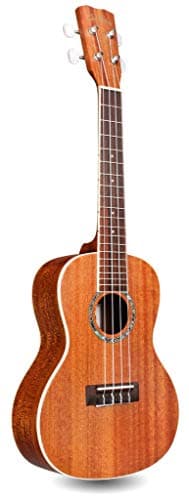
A 375 mm concert scale with 18 frets and a 35 mm nut. The extra inch and a bit of scale over a soprano is the difference between cramped and comfortable for most adults.
Published specifications
- Size:
- Concert
- Top / back / sides:
- Mahogany
- Fingerboard:
- Rosewood
- Scale length:
- 375 mm (14-3/4")
- Frets:
- 18
- Nut width:
- 35 mm (1-3/8")
- Body / overall:
- 280 mm body, 610 mm (24") overall
- Strings / finish:
- Aquila, satin finish, abalone rosette
What it gets right
- 18 frets against a soprano's 12 — a whole extra register that a soprano simply does not have
- The 375 mm scale gives noticeably more room between frets without becoming a tenor-sized instrument
- Aquila strings and an abalone rosette; it looks considerably more expensive than it is
Where it gives ground
- Identical 35 mm nut width to the Kala soprano — the extra room is between the frets, not across the neck
- 24 inches overall is a lot of instrument for a small child
What it is not good at
Sounding like a ukulele in the postcard sense. The concert body is fuller and rounder; the bright, plinky voice people picture is the soprano's.
How the specs score against a beginner’s needs
Scores are our reading of the published specifications above against what a beginner physically needs. They are not test results — we have not played this instrument.
Specifications from Cordoba Guitars — 15CM.
Yamaha P-145
YamahaBest for: Buy once, 88 weighted keys
88 graded hammer keys, a concert grand sample and 24 pounds. If the plan is piano lessons rather than keyboard playing, this is where the shopping actually starts.
Published specifications
- Keys:
- 88, GHC (Graded Hammer Compact), fully weighted and graded
- Polyphony:
- 64 notes
- Sound:
- Yamaha CFIIIS concert grand sample, damper resonance DSP
- Speakers:
- 7 W built-in
- Dimensions:
- 1,326 x 268 x 129 mm (52-3/16" x 10-9/16" x 5-1/16")
- Weight:
- 11.1 kg (24 lb 8 oz)
- In the box:
- Music rest, sustain foot switch
What it gets right
- Graded hammer action — the low keys are heavier than the high ones, which is the thing an unweighted keyboard cannot teach
- All 88 keys, so no method book ever runs off the end of the instrument
- Genuinely portable at 24 pounds and 268 mm deep; it fits on a desk
Where it gives ground
- 64-note polyphony is the entry-tier number; heavy sustain-pedal passages will drop notes eventually
- A single sustain footswitch, not a proper piano-style pedal — most players replace it
What it is not good at
Anything other than piano. There are only a handful of voices and no arranger features, so if the player wants to make beats or layer sounds, a PSR-E383 will make them happier for less money.
How the specs score against a beginner’s needs
Scores are our reading of the published specifications above against what a beginner physically needs. They are not test results — we have not played this instrument.
Specifications from Yamaha USA — P-145 specifications.
Questions people actually ask
What is the easiest instrument to learn for adults?
Ukulele, by a clear margin, because four nylon strings and one-finger chords mean a real song in the first sitting. Keyboard is next, because the note is correct as soon as you press the key. Both suit an adult who wants early evidence that this is going somewhere.
Am I too old to learn an instrument?
No. Adults learn differently rather than worse: better sustained attention, better pattern recognition, better ability to practice deliberately rather than repetitively. What adults have less of is tolerance for sounding bad, and that is a solvable problem rather than a biological one.
How long does it take an adult to learn guitar?
Comfortable strumming of a few songs takes a few months of regular practice for most adults. What varies enormously is practice consistency, not talent — fifteen minutes a day beats two hours on a Sunday, reliably.
Should an adult get lessons or teach themselves?
Even a handful of lessons at the start is worth more than the equivalent money spent on a better instrument. A teacher catches the physical habits — wrist angle, hand position, posture — that are invisible to the person doing them and expensive to unlearn later.
Sources
Still deciding?
Every recommendation on this site is built the same way, and the method is published in full — including what we do not do and what would get a pick dropped.
Read next
- What instrument should I learn?
Four practical constraints instead of a personality quiz, each one routing straight to the instrument that fits.
- The easiest instruments to learn
Ranked by time to a first real song, with the ceiling each one trades away, and a pick for the top three.
- Best beginner acoustic guitars: solid tops from $200 to $350
Solid versus laminate tops, the dreadnought body-size problem, and picks for adults and children separately.
- Best beginner digital pianos: 88 keys, honestly compared
Hammer action versus semi-weighted at the entry price, with the polyphony and weight trade-offs both stated.
- Best beginner ukuleles: what's worth it from $60 to $120
Segmented by hand size rather than price, with the nut-material spec that separates a real ukulele from a decoration.