Guitars
Best guitar books for beginners
The brand on the cover matters far less than the order the book teaches things in. Pick the one that starts where you want to start.
By Sawyer V. · Published · Last updated
After the guitar itself, a method book is the purchase that most shapes what the first few months look like. It decides what you practice, in what order, and whether the first song you play is a folk melody read from notation or a four-chord strum along to a record. Get that order wrong for the player and the book goes on a shelf.
The good news is that this is the cheapest decision on the site. Every book below costs a small fraction of a beginner guitar, and a wrong pick is a lesson rather than a loss.
We have not worked through these books. What we compared is what each publisher says the book contains: page count, the chords and skills it covers, whether it teaches notation or tab, and what audio or video comes with it. Every figure on the product cards links to that publisher page, and the full method is on how we pick. Each pick also carries its Starter Path band.
An adult teaching themselves to strum songs should buy the JustinGuitar Beginner’s Course. Anyone who wants to read music, or is heading for lessons or a school ensemble, should buy Hal Leonard Guitar Method Book 1, or the Complete Edition if they are sure they will continue. Guitar For Dummies is a reference to keep beside a method, not a course. For a young child, Guitar for Kids; for classical guitar, the Hal Leonard Classical Guitar Method.
The one decision that matters: chords first or reading first
Beginner guitar books split into two families, and the split matters far more than the publisher.
Chords-first books teach from chord boxes (a diagram of where the fingers go) and tablature (a map of which string and fret to play). You learn a handful of open chords, learn to strum them in time, and you are playing songs early. What you do not learn is how to read standard notation.
Reading-first books teach single-note melodies on standard notation in the first position, and add chords gradually alongside. Songs arrive more slowly, and the early material can feel like exercises. What you get in exchange is the ability to read music, which is what a school ensemble, a classical teacher or most traditional lessons will expect.
Neither is better. They answer different goals, and guitar is unusual in that you can play for years on chord boxes and tab alone — one of the reasons it is easier to start than people expect, as we cover in is guitar hard to learn.
Three questions settle it for almost everyone:
Is a teacher or a school program involved? Then buy the book they use, and nothing else. This one question overrides everything else on the page, and buying a different book first is the easiest way to waste money here.
Is the goal to strum and sing songs? Then chords-first. Many adult beginners are in this group, and a reading method will feel slow to them.
Is the goal classical guitar? Then a classical method, in standard notation, on a nylon-string guitar. The general methods here do not cover the classical right hand.
Five things to check on any guitar book
Before the picks, the criteria. These apply to any method book you are looking at, not only the seven here.
1. Which notation it teaches. Chord boxes, tab, standard notation, or some mix. The publisher’s page usually says, and Hal Leonard labels its tab editions as such. Match this to the decision above before anything else.
2. Whether audio comes with it. A beginner cannot tell from the page whether their rhythm is right; they need to hear it. Every book on this page comes with online audio. Hal Leonard’s books unlock it with a code printed inside each copy, which is worth checking before you buy one secondhand, and its PLAYBACK+ player can slow a track down without changing its pitch, which is more useful than it sounds.
3. How far it goes. The range on this page runs from 32 pages to 416. More is not automatically better: a first book you actually finish does more for motivation than a large one you abandon on page 60. Look at the last topic in the contents list, not only the page count.
4. Whether it is a course or a reference. A course decides the order for you. A reference answers questions in whatever order you ask them. Beginners need the first, and benefit from the second only once they know what to ask.
5. The edition. Popular method books stay in print for years and older editions keep circulating. Amazon’s results for the JustinGuitar course, for example, still show an older spiral-bound edition packaged with two CDs alongside the current online-audio edition. Buy the edition the publisher currently lists; every link on this page goes to one.
How we ranked these
Five criteria, in this order. They are our reading of each publisher’s published contents list, not the result of working through the books.
Gets you playing songs first, because practice that never starts to sound like music is where a beginner’s motivation runs out.
Works without a teacher second, since most people buying a guitar book are buying it instead of lessons, at least at first.
Scope for the money third: how much of the beginner stage one purchase covers.
Audio support fourth: demonstrations, play-along tracks, and video where it exists.
Room to grow last: whether there is a next book in the same series, so a learner who sticks with it does not have to start over.
The last two picks, for children and for classical guitar, rank lower because they serve narrower readers, not because they do their own jobs worse.
The picks
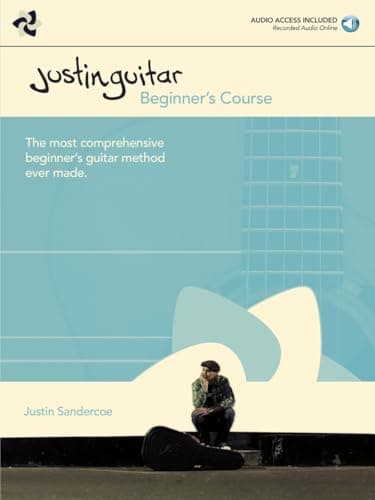
The JustinGuitar Beginner's Course#ad is the one we would hand most adults who bought a guitar to play songs. It is built around open chords, strumming and rhythm, reads from chord boxes and tab, and runs across 192 pages from choosing gear to fingerstyle patterns, blues and a first pentatonic scale. Audio demonstrates every chord, technique and exercise.
Its strongest point is not in the book. The author also teaches a beginner course free online in video, so when a page does not make sense there is a free lesson to watch. The honest cost follows from that: much of the material is free on his website, and what you are paying for is a printed, offline sequence. For many adults that is exactly the thing worth paying for. If reading music is the goal, this is the wrong book.
Guitar For Dummies, 4th Edition#ad is the widest book here by a distance: 416 pages covering how to choose a guitar, tuning, restringing and simple repairs, chord diagrams, notation and tab, several styles, and effects and amps, with more than 80 online videos and 35 audio tracks. It is the only pick with real video support built in.
What it is not is a course. It is a reference you navigate, and a beginner is the person least equipped to choose their own path through 416 pages. It is also the oldest edition on this page, published in June 2016, so the buying and gear chapters are the likeliest to have aged. We rank it second as the book to keep beside a method, not instead of one.
The Hal Leonard Guitar Method, Complete Edition#ad and Hal Leonard Guitar Method Book 1 (Second Edition)#ad are the same method bought two ways, and the choice between them is the Starter Path in miniature. Book 1 alone is the floor: 48 pages, first-position melody reading, rhythms through eighth notes, strumming, and the C, G, G7, D7 and Em chords, with online audio. The Complete Edition is enough: Books 1, 2 and 3 spiral-bound together, 144 pages, 164 full-band tracks, running on to power chords, fingerstyle, tablature, barre chords and string bends.
Buy Book 1 to find out whether a reading method suits you. Buy the Complete Edition if you already know it will, or if a teacher uses the series, and get a book that lies flat on a music stand into the bargain. The shared weakness is the reading-first order itself: single-note melodies come before strummed songs, and that is the stretch where impatient adults drift off. One practical note: Hal Leonard’s own store listed the Book 1 print edition on back order when we checked, while retail stock was available.
Alfred's Basic Guitar Method 1 (Third Edition)#ad is the long-running alternative, and it does the same job. Standard notation from the start, songs across blues, country, folk, jazz, rock and pop, online audio, and a longer first volume at 64 pages. Alfred sells video lessons and practice software as a separate edition; the one we link is audio only. There is no reason to own both this and Hal Leonard Book 1. Choose whichever your teacher uses, and with no teacher, either.
Guitar for Kids, Method Book 1#ad is built for young children: 32 pages, one concept at a time, standard notation on the first three strings, six chords, more than 30 play-along tracks, and 16 songs including Yellow Submarine, I’m a Believer and Hound Dog. It has no tablature at all. Hal Leonard does not publish an age range; retail listings have described it as ages 5 to 9. Expect to sit in with a child on this book, and a Book 2 exists for one who sticks with it.
The Hal Leonard Classical Guitar Method#ad by Paul Henry is the one pick that teaches the classical right hand: PIMA fingering, free stroke and rest stroke, two- and three-part music, and over 25 pieces by composers including Bach, Beethoven, Carcassi, Giuliani and Tarrega, with recorded accompaniments to play against. It has no tablature by design. It is the right book for a nylon-string player who wants classical repertoire, and the wrong one for somebody who bought a nylon-string guitar to strum pop songs.
Where the Starter Path bands fall for a book
The Starter Path we apply to instruments works for books too, with smaller numbers attached.
Below the floor: a songbook or a chord dictionary as the only book. Both assume you can already play. A chord chart shows you where the fingers go, and says nothing about how to move between shapes in time, which is the real wall in the first two months.
The floor: one method volume with audio. Hal Leonard Book 1, Alfred 1, Guitar for Kids and the classical method all sit here, and for a first purchase there is nothing wrong with that.
Enough: a complete beginner course in one purchase. The JustinGuitar course and the Hal Leonard Complete Edition sit here, with Guitar For Dummies as the reference that goes with either.
Where overspending starts: buying a method, a songbook, a theory book and an app subscription at once. The spending is small, and the cost is attention: four sources pulling in four directions is how beginners end up practicing nothing in order.
And the book cannot fix the guitar. A method that asks for a C chord on page 10 assumes a guitar you can press a C chord on, and a cheap instrument with high action makes every page harder than it should be. If that sounds familiar, read what a guitar setup is before you blame the book, or yourself.
A book, a video or a teacher
They do different jobs, and the efficient answer for most adults uses all three.
A book gives you order. It decides what comes next, which is the thing a beginner is worst at deciding and free video is worst at providing.
Video shows you hands. A photo of a chord shape is fine; watching someone change between two shapes in time is better, and that is why video support is one of our criteria.
A teacher diagnoses. They see the thumb wrapped over the neck, the collapsed wrist and the gripping hand that you cannot see yourself. A handful of lessons (one at the start, another a month or two in) covers the gap a book leaves, and the case for that hybrid is made in full in lessons or teaching yourself.
Matching the book to the player and the guitar
Children. For a young child the size of the guitar matters more than the book. A method written for small hands does not help on a guitar the child cannot reach around. Get the size right first with guitar sizes for kids, and the instruments are in best guitars for kids.
Nylon-string players. Owning a classical guitar does not mean you need a classical method. The general books above work on nylon strings; the classical method is for classical repertoire and technique. If you have not bought the guitar yet, the options are in best classical guitars for beginners.
Electric players. Every general method here works on electric. What changes is the amp and a few extra accessories, which are covered in guitar accessories you actually need.
Getting your money’s worth from a method book
Work in order. A method is a sequence, and skipping ahead to the page with the song you like is how gaps form. If a page is boring, do it quickly; do not skip it.
Use the audio every time. Play the track, play along with it, then play it without. Slow it down when you need to. This is what turns a book into something closer to a lesson.
Practice little and often. Fifteen minutes a day beats two hours on a Sunday, and a book open on a stand next to a guitar on a stand is the setup that makes daily practice happen. Realistic timelines are in how long it takes to learn guitar.
If one page stops you for two weeks, book a lesson. Being stuck for that long often means a physical problem the book cannot see, which is exactly what a teacher is for. The same goes for sore fingertips that do not settle; the causes are in why your guitar hurts your fingers.
Quick picks
Adults teaching themselves to play songs
Chords and strumming at the center, chord boxes and tab rather than notation, and a free online video course by the same author to watch when a page does not make sense.
| # | Product | Best for | Score | Price |
|---|---|---|---|---|
| 1 | JustinGuitar Beginner's CourseThe chords-first course. | Adults teaching themselvesEnough | 8.6 | $26.99 · View on Amazon #ad How we’re funded |
Learning to read music, or heading for lessons
Standard notation from the start. Buy the single book to find out whether the method suits you, or the three-book Complete Edition if you already know it will.
| # | Product | Best for | Score | Price |
|---|---|---|---|---|
| 1 | 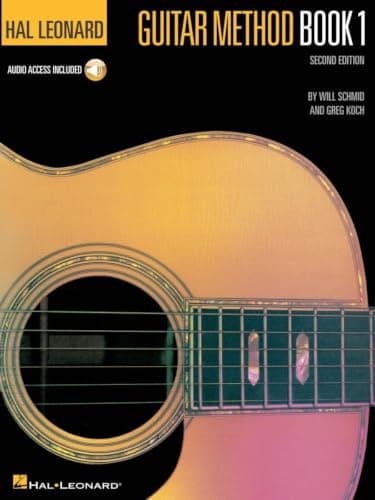 Hal Leonard Guitar Method Book 1 (Second Edition)The cheapest sensible start on the notation-first route. | Learning to read musicThe honest floor | 7.2 | $10.42 · View on Amazon #ad How we’re funded |
| 2 | 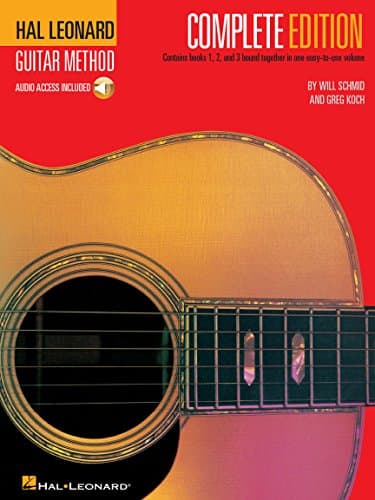 Hal Leonard Guitar Method, Complete EditionBooks 1, 2 and 3 of Hal Leonard's notation-first method, spiral-bound into one volume with 164 full-band audio tracks. | Buying the whole method onceEnough | 8.0 | $26.16 · View on Amazon #ad How we’re funded |
| 3 | 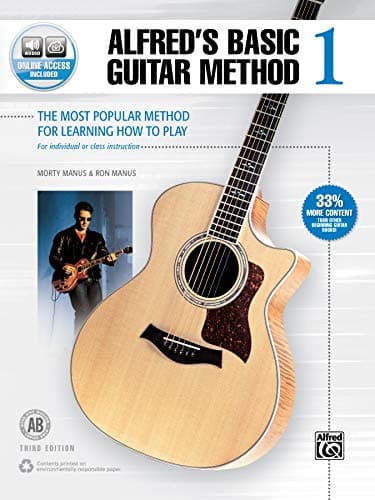 Alfred's Basic Guitar Method 1 (Third Edition)The long-running alternative to Hal Leonard's method, doing the same job: standard notation from the start, songs across blues, country, folk, jazz, rock and pop, and online audio. | The other notation-first methodThe honest floor | 6.8 | $9.49 · View on Amazon #ad How we’re funded |
A reference to keep beside the method
Everything from tuning and restringing to several styles, with more than 80 online videos. A reference you look things up in, not a course that sets the order.
| # | Product | Best for | Score | Price |
|---|---|---|---|---|
| 1 | 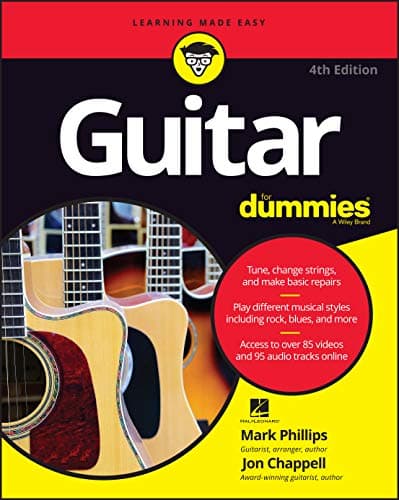 Guitar For Dummies, 4th EditionThe widest book here by a distance: buying, tuning, restringing, simple repairs, chords, notation and tab, and several styles, with more than 80 online videos. | A reference that answers everythingEnough | 8.2 | $16.49 · View on Amazon #ad How we’re funded |
Young children
32 pages, one idea per page, and songs a child is likely to know. Built for a young learner with an adult nearby.
| # | Product | Best for | Score | Price |
|---|---|---|---|---|
| 1 | 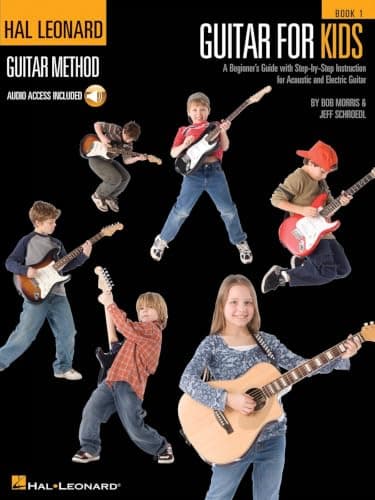 Guitar for Kids, Method Book 1A 32-page method built for young children: one concept per page, standard notation on the first three strings, six chords, and 16 songs they are likely to recognize, with more than 30 play-along tracks. | Young children, with an adult helpingThe honest floor | 6.4 | $12.91 · View on Amazon #ad How we’re funded |
Classical guitar
Free stroke, rest stroke and real classical repertoire, in standard notation only. For a nylon-string player who wants to play classical music, not strum.
| # | Product | Best for | Score | Price |
|---|---|---|---|---|
| 1 | 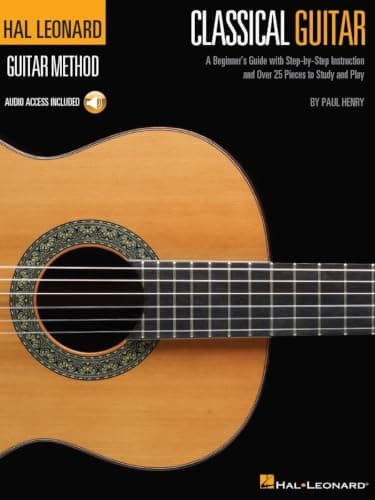 The Hal Leonard Classical Guitar MethodA classical method by Paul Henry: technique basics, free and rest stroke, two- and three-part music, and over 25 pieces by composers from Bach to Tarrega. | Nylon-string and classical playersThe honest floor | 6.2 | $16.99 · View on Amazon #ad How we’re funded |
The picks in full
JustinGuitar Beginner's Course
Hal LeonardBest for: Adults teaching themselves
The chords-first course. Open chords, strumming and rhythm are the core, it reads from chord boxes and tab rather than notation, and it is the print version of a beginner course its author also teaches free online.
Published specifications
- Author:
- Justin Sandercoe
- Pages:
- 192
- Format:
- Softcover with online audio (TAB edition)
- Notation:
- Chord boxes and tablature
- Audio:
- Demonstrations of every chord, technique and exercise, with PLAYBACK+ slow-down and looping
- Covers:
- Gear, tuning, open and power chords, rhythm, practice methods, blues, fingerstyle, pentatonic scales, basic improvisation
- ISBN:
- 978-1-4950-5996-4
What it gets right
- Built around chords and strumming from the start, which is what many adult beginners bought a guitar to do
- The whole beginner stage in one book, from choosing gear to a first pentatonic solo
- Audio demonstrates every chord, technique and exercise, and PLAYBACK+ slows it down without changing the pitch
- The author teaches a free beginner course online in video, so help is a click away when a page does not make sense
Where it gives ground
- Teaches from chord boxes and tab, not standard notation — the wrong book if reading music is the goal
- Much of the same material is free on the author's website, so what you are buying is a printed, offline sequence rather than content you cannot get elsewhere
- Priced near the top of this list for a single volume
- 192 pages is a lot of book to face on day one; it rewards working through in order rather than dipping in
What it is not good at
A child in lessons with a teacher who works from standard notation. The book and the lesson will be speaking two different languages.
How the specs score against a beginner’s needs
Scores are our reading of the published specifications above against what a beginner physically needs. They are not test results — we have not played this instrument.
Specifications from Hal Leonard — JustinGuitar Beginner's Course (HL 14043891), JustinGuitar — free beginner course.
Guitar For Dummies, 4th Edition
WileyBest for: A reference that answers everything
The widest book here by a distance: buying, tuning, restringing, simple repairs, chords, notation and tab, and several styles, with more than 80 online videos. It is a reference you navigate, not a course that tells you what to practice today.
Published specifications
- Authors:
- Mark Phillips and Jon Chappell
- Published:
- June 2016 (4th edition)
- Pages:
- 416
- Notation:
- Chord diagrams, standard notation and tablature
- Online media:
- More than 80 videos and 35 audio tracks
- Covers:
- Choosing a guitar and accessories, tuning, string changes, simple repairs, rock, blues, jazz and country, effects and amps
- ISBN:
- 978-1-119-29335-4
What it gets right
- The only book here that covers string changes and simple repairs as well as playing
- More than 80 online videos — the most video support of any pick on this page
- Teaches chord diagrams, notation and tab, so it does not force the chords-or-reading decision
- Works for acoustic and electric players equally
Where it gives ground
- A reference rather than a lesson-by-lesson sequence — you choose the path, which is exactly what a beginner is worst at
- The current edition dates from 2016, so the gear and buying chapters are the parts most likely to have aged
- 416 pages is far more than a first year needs, and most of it will sit unread for months
What it is not good at
Structure. A learner who needs to be told what to do next, in order, will get more from a method book that decides for them.
How the specs score against a beginner’s needs
Scores are our reading of the published specifications above against what a beginner physically needs. They are not test results — we have not played this instrument.
Specifications from Wiley — Guitar For Dummies, 4th Edition, Dummies.com — Guitar For Dummies, 4th Edition book page.
Hal Leonard Guitar Method, Complete Edition
Hal LeonardBest for: Buying the whole method once
Books 1, 2 and 3 of Hal Leonard's notation-first method, spiral-bound into one volume with 164 full-band audio tracks. It runs from first-position notes to barre chords and string bends, well past the beginner stage.
Published specifications
- Authors:
- Will Schmid and Greg Koch
- Pages:
- 144 (Books 1, 2 and 3)
- Binding:
- Spiral-bound
- Audio:
- 164 full-band tracks online, stream or download
- Book 1:
- Tuning, notes in first position, C, G, G7, D, D7, A7 and Em, rhythms through eighth notes
- Books 2 and 3:
- More chords, power chords, fingerstyle, tablature, scales, barre chords, drop D, slides, hammer-ons, pull-offs and bends
- ISBN:
- 978-0-634-04701-5
What it gets right
- One purchase covers the whole three-book method, so there is no second and third order to remember
- Spiral binding lies flat on a music stand, which a standard paperback will not
- 164 full-band tracks, so exercises are played against a band rather than alone
- Standard notation throughout, so a self-taught start carries straight into lessons with a teacher who reads
Where it gives ground
- Notation-first: melody reading comes before strumming songs, which loses some adults early
- A learner who stops in month two has paid for two books they never opened
- Tablature does not arrive until the Book 2 material
What it is not good at
The adult who wants to strum along to songs within two weeks. The method gets there, but it teaches reading on the way and that takes longer.
How the specs score against a beginner’s needs
Scores are our reading of the published specifications above against what a beginner physically needs. They are not test results — we have not played this instrument.
Specifications from Hal Leonard — Guitar Method, Second Edition, Complete Edition (HL 00697342).
Hal Leonard Guitar Method Book 1 (Second Edition)
Hal LeonardBest for: Learning to read music
The cheapest sensible start on the notation-first route. 48 pages, five chords, first-position melody reading and online audio. It is deliberately the first of three, and the next book continues exactly where it stops.
Published specifications
- Authors:
- Will Schmid and Greg Koch
- Pages:
- 48
- Format:
- Book with online audio (code inside the book)
- Audio:
- Online examples with PLAYBACK+ slow-down, looping and key change
- Covers:
- Tuning, first-position melody playing, rhythms through eighth notes, solos, ensembles, strumming
- Chords:
- C, G, G7, D7 and Em
- ISBN:
- 978-0-7935-3392-3
What it gets right
- An inexpensive way to find out whether a structured method suits you
- Teaches reading from the start, which is what a school ensemble or a reading-based teacher will expect
- Short enough to finish, which is more motivating than it sounds
- Books 2 and 3 continue the same sequence, so nothing is wasted if it sticks
Where it gives ground
- Only five chords, so strumming real songs is limited until Book 2
- At 48 pages a committed learner needs the next book within months — the Complete Edition is the better buy for anyone sure they will continue
- Hal Leonard's own store listed the print edition on back order when we checked; retail stock was available
What it is not good at
Getting an adult strumming along to songs quickly. It starts with single-note melodies on purpose, and that is the part impatient beginners skip.
How the specs score against a beginner’s needs
Scores are our reading of the published specifications above against what a beginner physically needs. They are not test results — we have not played this instrument.
Specifications from Hal Leonard — Guitar Method Book 1, Second Edition, Book/Online Audio (HL 00699027).
Alfred's Basic Guitar Method 1 (Third Edition)
Alfred MusicBest for: The other notation-first method
The long-running alternative to Hal Leonard's method, doing the same job: standard notation from the start, songs across blues, country, folk, jazz, rock and pop, and online audio. Buy it when a teacher uses it; otherwise it and Hal Leonard Book 1 are close substitutes.
Published specifications
- Authors:
- Morty Manus and Ron Manus
- Pages:
- 64
- Format:
- Book with online audio, download or stream
- Notation:
- Standard music notation
- Styles:
- Blues, country, folk, jazz and rock, plus pop songs
- Edition:
- Third edition, item 00-45304
- ISBN:
- 978-1-4706-2623-5
What it gets right
- A longer first volume than Hal Leonard Book 1 at a similar, inexpensive level
- A wide spread of styles, which helps when the learner does not yet know what they like
- Standard notation from the start, which suits students heading for school ensembles or lessons
Where it gives ground
- Video lessons and Alfred's practice software come with a separate edition (00-45305) — this one is audio only
- Overlaps almost entirely with Hal Leonard Book 1 in purpose, so there is no reason to own both
- Notation-first, with the same slow road to strummed songs as any reading method
What it is not good at
The learner who wants tab and chord-and-strum songs from the first week. Every reading method trades early songs for a skill that pays off later.
How the specs score against a beginner’s needs
Scores are our reading of the published specifications above against what a beginner physically needs. They are not test results — we have not played this instrument.
Specifications from Alfred Music — Alfred's Basic Guitar Method 1 (Third Edition), Book & Online Audio (00-45304).
Guitar for Kids, Method Book 1
Hal LeonardBest for: Young children, with an adult helping
A 32-page method built for young children: one concept per page, standard notation on the first three strings, six chords, and 16 songs they are likely to recognize, with more than 30 play-along tracks.
Published specifications
- Authors:
- Bob Morris and Jeff Schroedl
- Pages:
- 32
- Audio:
- More than 30 demonstration and play-along tracks online
- Notation:
- Standard notation; no tablature
- Covers:
- Choosing and holding the guitar, hand position, reading and counting, notes on the first three strings, strumming and picking
- Chords:
- C, G7, Em, G, D and A
- ISBN:
- 978-1-4234-6421-1
What it gets right
- Songs a child is likely to know, including Yellow Submarine, I'm a Believer and Hound Dog
- Clean layouts with one concept at a time, which is what a young attention span needs
- More than 30 play-along tracks, so practice sounds like music rather than drills
- A Book 2 exists, so a child who sticks with it has somewhere to go
Where it gives ground
- Only 32 pages — a keen child finishes it quickly
- No tablature at all, so it will not connect with the tab most online song resources use
- Hal Leonard does not publish an age range; retail listings have described it as ages 5 to 9, and a 12-year-old will find it young
What it is not good at
Teenagers and adults. The song list and page design are aimed squarely at young children.
How the specs score against a beginner’s needs
Scores are our reading of the published specifications above against what a beginner physically needs. They are not test results — we have not played this instrument.
Specifications from Hal Leonard — Guitar for Kids (HL 00865003).
The Hal Leonard Classical Guitar Method
Hal LeonardBest for: Nylon-string and classical players
A classical method by Paul Henry: technique basics, free and rest stroke, two- and three-part music, and over 25 pieces by composers from Bach to Tarrega. No tablature, by design.
Published specifications
- Author:
- Paul Henry
- Pages:
- 80
- Audio:
- Demo tracks and recorded accompaniments online, with Playback+ tempo and pitch tools
- Notation:
- Standard notation only; no tablature
- Covers:
- Classical technique basics, PIMA, free and rest stroke, time and key signatures, articulation, two- and three-part music
- Repertoire:
- Over 25 pieces, including Beethoven, Bach, Mozart, Giuliani, Carcassi, Aguado and Tarrega
- ISBN:
- 978-0-634-09329-6
What it gets right
- Written for the classical right hand — free stroke, rest stroke and PIMA — which the general methods on this page do not list
- Real repertoire from the start rather than exercises alone
- Recorded accompaniments to play against, not just demonstrations
Where it gives ground
- No tablature, so reading notation is not optional
- The wrong book for someone who bought a nylon-string guitar to strum pop songs
- Classical right-hand technique is exactly the kind of physical detail a book cannot watch you do
What it is not good at
Anyone on a steel-string acoustic or an electric. It is a classical method for a classical guitar, and it says so.
How the specs score against a beginner’s needs
Scores are our reading of the published specifications above against what a beginner physically needs. They are not test results — we have not played this instrument.
Specifications from Hal Leonard — The Hal Leonard Classical Guitar Method (HL 00697376).
Questions people actually ask
What is the best guitar book for a complete beginner?
It depends on one question: do you want to strum songs, or learn to read music? For an adult teaching themselves to play songs, a chords-first course such as the JustinGuitar Beginner’s Course. For reading music, lessons or a school program, a notation-first method such as Hal Leonard Guitar Method Book 1. If a teacher is involved, buy whichever book the teacher uses.
Can you learn guitar from a book alone?
You can learn what to play from a book, and the audio that comes with every book on this page tells you how it should sound. What a book cannot do is watch your hands. A few lessons early on, to check posture and thumb position, cover the gap that a book leaves.
Do I need to learn to read music to play guitar?
No. Guitar is one of the few instruments where chord boxes and tablature take you a very long way without standard notation. Reading is worth learning if you want to play classical guitar, join a school ensemble or study with a teacher who reads. Otherwise it is optional.
Hal Leonard or Alfred: which guitar method is better?
They do the same job. Both teach standard notation from the first pages, both come with online audio, and both continue into later books. Alfred’s first volume is longer on paper (64 pages against 48). Buy the one your teacher uses; with no teacher, either is fine, and there is no reason to own both.
Are guitar books worth it when lessons are free online?
Often, yes, and not because of the content. A book fixes the order, which is the thing free video does worst: it is easy to watch a lot of lessons and practice nothing in sequence. Every book here costs a small fraction of the guitar, so the question is really whether a set order will help you. For most beginners it does.
Sources
- Hal Leonard — JustinGuitar Beginner's Course (HL 14043891)
- JustinGuitar — free beginner course
- Wiley — Guitar For Dummies, 4th Edition
- Dummies.com — Guitar For Dummies, 4th Edition book page
- Hal Leonard — Guitar Method, Second Edition, Complete Edition (HL 00697342)
- Hal Leonard — Guitar Method Book 1, Second Edition, Book/Online Audio (HL 00699027)
- Alfred Music — Alfred's Basic Guitar Method 1 (Third Edition), Book & Online Audio
- Hal Leonard — Guitar for Kids (HL 00865003)
- Hal Leonard — The Hal Leonard Classical Guitar Method (HL 00697376)
Still deciding?
Every recommendation on this site is built the same way, and the method is published in full — including what we do not do and what would get a pick dropped.
Read next
- Lessons or teaching yourself?
Which instruments are self-teachable and which are not, what a teacher actually provides, and the hybrid most adults should use.
- Is guitar hard to learn?
Where the difficulty actually sits, the milestone that most people quit just before, and how much of it a setup removes.
- How long does it take to learn guitar?
Milestones by practice hours rather than months, what gates each phase, and why the first three weeks matter most.
- Guitar accessories you actually need
The four accessories that change how a beginner's guitar plays, the ones that can wait, and the ones that are pure margin.
- Best beginner guitars: one pick each for adults, teens and kids
Acoustic and electric in one place, segmented by player rather than price, with a single clear pick for each situation.