Guitars
Why the guitar hurts your fingers
Sore fingertips are expected and temporary. Aching hands and wrists are not, and they usually mean the instrument is fighting you.
By Sawyer V. · Published · Last updated

Almost everyone who starts guitar is told the same thing when they mention it hurts: keep going, it gets better, everyone goes through it. That advice is half right, and the half that is wrong is responsible for a lot of people quitting.
There are two entirely different kinds of guitar pain. One is normal and passes. The other is the instrument being wrong, and no amount of persistence fixes it.
Sore fingertips are normal and settle in two to four weeks. Aching in the hand, thumb, wrist or forearm is not normal — it usually means the strings are too far from the fretboard, the gauge is too heavy, or the thumb is gripping. Fix the guitar before you blame the hands.
The pain that is supposed to happen
Fretting a steel string means pressing a thin metal wire into soft fingertip skin hard enough to hold it against a fret. Nothing about the human hand is prepared for that at first, and the skin responds by thickening.
That process takes roughly two to four weeks of regular practice. It is uncomfortable rather than painful, it is worst in the first week, and it is genuinely unavoidable on a steel-string instrument.
What speeds it up is frequency, not duration. Fifteen minutes every day builds calluses faster and far less painfully than two hours on a Saturday, because the skin needs repeated moderate stress and time to recover between doses. The realistic timeline for the rest of it is in how long it takes to learn guitar.
Two things that do not help: rubbing alcohol to toughen the skin, and playing through a split. If a fingertip actually splits, stop for a couple of days. It heals quickly and playing on it does not.
The pain that means something is wrong
If the ache is in the joints, the palm, the base of the thumb, the wrist or up the forearm, that is not calluses. That is excessive force, and force comes from somewhere.
The action is too high. The action is the distance between the strings and the frets. The higher it is, the further you have to press and the harder you have to squeeze. On inexpensive guitars this is the single most common cause of hand pain, because factory setups are done to a tolerance rather than to a player, and a high-shipping guitar can require nearly twice the effort of a properly adjusted one.
The strings are too heavy. A heavier gauge sits at higher tension. Acoustic mediums on a beginner’s guitar are a common and unnecessary hardship.
The thumb is squeezing. Most beginners grip the neck as though the guitar might escape. The fretting force needed is much less than people apply, and the thumb should rest behind the neck rather than clamp against it.
The guitar is too big. A dreadnought played by someone small means reaching around a deep body, which changes the wrist angle and puts the hand at a disadvantage before a note is played. Our guitars for small hands page covers the body shapes and scale lengths that fix this.
The four fixes, in order of effect
1. Get a proper setup. Biggest lever by a distance, and the cheapest real improvement available to any guitar owner. A technician adjusts neck relief, string height at the nut and saddle, and intonation. On a budget guitar this can transform the instrument, and it is why we keep saying a well set-up cheap guitar beats a badly set-up expensive one. The wider maintenance picture is in guitar maintenance.
2. Check the nut slots specifically. If the guitar is much harder to play at the first three frets than at the seventh, the nut slots are cut too high. This is extremely common on cheap instruments, it is precisely where beginners play, and it is a quick job for a technician. It is also, quietly, why so many beginners find open chords brutal and barre chords impossible.
3. Fit lighter strings. On an electric, D'Addario EXL110 (10-46)#ad at 10-46 is the standard light gauge and a sensible default. On an acoustic, drop to a light set rather than mediums. Lower tension means less force for the same note.
4. Fix the thumb. Play a chord, then deliberately relax the fretting hand until the notes buzz, then add back just enough pressure to clear the buzz. That is how much force the instrument actually needs. Most players are using two or three times it.
If it is a child, suspect the instrument first
A child who says the guitar hurts is usually right, and usually holding an instrument that is too large or set up too high for the strength they have.
Steel strings on a full-size body demand real hand strength. Before concluding a child is not interested, check the size against guitar sizes for kids. A correctly sized instrument frequently ends the complaint entirely.
The nuclear option, and a genuinely good one for a young child, is to change instrument family for a year. A Kala KA-15S#ad uses nylon strings at very low tension that a five-year-old can fret without difficulty, and everything learned about rhythm, chord shapes and changes transfers to guitar later. We compare the two in ukulele versus guitar.
Does the guitar you buy change this?
Yes, more than most buying advice admits. Two specifications on an acoustic make a measurable difference to fretting effort: a narrower nut width, and a shorter scale length. Both reduce the tension and the stretch required.
The Fender CD-60S#ad is in our acoustic picks partly for this reason — the easy-to-play neck profile and rolled fingerboard edges are the difference between a beginner practicing for twenty minutes and stopping at eight. The rest of the field is in best beginner acoustic guitars.
Electrics are easier on the hands than acoustics as a category: lighter strings, lower tension, lower action. That is a legitimate reason to start on one, and it is one of the axes we weigh in acoustic versus electric.
When to stop rather than continue
Stop the session if you feel pain in a joint rather than on the skin, if a fingertip splits, if the ache continues after you put the guitar down, or if it is still there the next morning.
None of those are the callus process. They are signals that either the instrument or the technique needs changing, and continuing through them builds a habit of excessive force that takes far longer to undo than it took to acquire.
What we would buy
D'Addario EXL110 (10-46)
D'AddarioBest for: Electric, the default gauge
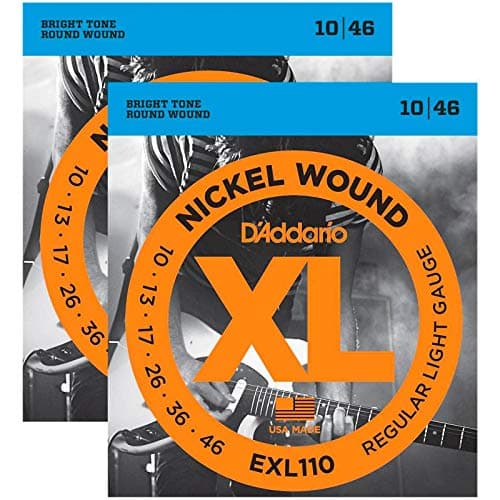
Regular light 10-46 nickel-wound, which is the gauge nearly every electric guitar leaves the factory with and the one every setup assumes.
Published specifications
- Gauge:
- 10-46, regular light
- Core:
- High carbon steel hex core
- Wrap:
- Nickel-plated steel
- Fits:
- Electric guitar, standard tuning
What it gets right
- The gauge most electrics ship with, so changing to these keeps the existing setup correct with no truss rod adjustment
- Nickel-plated steel is bright without being harsh, and it suits every style a beginner will try
- Cheap enough to keep a spare set in the case, which every guitarist should
Where it gives ground
- Nickel-wound strings dull faster than coated sets, so they need changing more often
- 10-46 is a compromise gauge: heavier players may want more tension, benders may want less
What it is not good at
Drop tunings. Tuned down, a 10-46 set goes slack and buzzes. Anyone tuning below standard should move to a heavier gauge and expect a setup afterward.
How the specs score against a beginner’s needs
Scores are our reading of the published specifications above against what a beginner physically needs. They are not test results — we have not played this instrument.
Specifications from D'Addario — EXL110 XL Nickel Wound.
Fender CD-60S
FenderBest for: Easiest acoustic to fret
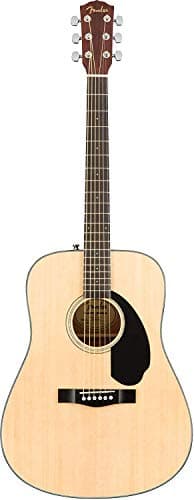
Solid spruce top, mahogany back and sides, and rolled fingerboard edges on a slightly shorter 25.3 inch scale. The rolled edges are the reason to pick this one.
Published specifications
- Top:
- Solid spruce
- Back / sides:
- Mahogany
- Scale length:
- 25.3" (643 mm)
- Nut width:
- 1.69" (43 mm)
- Fingerboard:
- 12" radius, 20 frets, rolled edges
- Bracing:
- Quartersawn scalloped "X"
- Neck:
- Fender "Easy-to-Play" shape
What it gets right
- Rolled fingerboard edges remove the sharp edge that makes a new player's hand hurt after twenty minutes
- Solid spruce top at the same tier as the FG800, with mahogany rather than nato back and sides
- The 25.3 inch scale is slightly shorter than most dreadnoughts — marginally lower string tension
Where it gives ground
- Still a full dreadnought body, so the size objection is the same as the FG800's
- The 12 inch fingerboard radius is quite round compared with the FG800's flatter 400 mm
What it is not good at
Being obviously better than the FG800. These two are genuinely close, they trade blows on back-and-sides wood versus bracing, and anyone telling you one is clearly superior has not looked at the spec sheets.
How the specs score against a beginner’s needs
Scores are our reading of the published specifications above against what a beginner physically needs. They are not test results — we have not played this instrument.
Specifications from Fender — CD-60S Dreadnought.
Kala KA-15S
Kala Brand MusicBest for: The honest floor, soprano
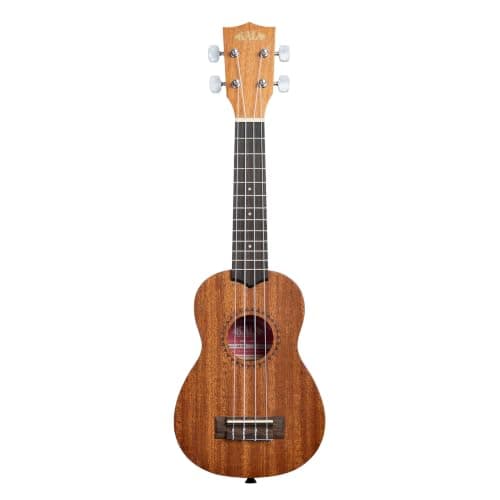
Mahogany throughout, a GraphTech NuBone nut and saddle, and Aquila strings fitted from the factory. The nut material is the spec that separates this from the pile of look-alikes.
Published specifications
- Size:
- Soprano
- Top / back / sides:
- Mahogany
- Neck / fretboard:
- Mahogany neck, rosewood fretboard
- Nut and saddle:
- GraphTech NuBone
- Scale length:
- 13.625"
- Frets:
- 12
- Nut width:
- 1.375"
- Overall length:
- 21.062"
- Strings:
- Aquila Super Nylgut
What it gets right
- NuBone nut and saddle rather than molded plastic — this is what decides whether the instrument plays in tune up the neck
- Aquila strings fitted at the factory, so the first thing you would otherwise replace is already done
- 21 inches overall and light enough for a small child to hold unsupported
Where it gives ground
- 12 frets only, and the body joint stops you well short of the high notes
- Soprano scale means less room between frets — adult fingers with wide fingertips will find it cramped
What it is not good at
Adult hands, sometimes. A 13.625 inch scale is genuinely tight. If the player is a grown-up with large hands, read our soprano-versus-concert comparison before buying this size.
How the specs score against a beginner’s needs
Scores are our reading of the published specifications above against what a beginner physically needs. They are not test results — we have not played this instrument.
Specifications from Kala Brand Music — KA-15S specifications.
Questions people actually ask
How long until guitar stops hurting your fingers?
Fingertip soreness typically settles within two to four weeks of regular short practice, as calluses form. Practicing a little most days builds them faster and less painfully than one long session a week.
Is it normal for guitar to hurt your hand and wrist?
No. Fingertip soreness is normal; aching in the palm, thumb, wrist or forearm is not. That pattern points at technique, at the instrument’s setup, or at practicing for too long in one sitting, and it should be investigated rather than pushed through.
Do lighter strings make guitar easier?
Meaningfully, yes. A lighter gauge sits at lower tension and takes less force to press. It is one of the cheapest ways to reduce effort, though it is a smaller lever than fixing a high action.
Should I push through the pain?
Through fingertip tenderness, within reason — short daily sessions beat long painful ones. Never through joint or wrist pain. That is a signal to stop, change something, and get the guitar looked at.
Sources
Still deciding?
Every recommendation on this site is built the same way, and the method is published in full — including what we do not do and what would get a pick dropped.
Read next
- Guitar maintenance a beginner actually needs
The four jobs that matter, the humidity problem that ruins acoustics, and an honest list of what you can safely ignore.
- Best beginner guitar strings
Why gauge outranks brand, the default set for electric and acoustic, and when going lighter actually helps.
- Are cheap guitars worth it?
The line between cheap and too cheap, named part by part, with what each failure does to a beginner who cannot diagnose it.
- How long does it take to learn guitar?
Milestones by practice hours rather than months, what gates each phase, and why the first three weeks matter most.
- Ukulele vs guitar for beginners
Why the ukulele is genuinely easier, exactly which skills transfer to guitar, and when the stepping-stone plan is a detour.