Guitars
What a guitar setup actually is
Every guitar leaves the factory adjusted to a tolerance rather than to a player. Closing that gap costs less than a set of strings plus an hour.
By Sawyer V. · Published · Last updated

We recommend a setup on nearly every page of this site and have never explained what one is. This page fixes that.
A setup is not a repair and nothing is broken. It is the adjustment of four things that are all designed to be adjustable, to suit one specific instrument in one specific climate with one specific set of strings.
A setup adjusts neck relief, string height at the saddle, string height at the nut, and intonation. It is the single largest improvement available to a budget guitar, it costs roughly what a couple of sets of strings do, and it should be done once a year.
The four adjustments
1. Neck relief. A guitar neck is not flat. Under string tension it bows forward very slightly, and that tiny curve gives the strings room to vibrate without hitting the middle frets. Too much and the action is high everywhere; too little and the strings buzz. It is controlled by a truss rod, a steel bar inside the neck adjusted with a hex key.
2. Action at the saddle. The overall string height, set at the bridge end. On an electric this is usually individual screws per string. On an acoustic it means sanding the underside of the saddle, which is not reversible — a good reason to let someone experienced do it.
3. Nut slot height. The most overlooked and, on cheap guitars, the most important. Factory nuts are cut deliberately high so the instrument does not buzz on the way out of the door. That makes the first three frets much harder to press than they should be — which is precisely where a beginner spends every minute of their first six months.
4. Intonation. Adjusting the effective length of each string so the guitar plays in tune with itself up the neck. Without it, a guitar tunes perfectly on open strings and is noticeably sharp by the twelfth fret.
Why the nut matters more than anything else for a beginner
If a guitar is much harder to play at the first three frets than at the seventh, the nut slots are cut too high. That is extremely common on inexpensive instruments and it is responsible for a great deal of quiet quitting.
Open chords all live in that first-three-fret region. A beginner fighting high nut slots concludes that their fingers are weak, that barre chords are impossible, and that guitar hurts — when the actual cause is a few tenths of a millimeter of bone. Filing the slots down is a quick job with the right files and an irreversible one with the wrong approach.
This is also why we say a well set-up cheap guitar beats a badly set-up expensive one. The relationship between price and playability is in are cheap guitars worth it, and the pain side of it is in why the guitar hurts your fingers.
When to get one
When the guitar is new. Including a brand-new one. Especially a brand-new inexpensive one.
Once a year afterwards. Wood moves with the seasons, and a neck that was right in July is often not in January.
When you change string gauge. Different gauges pull with different force, which changes neck relief and sometimes intonation. If you move from D'Addario EXL110 (10-46)#ad to a heavier set, the guitar needs readjusting to suit.
When something changes. New buzzing, a sudden change in action, or notes going out of tune with themselves. On an acoustic, a dropping action with new buzzing is frequently a humidity problem rather than a setup problem, and that distinction is in guitar maintenance.
What it costs and what to ask for
A standard setup is one of the cheapest services in music retail — broadly comparable to two or three sets of strings, more for an acoustic where the saddle work is slower. Many shops include one when you buy an instrument from them, which is a genuine reason to buy from a shop rather than a box.
Tell the technician three things: what you play, what string gauge you want, and that you want the action as low as it will go without buzzing. That last phrase is the useful one. A beginner benefits from low action far more than from the slightly fuller tone a higher action gives.
Bring the strings you want fitted. A setup is measured against a specific set, so having D'Addario EJ16 (12-53)#ad fitted and then swapping to something heavier undoes part of the work.
What you can do yourself
Safely: change strings, clean the fretboard, adjust electric bridge saddle heights, check intonation with a Snark clip-on chromatic tuner#ad by comparing the open string against the twelfth-fret harmonic and the fretted twelfth-fret note. String changing is covered in how to change guitar strings.
Carefully, after reading properly: truss rod adjustment. Small movements, a quarter turn at a time, and leave it to settle. Over-tightening a truss rod damages necks.
Leave alone: nut slot filing and acoustic saddle sanding. Both remove material permanently, both need specific tools, and both are cheap to have done properly.
What we would buy
D'Addario EXL110 (10-46)
D'AddarioBest for: Electric, the default gauge
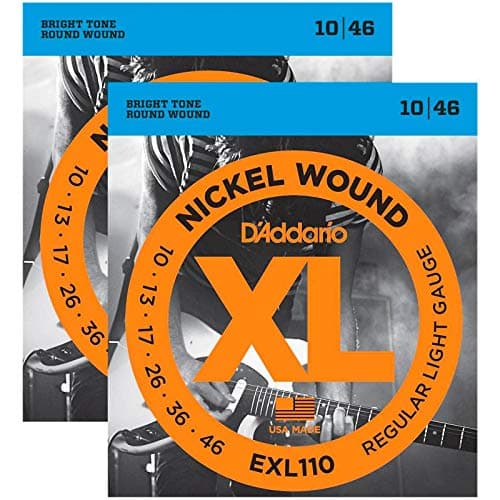
Regular light 10-46 nickel-wound, which is the gauge nearly every electric guitar leaves the factory with and the one every setup assumes.
Published specifications
- Gauge:
- 10-46, regular light
- Core:
- High carbon steel hex core
- Wrap:
- Nickel-plated steel
- Fits:
- Electric guitar, standard tuning
What it gets right
- The gauge most electrics ship with, so changing to these keeps the existing setup correct with no truss rod adjustment
- Nickel-plated steel is bright without being harsh, and it suits every style a beginner will try
- Cheap enough to keep a spare set in the case, which every guitarist should
Where it gives ground
- Nickel-wound strings dull faster than coated sets, so they need changing more often
- 10-46 is a compromise gauge: heavier players may want more tension, benders may want less
What it is not good at
Drop tunings. Tuned down, a 10-46 set goes slack and buzzes. Anyone tuning below standard should move to a heavier gauge and expect a setup afterward.
How the specs score against a beginner’s needs
Scores are our reading of the published specifications above against what a beginner physically needs. They are not test results — we have not played this instrument.
Specifications from D'Addario — EXL110 XL Nickel Wound.
D'Addario EJ16 (12-53)
D'AddarioBest for: Acoustic, the default gauge
Light-gauge phosphor bronze at 12-53, the acoustic equivalent of the EXL110: the gauge most steel-string acoustics ship with and the one they are set up for.
Published specifications
- Gauge:
- 12-53, light
- Wrap:
- Phosphor bronze
- Fits:
- Steel-string acoustic guitar
What it gets right
- Phosphor bronze is warmer and lasts longer than plain 80/20 bronze, which is the other common acoustic wrap
- 12-53 matches what most acoustics leave the factory with, so no setup change is needed
- Widely stocked, so a broken string on a Sunday is solvable
Where it gives ground
- Light gauge on a dreadnought gives up some volume against a medium set
- Uncoated, so they dull faster than a coated string in humid hands
What it is not good at
A classical or nylon-string guitar. Steel strings on an instrument built for nylon will damage it — check what your guitar takes before buying any set.
How the specs score against a beginner’s needs
Scores are our reading of the published specifications above against what a beginner physically needs. They are not test results — we have not played this instrument.
Specifications from D'Addario — EJ16 Phosphor Bronze acoustic strings.
Snark clip-on chromatic tuner
SnarkBest for: Tuning anything with strings
Clips to the headstock and reads pitch from the vibration of the wood, so it works in a noisy room and an adult who plays nothing can tune the instrument in twenty seconds.
Published specifications
- Type:
- Clip-on chromatic
- Sensing:
- Vibration through the headstock, not the microphone
- Fits:
- Guitar, bass, ukulele, violin, mandolin
- Display:
- Full-color rotating screen
What it gets right
- Vibration sensing means it works in a room with a television on, which a microphone tuner does not
- Chromatic, so one tuner covers every instrument in the house
- The rotating display means it reads correctly whichever way the instrument is held
Where it gives ground
- The clip is plastic and it is the part that eventually breaks
- Battery-powered, and it will be flat the one time you need it in a hurry
What it is not good at
Wind and brass instruments. It reads vibration through a solid body, so there is nothing for it to clip to on a flute or a trumpet.
How the specs score against a beginner’s needs
Scores are our reading of the published specifications above against what a beginner physically needs. They are not test results — we have not played this instrument.
Specifications from Snark tuners (retail listing with published feature set).
Questions people actually ask
Does a new guitar need a setup?
Usually, and inexpensive ones almost always. Factory setups are done to a production tolerance rather than to a player, and the instrument has since travelled and sat in a warehouse at a different humidity.
How often should a guitar be set up?
About once a year for most players, ideally at a seasonal change when the neck has moved most. More often if you change string gauge or if the guitar develops buzzing it did not have.
Can I set up my own guitar?
Partly. String height at the bridge on an electric and basic intonation are learnable. Nut slot filing and truss rod adjustment are the two jobs where a mistake is expensive, and both are best left to a technician the first few times.
Is a setup worth it on a cheap guitar?
It is worth it most on a cheap guitar. A well set-up inexpensive instrument is easier to play than a badly set-up expensive one, and the improvement is larger in proportion to what the guitar cost.
Sources
Still deciding?
Every recommendation on this site is built the same way, and the method is published in full — including what we do not do and what would get a pick dropped.
Read next
- Guitar maintenance a beginner actually needs
The four jobs that matter, the humidity problem that ruins acoustics, and an honest list of what you can safely ignore.
- Why the guitar hurts your fingers
Normal callus pain versus a badly set-up guitar, the four adjustments that reduce effort, and when to stop rather than push through.
- Are cheap guitars worth it?
The line between cheap and too cheap, named part by part, with what each failure does to a beginner who cannot diagnose it.
- How to change guitar strings
The full sequence for electric and acoustic, the three common mistakes, and why new strings drift for a day.
- Should a first instrument be used or new?
Where secondhand is the best value on the site and where it hides expensive faults, plus a check-before-you-pay list per family.