Start Here
Best music theory books for beginners
Forty pages you finish beats three hundred you read half of. The decision here is format, not content.
By Sawyer V. · Published · Last updated
Music theory books get bought with good intentions and finished by almost nobody, and the usual reason is a format mistake rather than a content one. The buyer picks the thickest book because it looks like the best value, reads forty pages of prose, and never writes an exercise — which means none of it stays.
Every pick below states its Starter Path band, and we have not worked through any of them cover to cover — the method is on how we pick. Page counts, contents and formats come from Alfred Music’s and Wiley’s own catalog entries, cited at the bottom.
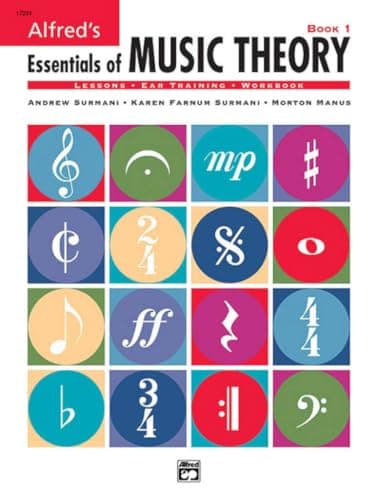
Buy Alfred’s Essentials of Music Theory, Book 1: 40 pages, lessons 1 to 25, exercises and a unit review. It is instrument-neutral and it is short enough to finish, which is the only property that matters in a theory book. Buy the Complete spiral edition instead if you already know you will keep going — it is Books 1 to 3 in 120 pages and costs less than the three separately.
The format decides whether you finish it
Theory books come in two shapes and they are not interchangeable.
A workbook teaches a small idea, then asks you to do it. Write out these note values. Identify these intervals. Mark the beats in these bars. It is tedious and it is the format that works, because theory is procedural knowledge and procedural knowledge comes from procedure.
A prose book explains. It tells you what an interval is, why a dominant chord resolves, how a key signature is constructed. It is far more interesting to read and it produces a satisfying feeling of understanding that fades within a fortnight if nothing is ever written down.
Alfred’s Essentials is a workbook. Music Theory For Dummies is a prose book. Both are good at what they are, and the mistake is buying the second expecting the first.
Why forty pages beats three hundred
Alfred’s Essentials of Music Theory, Book 1#ad covers lessons 1 to 25 in 40 pages. Alfred publishes the full list: the staff, notes and pitches, treble and bass clefs, the grand staff and ledger lines, note values, bar lines, 2/4, 3/4 and 4/4 time, whole, half and quarter notes and rests, dotted notes, ties and slurs, repeat signs and endings, eighth notes and rests, dynamics, tempo marks and articulation, D.C., D.S., coda and fine, flats, sharps and naturals, and whole and half steps.
That is, honestly, most of what a beginner instrumentalist needs in their first two years. It stops short of key signatures, scales, intervals and chords, which is a real limitation and also past where most people’s theory ambition actually goes.
The forty pages are the feature. A book you finish gives you a complete, usable foundation and the feeling of having completed something, which is what makes a second book likely. A 336-page book abandoned at page sixty gives you a vague sense of intervals and a small sense of failure.
When to buy the Complete edition instead
Alfred’s Essentials of Music Theory: Complete#ad is Books 1, 2 and 3 spiral-bound into 120 pages, and it costs less than the three volumes bought separately. It carries on where Book 1 stops: key signatures, scales, intervals, chords and basic harmony — the material that makes theory useful to a songwriter or anyone playing from chord charts.
Buy it over Book 1 if one of two things is true. Either you already know you want the whole arc — an adult who has decided to learn this properly — or the book is for more than one person and the extra material will get used eventually.
The spiral binding is a genuine practical advantage over Book 1’s stapled format: it lies flat beside an instrument while you write in it. It is also a write-in book, which means it is a one-student copy either way.
The prose option, and what it is actually for
Music Theory For Dummies, 4th Edition#ad is Michael Pilhofer and Holly Day, 336 pages, published July 2019. Wiley lists its coverage as major and minor scales, intervals, pitches and clefs; notation, time signatures, tempo, dynamics and navigation; and then melody, harmony, chord progressions and composition.
That last clause is why it is here. Composition and chord progressions are not in the Alfred workbooks at all, and they are the reason most self-taught adults go looking for theory in the first place — not to pass an exam, but to understand why the four chords in a song they like keep working.
Read it alongside a workbook, not instead of one. On its own it produces the specific and common outcome of someone who can explain what a secondary dominant is and cannot find one on their instrument.
The CD edition, and why it is the overspend pick
Alfred also sells Essentials of Music Theory: Complete with two ear-training CDs#ad, for roughly double the price of the identical book.
The ear training itself is the most defensible upsell on this page. Recognising an interval by ear is the one theory skill a printed book cannot teach, and it is arguably the most useful one for an actual musician. So this is not a case of a manufacturer charging for nothing.
It is a case of a delivery format that has aged out. Two compact discs require an optical drive, which no phone, tablet or laptop sold in the last decade has. If there is a CD player in the house, this edition is reasonable value. If there is not, you are paying double for the same book plus two coasters, and the honest move is to buy the book alone.
What we did not list, and why
Tonal Harmony, Harmony and Voice Leading, and the other college texts are the books a music degree uses. They are excellent and they assume a reading musician with a keyboard and a teacher. Recommending one to a beginner is the same error as recommending a medical textbook to someone with a cold.
Instrument-specific theory books — music theory for guitarists, for pianists, for bassists — were left off deliberately. What they add over a general book is diagrams showing where the theory lives on that instrument, which is genuinely useful and is not theory. A general workbook plus the instrument’s own method book covers the same ground for less.
Pocket theory references are cheap, comprehensive and almost never opened. A reference answers a question you already know how to ask, and a beginner does not yet know the questions. Buy one in year two.
Free online theory courses are a real competitor and several are excellent. The reason a book still wins for most people is that it has a fixed order and a visible end, so you can see how far through you are. That is most of what makes a beginner finish anything.
How much theory you actually need
Less than the books imply, and the honest version is worth saying on a page trying to sell you one.
A beginner guitarist, ukulele player or drummer can go a long way on none at all. A beginner pianist or string player needs reading, which is theory in the narrowest sense and is taught inside their method book anyway — our piano books, guitar books and violin books roundups all cover methods that teach notation as they go.
Where theory starts genuinely paying is the point someone wants to play with other people, because that is when charts, keys and transposition arrive all at once. Fifteen minutes a week from the beginning gets you there painlessly. Two months of theory before the first lesson gets you a person who has not played anything yet and has started to suspect this is not for them.
Quick picks
The one most people should buy
40 pages, lessons 1 to 25, exercises and a review at the end of each unit. It covers the staff through to sharps and flats, and it is short enough that a real person finishes it.
| # | Product | Best for | Score | Price |
|---|---|---|---|---|
| 1 | Alfred's Essentials of Music Theory, Book 140 pages covering lessons 1 to 25: the staff, clefs, note values, time signatures, ties and slurs, repeats, dynamics, and sharps and flats. | The first 25 lessons, cheaplyThe honest floor | 8.0 | $9.99 · View on Amazon #ad How we’re funded |
If you know you will keep going
Books 1, 2 and 3 spiral-bound into 120 pages, carrying on through key signatures, scales, intervals and chords. Cheaper than the three volumes separately, and three times the work.
| # | Product | Best for | Score | Price |
|---|---|---|---|---|
| 1 |  Alfred's Essentials of Music Theory, CompleteBooks 1, 2 and 3 spiral-bound into 120 pages. | The whole course, bought onceEnough | 8.4 | $16.19 · View on Amazon #ad How we’re funded |
If you would rather understand than drill
336 pages of prose from scales and intervals through to harmony, chord progressions and composition. The right shape for an adult, and it will not make the knowledge stick on its own.
| # | Product | Best for | Score | Price |
|---|---|---|---|---|
| 1 |  Music Theory For Dummies, 4th Edition336 pages of prose covering scales, intervals, pitches, clefs, notation, time signatures, tempo, dynamics, melody, harmony, chord progressions and composition. | Reading about theory rather than drilling itEnough | 7.4 | $12.15 · View on Amazon #ad How we’re funded |
Where overspending starts
The identical 120-page course plus two ear-training CDs, for roughly double. The ear training is the part a book genuinely cannot do; the delivery medium is a disc.
| # | Product | Best for | Score | Price |
|---|---|---|---|---|
| 1 |  Alfred's Essentials of Music Theory: Complete, Book & 2 CDsThe identical 120-page spiral-bound course, plus the two ear-training CDs, for roughly double the price of the book alone. | Where overspending startsWhere overspending starts | 7.0 | $37.40 · View on Amazon #ad How we’re funded |
The picks in full
Alfred's Essentials of Music Theory, Book 1
Alfred MusicBest for: The first 25 lessons, cheaply
40 pages covering lessons 1 to 25: the staff, clefs, note values, time signatures, ties and slurs, repeats, dynamics, and sharps and flats. It is a workbook with exercises and a review at the end of each unit, which is what makes theory stick.
Published specifications
- Authors:
- Andrew Surmani, Karen Farnum Surmani and Morton Manus
- Pages:
- 40
- Lessons:
- 1 to 25
- Covers:
- Staff, notes and pitches; treble and bass clefs; grand staff and ledger lines; note values; 2/4, 3/4 and 4/4; whole, half and quarter notes and rests; dotted notes; ties and slurs; repeats and endings; eighth notes; dynamics, tempo and articulation; D.C., D.S., coda and fine; flats, sharps and naturals; whole and half steps
- Format:
- Workbook with exercises and an end-of-unit review
- ISBN:
- 978-0-88284-894-5
What it gets right
- Forty pages is a quantity a real person finishes, which no 300-page theory reference can claim
- Exercises and unit reviews rather than explanation alone - theory is a doing subject and this is built that way
- Instrument-neutral, so it serves a guitarist, a drummer and a pianist equally
- The cheapest book on this page, and genuinely complete for what it covers
Where it gives ground
- Stops at sharps, flats and half steps - no key signatures, scales, intervals or chords
- The ear-training CDs it refers to are sold separately
- No answer key included; Alfred sells the teacher's answer key as its own item
- Workbook format means writing in it, so it cannot be passed to a second child
What it is not good at
Getting anyone to chords. It ends well before key signatures and intervals, which is where theory starts being useful to a guitarist or songwriter. Book 1 is a third of the course, priced accordingly.
How the specs score against a beginner’s needs
Scores are our reading of the published specifications above against what a beginner physically needs. They are not test results — we have not played this instrument.
Specifications from Alfred Music — Alfred's Essentials of Music Theory, Book 1 (item 00-17231): Surmani, Surmani and Manus, 40 pages, Lessons 1-25 contents, ISBN 978-0-88284-894-5.
Alfred's Essentials of Music Theory, Complete
Alfred MusicBest for: The whole course, bought once
Books 1, 2 and 3 spiral-bound into 120 pages. It runs from the staff all the way through key signatures, scales, intervals, chords and basic harmony, and buying the three volumes separately costs more than this does.
Published specifications
- Authors:
- Andrew Surmani, Karen Farnum Surmani and Morton Manus
- Pages:
- 120 (Books 1, 2 and 3)
- Binding:
- Spiral bound
- Lessons:
- Books 1-3 of the Essentials of Music Theory course
- Format:
- Lessons, exercises, ear-training references and unit reviews
- ISBN:
- 978-0-88284-897-6
What it gets right
- Spiral binding, so it lies flat beside an instrument while you write in it
- Covers the whole beginner arc including key signatures, intervals and chords - the part Book 1 stops short of
- Cheaper than buying Books 1, 2 and 3 as separate volumes
- Still instrument-neutral, so one copy serves a whole household
Where it gives ground
- 120 pages is enough to defeat someone who would have finished the 40-page Book 1
- The ear-training CDs it is written around are a separate purchase
- No answer key, which matters more here because the later material is harder to self-check
- Written in, so it is a one-student book
What it is not good at
Being read. It is a workbook: someone has to do the exercises for it to have any effect, and the complete edition is three times as much work as Book 1 for the same amount of willpower.
How the specs score against a beginner’s needs
Scores are our reading of the published specifications above against what a beginner physically needs. They are not test results — we have not played this instrument.
Specifications from Alfred Music — Alfred's Essentials of Music Theory: Complete: Book (item 00-17234): Surmani, Surmani and Manus, 120 pages, spiral bound, Books 1-3, ISBN 978-0-88284-897-6.
Music Theory For Dummies, 4th Edition
WileyBest for: Reading about theory rather than drilling it
336 pages of prose covering scales, intervals, pitches, clefs, notation, time signatures, tempo, dynamics, melody, harmony, chord progressions and composition. It explains rather than drills, which is the right shape for an adult who wants to understand why the chords in a song work.
Published specifications
- Authors:
- Michael Pilhofer and Holly Day
- Pages:
- 336
- Published:
- July 2019 (4th edition)
- Covers:
- Major and minor scales, intervals, pitches and clefs; notation, time signatures, tempo, dynamics and navigation; melody, harmony, chord progressions and composition
- Format:
- Prose explanation with worked examples, not a workbook
- ISBN:
- 978-1-119-57552-8
What it gets right
- Explains the reasoning, which a workbook deliberately does not; an adult who wants to know why a V chord pulls home gets an answer here
- Reaches chord progressions and composition, well past where the Alfred Book 1 stops
- Readable in bed, on a train, or anywhere a workbook and a pencil are not available
- Covers composition, which is the reason most self-taught musicians go looking for theory in the first place
Where it gives ground
- No exercises to speak of, and theory that is only read does not stay
- 336 pages of prose is a lot of reading before any of it is applied
- Wiley's product page does not state that audio examples are included, so assume there are none
- A child will not get through it
What it is not good at
Making the knowledge stick. Reading about intervals is not the same as writing fifty of them, and this book asks you to do the first thing only. It pairs well with a workbook and badly with nothing.
How the specs score against a beginner’s needs
Scores are our reading of the published specifications above against what a beginner physically needs. They are not test results — we have not played this instrument.
Specifications from Wiley — Music Theory For Dummies, 4th Edition: Michael Pilhofer and Holly Day, 336 pages, July 2019, ISBN 978-1-119-57552-8, published contents.
Alfred's Essentials of Music Theory: Complete, Book & 2 CDs
Alfred MusicBest for: Where overspending starts
The identical 120-page spiral-bound course, plus the two ear-training CDs, for roughly double the price of the book alone. The ear-training material is real and useful; the delivery medium is two compact discs, in a year when most buyers own no way to play one.
Published specifications
- Book contents:
- Identical to Alfred's Essentials of Music Theory: Complete - Books 1-3, 120 pages, spiral bound
- Added:
- Two ear-training CDs
- Authors:
- Andrew Surmani, Karen Farnum Surmani and Morton Manus
- Format:
- Book and two compact discs
What it gets right
- Ear training is the part of theory that a book genuinely cannot deliver, and this is the official material for it
- Bundled is cheaper than buying the book and the ear-training CDs as separate Alfred items
- Nothing about the book is reduced to make room for the discs - it is the same complete edition
- Alfred also sells software versions, so the ear-training content is not locked to the discs forever
Where it gives ground
- Roughly double the price of the identical book, for content on a format most households cannot play
- A phone or laptop bought in the last ten years has no optical drive
- The theory content - the part that teaches - is word for word the same book
- Ripping two CDs to use the material is a step most buyers will not take
What it is not good at
Being worth the difference in 2026. If the ear training matters, it matters enough to check first that there is something in the house that reads a CD. If there is not, buy the book alone and spend the difference elsewhere.
How the specs score against a beginner’s needs
Scores are our reading of the published specifications above against what a beginner physically needs. They are not test results — we have not played this instrument.
Specifications from Alfred Music — Alfred's Essentials of Music Theory: Complete: Book (item 00-17234), which lists the Book & 2 CDs edition as a related item at a higher price; book contents identical.
Questions people actually ask
What is the best music theory book for a beginner?
Alfred’s Essentials of Music Theory, Book 1#ad. Forty pages, lessons 1 to 25, with exercises and a review closing each unit. It is instrument-neutral, it is the cheapest book here, and its best feature is its length — a forty-page workbook is a thing people finish, and a finished forty pages teaches more than an unfinished three hundred.
Workbook or a book you read?
Workbook, for almost everybody. Theory is a doing subject: you learn intervals by writing fifty of them, not by reading what an interval is. A prose book like Music Theory For Dummies#ad is genuinely better at explaining why, which suits an adult, and it is a companion to a workbook rather than a replacement for one.
Do I need theory to learn an instrument?
No, and plenty of good musicians have very little. What theory buys you is speed: understanding why a chord progression works means learning the next song faster rather than memorising it from scratch. It also makes you useful in a group, because you can follow a chart and transpose on request. Our page on instruments if you cannot read music covers the other side of that argument.
Should I buy an instrument-specific theory book?
Usually not. Intervals, keys, rhythm notation and chord construction are identical whatever you play, and a general workbook is cheaper, better organized and serves a whole household rather than one player. Guitar-specific theory books mostly add fretboard diagrams, which are useful and are not theory.
Are the ear-training CDs worth it?
The ear training is worth it; the CDs are the problem. Ear training is the one part of theory a book genuinely cannot deliver, and Alfred’s material for it is good. It is delivered on two compact discs for roughly double the price of the identical book, in a year when most households own nothing that reads one. Check before you buy, and if there is no drive in the house, buy the book alone.
How long should a beginner spend on theory?
Fifteen minutes a week, alongside playing, is a better plan than a theory phase. The commonest failure here is treating theory as a prerequisite and spending two months on it before touching the instrument, which is both unnecessary and the fastest route to quitting — something we cover on how to stop a beginner quitting.
Sources
- Alfred Music — Alfred's Essentials of Music Theory, Book 1 (item 00-17231): authors, 40 pages, full Lessons 1-25 contents, ISBN
- Alfred Music — Alfred's Essentials of Music Theory: Complete: Book (item 00-17234): authors, 120 pages, spiral bound, Books 1-3, ISBN, and the Book & 2 CDs edition listed as a related item
- Wiley — Music Theory For Dummies, 4th Edition: Michael Pilhofer and Holly Day, 336 pages, July 2019, published contents, ISBN
Still deciding?
Every recommendation on this site is built the same way, and the method is published in full — including what we do not do and what would get a pick dropped.
Read next
- Best instruments if you cannot read music
Which instruments have a real alternative to notation, which do not, and three picks for learning without the dots.
- Lessons or teaching yourself?
Which instruments are self-teachable and which are not, what a teacher actually provides, and the hybrid most adults should use.
- Best guitar books for beginners
The one decision that matters (chords first or reading first), five things to check on any method book, and seven picks with their weaknesses stated.
- Best piano books for beginners
Adult or child, teacher or alone: the two questions that pick the book, plus four current methods with their weaknesses stated.
- Best violin books for beginners
Essential Elements teaches reading from page one; Suzuki deliberately does not. Which suits which child, the book that fills the gap Suzuki leaves, and what no violin book can do.
- Why beginners quit, and what prevents it
The three points where beginners stop, what causes each, and the interventions that work at each stage.