Guitars
How long does it take to learn guitar?
Measured in practice hours rather than months, because that is the variable people actually control. Here is what happens and when.
By Sawyer V. · Published · Last updated

Every answer to this question is either useless (“it depends”) or a lie (“play like a pro in 30 days”). Here is a more honest framing: measure in practice hours rather than calendar months, because hours are the thing anyone actually controls.
Roughly: 10 to 20 hours to your first recognizable song, 50 to 100 hours to play several songs comfortably and change chords without stopping, and 200 to 400 hours to feel like a guitarist rather than someone learning guitar. At twenty minutes a day that is about three weeks, four months and one to two years respectively.
The milestones
| Practice hours | At 20 min/day | What you can do | What is gating you |
|---|---|---|---|
| 0–10 | Weeks 1–3 | Single notes, one or two chords, badly | Fingertip pain and hand strength |
| 10–20 | Month 1–2 | A recognizable song with simple chords | Chord changes, not the chords themselves |
| 50–100 | Months 4–9 | Several songs, smooth changes, basic strumming patterns | Barre chords and rhythm independence |
| 200–400 | Years 1–2 | Play with others, learn a new song without help | Ear, vocabulary, repertoire |
| 1,000+ | Years 4–8 | Improvise, play in most styles, teach a beginner | Nothing mechanical — it is musical now |
The first three weeks decide everything
Nearly everyone who quits guitar quits inside the first month, and almost never because they lacked talent. Three things happen at once in those weeks and all three are temporary.
Fingertips hurt. The skin has not built calluses. It takes two to four weeks of regular playing, and daily short practice builds them faster than occasional long sessions, which let them soften in between.
Chord changes are impossibly slow. The individual shapes come within days; moving between them is a separate skill that takes weeks. Beginners consistently mistake this for failing at chords.
Nothing sounds like music yet. This is the real killer. A beginner hears themselves and hears failure, when what they are actually hearing is the normal sound of week two.
If the guitar is also fighting them — slipping tuners, high action, sharp fret ends — those three normal difficulties become indistinguishable from being bad at it. That is exactly why the floor matters, and why a well-set-up Squier Sonic Stratocaster#ad or Yamaha FG800#ad is a better bet than something cheaper.
What actually speeds it up
Daily short practice. Fifteen minutes every day beats two hours on a Sunday, reliably. Physical skills consolidate between sessions, and infrequent practice loses that consolidation. Adults default to the long-session model because it feels like proper effort; it is the less effective one.
Learning songs, not just exercises. Motivation is a resource and songs replenish it. Exercises alone drain it. It is also the biggest difference between beginner method books, which we compare in best guitar books for beginners.
A few lessons at the start. The highest-return spending in this entire category. A teacher catches the wrist angle and thumb position you cannot see, before either becomes a habit that takes a year to unpick.
Leaving the guitar out on a stand. Not a joke. An instrument within arm’s reach gets picked up several times a day for two minutes at a time, and that is what practice actually looks like for most people. The options, including wall hangers for households where a floor stand is a hazard, are in best guitar stands.
What does not speed it up
A more expensive guitar, past the floor. Above the point where the instrument stays in tune and plays cleanly, more money buys refinements a beginner cannot use yet.
More gear generally. Pedals, new picks, another guitar. This is shopping, and it feels like progress while consuming the time that would have been progress.
Practicing what you can already do. Comfortable repetition feels productive and moves nothing. The uncomfortable bar is the one worth twenty minutes.
If you are still deciding whether guitar is the right instrument at all, our ranking by time to a first song puts these numbers in context against the alternatives.
What we would buy
Squier Sonic Stratocaster
Squier by FenderBest for: The honest floor, electric
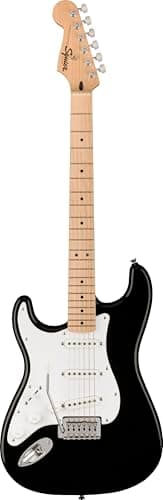
The cheapest electric that still has full-scale geometry, sealed tuners and a real 9.5 inch fingerboard radius. Nothing about it will make a beginner's first year harder.
Published specifications
- Scale length:
- 25.5" (647.7 mm) — full size
- Body / neck:
- Poplar body, maple neck, "C" profile
- Fingerboard:
- Maple or Indian laurel, 9.5" (241 mm) radius
- Frets:
- 21, narrow tall
- Nut width:
- 1.650" (42 mm), synthetic bone
- Pickups:
- Three ceramic single-coils (SSS)
- Bridge:
- 6-saddle vintage-style synchronized tremolo
What it gets right
- Full 25.5 inch scale, so nothing learned here has to be relearned later
- Synthetic bone nut rather than a soft plastic one — the part that decides whether a cheap guitar stays in tune
- Sealed-gear tuners, which is the single most important spec on a first electric
Where it gives ground
- Poplar body and ceramic pickups are exactly what you would expect at this tier
- The tremolo bridge will pull the guitar out of tune if a beginner uses it, and beginners always use it
What it is not good at
Staying in tune if you use the whammy bar. If that matters, buy the hardtail (HT) version of the same guitar instead — it is the identical instrument with the tremolo deleted.
How the specs score against a beginner’s needs
Scores are our reading of the published specifications above against what a beginner physically needs. They are not test results — we have not played this instrument.
Specifications from Squier Wiki — Sonic Stratocaster specifications.
Yamaha FG800
YamahaBest for: Buy once, acoustic
A solid Sitka spruce top with scalloped bracing at the entry price. Solid-versus-laminate is the one acoustic spec that changes what the instrument does over years, and this is the cheapest place to get it done right.
Published specifications
- Top:
- Solid Sitka spruce
- Back / sides:
- Nato / okume
- Neck / fingerboard:
- Nato neck, rosewood fingerboard, R400 mm (23-5/8") radius
- Scale length:
- 650 mm (25-9/16")
- Nut width:
- 43 mm (1-11/16")
- Bracing:
- Scalloped
- Body:
- Traditional Western (dreadnought), 412 mm (16-1/4") wide, 100-118 mm deep
- Hardware:
- Die-cast chrome tuners, urea nut and saddle
What it gets right
- A solid top, not a laminate — the only acoustic spec at this price that genuinely changes over time
- Scalloped bracing and die-cast tuners are specifications you normally pay considerably more for
- Yamaha's most-copied entry acoustic; parts, setups and advice are everywhere
Where it gives ground
- A full dreadnought body is a big box — 412 mm across and up to 118 mm deep
- Nato and okume back and sides are the cost saving; the top is where the money went
What it is not good at
Fitting a smaller player. The dreadnought body is wide and deep enough that a young teenager can struggle to get their arm over it comfortably. If that is the buyer, look at the JR1 or a concert-size body instead.
How the specs score against a beginner’s needs
Scores are our reading of the published specifications above against what a beginner physically needs. They are not test results — we have not played this instrument.
Specifications from Yamaha Europe — FG/FS800 series specifications.
Questions people actually ask
How long does it take to learn guitar as an adult?
Roughly the same as anyone else, and adults frequently move faster in the first year because they can practice deliberately rather than repetitively. Simple songs come within a couple of months of consistent practice; the variable is consistency, not age.
How long does it take to learn guitar by yourself?
Self-taught players reach the same early milestones on a similar timeline and tend to accumulate physical habits — wrist angle, thumb position, tension — that later limit them. A handful of lessons at the start is the cheapest correction available.
How much should I practice each day?
Fifteen to twenty minutes daily beats two hours on a Sunday, reliably. Physical skills consolidate between sessions, so frequency matters more than duration. Daily short practice is the single highest-leverage habit in learning any instrument.
Why do my fingertips hurt so much?
Because you have not built calluses yet. It takes roughly two to four weeks of regular playing, and it is temporary and universal. Playing a little every day builds them faster than long sessions with days off, which just lets them soften again.
Sources
Still deciding?
Every recommendation on this site is built the same way, and the method is published in full — including what we do not do and what would get a pick dropped.
Read next
- Best beginner guitars: one pick each for adults, teens and kids
Acoustic and electric in one place, segmented by player rather than price, with a single clear pick for each situation.
- Learning an instrument as an adult
What genuinely changes for an adult starter, which instruments suit it, and the three mistakes that end most attempts.
- Are cheap guitars worth it?
The line between cheap and too cheap, named part by part, with what each failure does to a beginner who cannot diagnose it.
- Acoustic vs electric guitar for beginners
The physical difference is real but small. The cost difference is larger than most people expect. Buy CTAs for both answers.
- The easiest instruments to learn
Ranked by time to a first real song, with the ceiling each one trades away, and a pick for the top three.
- Is guitar hard to learn?
Where the difficulty actually sits, the milestone that most people quit just before, and how much of it a setup removes.