Band & Orchestra
Woodwind or brass for a first band instrument?
One family gives you a sound and makes you learn the fingerings. The other gives you the fingerings and makes you earn the sound.
By Sawyer V. · Published · Last updated

A band room splits into two halves that operate on entirely different principles, and the division is not what the names suggest. A saxophone is made of brass and is a woodwind. A flute is made of metal and is a woodwind. The categories describe how the sound starts, not what the instrument is made of.
Woodwinds start the sound with a reed or with an airstream across an edge; brass starts it with the player’s buzzing lips. Reed woodwinds are the easiest to get a first note from and cost the most to run. Brass is cheap to run and demands weeks of lip development before it works.
Two ways to start a sound
Reed woodwinds — clarinet, saxophone, oboe, bassoon. A thin cane blade vibrates against a mouthpiece when air passes it. The reed does the fundamental work, so a beginner produces a sound quickly.
Flute is a woodwind with no reed. The player directs a narrow airstream across the edge of a hole, and the airstream splitting produces the sound. There is no mechanical helper, which makes flute the outlier — a woodwind with a brass-like starting difficulty. That comparison is in flute versus clarinet.
Brass — trumpet, trombone, horn, tuba. The lips buzz against a cup mouthpiece. The instrument is a resonating tube that amplifies and shapes that buzz.
Where the difficulty sits
This is the most useful distinction for a family choosing.
Woodwind puts the difficulty in the fingers. Once a sound is happening, the challenge is a large key mechanism and covering holes completely. On a clarinet a hole that is nine-tenths covered produces no note at all, which is unforgiving in a way a piano key is not. A Yamaha YCL-255#ad has a full key system to learn.
Brass puts the difficulty in the face. A trumpet has three valves, and each valve combination gives an entire harmonic series — several notes sharing one fingering, selected by the embouchure. So the fingering is simple and the playing is not, and the hard part is invisible from outside. A Yamaha YTR-2330#ad asks almost nothing of the fingers and a great deal of the lips.
Which matters because they fail differently. A woodwind student who is struggling can usually see the problem. A brass student who is struggling cannot.
If brass is the direction, the next question is which one — and the honest answer is narrower than the five instruments in the band room suggest. Our guide to the best brass instruments for beginners covers why only trumpet and trombone have a student model worth buying, and why the easiest brass instrument to get a sound out of is one you should rent instead.
Running costs
Reed woodwinds have a continuous reed budget. Reeds are consumables that chip, warp and lose response, and a student should keep several in rotation. This is also a hidden source of difficulty: a student on a dead reed finds everything harder and concludes they are getting worse. Detail in reeds explained.
Flute has no consumables at all beyond periodic servicing, which is a genuine and underrated advantage of the Yamaha YFL-222#ad and its equivalents.
Brass has valve oil and slide grease, both inexpensive and slow to use up.
Both families need periodic professional attention, and both benefit from a student routine — see how to clean a band instrument.
The used-instrument warning, which is family-specific
Woodwind seals with pads and corks, both consumables that degrade continuously rather than failing. A leaking instrument plays and makes the low notes disproportionately hard, and the student never reports it because nothing broke. A full repad can cost more than a student instrument did.
Brass has fewer consumables, and its problems are more visible: stuck valves, dents in the wrong place, seized slides. Still worth an inspection, and easier to assess.
So the secondhand advice differs by family. Neither should be bought used without someone competent looking at it — see used versus new.
Volume and practice at home
Brass is louder and carries further, particularly trumpet, whose bright high frequencies travel well through a building. Practice mutes exist and are cheap, and they change the resistance enough that they are not a complete substitute for open playing.
Woodwinds are moderate. A clarinet is quieter than a saxophone; a Yamaha YAS-280#ad projects strongly and sits lower in pitch, so it carries.
None of the band family has an electronic silent option the way keyboards and drums do, which is worth knowing before committing in an apartment.
Section sizes and where you sit
Woodwind sections are usually larger — clarinets especially, often split across several parts. More players means more places for a beginner to sit and be useful while they improve, and more competition for the top chairs.
Brass sections are smaller. Less competition, and considerably more exposure when you play, because there is nobody to hide behind.
Neither is better. A confident student often thrives on the exposure; a nervous one is frequently happier with company.
How to choose
Choose reed woodwind if early encouragement matters, if the student is small, or if they want a sound in the first week.
Choose brass if the student is persistent, if running costs matter over several years, or if they want to be heard.
Choose flute only if the student is patient. It has woodwind fingering and brass-like starting difficulty, which is a specific combination.
And take the band director’s recommendation seriously. They are assessing hand size, arm reach, teeth and lip shape against what the ensemble actually needs, which is information you do not have — that argument is in choosing a school band instrument.
What we would buy
Yamaha YCL-255
YamahaBest for: Step-up clarinet, year two onward
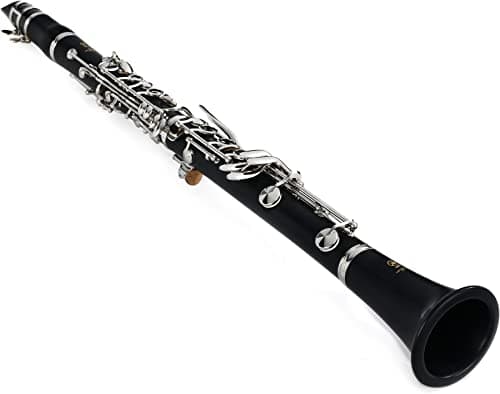
ABS resin body with a 65 mm barrel taken from Yamaha's high-end clarinets, Valentino pads and a 4C mouthpiece. The default student clarinet in most band rooms.
Published specifications
- Body:
- ABS resin, matte wood-like finish
- System:
- Boehm, 17 keys and 6 rings
- Keywork:
- Power-forged, nickel-plated nickel silver
- Barrel:
- 65 mm — the length used on Yamaha's high-end clarinets
- Pads:
- Valentino
- Bell:
- Solid ABS resin with resonance chamber
- Thumb rest:
- Adjustable, with strap ring
- Mouthpiece:
- Yamaha 4C
What it gets right
- ABS resin does not crack in a dry house, which is the failure that ends cheap wooden clarinets
- The 65 mm barrel is genuinely the same specification as Yamaha's expensive clarinets, and it is a large part of why this one plays in tune
- An adjustable thumb rest with a strap ring, which matters because a clarinet's weight lands on one thumb
Where it gives ground
- Resin will never have the warmth of grenadilla wood, and a student will notice when they play a wooden one
- The included 4C mouthpiece is competent and is the first thing many teachers upgrade
What it is not good at
Being a year-one purchase. Rent through the school first; directors reassign students in the first months and this is real money to have committed.
How the specs score against a beginner’s needs
Scores are our reading of the published specifications above against what a beginner physically needs. They are not test results — we have not played this instrument.
Specifications from Yamaha USA — YCL-255 overview.
Yamaha YFL-222
YamahaBest for: Step-up flute, year two onward
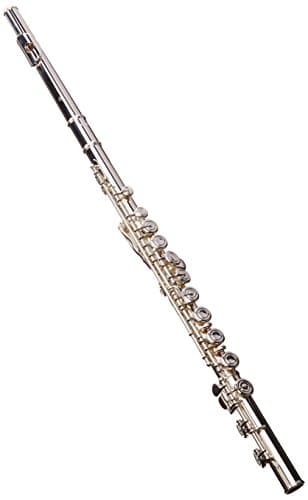
Silver-plated nickel silver throughout with pointed key arms and stainless steel springs. The flute most school programs treat as the standard once a student commits.
Published specifications
- Head / body / footjoint:
- Silver-plated nickel silver
- Keys:
- Hand-assembled silver-plated, offset G, closed hole (plateau)
- Footjoint:
- C foot
- Headjoint:
- CY, double flare taper with undercut embouchure hole
- Key arms:
- Pointed, for even pad-cup pressure
- Springs:
- Stainless steel
What it gets right
- Pointed key arms spread pressure evenly across the pad cup, which means a better seal and fewer leaks as the instrument ages
- Stainless steel springs resist the corrosion that makes cheap flute keys sluggish
- Closed-hole plateau keys give a beginner a solid platform for fingering before open holes are ever a question
Where it gives ground
- Offset G and closed holes are the right beginner choices and are also what a player eventually moves past
- Silver plate wears through at the contact points over years of daily use
What it is not good at
Being a year-one purchase. Rent through the school first — reassignment is common in the first months and this is not a cheap instrument to be stuck with.
How the specs score against a beginner’s needs
Scores are our reading of the published specifications above against what a beginner physically needs. They are not test results — we have not played this instrument.
Specifications from Yamaha YFL-222 published specifications (West Music).
Yamaha YTR-2330
YamahaBest for: Step-up trumpet, year two onward
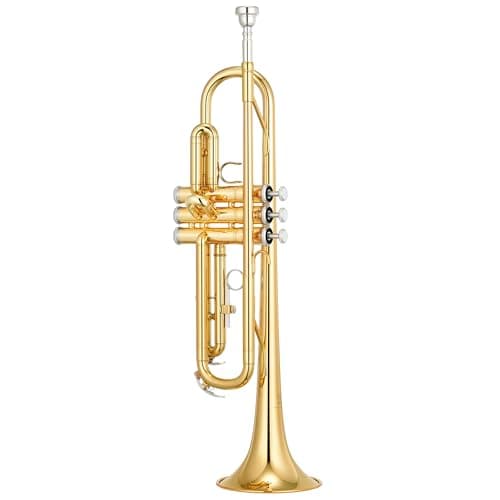
A .459 inch bore with monel pistons, a gold brass leadpipe and an adjustable third valve trigger. Yamaha's top-selling student trumpet and the one directors name first.
Published specifications
- Key:
- Bb
- Bore:
- .459"
- Bell:
- Yellow brass, two-piece, 4-7/8" diameter
- Leadpipe:
- Gold brass
- Valves:
- Monel pistons
- Third valve:
- Adjustable trigger
- Finish:
- Lacquer or silver plate
- Included:
- Mouthpiece
What it gets right
- Monel pistons are corrosion-resistant and stay smooth, which is the difference between a trumpet that stays fast and one that gums up
- The adjustable third valve trigger is how a player corrects the intonation problem every trumpet has on low D and C#
- A gold brass leadpipe warms the response slightly against plain yellow brass
Where it gives ground
- Student trumpets are all broadly similar on paper, so the case for this one is build quality rather than specification
- Lacquer wears at the contact points and looks tired long before it plays badly
What it is not good at
Being a year-one purchase. Brass reassignment is the most common kind in a band room, because embouchure suitability is unknowable in advance. Rent first.
How the specs score against a beginner’s needs
Scores are our reading of the published specifications above against what a beginner physically needs. They are not test results — we have not played this instrument.
Specifications from Yamaha Europe — YTR-2330 specifications.
Yamaha YAS-280
YamahaBest for: Step-up alto sax, year two onward
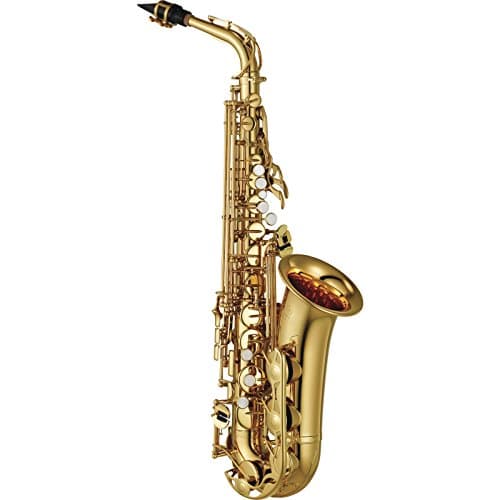
Lightweight, ergonomically shaped for a young player, with an adjustable thumb hook, a high F# key and a redesigned low B-to-C# connection. Widely treated as the standard student alto.
Published specifications
- Key:
- Eb alto
- Material:
- Brass, gold lacquer finish
- Bell:
- Two-piece
- Key touches:
- White polyester
- Mechanism:
- Improved B-C# connector, high F# key, adjustable thumb hook
- Neck receiver:
- Redesigned for stability
- Included:
- Yamaha 4C mouthpiece, case with rucksack straps, sax strap, cork grease
What it gets right
- Genuinely designed around a young player — light, and shaped so the hands fall naturally rather than reaching
- The adjustable thumb hook matters more than it sounds: a saxophone's weight lands on the right thumb, and a fixed hook fits one hand size
- High F# key included, which the method book will want before the second year is out
Where it gives ground
- Even a lightweight alto is heavy for a small eleven-year-old over a full rehearsal
- The 4C mouthpiece is a solid start and a very common first upgrade
What it is not good at
Being a year-one purchase. Saxophone is the most requested section and the most reassigned; rent until the placement is settled.
How the specs score against a beginner’s needs
Scores are our reading of the published specifications above against what a beginner physically needs. They are not test results — we have not played this instrument.
Specifications from Yamaha YAS-280 published specifications.
Questions people actually ask
What is the difference between woodwind and brass?
How the sound starts. Woodwind uses a vibrating reed or an airstream split across an edge; brass uses the player’s buzzing lips. Material is irrelevant — a saxophone is metal and is woodwind because it has a reed.
Is brass or woodwind easier to start?
Reed woodwinds are easiest to get a first sound from. Brass takes weeks of lip development. Flute sits with brass in difficulty, because it also has no reed doing the work.
Which family is cheaper to run?
Brass. Valve oil and slide grease cost very little and last. Reed woodwinds need a continuous supply of reeds, which is a genuine ongoing budget line.
Which family has more players?
Woodwind sections are usually larger, especially clarinets and flutes. Brass sections are smaller, which means less competition for a seat but also more exposure when you play.
Sources
Still deciding?
Every recommendation on this site is built the same way, and the method is published in full — including what we do not do and what would get a pick dropped.
Read next
- Choosing a school band instrument
Which instrument suits which child, what school rental covers, and the honest case for not buying in year one.
- Best brass instruments for beginners
Trumpet and trombone are the only brass instruments with a student model you can check on paper. Horn, baritone and tuba have no honest beginner purchase — rent those — and what separates trumpet from trombone is fingering against intonation.
- The easiest band instruments to learn
Ranked by time to a reliable first note, with what embouchure is and why it decides the ranking.
- Trumpet or saxophone for a beginner?
Embouchure versus fingering, weight and reach, running costs, and how each one sounds in the first six months.
- Flute or clarinet for a first band instrument?
Embouchure versus reeds, the first-two-weeks failure on each, running costs, and which suits smaller players.
- Best band instruments for smaller players
The physical constraint on each band instrument, which ones suit a small player, and the picks that fit without compromise.
- Clarinet vs trumpet for beginners
Sound production, fingering load, home volume, running costs and reassignment risk, compared for a student choosing a first band instrument.