Start Here
Should a first instrument be used or new?
The answer splits cleanly by instrument family, and it turns on one question: can a beginner tell whether this thing is broken?
By Sawyer V. · Published · Last updated

The advice on secondhand instruments is usually delivered as a blanket rule — either “always buy used, you get so much more instrument” or “never buy used, you do not know what you are getting.” Both are wrong, and the reason they are wrong is that instrument families differ enormously in how well they hide their faults.
The useful question is not whether used is cheaper. It is: if this instrument has an expensive problem, could a beginner tell?
Buy used for guitars, bass guitars, ukuleles, acoustic drum kits and amplifiers — their faults are visible and cheap to put right. Buy new, or rent, for woodwind, brass and bowed strings, where the costly faults are invisible to a beginner. Digital keyboards sit in between and are safe used if you can test every key.
The rule, stated properly
An instrument is a good secondhand buy when its failure modes are visible, audible or cheap. It is a bad secondhand buy when its failure modes are gradual, invisible and expensive.
A guitar with a warped neck looks warped when you sight along it. A clarinet with worn pads looks completely fine and plays almost fine, and the leak only shows as certain notes being harder to produce — which a beginner will attribute to themselves, for months, while the repair bill sits there uncollected.
That asymmetry is the whole decision.
Where used is genuinely the best value on this site
Guitars and bass guitars. A solid-body electric is a plank with hardware bolted to it. Practically everything that goes wrong — dead strings, slipping tuners, high action, dirty pots — is either a consumable or a setup adjustment. A used instrument two tiers above what your budget buys new is usually the better purchase, and this is the single strongest secondhand case in the whole category. Our are cheap guitars worth it page explains which specs you are actually buying.
Acoustic guitars, with one caution. The same logic applies, but check the bridge and the top. A bridge lifting away from the soundboard, or a visibly bellied top, is structural and costs real money. A used Yamaha FG800#ad in good condition is an outstanding buy; one with a lifting bridge is firewood with strings.
Amplifiers. Solid-state practice amps are extremely durable and are almost always sold because someone upgraded, not because something failed. Plug it in, turn every knob through its full sweep listening for crackle, and you have done the entire inspection.
Acoustic drum kits. Shells last decades. Heads are consumables and cost little. What you are really inspecting is hardware — whether the stands hold position under load and whether the pedals move without grinding.
Ukuleles, sometimes. They are cheap enough new that the saving is small, and a cracked top on a dry-stored ukulele is common. Worth it only if the model is a genuine step up from what you would buy new.
Where used is a trap for a beginner
Woodwind — flute, clarinet, saxophone. These seal with pads and corks, and both are consumables that degrade continuously rather than failing. A used instrument with tired pads plays, but leaks, and a leaking instrument makes the low notes disproportionately hard. A student never reports this, because there is no moment when it breaks; they simply conclude they are not getting better. A full repad can cost more than the instrument did.
Brass. Fewer consumables, but valves that have been stored dirty stick, and dents in the wrong place change how the instrument responds. Testable by someone who plays; not by a parent.
Bowed strings. A violin with a warped bridge, a shifted soundpost or pegs that will not hold looks entirely normal in a photograph. The bow is a second instrument in its own right and a warped stick is not economically repairable. Our violin outfit guide covers what a complete package should contain.
For all of these, the sensible route for year one is renting rather than buying at all, which we work through in rent or buy.
Digital keyboards: the in-between case
Keyboards are safe used with one specific discipline: play every key.
Digital pianos and keyboards fail per-note. A key stops sounding, or sounds at a different volume, or does not respond to velocity the way its neighbors do. It is trivially detectable if you test all 61 or all 88, and completely invisible if you play a chord in the middle and nod.
Also check the power supply is the correct original unit, and that the sustain pedal socket works. A used Yamaha PSR-E383#ad that passes those checks is a good buy; the same board with two dead keys in the top octave is not a bargain at any price.
What to check before you hand over money
| Family | Check this | Walk away if |
|---|---|---|
| Electric guitar / bass | Neck straightness, tuners hold, no fret sprout at the edges | Neck has a visible twist |
| Acoustic guitar | Bridge flush to the top, no cracks, action at the 12th fret | Bridge lifting, or a crack through the top |
| Keyboard | Every key sounds, correct power supply, pedal socket works | Any dead or uneven key |
| Drum kit | Stands hold under weight, pedals move freely, shells round | Cracked shell or seized pedal |
| Ukulele | No cracks, nut and saddle are bone or NuBone not plastic | Any crack, or a bowed neck |
| Woodwind / brass | Have a player or a tech check it, not a photograph | You cannot get it inspected |
| Violin / cello | Bridge upright, pegs hold, bow stick straight and not warped | Anything you cannot assess — rent instead |
When new is worth the premium anyway
When it is a gift. You cannot inspect an instrument properly and keep it a surprise, and a faulty gift is worse than a modest one. More on this in instrument gifts.
When nobody involved plays. The inspection lists above assume someone can tell whether a neck is straight. If nobody can, you are buying a lottery ticket and the new-price premium is the cost of not needing to.
When the saving is small. A Squier Sonic Stratocaster#ad is inexpensive enough new that a used one at two-thirds the price, with unknown history and no warranty, is not obviously the better deal.
When you want the setup included. A new instrument from a shop that sets it up is a genuinely different product from the same model bought from a stranger, because a good setup is most of what makes a cheap instrument playable.
What we would buy
Yamaha FG800
YamahaBest for: Buy once, acoustic
A solid Sitka spruce top with scalloped bracing at the entry price. Solid-versus-laminate is the one acoustic spec that changes what the instrument does over years, and this is the cheapest place to get it done right.
Published specifications
- Top:
- Solid Sitka spruce
- Back / sides:
- Nato / okume
- Neck / fingerboard:
- Nato neck, rosewood fingerboard, R400 mm (23-5/8") radius
- Scale length:
- 650 mm (25-9/16")
- Nut width:
- 43 mm (1-11/16")
- Bracing:
- Scalloped
- Body:
- Traditional Western (dreadnought), 412 mm (16-1/4") wide, 100-118 mm deep
- Hardware:
- Die-cast chrome tuners, urea nut and saddle
What it gets right
- A solid top, not a laminate — the only acoustic spec at this price that genuinely changes over time
- Scalloped bracing and die-cast tuners are specifications you normally pay considerably more for
- Yamaha's most-copied entry acoustic; parts, setups and advice are everywhere
Where it gives ground
- A full dreadnought body is a big box — 412 mm across and up to 118 mm deep
- Nato and okume back and sides are the cost saving; the top is where the money went
What it is not good at
Fitting a smaller player. The dreadnought body is wide and deep enough that a young teenager can struggle to get their arm over it comfortably. If that is the buyer, look at the JR1 or a concert-size body instead.
How the specs score against a beginner’s needs
Scores are our reading of the published specifications above against what a beginner physically needs. They are not test results — we have not played this instrument.
Specifications from Yamaha Europe — FG/FS800 series specifications.
Squier Sonic Stratocaster
Squier by FenderBest for: The honest floor, electric
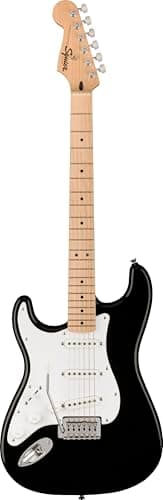
The cheapest electric that still has full-scale geometry, sealed tuners and a real 9.5 inch fingerboard radius. Nothing about it will make a beginner's first year harder.
Published specifications
- Scale length:
- 25.5" (647.7 mm) — full size
- Body / neck:
- Poplar body, maple neck, "C" profile
- Fingerboard:
- Maple or Indian laurel, 9.5" (241 mm) radius
- Frets:
- 21, narrow tall
- Nut width:
- 1.650" (42 mm), synthetic bone
- Pickups:
- Three ceramic single-coils (SSS)
- Bridge:
- 6-saddle vintage-style synchronized tremolo
What it gets right
- Full 25.5 inch scale, so nothing learned here has to be relearned later
- Synthetic bone nut rather than a soft plastic one — the part that decides whether a cheap guitar stays in tune
- Sealed-gear tuners, which is the single most important spec on a first electric
Where it gives ground
- Poplar body and ceramic pickups are exactly what you would expect at this tier
- The tremolo bridge will pull the guitar out of tune if a beginner uses it, and beginners always use it
What it is not good at
Staying in tune if you use the whammy bar. If that matters, buy the hardtail (HT) version of the same guitar instead — it is the identical instrument with the tremolo deleted.
How the specs score against a beginner’s needs
Scores are our reading of the published specifications above against what a beginner physically needs. They are not test results — we have not played this instrument.
Specifications from Squier Wiki — Sonic Stratocaster specifications.
Yamaha PSR-E383
YamahaBest for: Learning tools, 61 keys
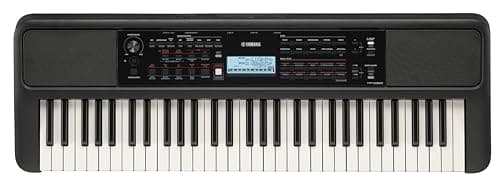
61 touch-sensitive keys and 125 lesson songs with hand-separate practice and scoring. The touch response is the spec that matters; the 650 tones are the spec that sells it.
Published specifications
- Keys:
- 61, organ-style (unweighted), touch-sensitive
- Touch response:
- Soft / medium / hard / off
- Polyphony:
- 48 notes
- Tones:
- 650 (258 panel, 25 drum/SFX, 20 arpeggio, 347 XGlite)
- Lessons:
- 125 lesson songs, right/left/both-hand practice with evaluation
- In the box:
- Music rest, PA130 power adapter
What it gets right
- Touch-sensitive keys — playing harder makes it louder, which is the thing a beginner has to learn early and a non-touch keyboard cannot teach
- The lesson mode with hand-separate practice and scoring is genuinely useful, not a gimmick
- Power adapter included, which is not a given at this tier
Where it gives ground
- Unweighted organ-style keys — this will not build the finger strength a piano needs
- 61 keys, so a method book that assumes 88 will eventually run out of instrument
What it is not good at
Preparing anyone for an acoustic piano. If there is a real piano in the child's future, the unweighted action is a habit to unlearn later. Read our 61-versus-88 comparison before deciding.
How the specs score against a beginner’s needs
Scores are our reading of the published specifications above against what a beginner physically needs. They are not test results — we have not played this instrument.
Specifications from Yamaha — PSR-E383 specifications.
Questions people actually ask
Is it worth buying a used instrument for a beginner?
For guitars, ukuleles and acoustic drum kits, frequently yes — those are simple objects whose faults are visible and cheap to fix. For woodwind, brass and bowed strings, be far more careful: the expensive faults are invisible and the repair costs can exceed what you paid.
What should I check on a used guitar?
Sight down the neck for a twist, check that every tuner turns smoothly and holds, press a string at the first and last fret to see how far the middle sits off the board, and look for a lifting bridge on an acoustic. A twisted neck or a lifting bridge is a walk-away.
Are used digital pianos safe to buy?
Reasonably, if you can play every single key. Digital pianos fail per-key — a dead or unresponsive note in one octave — and that is both easy to test in thirty seconds and expensive to repair. Test all of them, not a sample.
How much should a used instrument cost?
As a rough guide, a well-kept beginner instrument sells for around half to two-thirds of the current new price of the same model. If the asking price is close to new, buy new and get the warranty.
Sources
Still deciding?
Every recommendation on this site is built the same way, and the method is published in full — including what we do not do and what would get a pick dropped.
Read next
- Should you rent or buy a first instrument?
Rent-or-buy answered per instrument family, with the two questions that decide it and the maintenance cost people miss.
- Are cheap guitars worth it?
The line between cheap and too cheap, named part by part, with what each failure does to a beginner who cannot diagnose it.
- Are cheap keyboards worth it?
Why cheap keyboards fail invisibly rather than mechanically, and the three specs that separate a cheap board from a too-cheap one.
- Instrument gifts that actually get played
What to give when you cannot ask the recipient first: four instruments that work out of the box, plus the ten-dollar accessory that saves any of them.
- Renting vs buying a school band instrument
Why year one is a rental year, what programs cover, the maintenance nobody warns you about, and when buying starts to win.