Band & Orchestra
Flute or clarinet for a first band instrument?
The two most-chosen beginner woodwinds fail differently, and the failure that matters happens in the first two weeks.
By Sawyer V. · Published · Last updated

Flute and clarinet are the two instruments most commonly picked in a school band’s first year, and they are chosen for the wrong reasons more often than any other pair — usually because a friend picked one, or because the flute looked easier.
They fail differently, and the difference shows up in the first two weeks.
Clarinet is easier to start and costs more to run. Flute is harder to get a first sound from and has no consumables. For a smaller player, clarinet is usually the better physical fit because a flute is held out to the side.
How each one makes its sound
The clarinet uses a reed. A thin cane blade vibrates against the mouthpiece when air passes it. The player does have to form a reasonable embouchure, and the reed is doing the fundamental job of generating the vibration. Most students produce a sound in their first lesson.
The flute has no reed. The player directs a narrow, controlled stream of air across the edge of a hole, and the sound is generated by that airstream splitting. There is no mechanical helper. Some students get a note in ten minutes; others take two or three weeks of practice to produce one reliably.
That gap is the single biggest practical difference between the two instruments for a beginner, and it matters because a student who cannot make a sound at all is a student deciding they cannot play. Ten- and eleven-year-olds do not wait patiently through three weeks of nothing.
Then it inverts
Having produced a first sound, the clarinet gets harder in a specific place, and the flute gets easier.
The clarinet’s difficulty is the break — the transition between its lower and upper registers, which requires a different embouchure and a fingering change at the same moment. It is the point where clarinet students plateau, and it arrives in the first year.
The clarinet also has more holes than fingers can cover, and covering them completely, without gaps, requires genuine finger placement precision. A hole that is nine-tenths covered produces no note at all, which is unforgiving in a way a keyboard is not.
The flute’s difficulty stays where it started: consistent tone, breath control and intonation, which shifts as the player’s air speed changes. Beyond that first hurdle the fingering is comparatively straightforward.
The physical fit, which decides more cases than anything else
A flute is held horizontally out to the player’s right, with the arms raised and the head turned. That posture asks for arm length and shoulder rotation that a small ten-year-old often does not have yet, and it is why curved head joints exist for younger players.
A clarinet hangs down in front of the body. The arms are relaxed, nothing is held out to the side, and the weight is manageable. It is simply a less physically demanding instrument to hold for a small player.
A band director assessing a class will often make the recommendation on exactly this basis, and it is worth taking seriously — the sizing logic across the whole band is in choosing a school band instrument.
Reeds: the running cost nobody budgets for
Clarinet reeds are consumables. They chip on a music stand, warp if stored damp, and lose their response after a few weeks of regular playing. A student needs a continuous supply and should keep several in rotation rather than playing one until it dies.
This is a genuine ongoing cost and, more importantly, a genuine source of unexplained difficulty. A student playing on a dead reed finds everything harder and reports that they are getting worse. Parents who do not know about reeds do not think to check.
Flutes have nothing equivalent. Beyond periodic servicing, there is no consumable. Over several years that is a real difference in total cost.
What to buy, and when
The strong recommendation for year one is to rent rather than buy, on both instruments. Directors reassign students between sections in the first months based on physical fit and ensemble balance, and a family who bought a flute has turned a routine decision into a financial argument. The full reasoning is in renting versus buying a band instrument.
If you are buying anyway, the split is the same on both instruments.
Flute. The Yamaha YFL-222#ad is the step-up instrument that carries a student well past year one and holds resale value. The Jean Paul FL-220#ad is the budget option if buying in year one is unavoidable. The comparison is in best beginner flutes.
Clarinet. Same structure: the Yamaha YCL-255#ad is the buy-once choice, and the Jean Paul CL-300#ad is the budget entry. Details in best beginner clarinets.
One warning that applies to both: be very careful buying either used without an inspection. Woodwind seals with pads and corks, both are consumables, and a leaking instrument makes the low notes disproportionately hard while looking entirely normal. A student never reports this, because nothing breaks — they simply conclude they are not improving.
Which one, in one paragraph
Choose clarinet if the player is small, if you want them making a recognisable sound in the first week, or if there is any doubt about whether early frustration will end the project. Choose flute if the player is patient, has the arm length to hold it comfortably, and you would rather avoid a permanent reed budget.
If neither is settled, the broader ranking across the whole band room is in easiest band instruments to learn.
What we would buy
Yamaha YFL-222
YamahaBest for: Step-up flute, year two onward
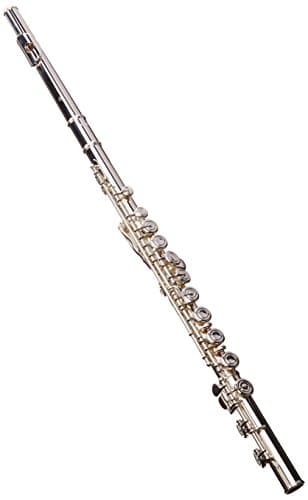
Silver-plated nickel silver throughout with pointed key arms and stainless steel springs. The flute most school programs treat as the standard once a student commits.
Published specifications
- Head / body / footjoint:
- Silver-plated nickel silver
- Keys:
- Hand-assembled silver-plated, offset G, closed hole (plateau)
- Footjoint:
- C foot
- Headjoint:
- CY, double flare taper with undercut embouchure hole
- Key arms:
- Pointed, for even pad-cup pressure
- Springs:
- Stainless steel
What it gets right
- Pointed key arms spread pressure evenly across the pad cup, which means a better seal and fewer leaks as the instrument ages
- Stainless steel springs resist the corrosion that makes cheap flute keys sluggish
- Closed-hole plateau keys give a beginner a solid platform for fingering before open holes are ever a question
Where it gives ground
- Offset G and closed holes are the right beginner choices and are also what a player eventually moves past
- Silver plate wears through at the contact points over years of daily use
What it is not good at
Being a year-one purchase. Rent through the school first — reassignment is common in the first months and this is not a cheap instrument to be stuck with.
How the specs score against a beginner’s needs
Scores are our reading of the published specifications above against what a beginner physically needs. They are not test results — we have not played this instrument.
Specifications from Yamaha YFL-222 published specifications (West Music).
Jean Paul FL-220
Jean Paul USABest for: Budget flute, if buying in year one
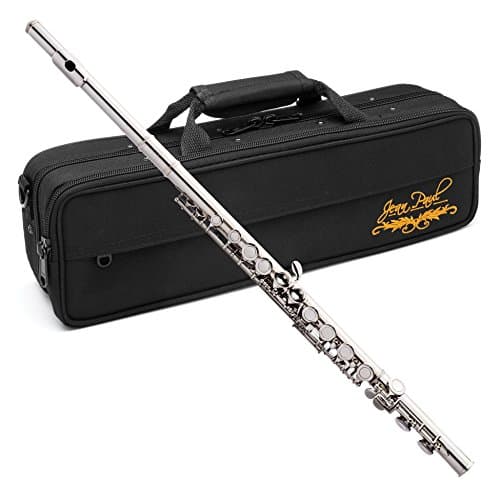
Closed-hole, offset G with a split E mechanism and power-forged keys. The split E is the notable inclusion at this price — it makes the third-octave E far easier to hit.
Published specifications
- Keys:
- Power-forged, closed hole (plateau)
- G key:
- Offset, for better hand alignment
- Mechanism:
- Split E, simplifying third-octave E
- Embouchure plate:
- Student-friendly design
- Finish:
- Silver plated
What it gets right
- A split E mechanism at this price is unusual and it removes one of the first real frustrations a flute student hits
- Offset G aligns the left hand more naturally, which matters for a smaller player
- Considerably cheaper than the Yamaha, which is the point
Where it gives ground
- Build tolerances are not the Yamaha's, and pad seating is where that shows over a year
- Resale value is low, so it is not a purchase you get much back from
What it is not good at
Lasting through a school career. It gets a student through the early years; a committed player will want the Yamaha or better by around year three.
How the specs score against a beginner’s needs
Scores are our reading of the published specifications above against what a beginner physically needs. They are not test results — we have not played this instrument.
Specifications from Jean Paul USA FL-220 published description.
Yamaha YCL-255
YamahaBest for: Step-up clarinet, year two onward
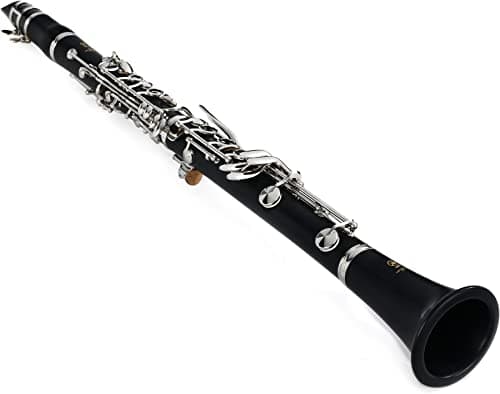
ABS resin body with a 65 mm barrel taken from Yamaha's high-end clarinets, Valentino pads and a 4C mouthpiece. The default student clarinet in most band rooms.
Published specifications
- Body:
- ABS resin, matte wood-like finish
- System:
- Boehm, 17 keys and 6 rings
- Keywork:
- Power-forged, nickel-plated nickel silver
- Barrel:
- 65 mm — the length used on Yamaha's high-end clarinets
- Pads:
- Valentino
- Bell:
- Solid ABS resin with resonance chamber
- Thumb rest:
- Adjustable, with strap ring
- Mouthpiece:
- Yamaha 4C
What it gets right
- ABS resin does not crack in a dry house, which is the failure that ends cheap wooden clarinets
- The 65 mm barrel is genuinely the same specification as Yamaha's expensive clarinets, and it is a large part of why this one plays in tune
- An adjustable thumb rest with a strap ring, which matters because a clarinet's weight lands on one thumb
Where it gives ground
- Resin will never have the warmth of grenadilla wood, and a student will notice when they play a wooden one
- The included 4C mouthpiece is competent and is the first thing many teachers upgrade
What it is not good at
Being a year-one purchase. Rent through the school first; directors reassign students in the first months and this is real money to have committed.
How the specs score against a beginner’s needs
Scores are our reading of the published specifications above against what a beginner physically needs. They are not test results — we have not played this instrument.
Specifications from Yamaha USA — YCL-255 overview.
Jean Paul CL-300
Jean Paul USABest for: Budget clarinet, if buying in year one
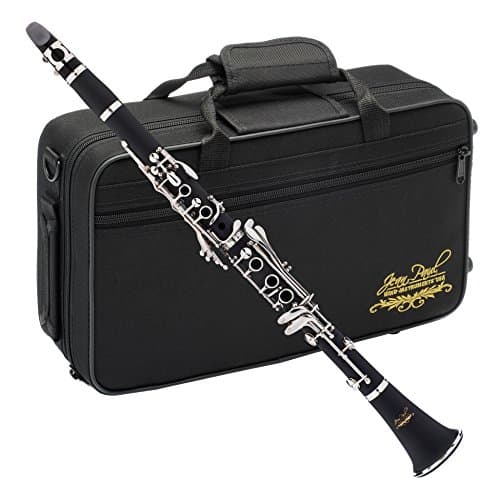
Ebonite body with nickel keys on the full Boehm 17-key system, at roughly half what the Yamaha costs. The system is complete; the tolerances are where the money went.
Published specifications
- Body:
- Ebonite
- Keys:
- Nickel-plated
- System:
- Boehm, 17 keys
What it gets right
- The full 17-key Boehm system, so nothing in the method book is unplayable on it
- Ebonite is stable in a dry house, same practical advantage as the Yamaha's resin
- Low enough cost that an uncertain first year is not an expensive bet
Where it gives ground
- Pad seating and key regulation are the weak points, and a leak develops sooner than on the Yamaha
- The supplied mouthpiece is basic even by student standards
What it is not good at
Surviving without maintenance. Woodwind pads are consumable on any instrument, and on a budget one they need attention sooner. This is exactly why school rental is worth its price.
How the specs score against a beginner’s needs
Scores are our reading of the published specifications above against what a beginner physically needs. They are not test results — we have not played this instrument.
Specifications from Jean Paul USA CL-300 published description.
Questions people actually ask
Is flute or clarinet easier for a beginner?
Clarinet is easier to get a first sound out of, because the reed does the work. Flute requires the player to form the sound with their lips alone, and some students take weeks to produce a reliable note at all.
Which is cheaper to run, flute or clarinet?
Flute. A clarinet needs a continuous supply of reeds, which are consumables that chip, warp and wear out. A flute has no reeds and no equivalent recurring cost beyond servicing.
Which is better for a small child?
Clarinet, usually. A flute is held out to the right side, which asks for arm length and shoulder rotation that smaller players struggle with. A clarinet is held in front of the body, which is far less demanding.
Which has more parts in a school band?
Both are well represented and flutes are usually the more crowded section. Clarinet sections tend to be larger overall but split into multiple parts, so there is more room to sit somewhere useful.
Sources
Still deciding?
Every recommendation on this site is built the same way, and the method is published in full — including what we do not do and what would get a pick dropped.
Read next
- Best beginner flutes
Closed-hole and offset G explained, the split E mechanism, and the two picks for a year-two step-up.
- Best beginner clarinets
Why resin beats wood for a student, what a 65mm barrel does for intonation, and two picks for the year-two step-up.
- The easiest band instruments to learn
Ranked by time to a reliable first note, with what embouchure is and why it decides the ranking.
- Choosing a school band instrument
Which instrument suits which child, what school rental covers, and the honest case for not buying in year one.
- Renting vs buying a school band instrument
Why year one is a rental year, what programs cover, the maintenance nobody warns you about, and when buying starts to win.