Guitars
Are guitar starter packs worth it?
A pack is priced against the convenience of not deciding. Whether that is a bargain depends entirely on which four items are in the bag.
By Sawyer V. · Published · Last updated
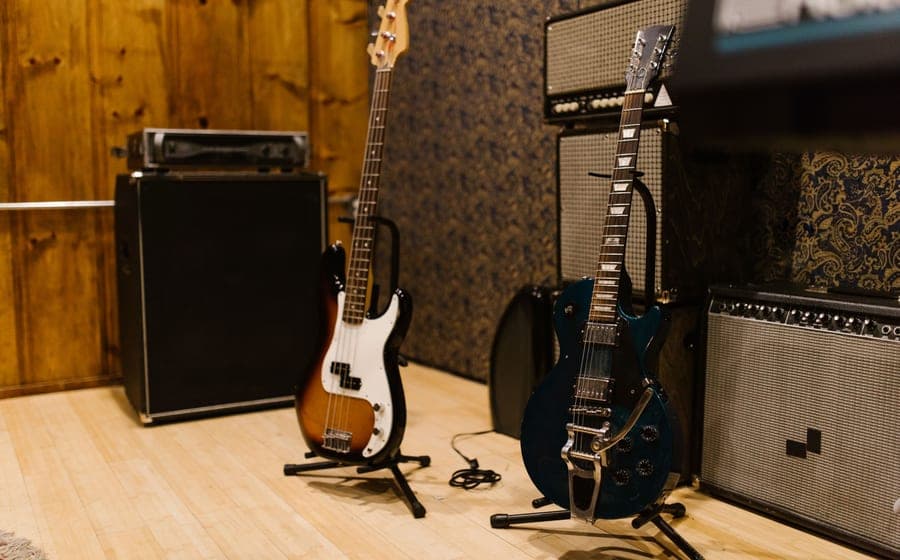
Starter packs are the default recommendation in a lot of guitar shops and the default suspicion online, and both positions miss the same thing. A pack is not one product. It is one good product and five cheap ones sold together, and the whole question is whether the good one is good enough.
Judge a starter pack entirely on the guitar in it. If that guitar is one you would buy on its own, the pack is good value and everything else in the bag is a bonus. If the guitar is a model you have never heard of, the accessories are there to distract you and the pack is worse than useless.
What is actually in the bag
A typical electric pack contains six things, and they are not equally serious.
The guitar. Ninety per cent of the value. Everything below is a rounding error by comparison, and yet it is where almost all the marketing attention goes.
The amp. Usually a small solid-state practice combo in the 10 to 15 watt range. This is the second-most consequential item and is normally fine for a bedroom.
The cable. Almost always the cheapest possible instrument cable. It will work, and it is the component most likely to develop an intermittent crackle within a year. A cheap replacement is genuinely cheap.
The gig bag. Thin nylon with no padding worth the name. Adequate to carry a guitar to a lesson in a car, not adequate to protect one on a bus. A bag whose maker publishes an actual padding depth costs about the same as a set of strings — the options are in best guitar cases and gig bags.
The strap and picks. Fine. Straps are straps, and picks are consumables that every player ends up choosing by feel anyway.
The tuner, if included. Frequently a very basic clip-on. Adequate. A better one costs very little, and the difference matters more than the strap does.
The test: would you buy the guitar alone?
This is the whole method. Take the guitar model out of the pack, look it up, and ask whether it would appear in a list of instruments you would recommend on its own merits.
A pack built around a Squier Sonic Stratocaster#ad passes. That is a full 25.5 inch scale, sealed tuners, a 9.5 inch fingerboard radius and a synthetic bone nut — the honest floor for an electric, and an instrument that will not make a beginner’s first year harder. It is a guitar we recommend by itself in the electric guitar roundup.
A pack built around an unbranded body shape with no published specifications fails, and the accessories are precisely why it exists. When a seller cannot make the instrument look attractive, they make the quantity of items look attractive instead. The consequences of that choice are set out in are cheap guitars worth it.
The amp question
The bundled amp is usually a genuine, if basic, product. The Fender Frontman 10G#ad is the archetype: a 10 watt solid-state combo with a 6 inch speaker, a clean channel, an overdrive channel and an aux input for playing along to music. That specification is not exciting and it does the job.
Where a bundled amp genuinely falls short is headphone practice, because not all of them have a headphone output — and for a beginner in a shared house, that single socket decides how many hours the guitar gets played. If quiet practice is the constraint, the Boss Katana Mini#ad route or a headphone amp is worth planning for from the start, which we cover in do you need an amp to learn electric guitar.
Building your own for about the same money
If you would rather choose each item, four things make a complete starter kit and none of them are the gig bag.
The guitar. Everything else is negotiable; this is not. Our beginner guitar roundup is the starting point, and the price bands are in what a first guitar should cost.
An amp, for electrics. Ten watts is plenty for a bedroom. Options are in the amp roundup.
A tuner. The Snark clip-on chromatic tuner#ad reads string vibration through the headstock rather than through a microphone, so it works in a room with a television on. A beginner cannot yet distinguish an out-of-tune guitar from their own mistakes, which makes this the highest-value cheap item in the whole set.
Spare strings. A set of D'Addario EXL110 (10-46)#ad lives in the case so that a broken string is a ten-minute interruption instead of a week off. The string question in full is in beginner guitar strings, and the procedure is in how to change guitar strings.
Acoustic packs are a different proposition
An acoustic pack has no amp and no cable in it, which removes the two most substantial non-guitar items. What is left is a guitar, a bag, a strap, picks and possibly a tuner.
That makes the math simpler and the conclusion sharper: an acoustic pack is a guitar with a handful of cheap accessories attached, so the only question worth asking is whether the guitar is right. If the pack costs meaningfully more than the same guitar alone, buy the guitar alone and pick your own tuner.
The one thing a pack cannot include
A setup. The distance between the strings and the fretboard is adjustable, it is set at the factory to a tolerance rather than to a player, and it is the difference between a guitar that is hard work and a guitar that is easy.
On an inexpensive instrument this matters enormously, because a high action on a cheap guitar is the most common reason a beginner concludes that guitar hurts and stops. That is a solvable problem — the causes and the fixes are in why the guitar hurts your fingers — but no bundle solves it, and a shop that includes a setup is worth more than a bundle that includes a strap.
The verdict
Packs are neither the trap nor the bargain they are made out to be. They are a convenience product with one item that matters, and they are worth buying when that item is one you would have chosen anyway.
Buy the pack if the guitar in it is a model we would recommend standing alone, if you want one purchase rather than four decisions, and if you have never owned an amp or a cable before. Skip it if the guitar is anonymous, if you already own an amp, or if the pack costs meaningfully more than the guitar plus a tuner plus strings.
What we would buy
Squier Sonic Stratocaster
Squier by FenderBest for: The honest floor, electric
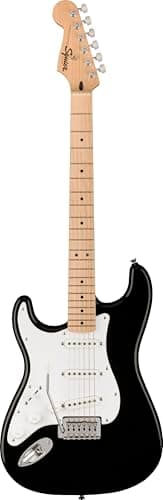
The cheapest electric that still has full-scale geometry, sealed tuners and a real 9.5 inch fingerboard radius. Nothing about it will make a beginner's first year harder.
Published specifications
- Scale length:
- 25.5" (647.7 mm) — full size
- Body / neck:
- Poplar body, maple neck, "C" profile
- Fingerboard:
- Maple or Indian laurel, 9.5" (241 mm) radius
- Frets:
- 21, narrow tall
- Nut width:
- 1.650" (42 mm), synthetic bone
- Pickups:
- Three ceramic single-coils (SSS)
- Bridge:
- 6-saddle vintage-style synchronized tremolo
What it gets right
- Full 25.5 inch scale, so nothing learned here has to be relearned later
- Synthetic bone nut rather than a soft plastic one — the part that decides whether a cheap guitar stays in tune
- Sealed-gear tuners, which is the single most important spec on a first electric
Where it gives ground
- Poplar body and ceramic pickups are exactly what you would expect at this tier
- The tremolo bridge will pull the guitar out of tune if a beginner uses it, and beginners always use it
What it is not good at
Staying in tune if you use the whammy bar. If that matters, buy the hardtail (HT) version of the same guitar instead — it is the identical instrument with the tremolo deleted.
How the specs score against a beginner’s needs
Scores are our reading of the published specifications above against what a beginner physically needs. They are not test results — we have not played this instrument.
Specifications from Squier Wiki — Sonic Stratocaster specifications.
Fender Frontman 10G
FenderBest for: The default first amp
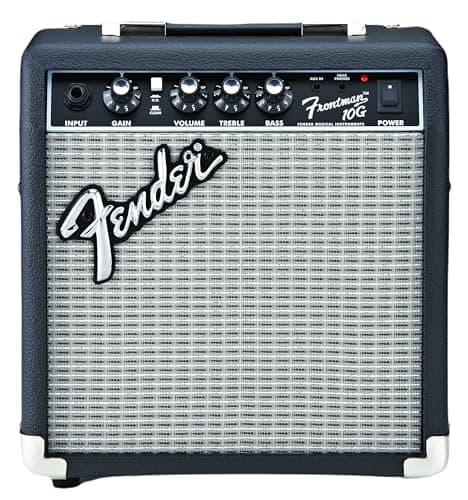
Ten watts, a 6 inch speaker, a headphone socket and an aux input. It is the amplifier almost every first electric guitar gets paired with, and there is no reason to argue with that.
Published specifications
- Power:
- 10 W
- Speaker:
- 6" special design
- Channels:
- Normal and drive, switchable
- EQ:
- 2-band
- Connections:
- 1/8" aux in, 1/8" headphone out
- Cabinet:
- Closed back
- Dimensions:
- 11" H x 10.25" W x 5.75" D
- Weight:
- 8.5 lb
What it gets right
- Headphone output — the single feature that decides whether an electric guitar can be practiced in the evening
- Aux input, so a beginner can play along with a phone without any extra hardware
- Two channels, so clean and distorted are a knob apart rather than a pedal purchase away
Where it gives ground
- The drive channel is fizzy at high gain, which is what you expect from a solid-state amp at this size
- A 6 inch speaker has no low end to speak of
What it is not good at
Playing with a drummer. Ten watts through a 6 inch speaker is a bedroom amplifier, and it will disappear the moment anyone hits a snare. That is fine — it is not what it is for.
How the specs score against a beginner’s needs
Scores are our reading of the published specifications above against what a beginner physically needs. They are not test results — we have not played this instrument.
Specifications from Sweetwater — Fender Frontman 10G specifications.
D'Addario EXL110 (10-46)
D'AddarioBest for: Electric, the default gauge
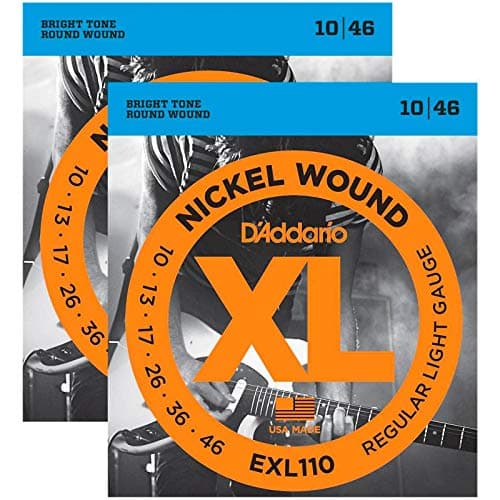
Regular light 10-46 nickel-wound, which is the gauge nearly every electric guitar leaves the factory with and the one every setup assumes.
Published specifications
- Gauge:
- 10-46, regular light
- Core:
- High carbon steel hex core
- Wrap:
- Nickel-plated steel
- Fits:
- Electric guitar, standard tuning
What it gets right
- The gauge most electrics ship with, so changing to these keeps the existing setup correct with no truss rod adjustment
- Nickel-plated steel is bright without being harsh, and it suits every style a beginner will try
- Cheap enough to keep a spare set in the case, which every guitarist should
Where it gives ground
- Nickel-wound strings dull faster than coated sets, so they need changing more often
- 10-46 is a compromise gauge: heavier players may want more tension, benders may want less
What it is not good at
Drop tunings. Tuned down, a 10-46 set goes slack and buzzes. Anyone tuning below standard should move to a heavier gauge and expect a setup afterward.
How the specs score against a beginner’s needs
Scores are our reading of the published specifications above against what a beginner physically needs. They are not test results — we have not played this instrument.
Specifications from D'Addario — EXL110 XL Nickel Wound.
Snark clip-on chromatic tuner
SnarkBest for: Tuning anything with strings
Clips to the headstock and reads pitch from the vibration of the wood, so it works in a noisy room and an adult who plays nothing can tune the instrument in twenty seconds.
Published specifications
- Type:
- Clip-on chromatic
- Sensing:
- Vibration through the headstock, not the microphone
- Fits:
- Guitar, bass, ukulele, violin, mandolin
- Display:
- Full-color rotating screen
What it gets right
- Vibration sensing means it works in a room with a television on, which a microphone tuner does not
- Chromatic, so one tuner covers every instrument in the house
- The rotating display means it reads correctly whichever way the instrument is held
Where it gives ground
- The clip is plastic and it is the part that eventually breaks
- Battery-powered, and it will be flat the one time you need it in a hurry
What it is not good at
Wind and brass instruments. It reads vibration through a solid body, so there is nothing for it to clip to on a flute or a trumpet.
How the specs score against a beginner’s needs
Scores are our reading of the published specifications above against what a beginner physically needs. They are not test results — we have not played this instrument.
Specifications from Snark tuners (retail listing with published feature set).
Questions people actually ask
Are guitar starter packs any good?
The good ones are a real guitar and a real amp with some cheap extras thrown in. The bad ones are a below-the-floor guitar padded out with accessories to make the price look justified. Judge the pack by the guitar model alone, then treat everything else as free.
What comes in a guitar starter pack?
Usually the guitar, a small practice amp, a cable, a gig bag, a strap, a few picks, sometimes a clip-on tuner and occasionally a spare set of strings. Quality across those items varies far more than the pack price suggests.
Is it cheaper to buy a starter pack or buy separately?
A pack is usually a little cheaper than the same items bought individually, and the items are usually a little worse. The gap is small enough that the decision should be made on the guitar, not on the arithmetic.
Do I need the amp that comes with the pack?
You need an amp of some kind to play an electric with other people or to hear what your playing actually sounds like. The bundled one is normally adequate for a bedroom and is the first thing most players upgrade.
Sources
Still deciding?
Every recommendation on this site is built the same way, and the method is published in full — including what we do not do and what would get a pick dropped.
Read next
- Best beginner electric guitars: what's worth it from $150 to $400
Segmented by player and price band, with the three specs that actually decide whether a first electric survives its first year.
- Best beginner guitar amps
Why the headphone socket outranks wattage, two picks, and the honest limits of a practice amp.
- How much should a beginner guitar cost?
Four price bands defined by specification rather than by number, plus the hidden costs that turn a $200 budget into a $270 purchase.
- Do you need an amp to learn electric guitar?
What playing unplugged hides, when an amp becomes necessary, and three silent routes for players who cannot make noise.
- Best beginner guitar strings
Why gauge outranks brand, the default set for electric and acoustic, and when going lighter actually helps.