Guitars
Best beginner guitar strings
The cheapest thing that transforms a guitar, and the easiest thing to get wrong. Gauge decides almost everything; brand decides almost nothing.
By Sawyer V. · Published · Last updated
Strings are the cheapest component on a guitar and the one that changes how it plays most immediately. They are also the one where beginners get the most contradictory advice, almost all of it about brand, almost none of it about the thing that matters.
Buy the gauge your guitar came with: 10-46 for most electrics, 12-53 for most steel-string acoustics. Gauge changes string tension, tension changes neck relief, and a big gauge change means a fresh setup. Brand is a distant second consideration.
Why gauge outranks brand
A guitar neck is under constant tension from the strings, and the truss rod is adjusted to balance it. Change the gauge significantly and you change that balance: heavier strings pull the neck into more bow, lighter ones let it straighten.
The consequences are practical. Go heavier and the action rises, the guitar gets harder to play, and it may need the truss rod tightened. Go lighter and the action drops, which sounds good until the strings start buzzing against the frets.
This is why “what the guitar came with” is the right default. The instrument was set up around that tension at the factory, and matching it means the setup stays correct.
Brand differences are real and small: coating, wrap alloy, how long they stay bright. None of them affects whether a beginner can play the guitar.
The two default sets
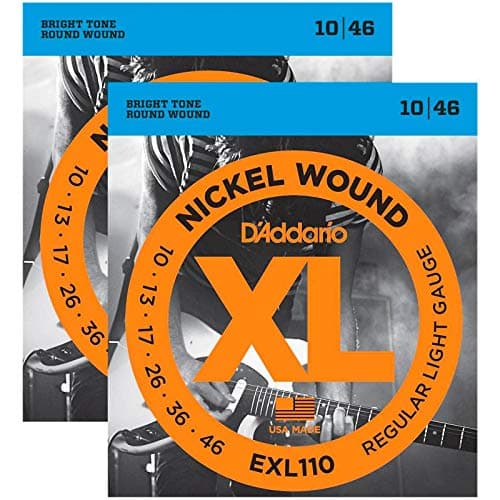
For electric, D'Addario EXL110 (10-46)#ad — regular light 10-46, nickel-plated steel on a high-carbon steel core. This is the most-sold electric string set there is, and being the default is the point: your guitar is probably already set up for it.
For steel-string acoustic, D'Addario EJ16 (12-53)#ad — light 12-53 phosphor bronze. Phosphor bronze is warmer and lasts longer than plain 80/20 bronze, and 12-53 is what most acoustics ship with.
Buying these is not a recommendation to prefer one manufacturer. It is a recommendation to buy the standard gauge from a maker who publishes their specifications, which most of the cheap multi-packs do not.
When to go lighter, deliberately
There is one situation where deviating from the default is right: a beginner whose fingertips hurt enough that they are not practicing.
Dropping from 10-46 to 9-42 on an electric, or 12-53 to 11-52 on an acoustic, reduces tension noticeably. Notes take less force, bends are easier, and the first three weeks hurt less. That is a legitimate trade, and if it is the difference between practicing and quitting it is obviously the right one.
The costs, stated honestly: less volume, a thinner tone, and a higher chance of fret buzz because the lower tension lets the strings vibrate wider. On an acoustic especially, lighter strings drive the top less hard and the guitar sounds quieter.
Lighter strings stack well with the other small-hands adjustments in our guide for small hands.
What to skip
Unbranded multi-packs. Ten sets for the price of two is a warning, not a bargain. Inconsistent winding means poor intonation, and strings that arrive already tarnished are dull before they are fitted.
Very heavy gauges, at first. Heavier strings genuinely sound fuller and they punish a beginner’s hands. That trade is worth making later, with a setup to match, and not in month one.
Coated strings, as a first purchase. They last considerably longer and cost more, and they feel slightly slick, which some players dislike. Try uncoated first and switch if changing strings becomes a chore you avoid.
How often, actually
Strings die gradually, which is exactly why beginners leave them on far too long. They go dull, they lose their intonation as the windings wear where the frets touch, and the guitar quietly becomes less pleasant to play.
Every three months of regular playing is a sensible habit. Sooner if you play daily or have acidic hands, immediately if one breaks — and always change the whole set, because a single new string next to five worn ones sounds obviously wrong.
If you have never done it, our step-by-step guide walks through it.
Quick picks
Electric guitar
Regular light 10-46 nickel wound. The gauge most electrics ship with, so changing to these keeps your existing setup correct.
| # | Product | Best for | Score | Price |
|---|---|---|---|---|
| 1 | D'Addario EXL110 (10-46)Regular light 10-46 nickel-wound, which is the gauge nearly every electric guitar leaves the factory with and the one every setup assumes. | Electric, the default gaugeThe honest floor | 8.8 | $16.29 · View on Amazon #ad How we’re funded |
Steel-string acoustic
Light 12-53 phosphor bronze. The acoustic equivalent: what most steel-strings leave the factory with and are set up for.
| # | Product | Best for | Score | Price |
|---|---|---|---|---|
| 1 | No image D'Addario EJ16 (12-53)Light-gauge phosphor bronze at 12-53, the acoustic equivalent of the EXL110: the gauge most steel-string acoustics ship with and the one they are set up for. | Acoustic, the default gaugeThe honest floor | 8.7 | Check price on Amazon → #ad How we’re funded |
The picks in full
D'Addario EXL110 (10-46)
D'AddarioBest for: Electric, the default gauge
Regular light 10-46 nickel-wound, which is the gauge nearly every electric guitar leaves the factory with and the one every setup assumes.
Published specifications
- Gauge:
- 10-46, regular light
- Core:
- High carbon steel hex core
- Wrap:
- Nickel-plated steel
- Fits:
- Electric guitar, standard tuning
What it gets right
- The gauge most electrics ship with, so changing to these keeps the existing setup correct with no truss rod adjustment
- Nickel-plated steel is bright without being harsh, and it suits every style a beginner will try
- Cheap enough to keep a spare set in the case, which every guitarist should
Where it gives ground
- Nickel-wound strings dull faster than coated sets, so they need changing more often
- 10-46 is a compromise gauge: heavier players may want more tension, benders may want less
What it is not good at
Drop tunings. Tuned down, a 10-46 set goes slack and buzzes. Anyone tuning below standard should move to a heavier gauge and expect a setup afterward.
How the specs score against a beginner’s needs
Scores are our reading of the published specifications above against what a beginner physically needs. They are not test results — we have not played this instrument.
Specifications from D'Addario — EXL110 XL Nickel Wound.
D'Addario EJ16 (12-53)
D'AddarioBest for: Acoustic, the default gauge
Light-gauge phosphor bronze at 12-53, the acoustic equivalent of the EXL110: the gauge most steel-string acoustics ship with and the one they are set up for.
Published specifications
- Gauge:
- 12-53, light
- Wrap:
- Phosphor bronze
- Fits:
- Steel-string acoustic guitar
What it gets right
- Phosphor bronze is warmer and lasts longer than plain 80/20 bronze, which is the other common acoustic wrap
- 12-53 matches what most acoustics leave the factory with, so no setup change is needed
- Widely stocked, so a broken string on a Sunday is solvable
Where it gives ground
- Light gauge on a dreadnought gives up some volume against a medium set
- Uncoated, so they dull faster than a coated string in humid hands
What it is not good at
A classical or nylon-string guitar. Steel strings on an instrument built for nylon will damage it — check what your guitar takes before buying any set.
How the specs score against a beginner’s needs
Scores are our reading of the published specifications above against what a beginner physically needs. They are not test results — we have not played this instrument.
Specifications from D'Addario — EJ16 Phosphor Bronze acoustic strings.
Questions people actually ask
What gauge strings should a beginner use?
Whatever the guitar came with, which is 10-46 on most electrics and 12-53 on most steel-string acoustics. Those are not arbitrary — the instrument was set up around that tension, and changing gauge changes the neck relief and can mean a fresh setup.
Are lighter strings easier to play?
Yes, measurably. Lower tension means less force per note and easier bending, which for a beginner with soft fingertips is a real difference. The costs are less volume, a thinner tone, and more buzzing if the action is already low.
How often should a beginner change strings?
Sooner than most beginners do. Strings go dull and lose intonation gradually, so the player never notices — they just slowly stop enjoying the sound. Every three months of regular playing is a reasonable habit, and immediately if one breaks.
Can I put electric strings on an acoustic?
You can, and you should not. Electric strings are lighter and made for magnetic pickups, so on an acoustic they sound thin and drive the top poorly. The reverse is worse: acoustic strings on an electric are heavy enough to pull the neck. And never put steel strings on a nylon-string guitar — that damages the instrument.
Sources
Still deciding?
Every recommendation on this site is built the same way, and the method is published in full — including what we do not do and what would get a pick dropped.
Read next
- How to change guitar strings
The full sequence for electric and acoustic, the three common mistakes, and why new strings drift for a day.
- Are cheap guitars worth it?
The line between cheap and too cheap, named part by part, with what each failure does to a beginner who cannot diagnose it.
- Best guitars for small hands
Scale length and nut width explained as a reach problem, with picks for adults with small hands and for children.
- Best beginner acoustic guitars: solid tops from $200 to $350
Solid versus laminate tops, the dreadnought body-size problem, and picks for adults and children separately.
- Best beginner electric guitars: what's worth it from $150 to $400
Segmented by player and price band, with the three specs that actually decide whether a first electric survives its first year.
- Guitar accessories you actually need
The four accessories that change how a beginner's guitar plays, the ones that can wait, and the ones that are pure margin.