Guitars
Best beginner guitar amps
The most forgotten purchase in the whole category. One specification decides whether an electric guitar gets practiced at all, and it is not the wattage.
By Sawyer V. · Published · Last updated
This is the purchase people forget, and forgetting it is how a $200 budget turns into a guitar and a disappointment. An electric guitar with no amplifier is a quiet plank.
Both picks state their Starter Path band, and we have not played either — our method is on how we pick.
A beginner amp needs a headphone socket, roughly 7 to 15 watts, and at least a clean and a driven sound. Wattage barely matters at this size. The headphone socket matters enormously, because it is what makes evening practice possible in a house with other people in it.
Why the headphone socket outranks everything
Look at when a beginner actually practices. After school, after work, after dinner — in the evening, in a house with other people, often through a wall from someone who did not choose this hobby.
An amp with a headphone socket can be played at any hour at full tilt, silently. An amp without one can be played when the household agrees. Twenty minutes every evening is around two and a half hours a week; forty minutes twice at the weekend is less than an hour and a half, in sessions the player may not feel like. The first schedule produces a guitarist.
This is the same argument that makes the electric quieter than the acoustic for household purposes, which surprises most people — we work through it in acoustic vs electric.
Why wattage is a red herring at this size
Wattage sells amplifiers and tells a beginner almost nothing. Loudness does not scale linearly with watts — a 20 watt amp is nowhere near twice as loud as a 10 watt one — and a bedroom needs a small fraction of either.
What wattage genuinely decides is whether an amp can keep up with a drummer, and that threshold sits far above anything on this page. Both picks here are explicitly practice amps. A player who joins a band will buy a bigger amp, and that is the correct order to do it in: nobody should spend band-amp money before they have a band.
The two picks
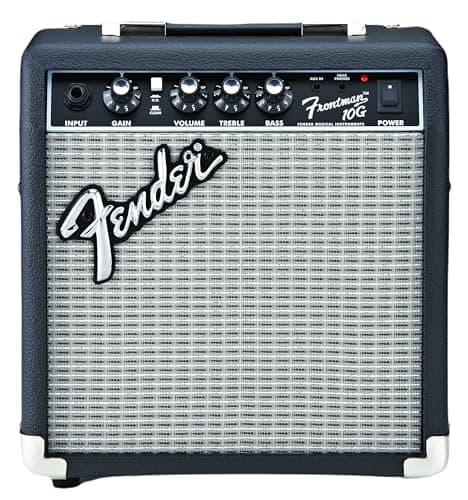
The Fender Frontman 10G#ad is the default first amp. Ten watts, a 6 inch speaker, two channels so clean and dirty are a knob apart, a headphone output and an aux input for playing along with a phone. Eight and a half pounds, and it does exactly what it says.
The Boss Katana Mini#ad is the more interesting box. Seven watts through a smaller 4 inch speaker, but with three amp voices, a genuine three-band analog tone stack rather than a single tone knob, a built-in tape-style delay, and AA battery power for around seven hours. Three pounds, so it genuinely travels.
The trade is specific: the Fender has the bigger speaker and the aux input; the Boss sounds better and goes anywhere. If the amp will sit on a desk next to a phone, take the Fender. If it will move around the house or leave it, take the Boss.
What to skip
The amp inside a very cheap starter bundle. At the bottom of the market the amplifier is frequently a buzzing speaker in a box with a volume knob, and it makes every note the beginner plays sound bad. They cannot tell whether it is them or the gear, which is the same trap as an out-of-tune guitar — see are cheap guitars worth it.
Anything without a headphone socket, for the reason above.
A big amp bought for the future. A 40 watt combo in a bedroom is never turned above two, which is exactly where most amps sound worst, and it is heavy, expensive and loud enough to be a household problem the first time it is turned up.
What you still need
A guitar cable, which is not usually included. Headphones — any closed-back pair works. And that is genuinely it: an electric guitar, an amp, a cable, a tuner and headphones is a complete setup.
Which amp suits which guitar is a separate question, and it changes what you can play — we match three complete first rigs in best guitar and amp pairings for beginners.
Quick picks
If it lives on a desk and needs a headphone socket
Ten watts through a 6 inch speaker with a headphone output and an aux input. The default first amp for a reason.
| # | Product | Best for | Score | Price |
|---|---|---|---|---|
| 1 | Fender Frontman 10GTen watts, a 6 inch speaker, a headphone socket and an aux input. | The default first ampThe honest floor | 8.2 | $89.99 · View on Amazon #ad How we’re funded |
If it needs to move, or you care about the tone
Seven watts, three amp voices, a real three-band analog tone stack and AA battery power. It sounds better than its size suggests.
| # | Product | Best for | Score | Price |
|---|---|---|---|---|
| 1 | 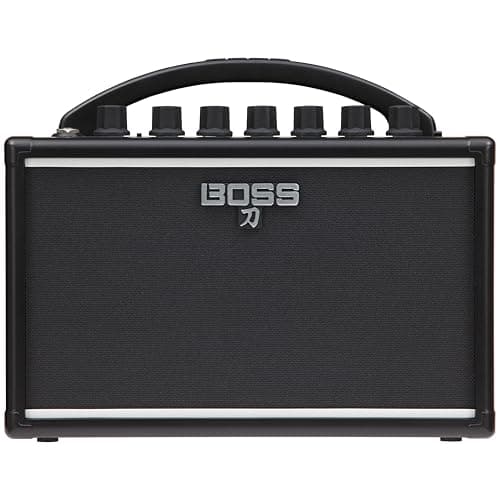 Boss Katana MiniSeven watts, three amp voices and a real analog three-band tone stack, running off AA batteries for around seven hours. | Battery power, better toneEnough | 8.6 | $114.99 · View on Amazon #ad How we’re funded |
The picks in full
Boss Katana Mini
BossBest for: Battery power, better tone
Seven watts, three amp voices and a real analog three-band tone stack, running off AA batteries for around seven hours. It sounds considerably better than its size suggests.
Published specifications
- Power:
- 7 W
- Speaker:
- 4" special design
- Amp types:
- Brown, crunch, clean
- Tone stack:
- Three-band analog
- Effects:
- Built-in tape-style delay
- Power source:
- AC adapter or AA batteries, approx. 7 hours alkaline
- Dimensions:
- 9" x 7" x 5"
- Weight:
- 3 lb
What it gets right
- Battery power and three pounds means it goes to a friend's house, a park, or a bedroom floor without a cable hunt
- A genuine three-band analog tone stack rather than a single tone knob — you can actually shape the sound
- The multi-stage gain circuit is a real step above the fizz of most amps this size
Where it gives ground
- A 4 inch speaker is smaller than the Frontman's 6 inch, and it shows in the low end
- No aux input on the standard model, so playing along to music needs another route
What it is not good at
Being the last amplifier anyone buys. It is excellent for what it is and it is still a 7-watt practice box; a player joining a band will outgrow it fast.
How the specs score against a beginner’s needs
Scores are our reading of the published specifications above against what a beginner physically needs. They are not test results — we have not played this instrument.
Specifications from Sweetwater — Boss Katana Mini specifications.
Fender Frontman 10G
FenderBest for: The default first amp
Ten watts, a 6 inch speaker, a headphone socket and an aux input. It is the amplifier almost every first electric guitar gets paired with, and there is no reason to argue with that.
Published specifications
- Power:
- 10 W
- Speaker:
- 6" special design
- Channels:
- Normal and drive, switchable
- EQ:
- 2-band
- Connections:
- 1/8" aux in, 1/8" headphone out
- Cabinet:
- Closed back
- Dimensions:
- 11" H x 10.25" W x 5.75" D
- Weight:
- 8.5 lb
What it gets right
- Headphone output — the single feature that decides whether an electric guitar can be practiced in the evening
- Aux input, so a beginner can play along with a phone without any extra hardware
- Two channels, so clean and distorted are a knob apart rather than a pedal purchase away
Where it gives ground
- The drive channel is fizzy at high gain, which is what you expect from a solid-state amp at this size
- A 6 inch speaker has no low end to speak of
What it is not good at
Playing with a drummer. Ten watts through a 6 inch speaker is a bedroom amplifier, and it will disappear the moment anyone hits a snare. That is fine — it is not what it is for.
How the specs score against a beginner’s needs
Scores are our reading of the published specifications above against what a beginner physically needs. They are not test results — we have not played this instrument.
Specifications from Sweetwater — Fender Frontman 10G specifications.
Questions people actually ask
How many watts does a beginner guitar amp need?
Far fewer than people expect. Seven to fifteen watts is ample for a bedroom, and wattage is close to irrelevant for a beginner. What matters is whether it has a headphone socket, because that is what decides whether the guitar can be played at ten in the evening.
Do I need an amp for an electric guitar?
To make a useful sound, yes. An unplugged electric is audible but very quiet and thin — fine for silent finger practice, useless for anything else. Budget the amp as part of the guitar purchase rather than discovering it afterward.
Can I use headphones with a guitar amp?
Only if it has a headphone socket, and not every practice amp does. It is the first thing to check on any amp you are considering, and both picks here have one.
Is a modeling amp better for a beginner?
Usually yes. A modeling amp gives several usable voices from one box, so a beginner can hear what a clean sound and a distorted sound actually are without buying pedals. The Katana Mini is the small end of that idea.
Sources
Still deciding?
Every recommendation on this site is built the same way, and the method is published in full — including what we do not do and what would get a pick dropped.
Read next
- Best beginner electric guitars: what's worth it from $150 to $400
Segmented by player and price band, with the three specs that actually decide whether a first electric survives its first year.
- Acoustic vs electric guitar for beginners
The physical difference is real but small. The cost difference is larger than most people expect. Buy CTAs for both answers.
- How much should a beginner guitar cost?
Four price bands defined by specification rather than by number, plus the hidden costs that turn a $200 budget into a $270 purchase.
- Best beginner bass guitars
Why a bass is not a big guitar, the two picks worth considering, and the amplifier cost nobody budgets for.
- Best beginner guitar strings
Why gauge outranks brand, the default set for electric and acoustic, and when going lighter actually helps.