Guitars
How to change guitar strings
The first genuinely useful maintenance skill, it takes twenty minutes the first time and five after that, and nobody teaches it.
By Sawyer V. · Published · Last updated

Changing strings is the first real maintenance job a guitarist learns, and it is one of very few things on this site you can genuinely get wrong in a way that damages the instrument. It is also easy once you have done it once.
Have the new set ready before you start — our strings guide covers which gauge to buy, which matters more than the brand.
What you need
A fresh set of the right gauge. Wire cutters. A string winder, which turns a ten-minute job into a two-minute one and costs very little. For an acoustic, something to lift the bridge pins — most string winders have a notch cut for exactly this, and it is far safer than pliers.
The sequence
1. Loosen and remove the old strings
Slacken each string with the tuner until it is completely loose, then cut it near the middle and remove both halves. Cutting a string under tension is the most common way people get hurt doing this — slacken first, every time.
On an acoustic, the ball end is held by a bridge pin. Lift the pin gently with the notch on a string winder. If it resists, push the string slightly further into the hole first to unseat the ball, then lift again. Never lever with metal pliers; the bridge is soft wood and it chips.
On an electric, the string either passes through the bridge or through the body from the back. Push the old one out the way it came.
2. Clean while it is empty
Two minutes, once every few months, and this is the only opportunity you get. Wipe the fretboard and around the frets with a dry cloth. Wipe the bridge and the area under where the strings sit, where dust and skin collect.
If the fretboard is rosewood or laurel and looks dry and gray, a very small amount of fretboard conditioner is worth doing at this point. A maple fretboard with a lacquer finish needs nothing but a wipe.
3. Fit the new string at the bridge
Acoustic: drop the ball end into the hole, insert the pin with its groove facing the nut, and pull gently up on the string until the ball seats against the underside of the bridge plate. You will feel it stop. Hold the pin down while you take up the slack, or it will pop out.
Electric: thread it through the bridge or the body until the ball end seats.
4. Wind it onto the post
The part people get wrong. Pull the string up to its tuning post, then pull back about two to three inches of slack — roughly the distance to the next post up. That slack becomes your wraps.
Thread it through the hole, kink it, and wind so that each wrap sits below the one before, working down the post toward the headstock. Aim for two to three neat wraps. Downward wraps increase the angle the string breaks over the nut, and a good break angle is part of what keeps a guitar in tune.
5. Tune up, stretch, repeat
Bring each string roughly to pitch. Then gently pull each one away from the fretboard at the twelfth fret — firmly, not violently — and retune. It will have gone flat. Repeat three or four times per string until it stops dropping.
This is the step that separates a guitar that settles in twenty minutes from one that drifts for three days. Skipping it is the most common beginner mistake.
6. Trim
Cut the excess close to the post. Leave a few millimeters rather than cutting flush; the cut ends are sharp and a stub you can see is a stub you will not catch a finger on.
The three mistakes
Cutting a string under tension. It whips. Slacken first.
Too much slack at the post, producing eight overlapping wraps that slip against each other and never hold pitch. Two to three neat wraps is the target.
Not stretching them, then concluding the guitar has a fault when it will not hold tune for two days.
Why they sound wrong at first
Brand-new strings are noticeably brighter than what you were playing an hour ago, and for the first day they can sound almost harsh. That settles within a few hours of playing as the very top end comes off.
The bigger surprise is usually the opposite direction: how dull the old ones had become. String wear is gradual enough that nobody notices it happening, which is exactly why so many beginners are playing on strings that have been dead for a year.
What we would buy
D'Addario EXL110 (10-46)
D'AddarioBest for: Electric, the default gauge
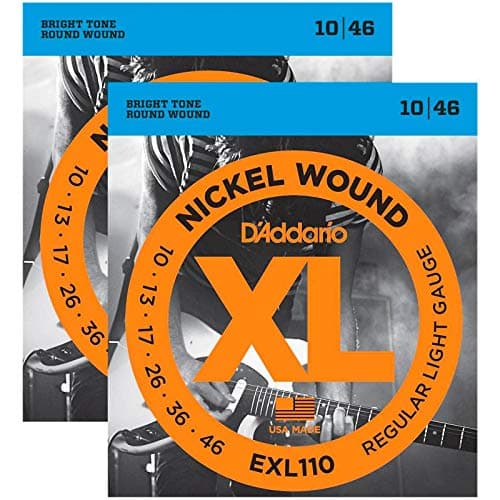
Regular light 10-46 nickel-wound, which is the gauge nearly every electric guitar leaves the factory with and the one every setup assumes.
Published specifications
- Gauge:
- 10-46, regular light
- Core:
- High carbon steel hex core
- Wrap:
- Nickel-plated steel
- Fits:
- Electric guitar, standard tuning
What it gets right
- The gauge most electrics ship with, so changing to these keeps the existing setup correct with no truss rod adjustment
- Nickel-plated steel is bright without being harsh, and it suits every style a beginner will try
- Cheap enough to keep a spare set in the case, which every guitarist should
Where it gives ground
- Nickel-wound strings dull faster than coated sets, so they need changing more often
- 10-46 is a compromise gauge: heavier players may want more tension, benders may want less
What it is not good at
Drop tunings. Tuned down, a 10-46 set goes slack and buzzes. Anyone tuning below standard should move to a heavier gauge and expect a setup afterward.
How the specs score against a beginner’s needs
Scores are our reading of the published specifications above against what a beginner physically needs. They are not test results — we have not played this instrument.
Specifications from D'Addario — EXL110 XL Nickel Wound.
D'Addario EJ16 (12-53)
D'AddarioBest for: Acoustic, the default gauge
Light-gauge phosphor bronze at 12-53, the acoustic equivalent of the EXL110: the gauge most steel-string acoustics ship with and the one they are set up for.
Published specifications
- Gauge:
- 12-53, light
- Wrap:
- Phosphor bronze
- Fits:
- Steel-string acoustic guitar
What it gets right
- Phosphor bronze is warmer and lasts longer than plain 80/20 bronze, which is the other common acoustic wrap
- 12-53 matches what most acoustics leave the factory with, so no setup change is needed
- Widely stocked, so a broken string on a Sunday is solvable
Where it gives ground
- Light gauge on a dreadnought gives up some volume against a medium set
- Uncoated, so they dull faster than a coated string in humid hands
What it is not good at
A classical or nylon-string guitar. Steel strings on an instrument built for nylon will damage it — check what your guitar takes before buying any set.
How the specs score against a beginner’s needs
Scores are our reading of the published specifications above against what a beginner physically needs. They are not test results — we have not played this instrument.
Specifications from D'Addario — EJ16 Phosphor Bronze acoustic strings.
Questions people actually ask
Should I change all the strings at once?
Yes, change the full set. Mixing one new string with five worn ones sounds obviously uneven. Some people remove and replace them one at a time to keep tension on the neck; on a steel-string guitar with a truss rod that is not necessary, though it does keep the bridge in place on instruments with a floating one.
Why won't my new strings stay in tune?
Because they have not stretched yet. A new string settles over the first day or two of playing and drifts flat repeatedly until it does. You can speed this up by gently pulling each string away from the fretboard a few times and retuning — repeat until it stops going flat.
How many times should the string wrap around the tuning post?
Two to three neat wraps, winding downward so each wrap sits below the last. Too few and the string slips; too many and the coil overlaps itself and slips differently. Neat downward wraps also increase the break angle over the nut, which helps tuning stability.
Do I need any tools?
A string winder and a pair of wire cutters make it much faster, and neither is expensive. A peg puller for acoustic bridge pins is useful and you can manage without — just do not lever a pin out with anything metal, which chips the bridge.
Sources
Still deciding?
Every recommendation on this site is built the same way, and the method is published in full — including what we do not do and what would get a pick dropped.
Read next
- Best beginner guitar strings
Why gauge outranks brand, the default set for electric and acoustic, and when going lighter actually helps.
- Are cheap guitars worth it?
The line between cheap and too cheap, named part by part, with what each failure does to a beginner who cannot diagnose it.
- Best beginner acoustic guitars: solid tops from $200 to $350
Solid versus laminate tops, the dreadnought body-size problem, and picks for adults and children separately.
- Best beginner electric guitars: what's worth it from $150 to $400
Segmented by player and price band, with the three specs that actually decide whether a first electric survives its first year.
- How to tune a ukulele
GCEA explained, using a clip-on tuner, why new strings drift for a week, and when tuning is not the problem.