Guitars
Do you need an amp to learn electric guitar?
Not on day one. But an unplugged electric hides the two mistakes a beginner most needs to hear, and that becomes a problem sooner than you would think.
By Sawyer V. · Published · Last updated
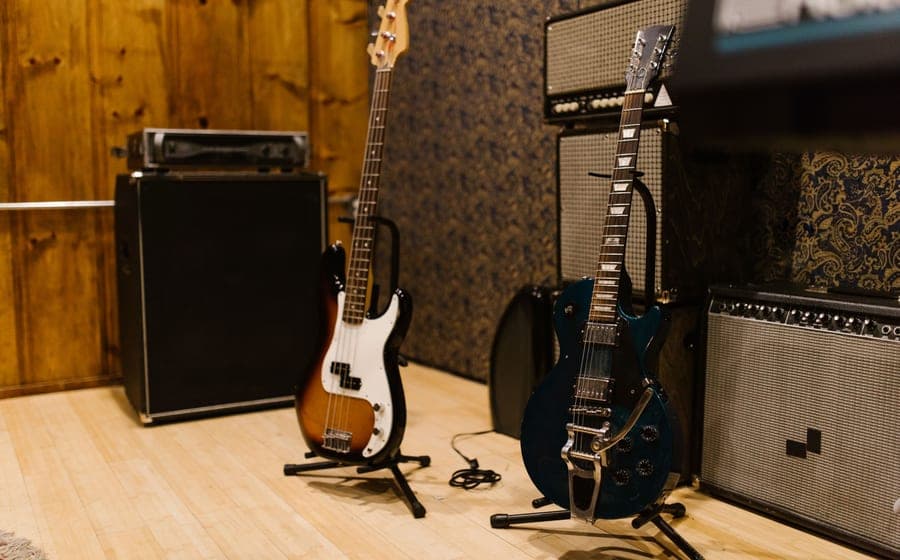
The standard answer is that an electric guitar without an amp is like a car without wheels. That is a good line and it is not true. Plenty of useful practice happens on an unplugged electric, and for a beginner in a shared house it may be the only practice that happens at all.
The honest version has a timeline in it.
No amp is needed for the first few weeks. After that, an unplugged electric hides buzzing notes and unwanted string noise, which are exactly the mistakes a beginner needs to hear. Get amplification of some kind by month two — and if noise is a problem, headphones through a small amp count.
What an unplugged electric is fine for
A solid-body electric makes a real, if quiet, acoustic sound. You can hear pitch, rhythm and whether a note sounded. That covers most of the first month: where the fingers go, chord shapes, changing between them, keeping time, basic strumming patterns.
It also has a substantial practical advantage. An unplugged electric is one of the quietest instruments anyone can practice on — quieter than an acoustic guitar, much quieter than a keyboard’s speakers — which means it can be played on a sofa at eleven at night without a conversation with anyone. Given that frequency of practice matters more than length, that is worth real money. The wider version of this argument is in best instruments for an apartment.
What it hides, and why that matters
An amplifier does not just make the guitar louder. It magnifies the difference between a clean note and a nearly clean one, and that is the entire pedagogical argument.
Fret buzz. A finger placed slightly too far from the fret produces a buzz that is barely audible unplugged and completely obvious through an amp. A beginner practicing unplugged can spend two months building a finger position that sounds fine to them and terrible through any amplifier.
Unmuted strings. Strings you are not playing ring sympathetically. Left hand muting is a real skill and it is invisible until something amplifies the noise it is supposed to prevent.
Dynamics. How hard you pick changes the sound dramatically through an amp and hardly at all unplugged. Picking-hand control is most of what separates players who sound good from players who sound tentative.
Motivation, honestly. An electric guitar plugged in sounds like the records. Unplugged it sounds like a thin acoustic. That difference is not a technical argument but it is a real one, and enthusiasm is a resource beginners cannot afford to waste.
The three routes to amplification
A small practice combo. The Fender Frontman 10G#ad is the default: 10 watts, a 6 inch speaker, a clean channel and an overdrive channel, plus an aux input so you can play along with music through the same speaker. It is enough for any bedroom and it is the amp most beginners actually buy. Alternatives are in the beginner amp roundup.
A battery amp with better sound. The Boss Katana Mini#ad is smaller and runs on batteries, which makes it the one that goes to a friend’s house or into a garden. It carries a headphone output as well, so it covers silent practice and portable practice with one purchase.
An interface into a laptop. The most flexible and the least immediate. A cheap audio interface plus amp-modeling software gives you every amp sound there is through headphones, and it introduces a setup step before every practice session. That friction is the reason it works better in year two than in month one — the whole principle is in setting up a practice space.
Headphones are the answer more often than people expect
If the reason you have not bought an amp is that you cannot make noise, buy an amp with a headphone socket rather than no amp.
Amplified sound in headphones gives you everything the amp is for — the buzz, the string noise, the dynamics, the tone — at zero volume in the room. The Audio-Technica ATH-M20x#ad is a closed-back monitoring headphone with a fixed 3 meter cable, which is enough to stand up and move without unplugging yourself.
One caution: practicing exclusively through headphones at high volume is a hearing risk that guitarists take less seriously than drummers do. Keep it at a level where you could hold a conversation over it.
What about an acoustic instead?
It is a legitimate alternative and worth stating plainly, because for a fixed budget the acoustic route buys more instrument.
An acoustic guitar needs nothing to be heard. The same money that buys an entry electric plus a small amp buys a noticeably better acoustic, and there is no cable, no power and nothing to set up. Against that, an acoustic is harder on the fingers, louder in a shared house, and is not the instrument if the player specifically wants to sound like the records they listen to.
The full comparison is in acoustic versus electric for beginners, and the budget split is in what a first guitar should cost.
The practical answer
Buy the guitar first if the budget only stretches to one thing. A better guitar with no amp beats a worse guitar with an amp, because the guitar is the part you cannot fix later with an accessory.
Then add amplification within the first month or two — a small combo with a headphone output covers both the loud case and the quiet one. If you are buying both together anyway, a bundle may be the simplest route, and we work through when that is sensible in are guitar starter packs worth it.
What we would buy
Fender Frontman 10G
FenderBest for: The default first amp
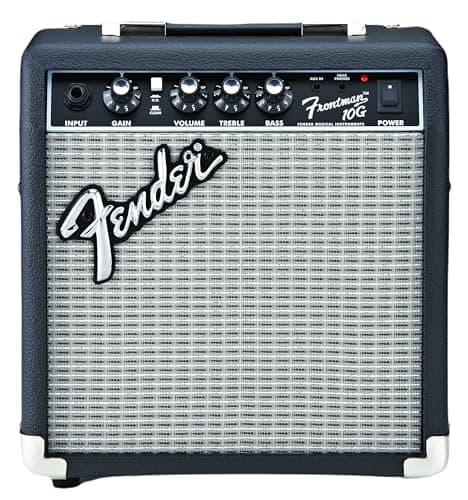
Ten watts, a 6 inch speaker, a headphone socket and an aux input. It is the amplifier almost every first electric guitar gets paired with, and there is no reason to argue with that.
Published specifications
- Power:
- 10 W
- Speaker:
- 6" special design
- Channels:
- Normal and drive, switchable
- EQ:
- 2-band
- Connections:
- 1/8" aux in, 1/8" headphone out
- Cabinet:
- Closed back
- Dimensions:
- 11" H x 10.25" W x 5.75" D
- Weight:
- 8.5 lb
What it gets right
- Headphone output — the single feature that decides whether an electric guitar can be practiced in the evening
- Aux input, so a beginner can play along with a phone without any extra hardware
- Two channels, so clean and distorted are a knob apart rather than a pedal purchase away
Where it gives ground
- The drive channel is fizzy at high gain, which is what you expect from a solid-state amp at this size
- A 6 inch speaker has no low end to speak of
What it is not good at
Playing with a drummer. Ten watts through a 6 inch speaker is a bedroom amplifier, and it will disappear the moment anyone hits a snare. That is fine — it is not what it is for.
How the specs score against a beginner’s needs
Scores are our reading of the published specifications above against what a beginner physically needs. They are not test results — we have not played this instrument.
Specifications from Sweetwater — Fender Frontman 10G specifications.
Boss Katana Mini
BossBest for: Battery power, better tone
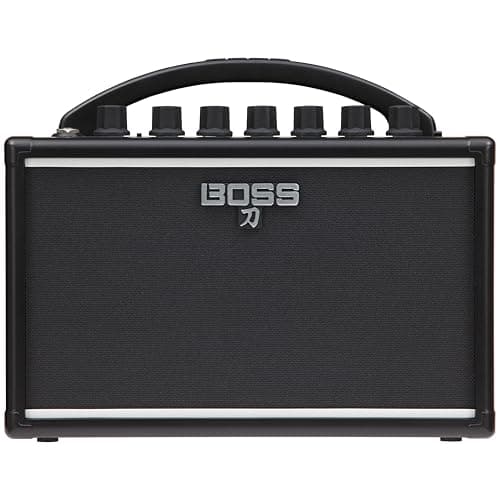
Seven watts, three amp voices and a real analog three-band tone stack, running off AA batteries for around seven hours. It sounds considerably better than its size suggests.
Published specifications
- Power:
- 7 W
- Speaker:
- 4" special design
- Amp types:
- Brown, crunch, clean
- Tone stack:
- Three-band analog
- Effects:
- Built-in tape-style delay
- Power source:
- AC adapter or AA batteries, approx. 7 hours alkaline
- Dimensions:
- 9" x 7" x 5"
- Weight:
- 3 lb
What it gets right
- Battery power and three pounds means it goes to a friend's house, a park, or a bedroom floor without a cable hunt
- A genuine three-band analog tone stack rather than a single tone knob — you can actually shape the sound
- The multi-stage gain circuit is a real step above the fizz of most amps this size
Where it gives ground
- A 4 inch speaker is smaller than the Frontman's 6 inch, and it shows in the low end
- No aux input on the standard model, so playing along to music needs another route
What it is not good at
Being the last amplifier anyone buys. It is excellent for what it is and it is still a 7-watt practice box; a player joining a band will outgrow it fast.
How the specs score against a beginner’s needs
Scores are our reading of the published specifications above against what a beginner physically needs. They are not test results — we have not played this instrument.
Specifications from Sweetwater — Boss Katana Mini specifications.
Audio-Technica ATH-M20x
Audio-TechnicaBest for: Practice headphones
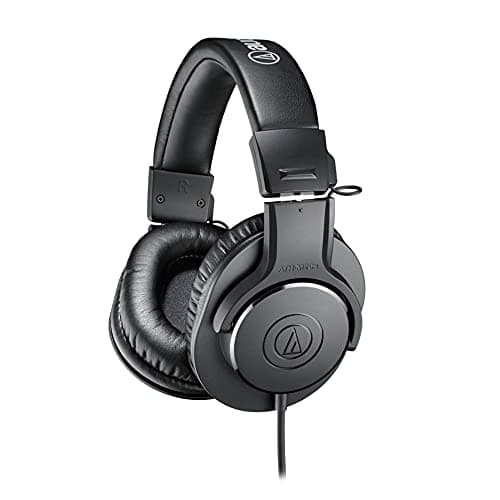
Closed-back 40 mm drivers with a 1/4 inch adapter included, which is the socket most digital pianos actually have. The cheapest headphones we would put on a practicing student.
Published specifications
- Type:
- Closed-back, circumaural (over-ear)
- Drivers:
- 40 mm, copper-clad aluminum voice coils
- Frequency response:
- 15 Hz - 20,000 Hz
- Cable:
- 9.8 ft (3.0 m), single-sided, straight
- Weight:
- 6.7 oz (190 g) without cable
- In the box:
- 6.3 mm (1/4") snap-on adapter
What it gets right
- Closed-back, so the sound stays in and the room stays out — the whole point of practice headphones
- The 1/4 inch adapter is included, and that is the socket most digital pianos have rather than the 1/8 inch a phone uses
- Under 200 grams, which matters over an hour of practice on a child's head
Where it gives ground
- The cable is fixed, not detachable, so a damaged cable means new headphones
- A 3 meter cable is generous at a piano and a trip hazard anywhere else
What it is not good at
Portability. They do not fold flat and there is no case. These live at the instrument.
How the specs score against a beginner’s needs
Scores are our reading of the published specifications above against what a beginner physically needs. They are not test results — we have not played this instrument.
Specifications from Audio-Technica ATH-M20x published specifications.
Questions people actually ask
Can you learn electric guitar without an amp?
For the first few weeks, comfortably. Chord shapes, finger placement and basic strumming all work unplugged. Beyond that you start missing information — specifically, buzzing notes and unwanted string noise that only an amplifier reveals.
How loud is an unplugged electric guitar?
Quiet — roughly comparable to a conversation across a room, and much quieter than an acoustic. It is one of the most neighbor-friendly instruments to practice on in an apartment, which is a genuine and underrated advantage.
What size amp does a beginner need?
Ten watts of solid-state amplification is enough for any bedroom and most living rooms. Wattage only starts to matter when you need to compete with a drummer, which is a year-two problem at the earliest.
Can I use headphones instead of an amp?
Yes, and for many beginners it is the better answer. A small amp with a headphone output, a dedicated headphone amp, or an audio interface into a laptop all give you the amplified signal at zero volume in the room.
Sources
Still deciding?
Every recommendation on this site is built the same way, and the method is published in full — including what we do not do and what would get a pick dropped.
Read next
- Best beginner guitar amps
Why the headphone socket outranks wattage, two picks, and the honest limits of a practice amp.
- Are guitar starter packs worth it?
Which pack contents hold up, which get replaced within a month, and the four-item alternative that costs about the same.
- Best beginner electric guitars: what's worth it from $150 to $400
Segmented by player and price band, with the three specs that actually decide whether a first electric survives its first year.
- Best instruments for an apartment
Four instruments that survive a shared wall, ranked by how quiet they are at their loudest, plus the headphones that make the difference.
- Acoustic vs electric guitar for beginners
The physical difference is real but small. The cost difference is larger than most people expect. Buy CTAs for both answers.