Drums
Best drum books for beginners
There are two kinds of beginner drum book and they teach different instruments. Work out which one you own before you spend anything.
By Sawyer V. · Published · Last updated
Almost every other instrument has one obvious first book. Drums has two, they look alike on a shelf, and nothing on either cover says plainly which instrument it teaches. A parent buying for a child in school band and a parent buying for a child with a kit in the garage need different books, and buying the other one wastes both the money and the first month.
Every pick below states its Starter Path band, and we have not worked through any of them cover to cover — the method is on how we pick. Authors, page counts and contents come from Alfred Music’s own catalog entries, cited at the bottom.
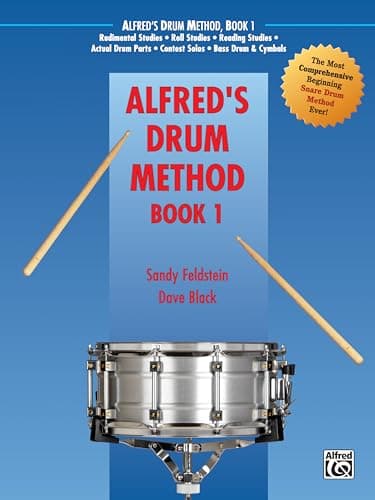
Decide which instrument you own first. School band means a snare drum and the book is Alfred’s Drum Method, Book 1 (80 pages, rudiments and 23 solos). A kit at home means Alfred’s Beginning Drumset Method (48 pages, rock and jazz, playing a beat in lesson one). Add Stick Control to either within the first month — it is 48 pages of hand technique that will still be useful in twenty years.
The decision nobody tells you about
A drum kit and a snare drum are, pedagogically, two different instruments. They share sticks and some notation and almost nothing else.
A snare drummer plays one drum with two hands. The skills are rudiments — named sticking patterns like the paradiddle and the flam — roll control, dynamics, and reading a part off a page in an ensemble. This is what school band and orchestra assess, and it is what Alfred’s Drum Method, Book 1 teaches across its 80 pages.
A drum set player coordinates four limbs across several instruments. The skills are independence, groove, and keeping time while the hands do different things. Alfred’s Beginning Drumset Method teaches that in 48 pages split into a rock section and a jazz section, and Alfred states its design goal plainly: the student plays a beat in the first lesson.
The practical test is simple. If a school sent a letter, the instrument is a snare drum (possibly inside a percussion kit with a bell set — our page on percussion kits for school band covers those). If the instrument arrived from a shop with cymbals attached, it is a kit. Buy accordingly.
Why Stick Control is on every drummer’s shelf
George Lawrence Stone’s Stick Control#ad is 48 pages, has no explanatory text, no audio and no tunes, and Modern Drummer named it the first of the 25 greatest drum books of all time in 1993. Stone’s own stated aim is control, speed, flexibility, touch, rhythm, lightness, delicacy, power, endurance, preciseness of execution and muscular coordination, “with extra attention given to the development of the weak hand.”
That last clause is the whole thing. The limiting factor for a right-handed drummer for the first several years is the left hand, and it is a limit most self-taught players never notice because they instinctively arrange everything to avoid it. Stick Control removes the option: the patterns are symmetrical and the weak hand gets exactly as much work as the strong one.
It works on a practice pad, a pillow or a kit, so it costs nothing to use. What it does need is a reason and a metronome, which is why it is a companion to a method rather than a replacement for one.
When Syncopation becomes the right purchase
Progressive Steps to Syncopation for the Modern Drummer#ad is 64 pages, the cheapest book here, and Modern Drummer put it second behind Stick Control on the same 1993 list. Alfred publishes its contents: accented eighths, dotted eighths and sixteenths, eighth-note triplets, sixteenth notes and extended solos.
It is the book teachers use as raw material. A single page of rhythms can generate dozens of exercises — play the line with the hands and quarter notes with the foot, then swap, then swap again — which is why lessons keep returning to it for years. On its own, without someone to assign those variations, it is 64 pages of rhythms with no instructions.
Buy it when reading is what is holding the player back, which is usually around the point they can play a beat comfortably but cannot learn a song from a chart.
What we did not list, and why
Drumming for Dummies and similar broad guides were left off because the drums situation is different from the guitar one. A guitarist genuinely benefits from a book that covers buying and setting up the instrument; a drummer’s equivalent questions — what size kit, acoustic or electronic, how loud is it really — are decisions made before any book is bought, and we answer them on how to buy your first drum set and how loud drums actually are.
Alfred’s Drum Method, Book 2 and the book-plus-video editions of both methods exist and are reasonable. They are not listed because the decision this page is for is the first purchase, and the first purchase should be Book 1 of whichever method matches the instrument.
Realistic Rock, Future Sounds and the other classic intermediate titles are excellent and assume a player who can already keep time around a kit. Naming them here would be the same error as recommending Stick Control as a first and only book.
Free online lesson material is a genuine competitor to all of these and we are not pretending otherwise. What a book does that a video does not is sit open on a stand in a fixed order so that a parent can see what week the student is on. For a child, that structure is most of the value.
What to own alongside the book
A metronome, before anything else. Everything in all four of these books is a timing exercise whether it says so or not, and a drummer practicing without a reference is practicing their own drift. Our metronome roundup covers the cheap ones that work.
A practice pad, if the instrument is a kit. Nothing in Stick Control needs a kit, and pad practice is the only drum practice that can happen while someone else is on the phone in the next room. The practice pad roundup covers those.
And sticks that fit the player — a 5A is the default for a reason, and a child with adult sticks will develop a grip that has to be undone later. Our page on choosing drum sticks works through the sizing.
Quick picks
If the player is in school band
School percussion is snare drum first, and this is the book the program almost certainly uses. 80 pages of rudiments, rolls, bass drum and cymbal technique, and 23 written solos.
| # | Product | Best for | Score | Price |
|---|---|---|---|---|
| 1 | Alfred's Drum Method, Book 180 pages of sequential snare drum instruction: rudiments, roll studies, bass drum and cymbal technique, and 23 solos written for recitals and contests. | The school snare drummerThe honest floor | 8.2 | $12.99 · View on Amazon #ad How we’re funded |
If there is a drum kit in the house
A drumset method, which is a different book entirely. The student plays a beat in lesson one, and the rock and jazz sections teach the limbs working together rather than one hand at a time.
| # | Product | Best for | Score | Price |
|---|---|---|---|---|
| 1 | 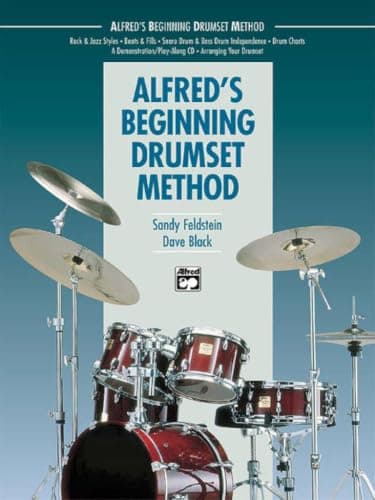 Alfred's Beginning Drumset Method48 pages split into a rock section and a jazz section, and the student plays a beat in the first lesson rather than reading rests for a month. | The kid who has a kit at homeThe honest floor | 8.0 | $10.99 · View on Amazon #ad How we’re funded |
The book they will still be using in twenty years
48 pages of sticking patterns and no explanation at all. It is not a method and it is not optional: every drummer who develops a reliable weak hand does it with this book or something like it.
| # | Product | Best for | Score | Price |
|---|---|---|---|---|
| 1 | 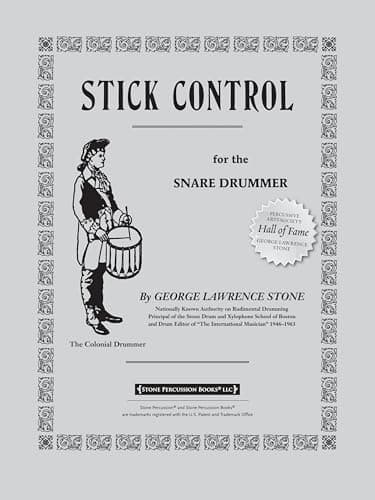 Stick Control: For the Snare Drummer48 pages of sticking patterns and nothing else - no tunes, no explanations, no audio. | Hand technique, for the next ten yearsEnough | 8.4 | $12.99 · View on Amazon #ad How we’re funded |
When reading becomes the limit
The rhythm-reading book teachers mine for exercises. Cheapest book here and the one with the longest working life, and completely useless without someone to say what to do with a page.
| # | Product | Best for | Score | Price |
|---|---|---|---|---|
| 1 | 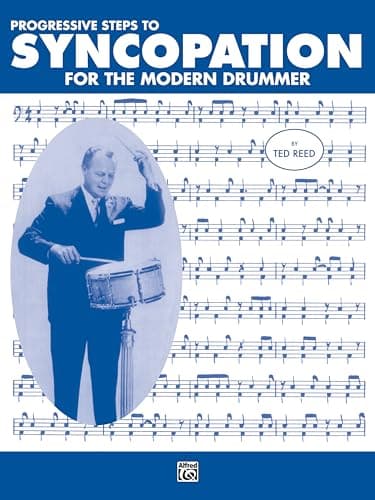 Progressive Steps to Syncopation for the Modern Drummer64 pages written to do one thing: teach a drummer to read syncopated rhythm. | Learning to read rhythmEnough | 8.0 | $9.99 · View on Amazon #ad How we’re funded |
The picks in full
Alfred's Drum Method, Book 1
Alfred MusicBest for: The school snare drummer
80 pages of sequential snare drum instruction: rudiments, roll studies, bass drum and cymbal technique, and 23 solos written for recitals and contests. This is the book a school band program hands out, and it is a snare book, not a drum kit book.
Published specifications
- Authors:
- Dave Black and Sandy Feldstein
- Instrument:
- Snare drum (concert and rudimental), not drum set
- Pages:
- 80
- Contents:
- Rudimental studies, roll studies, contest solos, bass drum and cymbal technique, 23 solos
- Publisher item:
- Alfred 00-138
- ISBN:
- 978-0-88284-793-1
What it gets right
- It is what school percussion programs actually use, so a student arrives with the same book as the class
- 23 written solos, which means there is performable material rather than only exercises
- Covers bass drum and cymbal technique, which the concert percussion student will be assessed on and which drum-set books ignore
- Sequential: the order is the lesson plan, so a parent can see what week they are on
Where it gives ground
- No drum set content at all - no beats, no coordination between limbs
- Reading-first, so a child who wants to play along to music will not find any here
- No audio included with the plain book edition
- The notation assumes someone will explain the rudiment names
What it is not good at
Teaching anyone to play a drum kit. It never asks the student to use both feet and both hands together, because that is not what a snare method is for. If there is a kit in the house, this is the wrong book.
How the specs score against a beginner’s needs
Scores are our reading of the published specifications above against what a beginner physically needs. They are not test results — we have not played this instrument.
Specifications from Alfred Music — Alfred's Drum Method, Book 1 (item 00-138): Dave Black and Sandy Feldstein, 80 pages, rudimental and roll studies, 23 solos, ISBN 978-0-88284-793-1.
Alfred's Beginning Drumset Method
Alfred MusicBest for: The kid who has a kit at home
48 pages split into a rock section and a jazz section, and the student plays a beat in the first lesson rather than reading rests for a month. If the drums in the house are a kit rather than a practice pad, this is the book - and it costs less than the snare method.
Published specifications
- Authors:
- Dave Black and Sandy Feldstein
- Instrument:
- Drum set
- Pages:
- 48
- Structure:
- Two sections: rock and jazz
- Covers:
- How hi-hat, ride cymbal, snare and bass drum are used in each style
- Audio:
- Play-along CD available separately, not included
- ISBN:
- 978-0-7390-0553-8
What it gets right
- The student plays an actual beat in lesson one, which is the single biggest predictor of a beginner continuing
- Splits rock and jazz rather than pretending one set of coordination patterns covers both
- Teaches the limbs together from the start, which is the whole difficulty of the drum set and the thing a snare book never addresses
- 48 pages at the lowest price of any book on this page
Where it gives ground
- No rudiments to speak of, so the hand technique a band director expects is not here
- The play-along CD is a separate purchase, and the book is noticeably thinner without it
- 48 pages runs out faster than the snare method does
- Does not prepare a student for concert percussion auditions
What it is not good at
Serving a school band student. School percussion is snare, mallets and timpani before it is ever a kit, and nothing in this book is assessed in that setting.
How the specs score against a beginner’s needs
Scores are our reading of the published specifications above against what a beginner physically needs. They are not test results — we have not played this instrument.
Specifications from Alfred Music — Alfred's Beginning Drumset Method (item 00-8965): Dave Black and Sandy Feldstein, 48 pages, rock and jazz sections, ISBN 978-0-7390-0553-8.
Stick Control: For the Snare Drummer
Stone Percussion BooksBest for: Hand technique, for the next ten years
48 pages of sticking patterns and nothing else - no tunes, no explanations, no audio. Modern Drummer named it the first of its 25 greatest drum books in 1993, and it is the one book on this page a drummer will still be using in twenty years.
Published specifications
- Author:
- George Lawrence Stone
- Pages:
- 48
- Publisher:
- Stone Percussion Books, LLC
- Contents:
- Single-beat combinations, triplets, short roll combinations, flam beats, flam triplets, dotted notes, short roll progressions
- Stated aim:
- Control, speed, flexibility, touch, endurance and coordination, with extra attention to the weak hand
- Publisher item:
- Alfred 00-32749
What it gets right
- The weak-hand emphasis is the reason it works: the left hand of a right-handed drummer is the limiting factor for years and this is the standard fix
- Works on a practice pad, a pillow or a kit, so it needs nothing bought alongside it
- 48 pages that genuinely last a decade, which no method book on this page can claim
- Every drum teacher knows it, so a student arriving with it is on familiar ground
Where it gives ground
- Not a method: there is no teaching, no notes, no sequence explained - just pages of patterns
- Deeply boring without a teacher or a metronome and a reason
- Nothing about the drum set, feet, or reading rhythms in context
- No audio and no video in any edition
What it is not good at
Being a first book. It assumes someone has already told you how to hold a stick and what the patterns are for; bought alone by a beginner it is 48 pages of apparently identical rows.
How the specs score against a beginner’s needs
Scores are our reading of the published specifications above against what a beginner physically needs. They are not test results — we have not played this instrument.
Specifications from Alfred Music — Stick Control: For the Snare Drummer (item 00-32749): George Lawrence Stone, Stone Percussion Books LLC, 48 pages, contents and stated aims.
Progressive Steps to Syncopation for the Modern Drummer
Alfred MusicBest for: Learning to read rhythm
64 pages written to do one thing: teach a drummer to read syncopated rhythm. Modern Drummer voted it second of the 25 greatest drum books in 1993, and teachers use its pages as raw material for exercises they invent on the spot.
Published specifications
- Author:
- Ted Reed
- Pages:
- 64
- Focus:
- Syncopation and reading, for drum set
- Contents:
- Accented eighths, dotted eighths and sixteenths, eighth-note triplets, sixteenth notes, extended solos
- Publisher item:
- Alfred 00-17308
- ISBN:
- 978-0-88284-795-5
What it gets right
- The cheapest book on this page and the one with the longest working life after Stick Control
- Built so a teacher can generate dozens of exercises from a single page, which is why lessons keep returning to it
- Reading syncopation is the skill that separates a drummer who can learn a song from one who needs to hear it twenty times
- Works equally for rock, jazz and funk because it teaches rhythm rather than style
Where it gives ground
- Gives almost no instruction: the pages are rhythms, and what to do with them comes from a teacher
- No audio, no video, no play-along
- A complete beginner cannot start here - it assumes reading quarter and eighth notes already
- Visually austere in a way that loses children quickly
What it is not good at
Standing alone for a self-taught beginner. Without someone to say 'play this line with your hands and quarter notes with your foot', it is 64 pages of rhythms with no instructions attached.
How the specs score against a beginner’s needs
Scores are our reading of the published specifications above against what a beginner physically needs. They are not test results — we have not played this instrument.
Specifications from Alfred Music — Progressive Steps to Syncopation for the Modern Drummer (item 00-17308): Ted Reed, 64 pages, contents, ISBN 978-0-88284-795-5.
Questions people actually ask
What is the best drum book for a complete beginner?
It depends on which instrument they have. If the player is in a school band program, the instrument is a snare drum and the book is Alfred’s Drum Method, Book 1#ad. If there is a drum kit at home, the book is Alfred’s Beginning Drumset Method#ad. They are different books by the same two authors and they are not interchangeable.
What is the difference between a snare method and a drumset method?
A snare method teaches one drum with two hands: rudiments, rolls, reading, and the technique a concert or marching percussionist is assessed on. A drumset method teaches four limbs on several instruments at once: hi-hat, ride, snare and bass drum in a groove. A student can finish a snare method and still not be able to play a beat, and finish a drumset method with no rudiments at all. Both of those are the book working as designed.
Is Stick Control a beginner book?
It is used by beginners and it is not a beginner book. There is no instruction in it — 48 pages of sticking patterns, and the student is expected to already know how to hold a stick and why they are doing this. Bought alongside a method, or with a teacher, it is the best value on this page. Bought alone by a self-taught beginner it is 48 pages of apparently identical rows.
Do I need a drum kit to use a drum book?
Not for the snare books. Alfred’s Drum Method, Stick Control#ad and Syncopation#ad all work on a practice pad, and a pad plus sticks plus Stick Control is a genuinely complete starting setup for far less than a kit. Our practice pad roundup covers the pads worth buying.
Do these books come with audio?
Mostly not, and this is where drum books differ from guitar and piano books. The plain editions of Alfred’s Drum Method and the Beginning Drumset Method have no audio included — Alfred sells book-and-video and book-and-CD editions as separate items. Stick Control and Syncopation have never had audio in any edition, because neither is music. Budget for a metronome instead.
Which book should an adult beginner start with?
An adult with a kit should start with the drumset method and add Stick Control within the first month. Adults tend to have the patience for Stick Control that children do not, and the weak-hand development it produces is the difference between a drummer who can play a fill and one who can only play a beat. Add Syncopation#ad once reading becomes the thing holding you back, which is usually around month six.
Sources
- Alfred Music — Alfred's Drum Method, Book 1 (item 00-138): authors, 80 pages, contents, ISBN
- Alfred Music — Alfred's Beginning Drumset Method (item 00-8965): authors, 48 pages, rock and jazz sections, ISBN
- Alfred Music — Stick Control: For the Snare Drummer (item 00-32749): author, publisher, 48 pages, contents and stated aims
- Alfred Music — Progressive Steps to Syncopation for the Modern Drummer (item 00-17308): author, 64 pages, contents, ISBN
Still deciding?
Every recommendation on this site is built the same way, and the method is published in full — including what we do not do and what would get a pick dropped.
Read next
- Drum rudiments a beginner should learn
The five rudiments that matter, what each one builds, and a practice routine that fits fifteen minutes on a pad.
- Best drum practice pads
Gum rubber versus neoprene, why 12 inches is the right size, and the honest limit of what pad practice builds.
- Best beginner drum sets: complete kits for teens and adults
Complete acoustic and electronic kits for adult players, with the total-purchase problem and the noise question both addressed.
- Best percussion kits for school band
What a school percussion supply list actually asks for, what 2.5 octaves means, and two kits with published contents.
- Best piano books for beginners
Adult or child, teacher or alone: the two questions that pick the book, plus four current methods with their weaknesses stated.
- Best guitar books for beginners
The one decision that matters (chords first or reading first), five things to check on any method book, and seven picks with their weaknesses stated.