Keys
Best piano books for beginners
Piano is the one instrument where reading music is not optional, so the book you start from shapes the whole first year. Two questions decide which one you need.
By Sawyer V. · Published · Last updated
Piano differs from every fretted instrument on this site in one way that decides the whole shelf of books: there is no tablature. A guitarist can play for years from chord boxes and never read a note. A pianist essentially cannot, so the method book is not an optional extra — it is the road.
The good news is that the field is small and stable. Two publishers dominate, the books have been in print for decades, and the differences between them are practical rather than mysterious.
We have not worked through these books. What we compared is what each publisher says the book contains: page count, format, what media is included and how you get it, and the publisher’s own description of the contents. Every figure on the cards below links to that publisher page, and the method is on how we pick.
Adult teaching yourself: Adult Piano Adventures All-in-One Book 1, because the video and audio come with it. Adult with a teacher: Alfred’s Basic Adult All-in-One Course Book 1, or whatever your teacher uses. Child: Alfred’s Basic Piano Library Lesson Book 1A. Keep Piano & Keyboard All-in-One For Dummies beside the method as a reference, not instead of one.
Two questions pick the book
Everything else is detail.
1. Adult or child? This is not snobbery about repertoire; it is pacing and page design. Children’s methods move slowly, put one idea on a page and use large notation. Adult methods cover the same first six months in roughly half the pages and assume you can read a paragraph of explanation. An adult given a children’s book gets bored; a seven-year-old given an adult book gets lost.
2. Teacher or no teacher? The question most buyers skip. Some books are written as a teacher’s curriculum and say so — Alfred states plainly that its adult course is designed for use with an instructor. Those books can be sparse on explanation because a person is supposed to fill the gaps. A self-teacher wants the opposite: more explanation, and recordings of how it should sound.
What to check on any piano method
Five things, and the publisher’s own page answers all of them.
1. Is audio included, and how do you get it? A beginner cannot tell from the page whether their rhythm is right. On this page the answers vary more than you would expect: Faber includes online video and audio, Wiley hosts streaming and downloadable audio, Alfred’s children’s book offers a CD version, and Alfred’s adult item includes nothing at all.
2. Does it lie flat? Trivial-sounding and genuinely important, because a book that snaps shut on the music desk is a book you fight every session. Faber’s adult book is spiral bound and Alfred’s adult course is Wire-O; both stay open.
3. Is the repertoire published? Alfred lists the complete song list for both of its books here. Faber publishes a partial list, and Wiley publishes none. If the songs matter to you — and for motivation they do — buy from a publisher that shows you the list.
4. All-in-one, or lesson plus theory plus technique? The older model sells three thin books per level. All-in-one volumes fold them together, which is one purchase and one thing to carry.
5. How far does it go? The books here run from 64 pages to 640. More is not better: a 64-page book a child finishes beats a 640-page reference that stays shut.
How we ranked these
Five criteria, in this order, and all of them are our reading of each publisher’s published contents rather than the result of working through the books.
Gets you playing songs first, because a piano beginner who is still doing finger drills in month two usually stops.
Works without a teacher second: how much explanation and recorded reference the book carries, since most people buying a piano book are buying it instead of lessons.
Scope for the money third — how much of the first year one purchase covers.
Audio support fourth: demonstrations, accompaniments and video.
Room to grow last, because a method with a next book in the same series means nothing is wasted when it works.
The picks
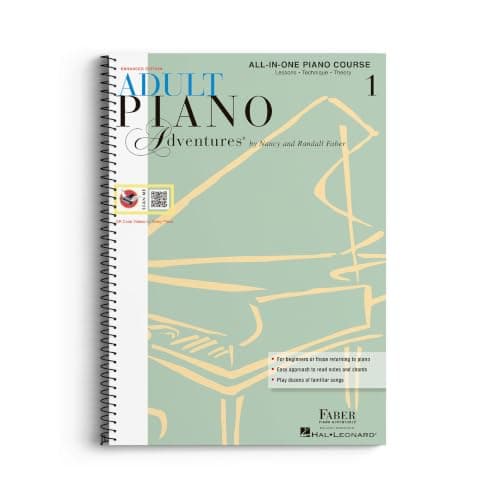
Adult Piano Adventures All-in-One Course Book 1#ad is the one we would hand an adult who has nobody to teach them. 184 spiral-bound pages holding lessons, technique and theory together, and — the part that matters — over two hours of instructional video plus accompaniment tracks online. The named repertoire runs from Eine Kleine Nachtmusik and The Entertainer to The Lion Sleeps Tonight, so it is not all folk songs.
The honest costs: Hal Leonard listed it on back order at its own store when we checked, the full song list is not published (the list ends in “and more”), and the media lives online rather than on a disc, so it needs an internet connection.
Piano & Keyboard All-in-One For Dummies, 2nd Edition#ad is the reference, and it is a big one: 640 pages combining four separate For Dummies titles, including music theory and piano exercises, with streaming and downloadable audio from the publisher’s own resource center. It is also the only book here that covers the electronic side — choosing a keyboard, caring for it, and connecting it to speakers and computers.
What it is not is a graded course. It is a compilation, so there is no single page-by-page progression to follow, and Wiley publishes no repertoire list. Wiley also notes that the current release refreshed the cover and design rather than the content. Buy it beside a method, not instead of one.
Alfred's Basic Adult All-in-One Course, Book 1#ad is the long-running standard, and the one your teacher most likely owns. 160 Wire-O pages of lesson, theory and technique, with additions the others do not advertise: isometric hand exercises, finger strengthening drills and written assignments. Alfred publishes the complete song list, more than seventy titles, which is genuinely useful before buying.
Two honest limits, both from Alfred’s own page. It is “designed for use with a piano instructor,” so a self-teacher is working against the book’s intent. And this item includes no recordings at all — no CD, no online audio — so nothing tells you how a piece should sound. Alfred sells a separate book and DVD item for that.
Alfred's Basic Piano Library Lesson Book 1A#ad is the children’s starting point: 64 pages that begin with the keyboard’s layout and white-key names against the black-key groups, then teach reading through interval recognition — seconds, thirds, fourths, fifths — rather than parking the hand in a fixed position. The song list is published in full and is unmistakably for children: My Robot, The Zoo, Batter Up!
The limits are the flip side of the same design. It is short, it stops around the interval of a fifth plus sharps and flats, so it is a first half rather than a complete beginner course. The audio option at this level is a physical CD rather than online streaming. And an adult will find the artwork and repertoire hard going.
The book cannot fix the keyboard
One thing worth saying on a page about piano books. A method that asks for a sustain pedal in month two assumes an instrument with a pedal jack, and one that spreads the hands two octaves apart assumes enough keys to do it on.
That is why we treat 61 keys as the floor and touch sensitivity as non-negotiable — the reasoning is in 49 vs 61 keys and what you actually need to start piano. If the instrument is still undecided, start with best beginner keyboards.
How to actually use one
Work in order, and do not skip the technique pages. They are short, they are boring, and they are where hand shape comes from.
Play the audio before you play the page. Hearing the piece first turns a page of dots into a target, which is the difference between practicing and decoding.
Short and daily beats long and weekly. Fifteen minutes a day is the habit that moves a beginner through a method book; the fuller argument is in how to practice piano effectively.
Book one lesson when you are three pages stuck. On piano, being stuck is almost always physical — wrist height, thumb position, a collapsing finger joint — and that is the one thing no book can see.
The same decision for guitar, where the answer is genuinely different because tab exists, is in best guitar books for beginners.
Quick picks
An adult teaching themselves
Lessons, theory and technique in one spiral-bound volume, with over two hours of instructional video and accompaniment audio online. The book that assumes nobody is sitting next to you.
| # | Product | Best for | Score | Price |
|---|---|---|---|---|
| 1 | Adult Piano Adventures All-in-One Course Book 1Lessons, technique and theory in one spiral-bound volume, with over two hours of instructional video and accompaniment tracks online. | An adult with no teacherEnough | 8.6 | $19.75 · View on Amazon #ad How we’re funded |
An adult working with a teacher
The long-running Alfred adult course, which the publisher states is designed for use with a piano instructor. No audio is included at this item number.
| # | Product | Best for | Score | Price |
|---|---|---|---|---|
| 1 | 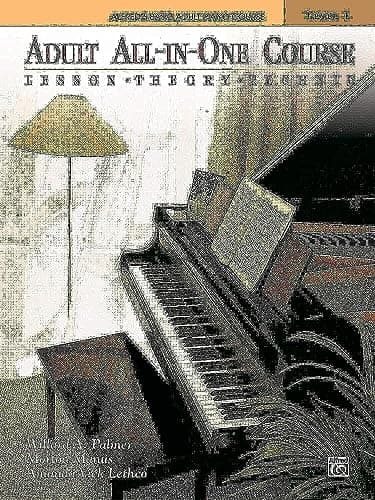 Alfred's Basic Adult All-in-One Course, Book 1The long-running adult standard, and the book your teacher probably owns. | Working with a teacherThe honest floor | 6.2 | $12.84 · View on Amazon #ad How we’re funded |
A child starting out
64 pages that teach reading by interval recognition rather than fixed hand positions, with a song list built around pieces a young child will actually like.
| # | Product | Best for | Score | Price |
|---|---|---|---|---|
| 1 | 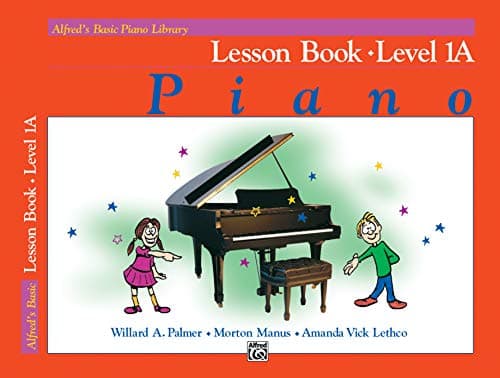 Alfred's Basic Piano Library Lesson Book 1A64 pages that start with the shape of the keyboard and teach reading by interval recognition rather than a fixed hand position. | A child starting outThe honest floor | 5.8 | $9.99 · View on Amazon #ad How we’re funded |
A reference to keep beside the method
640 pages spanning theory, exercises and the electronic side of keyboards, including how to connect one to speakers and computers. A reference, not a course.
| # | Product | Best for | Score | Price |
|---|---|---|---|---|
| 1 | 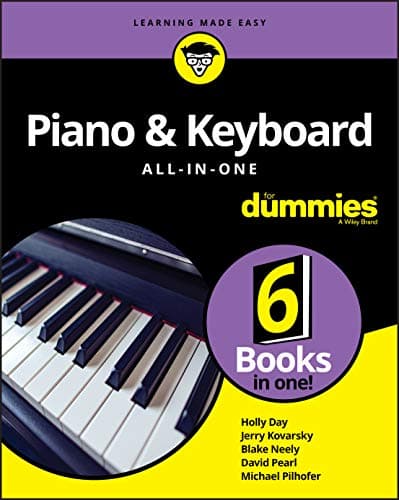 Piano & Keyboard All-in-One For Dummies, 2nd Edition640 pages combining four separate titles, including music theory and piano exercises, with streaming and downloadable audio. | Looking things upEnough | 7.6 | $19.40 · View on Amazon #ad How we’re funded |
The picks in full
Adult Piano Adventures All-in-One Course Book 1
Faber Piano AdventuresBest for: An adult with no teacher
Lessons, technique and theory in one spiral-bound volume, with over two hours of instructional video and accompaniment tracks online. The adult method that assumes nobody is sitting beside you.
Published specifications
- Authors:
- Nancy Faber and Randall Faber
- Pages:
- 184
- Format:
- Spiral-bound softcover, media online
- Media:
- Over two hours of instructional video plus accompaniment audio
- Notation:
- Standard notation; fundamentals of notation, chord playing and musical form
- Item numbers:
- HL 00420242 / Faber FF1302
- ISBN:
- 978-1-6167-7302-1
What it gets right
- One spiral-bound volume covers lessons, technique and theory, so there is no three-book set to assemble
- Over two hours of video is the most instruction of any book here, and it is what a self-teacher is otherwise missing
- Spiral binding lies flat on a music desk across all 184 pages
- Named repertoire spans Eine Kleine Nachtmusik and The Entertainer through The Lion Sleeps Tonight
Where it gives ground
- Hal Leonard listed it on back order at its own store when we checked
- The song list published is partial — it ends in "and more", so you cannot see the full repertoire before buying
- Video and audio live online rather than on a disc, so the media needs an internet connection
What it is not good at
A young child. The pacing and page design assume an adult reader who can take a paragraph of explanation at a time.
How the specs score against a beginner’s needs
Scores are our reading of the published specifications above against what a beginner physically needs. They are not test results — we have not played this instrument.
Specifications from Hal Leonard — Adult Piano Adventures All-in-One Book 1 (HL 420242), Faber Piano Adventures — Adult Piano Adventures All-in-One Book 1.
Piano & Keyboard All-in-One For Dummies, 2nd Edition
WileyBest for: Looking things up
640 pages combining four separate titles, including music theory and piano exercises, with streaming and downloadable audio. The only book here that also covers choosing a keyboard and wiring it up.
Published specifications
- Authors:
- Holly Day, Jerry Kovarsky, Blake Neely, David Pearl, Michael Pilhofer
- Pages:
- 640
- Published:
- August 2020 (paperback)
- Media:
- Streaming and downloadable audio via the publisher's resource center
- Notation:
- Standard notation; includes sight-reading
- Covers:
- Choosing and caring for a keyboard, practice strategies, composing, connecting to speakers and computers
- ISBN:
- 978-1-119-70084-5
What it gets right
- 640 pages of reference, spanning theory, exercises, technique and gear in one volume
- Bundles four For Dummies titles including Music Theory, so theory is not an afterthought
- Audio is both streamable and downloadable from the publisher's own resource center, organized by chapter
- The only book here that covers the electronic side: choosing a keyboard and connecting it to speakers or a computer
Where it gives ground
- A compilation rather than a graded method — there is no single lesson-by-lesson progression to follow
- Wiley notes the current release refreshed the cover and design rather than the content
- No song or repertoire list is published, so you cannot see what you will actually play
What it is not good at
Being the book on the music desk in week one. At 640 pages it is a reference you consult, not a course you work through.
How the specs score against a beginner’s needs
Scores are our reading of the published specifications above against what a beginner physically needs. They are not test results — we have not played this instrument.
Specifications from Wiley — Piano & Keyboard All-in-One For Dummies, 2nd Edition, Dummies.com — Piano & Keyboard All-in-One For Dummies book page.
Alfred's Basic Adult All-in-One Course, Book 1
Alfred MusicBest for: Working with a teacher
The long-running adult standard, and the book your teacher probably owns. 160 lay-flat pages of lesson, theory and technique, with a complete published song list and no recordings at all.
Published specifications
- Authors:
- Willard A. Palmer, Morton Manus, Amanda Vick Lethco
- Pages:
- 160
- Format:
- Wire-O lay-flat book, book only at this item number
- Media:
- None included; Alfred sells a separate book and DVD item
- Notation:
- Standard notation, with chord theory and playing styles
- Extras:
- Isometric hand exercises, finger strengthening drills, written assignments
- Item number:
- 00-5753; ISBN 978-0-88284-818-1
What it gets right
- Alfred publishes the complete song list, more than seventy titles, so the repertoire is visible before you buy
- Lesson, theory and technique in one Wire-O volume that lies flat on the desk
- Adds technique work the others do not advertise: isometric hand exercises and finger strengthening drills
- In stock at the publisher, where both Hal Leonard titles here were on back order
Where it gives ground
- Alfred states it is designed for use with a piano instructor, so a self-teacher is working against the book's intent
- No CD, DVD or online audio at this item number — nothing tells you how a piece should sound
- 160 pages with no recordings makes it the weakest book here for anyone learning alone
What it is not good at
Self-teaching. The publisher positions it for use with an instructor and ships it with no audio of any kind.
How the specs score against a beginner’s needs
Scores are our reading of the published specifications above against what a beginner physically needs. They are not test results — we have not played this instrument.
Specifications from Alfred Music — Basic Adult All-in-One Course Book 1 (00-5753).
Alfred's Basic Piano Library Lesson Book 1A
Alfred MusicBest for: A child starting out
64 pages that start with the shape of the keyboard and teach reading by interval recognition rather than a fixed hand position. The song list is published in full and is unmistakably for children.
Published specifications
- Authors:
- Willard A. Palmer, Morton Manus, Amanda Vick Lethco
- Pages:
- 64
- Format:
- Book only (00-2104) or book with CD (00-20656)
- Notation:
- Standard notation taught through interval recognition (2nds, 3rds, 4ths, 5ths)
- Starts with:
- Keyboard topography and white-key names against the black-key groups
- Level:
- 1A, the first book of the library
- Item numbers:
- 00-2104 (book), 00-20656 (book and CD)
What it gets right
- The complete song list is published, and the titles are plainly child-facing — My Robot, The Zoo, Batter Up!
- Teaches reading by interval recognition rather than parking the hand in one position, which Alfred makes the explicit method
- Available with or without a CD, so you can skip the disc
- 64 pages is short enough for a young beginner to finish, which matters more than coverage at that age
Where it gives ground
- Aimed at children — the artwork and repertoire will put off an adult beginner
- It stops around the interval of a fifth plus sharps and flats, so it is a first half rather than a full beginner course
- The audio option at this level is a physical CD; Alfred lists no online streaming for it
What it is not good at
An adult learner. The published song list is built around children's pieces from beginning to end.
How the specs score against a beginner’s needs
Scores are our reading of the published specifications above against what a beginner physically needs. They are not test results — we have not played this instrument.
Specifications from Alfred Music — Basic Piano Library Lesson Book 1A (00-2104), Alfred Music — Lesson Book 1A with CD (00-20656).
Questions people actually ask
What is the best piano book for an adult beginner?
For an adult teaching themselves, Adult Piano Adventures All-in-One Book 1: it puts lessons, theory and technique in one volume and includes video and accompaniment audio, which is the part a self-teacher is otherwise missing. If you are working with a teacher, use whichever book the teacher specifies.
Can you teach yourself piano from a book?
Further than most instruments, because pressing a key gives you the correct note. What a book cannot see is your hands: collapsed knuckles, flat fingers and a raised wrist all feel normal while they are forming. That is the specific gap a few lessons fill, and it is covered in piano lessons versus learning apps.
Do I need to read music to play piano?
In practice, yes. Guitar has tablature and chord boxes as an alternative system; piano does not have an equivalent that takes you very far. Every book on this page teaches standard notation, because on this instrument reading is the normal route.
Alfred or Faber for an adult beginner?
Faber’s adult book includes online video and audio and is written to be worked through alone. Alfred’s adult course is longer-established and its publisher states it is designed for use with an instructor, and the standard item includes no recordings. Pick on that difference rather than on the brand.
What book should a child start with?
Alfred’s Basic Piano Library Lesson Book 1A if they are starting young, and expect an adult to sit in. It is 64 pages, it teaches reading by interval recognition, and the publisher lists the full song list so you can see the repertoire before you buy.
Sources
- Hal Leonard — Adult Piano Adventures All-in-One Course Book 1 (HL 420242)
- Faber Piano Adventures — Adult Piano Adventures All-in-One Book 1
- Alfred Music — Basic Adult All-in-One Course Book 1 (00-5753)
- Alfred Music — Basic Piano Library Lesson Book 1A (00-2104)
- Wiley — Piano & Keyboard All-in-One For Dummies, 2nd Edition
Still deciding?
Every recommendation on this site is built the same way, and the method is published in full — including what we do not do and what would get a pick dropped.
Read next
- What you actually need to start piano
The complete accessory list in priority order, with what each one is for and which ones can genuinely wait.
- Piano lessons or a learning app?
What apps do well, the two things only a person can catch, and a hybrid approach that costs a fraction of weekly lessons.
- How to practice piano so it actually works
A session structure that fits twenty minutes, why hands-separate practice works, and the equipment that removes excuses.
- Best beginner keyboards: 61 keys that suit real lessons
Touch response over tone count, segmented for children and adult learners, with the 61-key ceiling stated plainly.
- Best guitar books for beginners
The one decision that matters (chords first or reading first), five things to check on any method book, and seven picks with their weaknesses stated.