Start Here
Best metronomes for beginners
The cheapest accessory that makes you better, and the one every teacher recommends and almost no beginner buys.
By Sawyer V. · Published · Last updated
Timing is the skill that separates a beginner who sounds like a beginner from one who does not, and it is the one almost nobody practices deliberately. Wrong notes are obvious. Unsteady time is not, because the player is the one setting the pulse and it always feels correct from the inside.
A metronome is the cheapest way to find out the truth. It is also, for most instruments on this site, the accessory a teacher asks about in the second lesson.
We have not used these units. What follows is our reading of what each maker publishes, and the method is on how we pick.
Start with a phone app if you already have one. Buy the Korg MA-2 if you want a dedicated unit that does everything a beginner needs. Buy the BOSS DB-30 instead if you practice in a shared house and need a headphone jack, or if your music has meters an ordinary metronome cannot express. Buy the Wittner only if you want a mechanical object.
Why a dedicated unit at all
Phone metronomes are accurate. The case against them is practical rather than technical.
Interruptions. A phone on a music stand is a phone, and practice sessions end when a notification arrives.
Controls you can reach. Nudging a tempo up four clicks with an instrument in your hands is easier with a physical button than a touchscreen.
Headphones. This is the one that decides it for a lot of people. A metronome clicking out loud in a shared room is another noise for everybody else; a metronome in your headphones is nobody’s business but yours. Only some units have an output at all.
The four specs worth comparing
1. Tempo range. Beginners live between roughly 40 and 160 beats per minute, and every metronome here covers that. The extremes only matter later.
2. Subdivisions and beat grouping. The genuinely useful feature. Being able to click eighths, triplets or sixteenths, and to accent the first beat of a bar, is how a metronome teaches rhythm rather than just marking time.
3. A headphone output. Present far less often than you would expect. It is the difference between practicing with a metronome at 10pm and not.
4. Power. AAA batteries, a coin cell, or a clockwork spring. Coin cells last a long time and are annoying to replace at short notice; AAAs are everywhere; clockwork never runs out and must be wound before every use.
How we ranked these
Tempo range first, then rhythm subdivisions, then whether you can practice into headphones, then battery and power, then room to grow.
The picks
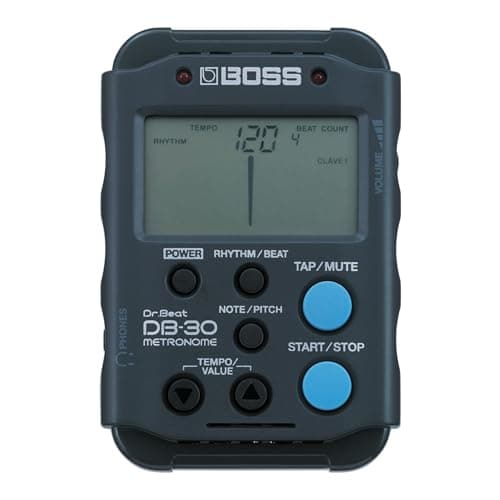
The BOSS DB-30 Dr. Beat#ad is the most capable, and the headphone jack is why it tops this page. BOSS publishes a stereo mini phones jack, 24 beat settings including additive meters such as 2+3 and 7+8, nine rhythm patterns including Clave variations, tempo accuracy of 0.1 per cent and reference tone accuracy of 1 cent. It has auto power off after an hour and remembers its settings.
Two honest limits. It runs on a single CR2032 coin cell and BOSS publishes no battery life figure at all, so keep a spare. And its reference pitch calibrates only across 438 to 445 Hz, a much narrower window than the Korg’s.
The Korg MA-2#ad is the one most teachers hand a student, and for a beginner it is enough. 30 to 252 bpm with tap tempo, 0 to 9 beats with eight rhythm subdivisions covering triplets and sixteenths, a moving digital needle plus a measure-change icon, and roughly 400 hours on alkaline AAAs. It weighs 68 grams with the batteries in and folds out a stand.
What it does not have is a headphone output in the published specifications, which is the reason it is second here rather than first. Its pitch feature is a one-octave reference tone rather than a tuner, so a violin or band student still needs something else.
The Wittner Taktell Piccolo (836)#ad is the wind-up one, made in Germany, with a tempo scale marked Largo through Prestissimo from 40 to 208. There is a real pleasure in a pendulum you can see, and Wittner is straightforward that no batteries are required.
It is also, by the criteria on this page, the weakest tool here and the most expensive. This model is published without a bell, so there is no accented downbeat; there are no subdivisions, no rhythm patterns, no reference pitch and no headphone output; and it must be wound immediately before use, with no running time published. On the Starter Path it sits squarely in where overspending starts, which does not make it a bad object — only a bad first metronome.
How to actually use one
Owning a metronome does nothing. Three habits do.
Set it slower than feels sensible. Find the tempo at which you can play a passage correctly five times running. That is your starting tempo, however slow it is.
Move up in small steps. Four or five beats per minute at a time, and only after five clean repetitions. Jumping twenty is how you practice mistakes at speed.
Use subdivisions when something feels rushed. If a passage keeps collapsing, click eighths instead of quarters. Rushing almost always happens between beats, not on them.
Turn it off regularly. The goal is internal time, not dependence. Play a phrase with it, then the same phrase without, and listen for the drift.
The instrument-specific versions of this are in how to practice piano effectively and drum rudiments for beginners, where a metronome is not optional at all. Where the metronome sits in a practice corner is covered in setting up a home practice space.
Quick picks
If you share a house
The only one here with a published headphone jack, plus 24 beat settings including additive meters and published accuracy figures.
| # | Product | Best for | Score | Price |
|---|---|---|---|---|
| 1 | BOSS DB-30 Dr. BeatThe one with a headphone jack, which makes it the metronome for a shared house. | Headphones and odd metersEnough | 8.6 | $39.99 · View on Amazon #ad How we’re funded |
The default practice metronome
Card-sized, the widest tempo range here, eight rhythm subdivisions and around 400 hours from two AAA batteries.
| # | Product | Best for | Score | Price |
|---|---|---|---|---|
| 1 | 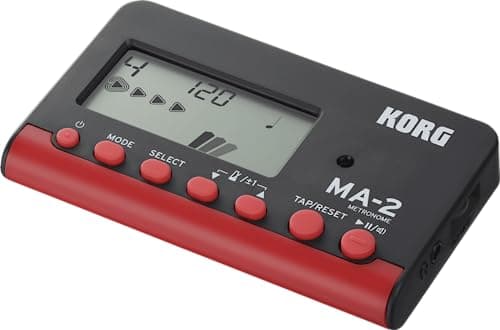 Korg MA-2A card-sized metronome with the widest tempo range here, eight rhythm subdivisions and around 400 hours from two AAA batteries. | The default practice metronomeThe honest floor | 7.4 | $18.99 · View on Amazon #ad How we’re funded |
If you want no batteries at all
Wind-up clockwork with a swinging pendulum. It does less than either digital unit and costs more, and some players want exactly that.
| # | Product | Best for | Score | Price |
|---|---|---|---|---|
| 1 | 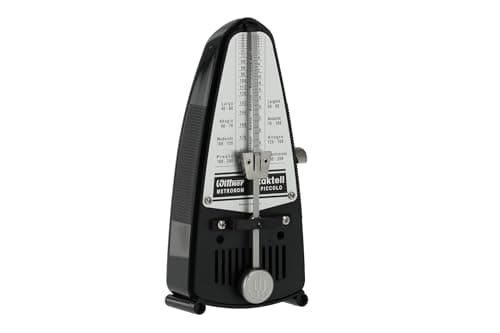 Wittner Taktell Piccolo (836)A wind-up clockwork metronome with a swinging pendulum and nothing to charge. | No batteries, everWhere overspending starts | 5.2 | $60.64 · View on Amazon #ad How we’re funded |
The picks in full
BOSS DB-30 Dr. Beat
BOSSBest for: Headphones and odd meters
The one with a headphone jack, which makes it the metronome for a shared house. Twenty-four beat settings including additive meters, nine rhythms, and published accuracy figures.
Published specifications
- Tempo range:
- 30 to 250 bpm, accuracy +/-0.1%
- Beats:
- 24 kinds, including 2+3, 3+4, 5+6, 7+8 additive meters
- Rhythms:
- 9 kinds, including triplets, sixteenths and Clave 3-2 / 2-3
- Reference tone:
- C4 to B4, A4 = 438-445 Hz, accuracy +/-1 cent
- Output:
- Stereo miniature phones jack
- Power:
- One CR2032 lithium battery; auto power off after 60 min
- Size / weight:
- 61 x 90 x 20 mm; 70 g
What it gets right
- A published headphone jack — the only one of the three, and the reason it works at 11pm in an apartment
- 24 beat settings covering additive and compound meters that most metronomes cannot express
- Tempo accuracy of 0.1% and reference-tone accuracy of 1 cent are both published figures
- Auto power off after an hour and settings retained when switched off
Where it gives ground
- Runs on a single CR2032 coin cell and BOSS publishes no battery-life figure at all
- Reference pitch calibrates only across 438-445 Hz, a much narrower window than the Korg's 410-480
- Tempo tops out at 250 bpm, marginally below the Korg
What it is not good at
Long unattended running. With no published battery life on a coin cell, it is the one to keep a spare battery for.
How the specs score against a beginner’s needs
Scores are our reading of the published specifications above against what a beginner physically needs. They are not test results — we have not played this instrument.
Specifications from BOSS — DB-30 specifications.
Korg MA-2
KorgBest for: The default practice metronome
A card-sized metronome with the widest tempo range here, eight rhythm subdivisions and around 400 hours from two AAA batteries. The one most teachers end up recommending.
Published specifications
- Tempo range:
- 30 to 252 bpm; pendulum step, full step and tap tempo
- Beats / rhythms:
- 0-9 beats with 8 rhythms including triplets and quadruplets
- Reference pitch:
- C4 to B4, calibration A4 = 410-480 Hz, tone accuracy under 1 cent
- Display:
- Digital needle plus a beat-position and measure-change icon
- Power:
- Two AAA; approx. 400 h alkaline (tempo 120, 4 beats, max volume)
- Size / weight:
- 100 x 60 x 16 mm; 68 g including batteries
- Headphone output:
- Not listed in the published specifications
What it gets right
- Widest published tempo range of the three, to 252 bpm, with tap tempo as well as stepped setting
- Eight rhythm subdivisions cover the triplet and sixteenth work where beginners actually lose time
- About 400 hours on alkalines from two AAA cells, at 68 g with the batteries in
- A moving needle and a measure icon give a visual beat, not just a click
Where it gives ground
- The pitch feature is a one-octave reference tone only — it does not detect pitch, so it is not a tuner
- No headphone output in the published specifications, which matters in a shared room
- Battery life is quoted for one setting only, so real figures vary with volume and tempo
What it is not good at
Tuning. Korg publishes a reference tone and nothing more, so a string or band player still needs a tuner.
How the specs score against a beginner’s needs
Scores are our reading of the published specifications above against what a beginner physically needs. They are not test results — we have not played this instrument.
Specifications from Korg — MA-2 specifications, Korg — MA-2 product page.
Wittner Taktell Piccolo (836)
WittnerBest for: No batteries, ever
A wind-up clockwork metronome with a swinging pendulum and nothing to charge. It does less than either digital unit here and costs more, and for some players the visible swing is worth exactly that.
Published specifications
- Mechanism:
- Mechanical clockwork, wound with a key; no batteries required
- Tempo scale:
- Largo 40 through Prestissimo 208
- Bell:
- None — this model is published as without bell
- Case:
- Plastic, Series 830, made in Germany
- Tempo setting:
- Slide the pendulum weight to the marked line, then push the pendulum
- Running time per wind:
- Not published by Wittner
- Size / weight:
- Not published by Wittner
What it gets right
- Nothing to charge or replace — Wittner states plainly that no batteries are required
- The swinging pendulum is a visual beat you can follow without looking at a screen
- Published tempo scale carries the traditional tempo terms, which is useful when a score says Andante rather than a number
Where it gives ground
- Published without a bell, so there is no downbeat accent — it ticks an undifferentiated pulse
- No subdivisions, no rhythm patterns, no reference pitch and no headphone output
- Must be wound immediately before use, and Wittner publishes no running time per wind
- Costs more than either digital metronome here while doing considerably less
What it is not good at
Practicing subdivisions or compound meters. It produces one unaccented pulse and offers no way to group it.
How the specs score against a beginner’s needs
Scores are our reading of the published specifications above against what a beginner physically needs. They are not test results — we have not played this instrument.
Specifications from Wittner — Taktell Piccolo Series 830, Wittner — Taktell Piccolo instruction manual.
Questions people actually ask
Do I need a metronome, or is a phone app fine?
An app is fine to start, and many people never need more. A dedicated unit wins on three practical points: it does not interrupt you with notifications, it has a physical dial or buttons you can change mid-practice, and on some models it has a headphone jack so nobody else hears it.
What tempo should a beginner practice at?
Slow enough to play the passage correctly every time, which is almost always slower than feels reasonable. The rule that matters is not the number: it is that you only speed up once the passage is clean at the current tempo.
What are subdivisions and why do they matter?
A subdivision is a metronome clicking the smaller beats inside the main pulse — eighths, triplets, sixteenths. It is how you find out whether your timing is genuinely steady or only steady at the moment the beat lands, which is where most rhythm problems hide.
Mechanical or digital?
Digital does more for less money: subdivisions, accented beats, a headphone output, battery life measured in hundreds of hours. Mechanical gives you a visible swinging pendulum, no batteries, and an object that looks good on a piano. Buy mechanical because you want one, not because it works better.
Is a metronome useful for singers and wind players too?
Yes, and for band and orchestra students a combined tuner and metronome is usually the better purchase, since programs ask for both. That unit is covered in best clip-on tuners.
Sources
Still deciding?
Every recommendation on this site is built the same way, and the method is published in full — including what we do not do and what would get a pick dropped.
Read next
- Setting up a practice space that gets used
Why the instrument should never live in its case, the seat height that prevents wrist problems, and the two cheap accessories that matter most.
- Best clip-on tuners for beginners
Why a clip-on beats a phone app, the four specs that separate them, and three tuners for guitar, ukulele and band instruments.
- Drum rudiments a beginner should learn
The five rudiments that matter, what each one builds, and a practice routine that fits fifteen minutes on a pad.
- How to practice piano so it actually works
A session structure that fits twenty minutes, why hands-separate practice works, and the equipment that removes excuses.
- Why beginners quit, and what prevents it
The three points where beginners stop, what causes each, and the interventions that work at each stage.