Drums
Drum rudiments a beginner should learn
There are forty official rudiments and you need five of them. Learning those five properly is worth more than knowing all forty badly.
By Sawyer V. · Published · Last updated
Rudiments have a reputation for being the boring part, and beginners routinely skip them in favor of learning beats. That is understandable and it is the reason a lot of amateur drummers plateau after a year with uneven hands and no speed.
A rudiment is not an exercise for its own sake. It is a specific sticking pattern that appears constantly in real drumming, and drilling it is how the hands learn to do it without thought.
Learn five: the single stroke roll, the double stroke roll, the single paradiddle, the flam and the single stroke four. Practice them on a 12 inch pad at a snare stand, slowly, with a metronome, for ten to fifteen minutes a day.
Notation, in one paragraph
Rudiments are written as sequences of R and L for right hand and left hand. RLRL means alternating single strokes; RRLL means two with each hand.
Everything below is written for a right-handed player. Left-handed drummers reverse it, and should practice starting from both hands regardless — leading with the weaker hand is one of the most useful things you can do.
1. The single stroke roll
RLRLRLRL. Strictly alternating.
The most fundamental pattern in drumming and the one that reveals every weakness. It sounds trivial and is genuinely hard to do well, because your two hands do not naturally strike with the same volume or at the same moment.
Practice it slowly and listen for evenness, not speed. If a listener can tell which hand is which, the pattern is not yet correct. This is the rudiment that builds the fills that run around the toms, and it is worth more practice time than everything else combined.
2. The double stroke roll
RRLLRRLL. Two strokes with each hand.
The important thing here is that the second stroke of each pair is not a separate arm movement. It comes from the stick rebounding off the surface, controlled by the fingers. One motion, two notes.
That is why a practice surface has to bounce like a drumhead. Gum rubber does; hard plastic and thin foam do not, and hours spent on the wrong surface teach a lifting motion instead of a rebounding one. The Evans RealFeel 12" two-sided practice pad#ad has gum rubber on one face for exactly this, with a harder neoprene side for building strength against resistance.
Doubles are slower to learn than singles and they unlock the buzz roll, the press roll and most of what makes drumming sound fluid.
3. The single paradiddle
RLRR LRLL. Single, single, double — then the same starting with the other hand.
The paradiddle exists to solve a real problem: it lets you change which hand leads without breaking the flow. That is what makes it useful for moving around a kit, because the hand that arrives at a tom can be chosen rather than dictated.
It combines singles and doubles, so it is also the pattern that exposes whether both are actually solid. Start extremely slowly and say the sticking out loud until it stops requiring thought.
4. The flam
A quiet grace note immediately before a main stroke, played with opposite hands.
One stick starts low and close to the head, the other starts high. Both drop together, and because they start from different heights the low one lands slightly first. The result is a thick, wide-sounding single hit rather than two distinct notes.
The technique is stick height, not timing. Beginners try to play two separate notes very close together and it never sounds right; set the heights and let physics do it.
Flams are everywhere in real drumming — they are what makes a backbeat sound fat.
5. The single stroke four
RLRL as a burst of four, then a gap, then the same again.
This is the bridge from exercises to actual playing. Four fast, even strokes with a rest around them is the shape of an enormous number of fills, and practicing it as a burst rather than a continuous roll is how you learn to place a fill precisely rather than arriving at it.
How to practice them
Use a metronome. Non-negotiable for a drummer. Timing is the job, and practicing without a reference builds confident inaccuracy.
Start slower than feels sensible. Slow enough that every stroke is correct, every time. A pattern played correctly twenty times at a crawl becomes reliable faster than the same pattern played approximately a hundred times at speed.
Raise the tempo in small steps, and drop back immediately when evenness goes. The point at which the pattern breaks down is the tempo you should be practicing just below.
Lead with both hands. Every rudiment, from the left as well as the right. It is uncomfortable and it is where most of the improvement lives.
Ten to fifteen minutes a day. More than that and quality drops; less than daily and it does not consolidate.
Why a pad and not a kit
Rudiments are two hands on one surface. A kit adds nothing to that, and it adds noise, setup, and the temptation to play something fun instead.
A 12 inch pad on a snare stand puts the surface at real playing height, so the stroke you build transfers directly. The Evans RealFeel 12" single-sided practice pad#ad is the lighter, cheaper version of the same idea and the surface that matters is identical. Both are covered in best drum practice pads.
It also means practice can happen at eleven at night in a shared building, which is most of why teachers assign pad homework rather than kit homework.
What rudiments will not do
They build hand technique, evenness, speed and timing. They do not build limb independence, which needs four limbs on four things and only happens at a kit.
So rudiments are half of drumming rather than all of it, and a player who only ever practices on a pad will have excellent hands and no groove. Both halves matter, and the honest split is in kit versus pad to start.
One last practical note: use the right sticks. A 5A is the standard general-purpose size and the correct default for rudiment work — details in how to choose drum sticks.
What we would buy
Evans RealFeel 12" two-sided practice pad
EvansBest for: The standard practice pad
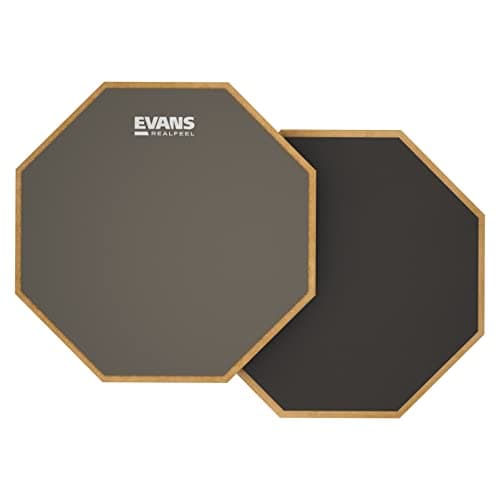
Gum rubber on one side and neoprene on the other, so one pad gives you a realistic rebound surface and a harder, slower one for building control. The default recommendation.
Published specifications
- Diameter:
- 12"
- Surfaces:
- Two — natural gum rubber and neoprene
- Gum side:
- Responds much the way a drumhead does
- Manufacture:
- Designed, engineered and made in the USA
What it gets right
- The gum side rebounds close enough to a real head that the stroke you build on it works on a kit
- The second surface is slower and harder, which is genuinely useful for building hand strength rather than just speed
- 12 inches is snare-sized, so it mounts on a snare stand at the right height
Where it gives ground
- Heavier than a single-sided pad, which matters if it lives in a backpack
- No stand mount on the pad itself in the basic version — check what you are buying
What it is not good at
Teaching anything involving feet. A pad is a hands tool; limb independence needs a kit, and no amount of pad work substitutes.
How the specs score against a beginner’s needs
Scores are our reading of the published specifications above against what a beginner physically needs. They are not test results — we have not played this instrument.
Specifications from Evans RealFeel practice pad published description.
Evans RealFeel 12" single-sided practice pad
EvansBest for: Lighter, one surface
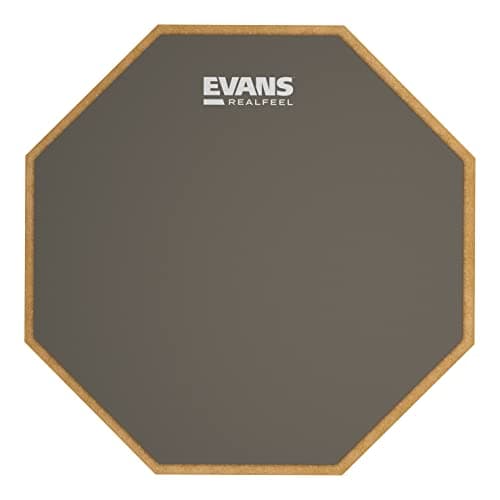
The same gum rubber playing surface as the two-sided pad, without the neoprene side. Lighter and cheaper, and for a beginner the second surface is not the point yet.
Published specifications
- Diameter:
- 12"
- Surface:
- Single — natural gum rubber
- Response:
- Realistic stick rebound, consistent across the surface
- Manufacture:
- Designed, engineered and made in the USA
What it gets right
- Identical playing surface to the two-sided pad, which is the part that matters
- Lighter, so it actually travels
- The cheapest genuinely good pad, which makes it the right first one
Where it gives ground
- One surface, so no harder option for strength work later
- The flat back slides on a smooth table without a stand
What it is not good at
Being the last pad a committed drummer owns. Most people who keep drumming end up wanting the second surface eventually.
How the specs score against a beginner’s needs
Scores are our reading of the published specifications above against what a beginner physically needs. They are not test results — we have not played this instrument.
Specifications from Evans RealFeel single-sided pad published description.
Questions people actually ask
What are drum rudiments?
Short sticking patterns that form the vocabulary of drumming — single strokes, double strokes, paradiddles, flams and rolls. Everything played on a kit is built from them, which is why teachers assign them from the first lesson.
How many rudiments do I need to know?
Five will carry a beginner a long way: single stroke roll, double stroke roll, paradiddle, flam and single stroke four. The full list of forty is a reference, not a syllabus to work through in order.
Can you practice rudiments without a drum kit?
Yes, and a practice pad is the correct tool rather than a compromise. Rudiments are a two-hands-on-one-surface skill, so a pad does the whole job silently and at any hour.
How long should I practice rudiments for?
Ten to fifteen minutes a day is plenty and beats an hour once a week. Hand technique consolidates between sessions, so frequency matters more than the length of any single one.
Sources
Still deciding?
Every recommendation on this site is built the same way, and the method is published in full — including what we do not do and what would get a pick dropped.
Read next
- Best drum practice pads
Gum rubber versus neoprene, why 12 inches is the right size, and the honest limit of what pad practice builds.
- Drum kit or practice pad first?
What a pad genuinely teaches, what it cannot, and when starting on one is the right call rather than a compromise.
- How to choose drum sticks
What the numbers and letters mean, which size suits which player, tip materials, and why sticks are a consumable.
- Drum accessories you actually need
Sticks, a pad, hearing protection and a throne, in priority order, plus the upgrades that genuinely change how a cheap kit sounds.
- How to set up a drum set
Build order from the throne outward, the angles that prevent wrist and back trouble, and how an electronic rack differs.