Drums
How to choose drum sticks
The sizing system is a hundred years old, is not intuitive, and still tells you exactly what you need to know once someone explains it.
By Sawyer V. · Published · Last updated
Drum sticks look like the least consequential purchase in drumming. They are also the only part of the kit you actually touch, and the wrong ones make a beginner work harder for a worse sound.
The naming system is genuinely confusing, so here it is in plain terms.
Buy 5A wood tip. It is the general-purpose standard and the right default for almost every beginner. Choose 7A for a child or an adult with small hands. Buy two pairs, because sticks break and a broken stick with no spare stops practice.
The numbers, which run backwards
The number describes circumference, and lower numbers are thicker. That is the part that trips everyone up.
| Size | Feel | Suits |
|---|---|---|
| 7A | Thin and light | Children, small hands, quiet playing, jazz |
| 5A | The standard middle | Almost every beginner |
| 5B | Noticeably thicker and heavier | Louder playing, rock, larger hands |
| 2B | Heavy | Marching, deliberate strength practice |
The letter is a historical usage marker: A was for dance bands, B for concert band, S for street and marching. Nobody uses those categories today, and the letter survives as part of the size name.
Why 5A is the right default
It sits in the middle of every trade-off. Heavy enough to produce a solid sound without effort, light enough not to tire the hands, and thick enough to survive a beginner’s less-than-perfect strokes.
It is also what teachers and books assume. If an instruction says to hold the stick at the balance point, that instruction was written with a 5A in mind.
The main reason to go lighter is hand size. A 7A is thinner and lighter, and for a child or a small-handed adult it genuinely reduces fatigue and improves control. That matters for a junior kit player, and it is worth pairing with the sizing advice in best drum sets for kids.
The main reason to go heavier is volume, and it is a poor reason for a beginner. A heavier stick gets loud through mass rather than technique, which builds a habit of hitting hard instead of striking well.
Tips
Wood tips give a warmer, rounder cymbal sound. They chip and wear, especially on rubber electronic pads, and they are what most drummers use on an acoustic kit.
Nylon tips are a molded cap glued to the wood. Brighter and more cutting on cymbals, and considerably more durable. They can also come loose eventually, which ends the stick.
Practical rule: wood on an acoustic kit like the Pearl Roadshow RS525SC#ad, nylon if you are playing an electronic kit such as the Alesis Nitro Max Kit#ad daily, because rubber cymbal pads eat wood tips.
Tip shape also changes the cymbal sound — round is focused, barrel is broader, teardrop is in between. It is a real difference and comfortably below what a beginner needs to think about.
Wood type
Hickory is the default for good reason: it absorbs shock well, which means less vibration into the hands, and it is durable. Buy hickory unless you have a specific reason not to.
Maple is lighter for the same dimensions, so a maple 5A feels quicker and less tiring. It breaks sooner.
Oak is denser and tougher, transmits more vibration, and lasts longest.
Sticks are a consumable
They chip at the tip, dent along the shoulder where they strike cymbal edges, and eventually break — usually at the shoulder, usually mid-session.
Beginners get through them faster than experienced players because the stroke is less controlled and rim shots land in the wrong place. That is normal and not a sign of doing anything badly.
Own at least two pairs. A broken stick with no replacement in the house means a week of not practicing, and week-long gaps are how beginners quietly stop. Retire a stick when the tip is visibly chipped or the shaft has a splintered dent — a stick that breaks mid-stroke can throw a sharp fragment.
Checking a pair before you buy
Sticks are wood, and no two pieces of wood are identical. Two quick checks matter.
Roll each one on a flat surface. A straight stick rolls smoothly. A warped one wobbles, and a warped stick feels wrong and rebounds unpredictably.
Tap each one and listen. A matched pair sounds close to the same pitch, which means they weigh about the same. A badly mismatched pair makes it much harder to play evenly, which is precisely the skill rudiment practice is building — see drum rudiments for beginners.
Many shops sell pre-matched pairs, which is worth a small premium.
What else you hit things with
Brushes. Wire or plastic fans for quiet playing and jazz. A specific technique rather than a beginner item.
Rods. Bundled thin dowels. Noticeably quieter than sticks and a genuine option for practicing an acoustic kit in a house where full volume is a problem — worth knowing alongside the pad route in best drum practice pads, and useful with a Evans RealFeel 12" two-sided practice pad#ad for late sessions.
Mallets. Soft heads for cymbal swells. Occasional use, not a starting purchase.
What we would buy
Evans RealFeel 12" two-sided practice pad
EvansBest for: The standard practice pad
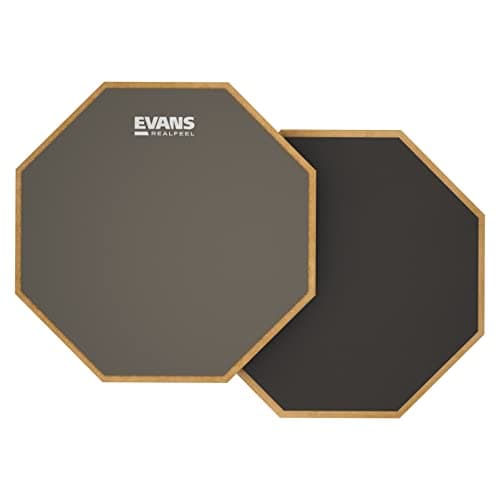
Gum rubber on one side and neoprene on the other, so one pad gives you a realistic rebound surface and a harder, slower one for building control. The default recommendation.
Published specifications
- Diameter:
- 12"
- Surfaces:
- Two — natural gum rubber and neoprene
- Gum side:
- Responds much the way a drumhead does
- Manufacture:
- Designed, engineered and made in the USA
What it gets right
- The gum side rebounds close enough to a real head that the stroke you build on it works on a kit
- The second surface is slower and harder, which is genuinely useful for building hand strength rather than just speed
- 12 inches is snare-sized, so it mounts on a snare stand at the right height
Where it gives ground
- Heavier than a single-sided pad, which matters if it lives in a backpack
- No stand mount on the pad itself in the basic version — check what you are buying
What it is not good at
Teaching anything involving feet. A pad is a hands tool; limb independence needs a kit, and no amount of pad work substitutes.
How the specs score against a beginner’s needs
Scores are our reading of the published specifications above against what a beginner physically needs. They are not test results — we have not played this instrument.
Specifications from Evans RealFeel practice pad published description.
Pearl Roadshow RS525SC
PearlBest for: Complete acoustic kit, teen and up
A full 22 inch kick, five drums, four stands, a pedal, a throne and cymbals, on 9-ply poplar shells with hand-cut bearing edges. Nothing else needs buying to play it.
Published specifications
- Configuration:
- 5-piece: 22x16 bass, 14x5.5 snare, 10x8 and 12x9 rack toms, 16x16 floor tom
- Shells:
- 9-ply poplar, 7 mm, hand-cut 45-degree bearing edges
- Hoops:
- 1.6 mm triple-flanged steel
- Hardware included:
- H-50 hi-hat, C-50 cymbal, S-50 snare stand, P-50 pedal, D-50 throne
- Cymbals included:
- 16" brass crash/ride, 14" hybrid hi-hats
- Also included:
- Two pairs of maple sticks, stick bag
What it gets right
- Genuinely complete — stands, pedal, throne, cymbals and sticks are all in the box, which almost never happens at this price
- Hand-cut 45-degree bearing edges on poplar shells; the edge is what lets a drum be tuned at all
- Triple-flanged steel hoops rather than the pressed hoops on the tier below
Where it gives ground
- The included brass cymbals are the weak point and the first thing anyone replaces
- A 22 inch kick is a full-size kit and needs the floor space of one
What it is not good at
Being quiet, or fitting a child. This is a loud acoustic kit at adult dimensions — a 22 inch bass drum puts the pedal where an eight-year-old's leg does not reach. For that buyer, see the kids' kits and the electronic options.
How the specs score against a beginner’s needs
Scores are our reading of the published specifications above against what a beginner physically needs. They are not test results — we have not played this instrument.
Specifications from Pearl Roadshow RS525SC published specifications (Percussion Source).
Alesis Nitro Max Kit
AlesisBest for: Apartments and shared walls
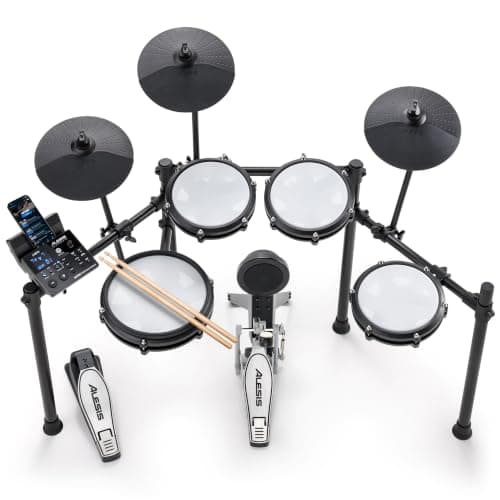
Mesh heads on every pad, a dual-zone snare and Bluetooth audio for playing along. Mesh is the spec that makes an electronic kit tolerable to sit at for an hour.
Published specifications
- Pads:
- 10" dual-zone mesh snare, three 8" mesh toms
- Cymbals:
- Three 10" pads — hi-hat, crash, ride
- Module:
- 440 sounds, 32 kits, 60 play-along songs, performance recorder
- Connectivity:
- Bluetooth audio, USB-MIDI
- Mounting:
- Included four-post rack
- Weight:
- Under 15 kg complete
What it gets right
- Mesh heads on every drum pad — quieter and far closer to a real rebound than the rubber pads a tier down
- Bluetooth audio means playing along to a phone with no cable and no extra mixer
- USB-MIDI, so it doubles as a controller for recording software later
Where it gives ground
- Mesh heads are quiet in the room but the kick pedal thumps through a floor; downstairs neighbors still hear it
- Single-zone toms — no rimshot on anything except the snare
What it is not good at
Teaching cymbal technique. Three 10 inch pads cannot reproduce how a real hi-hat or a crash responds, and a drummer moving to an acoustic kit later has that to learn from scratch.
How the specs score against a beginner’s needs
Scores are our reading of the published specifications above against what a beginner physically needs. They are not test results — we have not played this instrument.
Specifications from Alesis Drums — Nitro Max Kit.
Questions people actually ask
What drum sticks should a beginner use?
5A. It is the general-purpose standard, suits almost everyone, and is what most teachers assume you have. 7A is the lighter option for smaller hands and younger players.
What do the numbers on drum sticks mean?
The number is thickness — confusingly, lower numbers mean thicker sticks, so 5 is thicker than 7. The letter originally indicated intended use: A for dance bands, B for band, S for street and marching.
Wood tip or nylon tip?
Wood for a warmer cymbal sound, nylon for a brighter one and longer life. Start with wood. On rubber electronic pads, nylon lasts noticeably longer.
How often do drum sticks break?
More often for beginners than for experienced players, because the stroke is less controlled and rim shots land badly. Own at least two pairs so a break does not end a practice session.
Sources
Still deciding?
Every recommendation on this site is built the same way, and the method is published in full — including what we do not do and what would get a pick dropped.
Read next
- Drum accessories you actually need
Sticks, a pad, hearing protection and a throne, in priority order, plus the upgrades that genuinely change how a cheap kit sounds.
- Drum rudiments a beginner should learn
The five rudiments that matter, what each one builds, and a practice routine that fits fifteen minutes on a pad.
- Best drum practice pads
Gum rubber versus neoprene, why 12 inches is the right size, and the honest limit of what pad practice builds.
- Best drum sets for kids
Picks by age band with real shell dimensions, plus the electronic option that makes a kids kit possible in an apartment.
- Every part of a drum kit, explained
What every drum, cymbal and stand is for, which parts are the weak link on a budget kit, and what a five-piece actually means.