Drums
How loud are drums?
Loud enough that the answer changes what you should buy. Here are the numbers, the safety limit, and which quieting options genuinely work.
By Sawyer V. · Published · Last updated

Published measurements put an acoustic drum kit at roughly 90 to 130 dB, with snare rimshots and cymbals at the top end. NIOSH treats 85 dB as the safe limit for prolonged exposure and allows about 15 minutes a day at 100 dB. A kit therefore requires hearing protection every session and cannot be played quietly.
The numbers
An acoustic kit measures between about 90 and 130 dB depending on the stroke and the instrument, with snare rimshots and crash cymbals at the top of the range.
The relevant comparison is the NIOSH exposure guidance, which sets 85 dB(A) as the limit for an eight-hour day and then halves the permitted time for roughly every 3 dB above it: about two hours at 91 dB, and about fifteen minutes at 100 dB.
A drummer sits within a couple of feet of every one of those sources. An hour of practice on an unprotected acoustic kit is well outside the guidance, and the damage is cumulative and permanent.
What this means for the purchase
Two things, and both are practical rather than alarmist.
Hearing protection is not optional and not a later upgrade. Musicians’ earplugs use a filter that attenuates evenly across frequencies, so the kit still sounds like a kit at a lower volume — unlike foam plugs, which cut the top end hard and make cymbals disappear. They cost very little. Every session, including the first one, including for children.
The building decides the instrument. This is the real reason the noise question belongs at the start of a drum purchase rather than the end. Covered in full in acoustic vs electronic drums.
What actually travels
Worth understanding, because it explains why some quieting attempts work and others do not.
Airborne sound is what you hear standing next to the kit: cymbals, snare crack, tom attack. It is mostly mid and high frequency, and it is reduced reasonably well by mass — a solid closed door, a filled wall.
Structure-borne sound is the bass drum and the pedals, transmitted as vibration through the floor into the building’s structure. This is what a downstairs neighbor hears, and it barely attenuates with distance. Mass in the walls does nothing about it.
That distinction explains the most common disappointment in this area: someone hangs acoustic foam, finds the room sounds different inside, and discovers the neighbor still hears everything. Foam absorbs reflections within a room. It has essentially no effect on transmission through a wall or a floor.
What works and what does not
| Approach | Effect | Verdict |
|---|---|---|
| Musicians’ earplugs | Protects the drummer’s hearing; no effect on the room | Essential |
| Acoustic foam on walls | Changes the room’s internal sound | Does not help neighbors |
| Rug under the kit | Reduces some floor coupling; stops the kit walking | Worth doing, modest |
| Noise-isolation mat | Meaningfully reduces kick and pedal transmission | Effective |
| Rubber mute pads | Large volume cut; removes rebound and sound | Emergency use only |
| Low-volume cymbals | Substantial cut on the loudest components | Genuinely useful |
| Mesh-head electronic kit | Near-silent pads; kick still transmits | The real solution |
| Practice pad | Effectively silent | Solves technique work only |
| Building a room within a room | Works properly | A construction project |
The honest summary
You cannot make an acoustic drum kit quiet. You can make it quieter, and every method that does so also makes it less rewarding to play — which matters, because a kit that is unrewarding gets played less, and practice hours are the whole game.
If the building will not tolerate an acoustic kit, the answer is a mesh-head electronic kit on an isolation mat, not a muted acoustic one. That is a straightforwardly good instrument rather than a compromised version of a better one.
The other honest route out of the noise problem is to play a different percussion instrument entirely. A cajon has no pedal, so nothing is being driven into the floor, and it sits roughly at acoustic-guitar volume rather than kit volume — see best cajons for beginners.
And whichever you buy, if it is acoustic: earplugs, from the first session, every session.
If you are considering treating the room rather than changing instrument, read how to soundproof a drum room first — most of the advice online targets the wrong kind of sound, and acoustic foam does essentially nothing for drums.
What we would buy
Alesis Nitro Max Kit
AlesisBest for: Apartments and shared walls
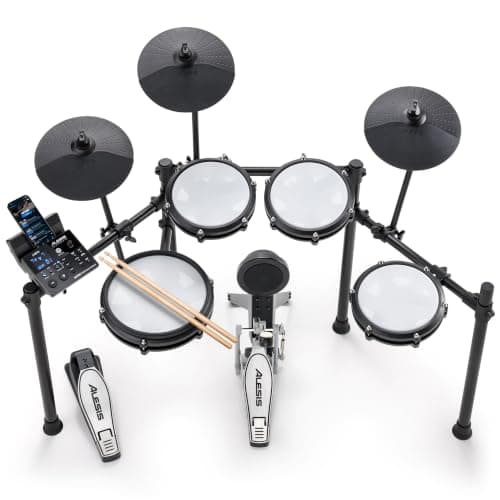
Mesh heads on every pad, a dual-zone snare and Bluetooth audio for playing along. Mesh is the spec that makes an electronic kit tolerable to sit at for an hour.
Published specifications
- Pads:
- 10" dual-zone mesh snare, three 8" mesh toms
- Cymbals:
- Three 10" pads — hi-hat, crash, ride
- Module:
- 440 sounds, 32 kits, 60 play-along songs, performance recorder
- Connectivity:
- Bluetooth audio, USB-MIDI
- Mounting:
- Included four-post rack
- Weight:
- Under 15 kg complete
What it gets right
- Mesh heads on every drum pad — quieter and far closer to a real rebound than the rubber pads a tier down
- Bluetooth audio means playing along to a phone with no cable and no extra mixer
- USB-MIDI, so it doubles as a controller for recording software later
Where it gives ground
- Mesh heads are quiet in the room but the kick pedal thumps through a floor; downstairs neighbors still hear it
- Single-zone toms — no rimshot on anything except the snare
What it is not good at
Teaching cymbal technique. Three 10 inch pads cannot reproduce how a real hi-hat or a crash responds, and a drummer moving to an acoustic kit later has that to learn from scratch.
How the specs score against a beginner’s needs
Scores are our reading of the published specifications above against what a beginner physically needs. They are not test results — we have not played this instrument.
Specifications from Alesis Drums — Nitro Max Kit.
Alesis Debut Kit
AlesisBest for: Ages roughly 5-9
Four 6 inch mesh pads sized and spaced for a small child, with headphones, a throne and sticks in the box. Alesis states it is designed for ages 5 to 9 and the geometry backs that up.
Published specifications
- Pads:
- Four 6" mesh pads (snare and three toms)
- Cymbals:
- Three 10" pads — hi-hat, crash, ride
- Pedals:
- Hi-hat and bass drum pedals included
- Module:
- DM-Lite: 120 sounds, 10 kits, 30 play-along tracks, drum coach
- Age guidance:
- Manufacturer states ages 5-9
- In the box:
- Metal rack, height-adjustable throne, sticks, headphones, cables, Melodics lessons
What it gets right
- Purpose-built small geometry — the pads are within a small child's reach rather than an adult kit with the legs shortened
- Headphones included, which for a kids' drum kit is the difference between practicing and being asked to stop
- Height-adjustable throne, so it tracks a growing child for a couple of years
Where it gives ground
- 6 inch pads are small enough that an older child will feel boxed in quickly
- The DM-Lite module is basic; 120 sounds and no real editing
What it is not good at
Lasting. Alesis's own 5-to-9 guidance is honest, and a 10-year-old should start on the Nitro Max instead. Buying this for an older child to save money buys a kit they will resent in a year.
How the specs score against a beginner’s needs
Scores are our reading of the published specifications above against what a beginner physically needs. They are not test results — we have not played this instrument.
Specifications from Alesis Drums — Debut Kit.
Questions people actually ask
How loud is a drum kit in decibels?
Published measurements put an acoustic kit in the region of 90 to 130 dB depending on the stroke, with snare rimshots and cymbals at the top of that range. For comparison, NIOSH treats 85 dB as the limit for prolonged exposure and allows only 15 minutes a day at 100 dB.
Can you soundproof a room for drums?
Properly, yes, and it involves adding mass and decoupling the structure — a genuine construction project, not foam panels. Acoustic foam on the walls changes how the room sounds inside and does close to nothing about what the neighbors hear.
Are electronic drums quiet enough for an apartment?
The pads are, with headphones. The kick pedal is the problem: it thumps into the floor and low-frequency structural vibration travels extremely well downward. A dense noise-isolation mat under the whole kit is the fix, and it is worth budgeting for.
Do drum mutes work?
Rubber mute pads that sit on the heads reduce the volume substantially and also remove almost all the rebound and the sound, so playing becomes unrewarding. They are a workable emergency measure and a poor permanent arrangement.
Sources
Still deciding?
Every recommendation on this site is built the same way, and the method is published in full — including what we do not do and what would get a pick dropped.
Read next
- Acoustic vs electronic drums for beginners
Feel against practice hours, what transfers in each direction, and the building question that settles it. Buy paths for both.
- Best electronic drum sets for beginners
Mesh versus rubber pads, the kick-thump problem that headphones do not solve, and picks for adults and children.
- Drum kit or practice pad first?
What a pad genuinely teaches, what it cannot, and when starting on one is the right call rather than a compromise.
- Best beginner drum sets: complete kits for teens and adults
Complete acoustic and electronic kits for adult players, with the total-purchase problem and the noise question both addressed.
- Best drum sets for kids
Picks by age band with real shell dimensions, plus the electronic option that makes a kids kit possible in an apartment.