Keys
Best keyboards for bedroom producers
The keyboard is the cheap part. The decisions that matter are what it connects to and whether you can hear it without a delay.
By Sawyer V. · Published · Last updated
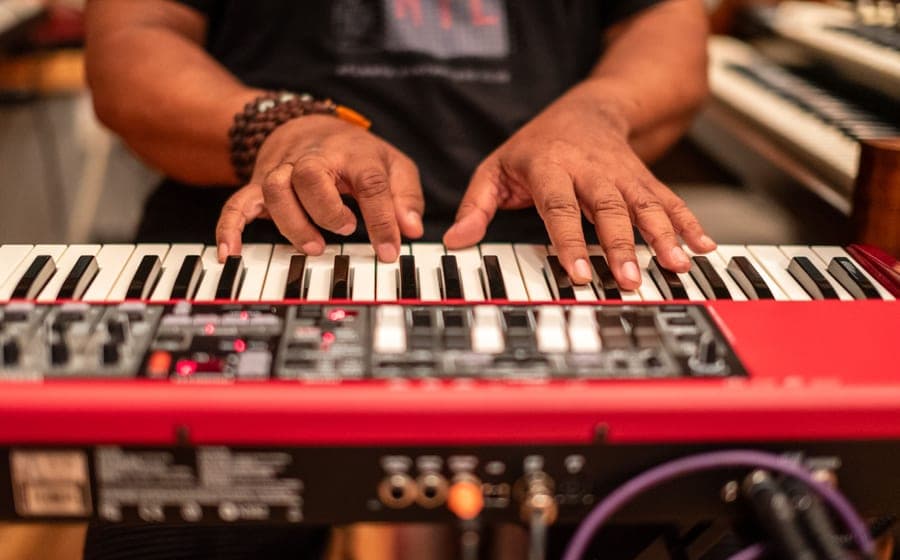
Most guides to a first home music setup start with the keyboard. That is the wrong end. The keyboard is the cheapest and least consequential decision in the chain; what decides whether the setup works is what it connects to and whether you can hear it accurately.
Every pick states its Starter Path band, and we have not physically tested any of them — the method is on how we pick.
If you also want to play, buy a standalone keyboard with a USB port — it is an instrument and a controller in one. If it will live permanently beside a laptop and you only sketch parts, a dedicated 25-key controller is smaller and cheaper. Budget for monitoring either way.
The decision that actually matters
A dedicated controller makes no sound. It sends note data over USB and a computer does the rest. Smaller, cheaper, and useless when the laptop is closed.
A standalone keyboard with USB does both. It works alone as an instrument with its own sounds and speakers, and it sends the same MIDI data when a computer is connected.
That second option is a superset, and it is the one most people should take. The reason is behavioral rather than technical: the strongest predictor of whether anyone actually plays is how many seconds pass between deciding to play and playing. A board you can switch on and use is a three-second start; a controller is a two-minute boot sequence.
The controller is genuinely the right tool when the workflow is production-first — programming drums, arranging, working entirely inside software. The full fork is in MIDI keyboard versus digital piano.
The picks
The Casio Casiotone CT-S1#ad is the board we would buy for this. 61 full-size touch-sensitive keys, a piano voice clearly prioritized over a features list, light enough to move, and a USB port so it doubles as a controller.
Sixty-one keys is the underrated part. Two full hands fit, so you can record an actual performance rather than draw notes in afterwards, and full-size keys mean the technique transfers to any real piano.
Against it: no pads, few assignable controls, and nothing pre-mapped to a DAW, so it is a keyboard rather than a control surface.
The Arturia MiniLab 3#ad and Akai MPK Mini MK3#ad are the compact controllers, and the split between them is simple: Arturia for playing parts, with aftertouch and a strong software bundle; Akai for beats, with clearly better pads and note repeat.
Both give up the same things: no sound of their own, 25 slim keys that are not full-size, and no weighting. They are ranked head to head in best MIDI keyboards for beginners.
Monitoring is where budgets go wrong
The keyboard is the visible purchase. Monitoring is the one that determines whether anything you make sounds right anywhere else.
Laptop speakers are not an option. They have essentially no bass, so you will mix bass you cannot hear. Worse, a basic audio path introduces latency, and a delay between key and sound teaches your hands to play early.
Headphones first. The Audio-Technica ATH-M20x#ad is a closed-back monitoring headphone with a fixed 3 meter cable. Closed-back matters in a bedroom because an open design leaks, and the cable length lets you sit properly at the keys.
Speakers later, if at all. A small untreated bedroom misleads you about bass far more than headphones do. Monitors are a real upgrade in a treated room and a questionable one otherwise.
An audio interface when latency bites. Not day one. When you notice the delay, that is what fixes it.
What you do not need yet
Expensive software. Both controllers here ship with usable bundles, and free DAWs are genuinely good. Software is the last thing that limits a beginner.
A big keyboard. 88 weighted keys is a piano purchase, not a producer purchase. If you want that, you want best weighted keyboards instead.
A microphone. Only when you have something to record with it.
Acoustic foam. It changes how a room sounds when you record in it and does essentially nothing to stop sound leaving. It is the most reliably wasted money in home setups — see setting up a practice space.
Quick picks
The board that does both jobs
61 full-size keys that work alone as an instrument and connect over USB as a controller. The superset answer for most people.
| # | Product | Best for | Score | Price |
|---|---|---|---|---|
| 1 | No image Casio Casiotone CT-S161 full-size touch-sensitive keys, 61 tones and no arranger clutter. | 61 keys, piano sound firstThe honest floor | 7.8 | Check price on Amazon → #ad How we’re funded |
If it lives next to the laptop
A compact controller with aftertouch, pre-mapped controls and a software bundle that gets you started with no extra spend.
| # | Product | Best for | Score | Price |
|---|---|---|---|---|
| 1 | No image Arturia MiniLab 3The same 25-key footprint aimed at people who play melodies rather than program drums. | Playing parts and DAW controlThe honest floor | 8.4 | Check price on Amazon → #ad How we’re funded |
| 2 | No image Akai MPK Mini MK325 slim keys and eight genuinely good backlit pads. | Beat-making and finger drummingThe honest floor | 8.2 | Check price on Amazon → #ad How we’re funded |
The part people skip
Closed-back headphones. Monitoring is where a bedroom setup succeeds or fails, and laptop speakers are not monitoring.
| # | Product | Best for | Score | Price |
|---|---|---|---|---|
| 1 | No image Audio-Technica ATH-M20xClosed-back 40 mm drivers with a 1/4 inch adapter included, which is the socket most digital pianos actually have. | Practice headphonesThe honest floor | 8.7 | Check price on Amazon → #ad How we’re funded |
The picks in full
Casio Casiotone CT-S1
CasioBest for: 61 keys, piano sound first
61 full-size touch-sensitive keys, 61 tones and no arranger clutter. It is the 61-key board for someone who wants to play piano rather than operate a keyboard.
Published specifications
- Keys:
- 61, full-size, touch-sensitive
- Polyphony:
- 64 notes
- Tones:
- 61, including a stereo grand piano
- Weight:
- 9.9 lb
- Dimensions:
- 36.61" W x 10.15" D x 3.30" H
- Connectivity:
- USB-MIDI
What it gets right
- Deliberately few sounds and a clean panel, which removes the single biggest distraction from actual practice
- 9.9 pounds and 3.3 inches tall — it can live on a shelf between sessions, and an instrument that lives out of the way gets played less
- 64-note polyphony, higher than the PSR-E383's 48
Where it gives ground
- No lesson mode at all, unlike the PSR-E383
- Unweighted keys, same fundamental limit as any 61-key board
What it is not good at
Entertaining a young child. There is no light-up key guidance, no play-along scoring and only 61 sounds. That restraint is the point for an adult beginner and a drawback for a seven-year-old.
How the specs score against a beginner’s needs
Scores are our reading of the published specifications above against what a beginner physically needs. They are not test results — we have not played this instrument.
Specifications from Casio — CT-S1 product page.
Arturia MiniLab 3
ArturiaBest for: Playing parts and DAW control
The same 25-key footprint aimed at people who play melodies rather than program drums. Aftertouch on the keys and a bundled software instrument library make it the better first controller for a musician.
Published specifications
- Keys:
- 25 slim, velocity-sensitive, with aftertouch
- Pads:
- 8 RGB
- Controls:
- Endless encoders and faders, pre-mapped to Analog Lab
- Connection:
- USB — requires a computer, tablet or phone
- Bundle:
- Analog Lab Intro, Ableton Live Lite, UVI Model D
What it gets right
- Aftertouch on the keys, which the Akai does not have — real expressive control for a beginner
- Encoders and faders arrive pre-mapped, so it works out of the box instead of needing setup
- Bundled software is a genuine value: an instrument library, a DAW and a piano
- Tight integration with Ableton, Logic and FL Studio
Where it gives ground
- Makes NO sound by itself — the bundled software and a computer are the instrument
- Pads are good and are not as good as the Akai's for finger drumming
- 25 slim keys, so the same 'wrong hand span for piano' problem as the Akai
- The bundled Analog Lab Intro is a cut-down version designed to sell you the full one
What it is not good at
Being a piano. Slim 25 keys is two octaves of narrow plastic — excellent for sketching parts, useless for learning repertoire that needs both hands and a full keyboard.
How the specs score against a beginner’s needs
Scores are our reading of the published specifications above against what a beginner physically needs. They are not test results — we have not played this instrument.
Specifications from Melodics — Arturia MiniLab 3 vs Akai MPK Mini MK3, B&H — Arturia MiniLab 3 vs Akai MPK Mini MK3 published spec comparison.
Akai MPK Mini MK3
Akai ProfessionalBest for: Beat-making and finger drumming
25 slim keys and eight genuinely good backlit pads. The pads are the reason to buy it — this is an MPC workflow shrunk onto a desk, and it makes no sound on its own.
Published specifications
- Keys:
- 25 slim, velocity-sensitive
- Pads:
- 8 RGB backlit, pressure-sensitive
- Connection:
- USB — requires a computer, tablet or phone
- Sound engine:
- None — controller only
- Notable:
- Note repeat, MPC-style workflow
What it gets right
- The best pads in this class — responsive, backlit, and the reason most people choose this over the Arturia
- Note repeat is genuinely useful for programming hi-hats and rolls
- Compact enough to sit in front of a laptop permanently
- Sprung keybed that feels comparable to the Arturia despite the price
Where it gives ground
- Makes NO sound by itself — a computer and software are mandatory, which beginners buying a 'keyboard' routinely miss
- 25 slim keys are not full-size and teach a hand span that is wrong on a real piano
- No aftertouch on the keys, unlike the Arturia
- Pads need slightly more force than the Arturia's to trigger
What it is not good at
Learning piano. This is a studio input device with keys attached. A student who needs to build piano technique needs full-size weighted keys and an instrument that makes a sound when a computer is not running.
How the specs score against a beginner’s needs
Scores are our reading of the published specifications above against what a beginner physically needs. They are not test results — we have not played this instrument.
Specifications from B&H — Arturia MiniLab 3 vs Akai MPK Mini MK3 published spec comparison, Melodics — Arturia MiniLab 3 vs Akai MPK Mini MK3.
Audio-Technica ATH-M20x
Audio-TechnicaBest for: Practice headphones
Closed-back 40 mm drivers with a 1/4 inch adapter included, which is the socket most digital pianos actually have. The cheapest headphones we would put on a practicing student.
Published specifications
- Type:
- Closed-back, circumaural (over-ear)
- Drivers:
- 40 mm, copper-clad aluminum voice coils
- Frequency response:
- 15 Hz - 20,000 Hz
- Cable:
- 9.8 ft (3.0 m), single-sided, straight
- Weight:
- 6.7 oz (190 g) without cable
- In the box:
- 6.3 mm (1/4") snap-on adapter
What it gets right
- Closed-back, so the sound stays in and the room stays out — the whole point of practice headphones
- The 1/4 inch adapter is included, and that is the socket most digital pianos have rather than the 1/8 inch a phone uses
- Under 200 grams, which matters over an hour of practice on a child's head
Where it gives ground
- The cable is fixed, not detachable, so a damaged cable means new headphones
- A 3 meter cable is generous at a piano and a trip hazard anywhere else
What it is not good at
Portability. They do not fold flat and there is no case. These live at the instrument.
How the specs score against a beginner’s needs
Scores are our reading of the published specifications above against what a beginner physically needs. They are not test results — we have not played this instrument.
Specifications from Audio-Technica ATH-M20x published specifications.
Questions people actually ask
Do I need a MIDI controller to make music at home?
No. Any modern keyboard with a USB port sends the same MIDI data a dedicated controller does. A standalone board with USB gives you both an instrument and a controller in one purchase.
What is latency and why does it matter?
The delay between pressing a key and hearing the note. Through laptop speakers or a basic audio path it can be large enough to actively teach your hands to anticipate the sound, which is a habit that transfers badly to any real instrument.
How many keys does a home producer need?
25 is enough for sketching parts one hand at a time. 49 or 61 is where you can play with two hands, which matters more than most beginners expect once you start recording actual performances rather than drawing notes in.
Do I need studio monitors?
Not to start, and headphones are usually the better first purchase in a bedroom anyway — a small untreated room misleads you about bass far more than headphones do.
Sources
Still deciding?
Every recommendation on this site is built the same way, and the method is published in full — including what we do not do and what would get a pick dropped.
Read next
- Best MIDI keyboards for beginners
Pads versus keys, what each bundle actually includes, and the one check to run before buying a controller instead of an instrument.
- MIDI keyboard or digital piano?
What a controller does and does not include, the hidden costs, and why a beginner learning piano almost always wants the standalone instrument.
- Best portable keyboards
The three specs that decide whether a keyboard actually travels, and the boards that get all three right at a beginner price.
- Best instruments for a teenager to start
Four picks matched to what teenagers actually want to play, plus the noise and cost problems that end teenage instruments.
- Keyboard specs, and which ones matter
What polyphony really limits, why 700 voices is not a feature, and the four specs that genuinely decide whether a keyboard is good.