Keys
Best portable keyboards
Portability on a keyboard is decided by three specifications, and only one of them appears in the marketing.
By Sawyer V. · Published · Last updated
“Portable keyboard” is a category name rather than a claim, and it is applied to boards that weigh thirty pounds and need a mains socket. That is not portable in any sense a person carrying it would recognise.
Three specifications decide whether a keyboard genuinely travels, and one of them is almost never in the headline.
Every pick states its Starter Path band, and we have not physically tested any of them — the method is on how we pick.
Look for full-size keys, an unweighted action, and battery operation. That combination keeps a 61-key board around ten pounds, which one person carries in one hand. Weighted 88-key boards are excellent instruments and they are not portable ones.
The three specifications that matter
Weight, and where it comes from. Keyboard weight is dominated by the key action. A hammer action puts a physical weighted lever under every key, and 88 of those is most of what you are carrying. An unweighted action uses sprung keys and weighs a fraction as much. This is why a portable board is nearly always unweighted — not cost-cutting, physics.
Battery operation. Sounds like a convenience feature and behaves like a friction remover. A board that runs on AA batteries can be played on a kitchen table, in a garden, in a bedroom without a free socket. Every one of those is a practice session that would otherwise not have happened.
Key width. The one people trade away to save weight, and the one they should not. Full-size keys are the standard every piano in the world uses. A mini-key board teaches a hand span that is wrong everywhere else, and that habit is harder to unlearn than it was to learn. We are strict about this, for the reasons in best keyboards for kids.
The picks
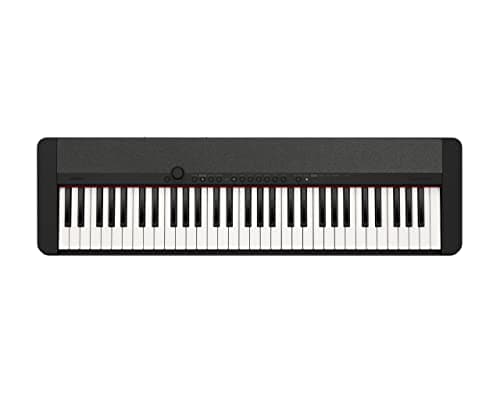
The Casio Casiotone CT-S1#ad is the one we would buy. 61 full-size keys, battery capable, and around ten pounds — light enough to move one-handed and stand on end behind a door.
What makes it interesting is what it leaves out. There is no large voice library and no lesson system; the design priority is the piano sound and the speakers that reproduce it. For a player who intends to learn piano rather than explore a features list, that trade is the right way round, and it is the reason this board sounds better than its size suggests.
The Casio Casiotone CT-S200#ad is the same fundamental proposition at a lower price with a simpler sound set. It keeps the two things we refuse to compromise on — full-size keys and touch response — and gives up refinement in the piano voice. This is the board to buy if it will be carried by a child, taken to school, or left permanently at a grandparent’s house.
The Yamaha PSR-E383#ad is the least portable of the three and the most capable. It is heavier and physically larger, and it carries a built-in lesson system and a much wider voice library. Buy it if the board will mostly live in one place and occasionally travel; skip it if the reverse is true.
What portability costs you
Being honest about the trade matters more here than in most categories, because the thing you give up is the thing a piano teacher will ask about.
Weighted key feel. An unweighted board does not build the finger strength or the dynamic control that a piano action does. For a casual player that is fine. For someone working through graded piano exams it is a real limitation, and the trade-offs are laid out in weighted versus unweighted keys.
Key count. 61 keys covers essentially all beginner repertoire and runs out somewhere in intermediate classical material. When that happens it is a genuine ceiling rather than an inconvenience, and the detail is in 61 versus 88 keys.
Speaker size. Small cabinets cannot move much air. All three of these sound better through headphones than through their own speakers, which is normal and worth planning for.
Portable does not mean it stays on a table
The most common mistake with a portable board is treating portability as permission to skip the stand. A keyboard on a dining table sits roughly four inches too high, which bends the wrists upward to reach the keys and is how beginners acquire wrist pain and conclude that piano hurts.
A folding X-stand weighs very little, packs flat and travels with the board. The specifics of height and bench choice are in our stand and bench guide, and the rest of the surrounding kit is in keyboard accessories you actually need.
Who should buy a portable board
Anyone in a small apartment where the instrument cannot occupy permanent floor space. Anyone splitting time between two homes. Anyone whose practice happens in whichever room is free. Anyone buying for a child who will want to show people.
Who should not: anyone working toward graded exams on a weighted action, and anyone whose board will sit in one corner of one room for the next five years. In that second case the portability premium buys nothing, and the money is better spent on the action — see best beginner digital pianos.
Quick picks
Best sound in the smallest package
61 full-size keys built around piano tone rather than a features list, on batteries, at a weight one person can carry in one hand.
| # | Product | Best for | Score | Price |
|---|---|---|---|---|
| 1 | Casio Casiotone CT-S161 full-size touch-sensitive keys, 61 tones and no arranger clutter. | 61 keys, piano sound firstThe honest floor | 7.8 | $219.99 · View on Amazon #ad How we’re funded |
Lightest, and cheapest to replace
The same 61 full-size keys with a simpler sound set. The one to buy if it is going to be carried by a child or left at a grandparent's house.
| # | Product | Best for | Score | Price |
|---|---|---|---|---|
| 1 | 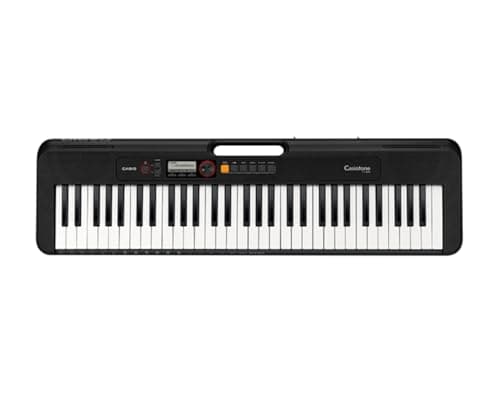 Casio Casiotone CT-S20061 full-size keys, 400 tones and a power supply in the box, at the price where most keyboards still ship with narrow mini keys. | Kids, full-size keysThe honest floor | 7.4 | $144.99 · View on Amazon #ad How we’re funded |
Portable, but with the learning tools
Heavier and larger than the Casios, and the only one here with a built-in lesson system and a wide voice library.
| # | Product | Best for | Score | Price |
|---|---|---|---|---|
| 1 | 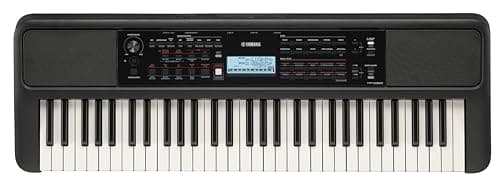 Yamaha PSR-E38361 touch-sensitive keys and 125 lesson songs with hand-separate practice and scoring. | Learning tools, 61 keysThe honest floor | 7.6 | $199.99 · View on Amazon #ad How we’re funded |
The picks in full
Casio Casiotone CT-S1
CasioBest for: 61 keys, piano sound first
61 full-size touch-sensitive keys, 61 tones and no arranger clutter. It is the 61-key board for someone who wants to play piano rather than operate a keyboard.
Published specifications
- Keys:
- 61, full-size, touch-sensitive
- Polyphony:
- 64 notes
- Tones:
- 61, including a stereo grand piano
- Weight:
- 9.9 lb
- Dimensions:
- 36.61" W x 10.15" D x 3.30" H
- Connectivity:
- USB-MIDI
What it gets right
- Deliberately few sounds and a clean panel, which removes the single biggest distraction from actual practice
- 9.9 pounds and 3.3 inches tall — it can live on a shelf between sessions, and an instrument that lives out of the way gets played less
- 64-note polyphony, higher than the PSR-E383's 48
Where it gives ground
- No lesson mode at all, unlike the PSR-E383
- Unweighted keys, same fundamental limit as any 61-key board
What it is not good at
Entertaining a young child. There is no light-up key guidance, no play-along scoring and only 61 sounds. That restraint is the point for an adult beginner and a drawback for a seven-year-old.
How the specs score against a beginner’s needs
Scores are our reading of the published specifications above against what a beginner physically needs. They are not test results — we have not played this instrument.
Specifications from Casio — CT-S1 product page.
Casio Casiotone CT-S200
CasioBest for: Kids, full-size keys
61 full-size keys, 400 tones and a power supply in the box, at the price where most keyboards still ship with narrow mini keys. That one specification is why it is here.
Published specifications
- Keys:
- 61, full-size
- Polyphony:
- 48 notes
- Tones:
- 400
- Rhythms:
- 77
- Display:
- LCD
- Connectivity:
- USB-MIDI
- In the box:
- Power supply, music rest
What it gets right
- Full-size keys at a price where mini keys are the norm — this is the specification that decides whether a child learns a hand span they can keep
- Power supply included, which is not a given and turns a cheap keyboard into an expensive paperweight when it is missing
- Light and simple enough that a child can set it up themselves, which means it gets used
Where it gives ground
- Unweighted keys, so it will not build the finger strength an acoustic piano needs
- 400 tones is a lot of browsing for a child who is meant to be practicing
What it is not good at
Preparing anyone for a real piano. It is a first keyboard for a young child, not a piano substitute — read our weighted-versus-unweighted comparison before assuming otherwise.
How the specs score against a beginner’s needs
Scores are our reading of the published specifications above against what a beginner physically needs. They are not test results — we have not played this instrument.
Specifications from Casio Casiotone CT-S200 published specifications.
Yamaha PSR-E383
YamahaBest for: Learning tools, 61 keys
61 touch-sensitive keys and 125 lesson songs with hand-separate practice and scoring. The touch response is the spec that matters; the 650 tones are the spec that sells it.
Published specifications
- Keys:
- 61, organ-style (unweighted), touch-sensitive
- Touch response:
- Soft / medium / hard / off
- Polyphony:
- 48 notes
- Tones:
- 650 (258 panel, 25 drum/SFX, 20 arpeggio, 347 XGlite)
- Lessons:
- 125 lesson songs, right/left/both-hand practice with evaluation
- In the box:
- Music rest, PA130 power adapter
What it gets right
- Touch-sensitive keys — playing harder makes it louder, which is the thing a beginner has to learn early and a non-touch keyboard cannot teach
- The lesson mode with hand-separate practice and scoring is genuinely useful, not a gimmick
- Power adapter included, which is not a given at this tier
Where it gives ground
- Unweighted organ-style keys — this will not build the finger strength a piano needs
- 61 keys, so a method book that assumes 88 will eventually run out of instrument
What it is not good at
Preparing anyone for an acoustic piano. If there is a real piano in the child's future, the unweighted action is a habit to unlearn later. Read our 61-versus-88 comparison before deciding.
How the specs score against a beginner’s needs
Scores are our reading of the published specifications above against what a beginner physically needs. They are not test results — we have not played this instrument.
Specifications from Yamaha — PSR-E383 specifications.
Questions people actually ask
What makes a keyboard portable?
Three things together: weight under roughly fifteen pounds, the ability to run on batteries, and an unweighted key action that has no hammer mechanism to knock out of alignment. Missing any one of them and the board is transportable rather than portable.
Can you get a portable keyboard with 88 keys?
Yes, but almost never with weighted keys and batteries at a beginner price. An 88-key hammer-action board is inherently heavy, because the weight is the feature. Portable 88-key boards are usually unweighted and are a different instrument.
Do portable keyboards have full-size keys?
The good ones do, and it is the specification to check before any other. Mini-key boards are lighter and teach a hand span that has to be unlearned on every real piano. All three picks here use full-size keys.
Are battery-powered keyboards worth it?
If the board will move between rooms or houses, very much so — it removes the search for a socket, which is a real source of practice friction. If it will live in one place, the feature is close to irrelevant.
Sources
Still deciding?
Every recommendation on this site is built the same way, and the method is published in full — including what we do not do and what would get a pick dropped.
Read next
- Best keyboard gig bags and cases
Published interior lengths for 88-key bags run from 53 to 59 inches, so the label tells you nothing. How to measure, when wheels earn their 22 pounds, and four bags on real dimensions.
- Best beginner keyboards: 61 keys that suit real lessons
Touch response over tone count, segmented for children and adult learners, with the 61-key ceiling stated plainly.
- 61 vs 88 key keyboard
When 61 keys stops being enough, what 88 actually costs in money and floor space, and buy paths for both answers.
- Keyboard accessories you actually need
Stand, bench, sustain pedal and headphones, ranked by how much they change your playing, plus the bundle items that get thrown away.
- Best instruments for an apartment
Four instruments that survive a shared wall, ranked by how quiet they are at their loudest, plus the headphones that make the difference.
- Best keyboards for kids
Why mini keys are disqualifying, and two picks that keep full-size touch-sensitive keys within a child's budget.