Keys
Keyboard specs, and which ones matter
The number printed largest on the box is almost always the least important one on the sheet.
By Sawyer V. · Published · Last updated
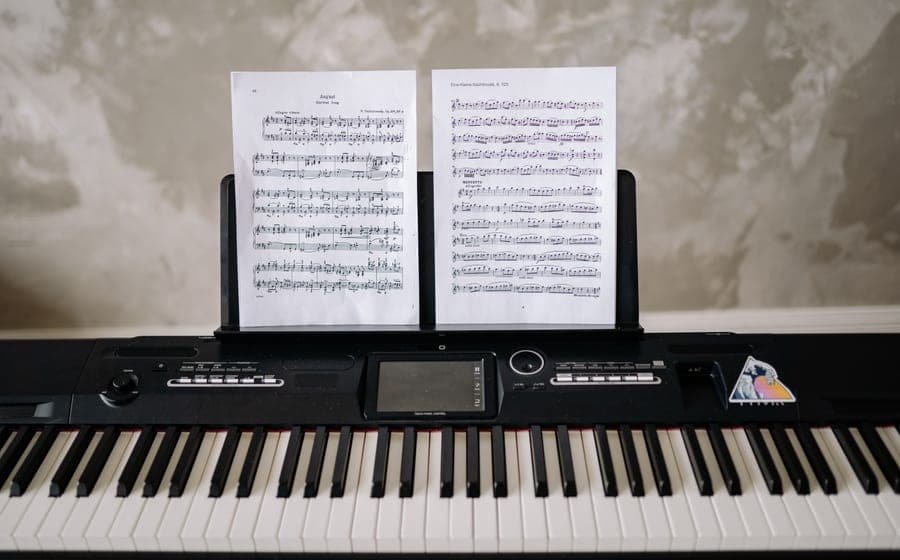
Keyboard marketing is unusual in how completely it inverts the priority order. The headline is nearly always the voice count, which is close to meaningless, while the specification that decides whether the instrument is usable gets a line in a table.
This page reorders the sheet.
The four specs that matter, in order: full-size keys, touch response, key action, and key count. Polyphony matters below about 32 notes and stops mattering above 64. Voice count, rhythm styles and built-in songs are close to irrelevant.
The four that matter
1. Full-size keys. The standard width every piano in the world uses. Narrower keys teach a hand span that is wrong on every other instrument the player will ever touch, and physical habits are far harder to unlearn than to learn. This is the one specification we treat as non-negotiable, which is why the Casio Casiotone CT-S200#ad is in our picks despite being an inexpensive board — it does not compromise here.
2. Touch response. Also called touch sensitivity or velocity sensitivity. The keyboard measures how fast the key goes down and plays proportionally louder. Without it, every note is the same volume regardless of how you play, which makes dynamics impossible and makes practice actively misleading.
3. Key action. What the key feels like. Synth action is light and springy; semi-weighted adds resistance; a graded hammer action puts a real weighted lever under each key and makes the low notes heavier than the high ones, like an acoustic piano. The Yamaha P-145#ad uses a graded hammer action and that is most of what its price buys. The full argument is in weighted versus unweighted keys.
4. Key count. 61 covers essentially all beginner material; 88 covers everything written for piano. It is a real ceiling rather than a preference, and where it bites is set out in 61 versus 88 keys.
Polyphony, properly explained
Polyphony is the number of notes the sound engine can produce simultaneously, and it is the one spec-sheet number that is genuinely worth reading.
The confusion is that it does not mean fingers. Several things consume the pool at once:
Sustained notes still count. Hold the sustain pedal and play a passage, and every note that is still ringing is still using a voice. This is the situation that exhausts low polyphony first.
Layered sounds double it. Playing piano and strings together means each key consumes two.
Accompaniment uses it. Auto-rhythm and backing styles are notes too.
When the limit is reached, the board silently drops the oldest notes. You do not get an error; you get a chord that quietly loses its bass while you are holding the pedal, which sounds like the instrument failing at random.
Practically: below 32 is a real problem, 48 is fine for a beginner, and 64 or more is more than enough. Above that the number stops meaning anything to a learner.
The specs that do not matter
Voice count. The big number on the box. A board advertising several hundred sounds has a good piano, a decent electric piano, a usable organ, some strings, and several hundred variations nobody plays twice. Judge a board by whether its piano sound is good, because that is the one you will use.
The Casio Casiotone CT-S1#ad makes this argument explicitly: it carries a deliberately short voice list and spends the engineering on the piano sound and the speakers. For a player learning piano, that is the right trade and it is the opposite of what the market rewards.
Rhythm and accompaniment styles. Fun for a week. Some players genuinely use them and most switch them on twice. The Yamaha PSR-E383#ad has a substantial set and a lesson system, and it is a legitimate reason to buy it — if you know you are the sort of person who will use them.
Built-in song libraries. Useful for the lesson features that reference them, otherwise decoration.
Speaker wattage. Small numbers on small cabinets. Every board in this class sounds better through headphones, and comparing wattage figures between manufacturers tells you very little.
Two specs that are quietly useful
A proper sustain pedal socket. Written piano music assumes a sustain pedal within months. A board with no socket, or one that only accepts a sliding plastic footswitch, has a real limitation. Details in keyboard accessories you actually need.
A headphone output. Present on essentially everything, and worth confirming. It is the feature that decides whether practice can happen in the evening, and it is the only reason a keyboard can be silent in a shared house.
Reading a spec sheet in ninety seconds
Find the key width. If it does not say full-size, stop.
Find touch response. If it is absent, stop — that is a below-the-floor instrument regardless of anything else on the sheet.
Find the action type, and decide whether you need weighted keys based on what you intend to play rather than on aspiration.
Find polyphony. Anything 48 or above is fine.
Then ignore the rest of the page. The remaining specs are how manufacturers differentiate products that are, in the ways that matter to a learner, the same. Where the line between acceptable and not sits is in are cheap keyboards worth it.
What we would buy
Yamaha PSR-E383
YamahaBest for: Learning tools, 61 keys
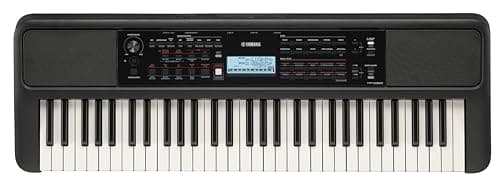
61 touch-sensitive keys and 125 lesson songs with hand-separate practice and scoring. The touch response is the spec that matters; the 650 tones are the spec that sells it.
Published specifications
- Keys:
- 61, organ-style (unweighted), touch-sensitive
- Touch response:
- Soft / medium / hard / off
- Polyphony:
- 48 notes
- Tones:
- 650 (258 panel, 25 drum/SFX, 20 arpeggio, 347 XGlite)
- Lessons:
- 125 lesson songs, right/left/both-hand practice with evaluation
- In the box:
- Music rest, PA130 power adapter
What it gets right
- Touch-sensitive keys — playing harder makes it louder, which is the thing a beginner has to learn early and a non-touch keyboard cannot teach
- The lesson mode with hand-separate practice and scoring is genuinely useful, not a gimmick
- Power adapter included, which is not a given at this tier
Where it gives ground
- Unweighted organ-style keys — this will not build the finger strength a piano needs
- 61 keys, so a method book that assumes 88 will eventually run out of instrument
What it is not good at
Preparing anyone for an acoustic piano. If there is a real piano in the child's future, the unweighted action is a habit to unlearn later. Read our 61-versus-88 comparison before deciding.
How the specs score against a beginner’s needs
Scores are our reading of the published specifications above against what a beginner physically needs. They are not test results — we have not played this instrument.
Specifications from Yamaha — PSR-E383 specifications.
Casio Casiotone CT-S1
CasioBest for: 61 keys, piano sound first
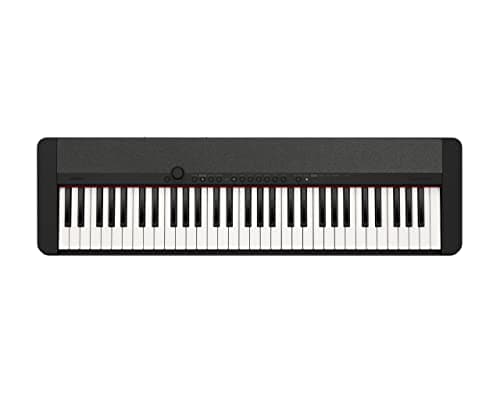
61 full-size touch-sensitive keys, 61 tones and no arranger clutter. It is the 61-key board for someone who wants to play piano rather than operate a keyboard.
Published specifications
- Keys:
- 61, full-size, touch-sensitive
- Polyphony:
- 64 notes
- Tones:
- 61, including a stereo grand piano
- Weight:
- 9.9 lb
- Dimensions:
- 36.61" W x 10.15" D x 3.30" H
- Connectivity:
- USB-MIDI
What it gets right
- Deliberately few sounds and a clean panel, which removes the single biggest distraction from actual practice
- 9.9 pounds and 3.3 inches tall — it can live on a shelf between sessions, and an instrument that lives out of the way gets played less
- 64-note polyphony, higher than the PSR-E383's 48
Where it gives ground
- No lesson mode at all, unlike the PSR-E383
- Unweighted keys, same fundamental limit as any 61-key board
What it is not good at
Entertaining a young child. There is no light-up key guidance, no play-along scoring and only 61 sounds. That restraint is the point for an adult beginner and a drawback for a seven-year-old.
How the specs score against a beginner’s needs
Scores are our reading of the published specifications above against what a beginner physically needs. They are not test results — we have not played this instrument.
Specifications from Casio — CT-S1 product page.
Yamaha P-145
YamahaBest for: Buy once, 88 weighted keys
88 graded hammer keys, a concert grand sample and 24 pounds. If the plan is piano lessons rather than keyboard playing, this is where the shopping actually starts.
Published specifications
- Keys:
- 88, GHC (Graded Hammer Compact), fully weighted and graded
- Polyphony:
- 64 notes
- Sound:
- Yamaha CFIIIS concert grand sample, damper resonance DSP
- Speakers:
- 7 W built-in
- Dimensions:
- 1,326 x 268 x 129 mm (52-3/16" x 10-9/16" x 5-1/16")
- Weight:
- 11.1 kg (24 lb 8 oz)
- In the box:
- Music rest, sustain foot switch
What it gets right
- Graded hammer action — the low keys are heavier than the high ones, which is the thing an unweighted keyboard cannot teach
- All 88 keys, so no method book ever runs off the end of the instrument
- Genuinely portable at 24 pounds and 268 mm deep; it fits on a desk
Where it gives ground
- 64-note polyphony is the entry-tier number; heavy sustain-pedal passages will drop notes eventually
- A single sustain footswitch, not a proper piano-style pedal — most players replace it
What it is not good at
Anything other than piano. There are only a handful of voices and no arranger features, so if the player wants to make beats or layer sounds, a PSR-E383 will make them happier for less money.
How the specs score against a beginner’s needs
Scores are our reading of the published specifications above against what a beginner physically needs. They are not test results — we have not played this instrument.
Specifications from Yamaha USA — P-145 specifications.
Casio Casiotone CT-S200
CasioBest for: Kids, full-size keys
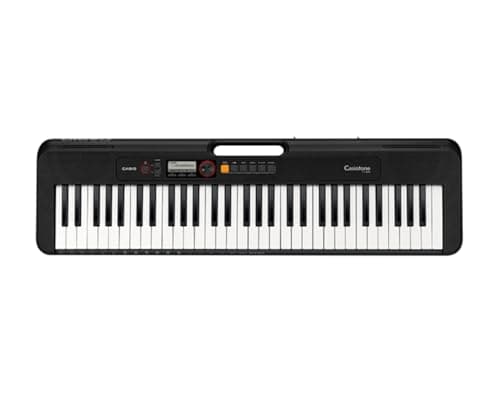
61 full-size keys, 400 tones and a power supply in the box, at the price where most keyboards still ship with narrow mini keys. That one specification is why it is here.
Published specifications
- Keys:
- 61, full-size
- Polyphony:
- 48 notes
- Tones:
- 400
- Rhythms:
- 77
- Display:
- LCD
- Connectivity:
- USB-MIDI
- In the box:
- Power supply, music rest
What it gets right
- Full-size keys at a price where mini keys are the norm — this is the specification that decides whether a child learns a hand span they can keep
- Power supply included, which is not a given and turns a cheap keyboard into an expensive paperweight when it is missing
- Light and simple enough that a child can set it up themselves, which means it gets used
Where it gives ground
- Unweighted keys, so it will not build the finger strength an acoustic piano needs
- 400 tones is a lot of browsing for a child who is meant to be practicing
What it is not good at
Preparing anyone for a real piano. It is a first keyboard for a young child, not a piano substitute — read our weighted-versus-unweighted comparison before assuming otherwise.
How the specs score against a beginner’s needs
Scores are our reading of the published specifications above against what a beginner physically needs. They are not test results — we have not played this instrument.
Specifications from Casio Casiotone CT-S200 published specifications.
Questions people actually ask
What is polyphony on a keyboard?
The maximum number of notes that can sound at once. It is not the same as the number of keys you can hold down, because sustained notes, layered sounds and accompaniment styles all consume the same pool.
How much polyphony does a beginner need?
32 notes is workable, 48 is comfortable, and 64 or more is plenty for anything a beginner plays. Below 32 you can hear notes cut off when using the sustain pedal, which is genuinely disruptive.
Do more voices make a keyboard better?
Almost never. A board with 700 voices typically has a handful of good ones and a long tail nobody uses. A board with 20 well-made sounds and a strong piano voice is the more useful instrument.
What is touch response?
The keyboard sensing how hard you press and playing louder or softer accordingly. Without it every note comes out at identical volume, which makes expressive playing impossible and is the clearest below-the-floor specification in this category.
Sources
Still deciding?
Every recommendation on this site is built the same way, and the method is published in full — including what we do not do and what would get a pick dropped.
Read next
- Best beginner keyboards: 61 keys that suit real lessons
Touch response over tone count, segmented for children and adult learners, with the 61-key ceiling stated plainly.
- Weighted vs unweighted keys
Hammer, semi-weighted and synth action explained by effect on the hands, with the one question that settles the choice.
- 61 vs 88 key keyboard
When 61 keys stops being enough, what 88 actually costs in money and floor space, and buy paths for both answers.
- Are cheap keyboards worth it?
Why cheap keyboards fail invisibly rather than mechanically, and the three specs that separate a cheap board from a too-cheap one.
- MIDI keyboard or digital piano?
What a controller does and does not include, the hidden costs, and why a beginner learning piano almost always wants the standalone instrument.
- Best keyboard brands for beginners
What Yamaha, Casio, Alesis, Roland and Korg each do well at the beginner end, and the specifications that outrank the badge.