Guitars
Best beginner acoustic guitars: solid tops from $200 to $350
One spec separates an acoustic that gets better over a decade from one that never changes. It costs about eighty dollars and it is not on the front of the box.
By Sawyer V. · Published · Last updated
An acoustic guitar is harder to play than an electric and simpler to buy. Harder because the strings are thicker and sit further from the fingerboard, so fretting a clean chord takes more hand strength in the first month. Simpler because there is nothing to plug it into — the guitar, a tuner and a set of spare strings is the complete purchase.
Which means the shopping question narrows to one thing quite quickly. Every pick below states its Starter Path band and what it is not good at, and we have not played any of them — the method is on how we pick.
Solid top versus laminate: the one spec worth paying for
A guitar top is the large flat face with the sound hole in it, and it does most of the work of turning string vibration into sound. It is built one of two ways. A solid top is a single piece of wood, usually spruce, sawn thin. A laminate top is several thin layers glued together, like plywood.
A solid top flexes as one piece and keeps changing. The wood fibers loosen with vibration over years of playing and the instrument gets louder and more responsive — slowly, but genuinely. A laminate top is stiffened by its glue lines and sounds the same in year ten as on day one. Neither is a defect. But if a beginner is going to own one guitar for a decade, a solid top is the version of that guitar that rewards the decade.
The reason to care right now is that the price of entry for a solid top has collapsed. The Yamaha FG800 specifies a solid Sitka spruce top with scalloped bracing in the same price bracket where laminate-top guitars still sell. There is no longer a good reason for an adult beginner to buy a laminate-top full-size acoustic.
The body-size problem nobody mentions
Most beginner acoustics are dreadnoughts, which is the big square-shouldered shape everyone pictures. Dreadnoughts are loud and full and they are also large: the FG800 body is 412 mm across and between 100 and 118 mm deep.
For an adult of average build that is fine. For a twelve-year-old, or a smaller adult, it is a real obstacle — the strumming arm has to reach over the top edge and the fretting arm has to come around the side, and if the box is too deep for the player’s torso both of those go wrong at once. The player compensates by hunching, the wrist angle gets worse, and everything becomes harder than it needed to be.
The fixes are a concert-size body, which is the same scale length in a smaller box, or a genuine 3/4 instrument like the JR1 for a child. The JR1 body is 317 mm across against the FG800’s 412 mm, and that 95 mm is the entire difference between a child being able to hold it and not.
What to skip
The full-size acoustic with a laminate top sold at the same price as a solid-top FG800 or CD-60S. These still exist in quantity, usually from brands whose listings talk about the color and the included accessories rather than the top. If two guitars cost the same and one has a solid top, the choice has been made for you.
And skip the very cheap full-size acoustic for a child. Acoustics are the worst instrument to buy too big, because unlike an electric there is no low-action escape hatch. A child on an oversized acoustic with high action is fighting the instrument with every chord. If the budget is tight, a ukulele is a far better use of the same money than a bad full-size acoustic — nylon strings, a small body, and chords that a small hand can actually form.
FG800 or CD-60S: how to choose between them
These two are close enough that anyone declaring a clear winner has not read both spec sheets. They trade blows.
The Fender uses mahogany back and sides against the Yamaha’s nato and okume, and it has rolled fingerboard edges — the corners of the fingerboard are softened rather than left square. That is a small thing that matters a lot in month one, when a new player’s hand is sliding up and down an unfamiliar neck and a sharp edge is the difference between practicing for forty minutes and stopping at fifteen. The Fender is also slightly shorter in scale at 25.3 inches against Yamaha’s 650 mm, which very marginally lowers string tension.
The Yamaha answers with scalloped bracing — the internal struts under the top are carved away where they can be, which lets the top move more freely — and with the flatter 400 mm fingerboard radius that suits chord playing slightly better than the Fender’s rounder 12 inch. Both have die-cast tuners and a solid spruce top.
If the player has small or sensitive hands, take the Fender for the rolled edges. Otherwise take whichever is cheaper on the day, and you will not have made a mistake either way.
Three variations on the acoustic worth knowing about before you commit. Nylon strings are far gentler on sore fingertips — see best classical guitars for beginners. A pickup is worth paying for only if you will plug in, which is worked through in best acoustic-electric guitars. And if you pick rather than strum, the specifications shift — see best guitars for fingerstyle beginners and, for something to carry, best travel guitars.
Quick picks
Adults and teenagers, full-size
Both of these have a solid spruce top, which is the specification worth paying for. They differ on back-and-sides wood and on how the neck feels, and they are genuinely close.
| # | Product | Best for | Score | Price |
|---|---|---|---|---|
| 1 | No image Yamaha FG800A solid Sitka spruce top with scalloped bracing at the entry price. | Buy once, acousticEnough | 8.8 | Check price on Amazon → #ad How we’re funded |
| 2 | 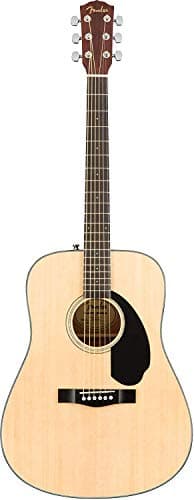 Fender CD-60SSolid spruce top, mahogany back and sides, and rolled fingerboard edges on a slightly shorter 25. | Easiest acoustic to fretEnough | 8.8 | $229.99 · View on Amazon #ad How we’re funded |
Children, roughly ages 7 to 11
A 3/4 body, chosen because a child cannot get their arm over a full dreadnought. The compromise is a laminate top, and that is the right compromise at this size.
| # | Product | Best for | Score | Price |
|---|---|---|---|---|
| 1 | 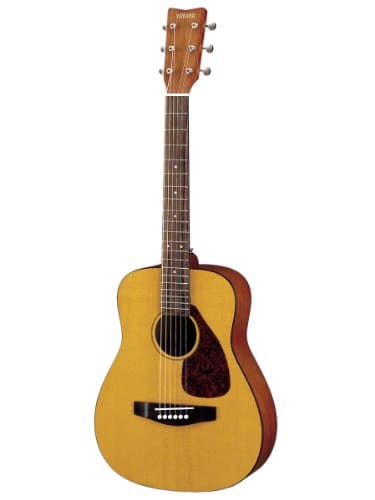 Yamaha JR1 (FG Junior)A 540 mm scale on a body 389 mm long and 317 mm across, with a gig bag included. | 3/4 acoustic, ages 7-11The honest floor | 8.2 | $189.99 · View on Amazon #ad How we’re funded |
The picks in full
Yamaha FG800
YamahaBest for: Buy once, acoustic
A solid Sitka spruce top with scalloped bracing at the entry price. Solid-versus-laminate is the one acoustic spec that changes what the instrument does over years, and this is the cheapest place to get it done right.
Published specifications
- Top:
- Solid Sitka spruce
- Back / sides:
- Nato / okume
- Neck / fingerboard:
- Nato neck, rosewood fingerboard, R400 mm (23-5/8") radius
- Scale length:
- 650 mm (25-9/16")
- Nut width:
- 43 mm (1-11/16")
- Bracing:
- Scalloped
- Body:
- Traditional Western (dreadnought), 412 mm (16-1/4") wide, 100-118 mm deep
- Hardware:
- Die-cast chrome tuners, urea nut and saddle
What it gets right
- A solid top, not a laminate — the only acoustic spec at this price that genuinely changes over time
- Scalloped bracing and die-cast tuners are specifications you normally pay considerably more for
- Yamaha's most-copied entry acoustic; parts, setups and advice are everywhere
Where it gives ground
- A full dreadnought body is a big box — 412 mm across and up to 118 mm deep
- Nato and okume back and sides are the cost saving; the top is where the money went
What it is not good at
Fitting a smaller player. The dreadnought body is wide and deep enough that a young teenager can struggle to get their arm over it comfortably. If that is the buyer, look at the JR1 or a concert-size body instead.
How the specs score against a beginner’s needs
Scores are our reading of the published specifications above against what a beginner physically needs. They are not test results — we have not played this instrument.
Specifications from Yamaha Europe — FG/FS800 series specifications.
Fender CD-60S
FenderBest for: Easiest acoustic to fret
Solid spruce top, mahogany back and sides, and rolled fingerboard edges on a slightly shorter 25.3 inch scale. The rolled edges are the reason to pick this one.
Published specifications
- Top:
- Solid spruce
- Back / sides:
- Mahogany
- Scale length:
- 25.3" (643 mm)
- Nut width:
- 1.69" (43 mm)
- Fingerboard:
- 12" radius, 20 frets, rolled edges
- Bracing:
- Quartersawn scalloped "X"
- Neck:
- Fender "Easy-to-Play" shape
What it gets right
- Rolled fingerboard edges remove the sharp edge that makes a new player's hand hurt after twenty minutes
- Solid spruce top at the same tier as the FG800, with mahogany rather than nato back and sides
- The 25.3 inch scale is slightly shorter than most dreadnoughts — marginally lower string tension
Where it gives ground
- Still a full dreadnought body, so the size objection is the same as the FG800's
- The 12 inch fingerboard radius is quite round compared with the FG800's flatter 400 mm
What it is not good at
Being obviously better than the FG800. These two are genuinely close, they trade blows on back-and-sides wood versus bracing, and anyone telling you one is clearly superior has not looked at the spec sheets.
How the specs score against a beginner’s needs
Scores are our reading of the published specifications above against what a beginner physically needs. They are not test results — we have not played this instrument.
Specifications from Fender — CD-60S Dreadnought.
Yamaha JR1 (FG Junior)
YamahaBest for: 3/4 acoustic, ages 7-11
A 540 mm scale on a body 389 mm long and 317 mm across, with a gig bag included. It is a scaled-down FG, not a toy that happens to be small.
Published specifications
- Scale length:
- 540 mm (21-1/4") — 3/4 size
- Nut width:
- 43 mm (1-11/16")
- Top:
- Spruce (laminate)
- Back / sides:
- Meranti
- Neck / fingerboard:
- Nato neck, rosewood fingerboard and bridge
- Body:
- 389 mm long, 317 mm wide, 80-90 mm deep; 845 mm overall
- In the box:
- Gig bag
What it gets right
- The body is genuinely small — 317 mm across against the FG800's 412 mm, which is what actually decides whether a child can hold it
- Full 43 mm nut width despite the short scale, so chord shapes are not cramped
- Gig bag included, which on a child's instrument is not an accessory but a requirement
Where it gives ground
- Laminate spruce top, unlike the solid-top FG800 — this is the compromise for the size and price
- Meranti back and sides are basic
What it is not good at
Being a lifetime instrument. This is deliberately a stepping stone; a child who keeps playing moves to a full-size body in a few years and this one becomes the travel guitar.
How the specs score against a beginner’s needs
Scores are our reading of the published specifications above against what a beginner physically needs. They are not test results — we have not played this instrument.
Specifications from Yamaha USA shop — JR1 3/4 size acoustic guitar.
Questions people actually ask
Are cheap acoustic guitars worth buying?
Above roughly the $180 mark, yes — that is where solid tops, adjustable truss rods and decent tuners start appearing together. Below about $120 on a full-size acoustic you are usually buying an instrument with high action that takes real hand strength to fret, which is the specific reason beginners give up on acoustics. The full breakdown is in are cheap guitars worth it.
What is the difference between a solid top and a laminate top?
A solid top is a single piece of wood; a laminate is thin layers glued together. The practical difference is that a solid top flexes and resonates as a unit and keeps opening up over years of playing, while a laminate sounds the same on day one and in year ten. On a first guitar it is the one specification worth paying up for, and both full-size picks here have one.
Is a dreadnought too big for a beginner?
For an adult, no. For a smaller teenager or anyone under about five feet, often yes. A Yamaha FG800 body is 412 mm across and up to 118 mm deep — that is a lot of box to get an arm over. If the player is small, look at a concert-size body or the 3/4 JR1 rather than assuming they will manage.
Do I need anything else with an acoustic guitar?
A clip-on tuner and a set of spare strings, and that is genuinely it. This is the acoustic’s real advantage over an electric: no amplifier, no cable, no power. A capo is useful within the first few months but not on day one.
Sources
Still deciding?
Every recommendation on this site is built the same way, and the method is published in full — including what we do not do and what would get a pick dropped.
Read next
- Acoustic vs electric guitar for beginners
The physical difference is real but small. The cost difference is larger than most people expect. Buy CTAs for both answers.
- How much should a beginner guitar cost?
Four price bands defined by specification rather than by number, plus the hidden costs that turn a $200 budget into a $270 purchase.
- What size guitar does a child need?
Age and height chart with real scale lengths, the ten-second fit check, and why height beats age every time.
- Best beginner electric guitars: what's worth it from $150 to $400
Segmented by player and price band, with the three specs that actually decide whether a first electric survives its first year.
- Ukulele vs guitar for beginners
Why the ukulele is genuinely easier, exactly which skills transfer to guitar, and when the stepping-stone plan is a detour.