Guitars
Guitar maintenance a beginner actually needs
Most guitars that get ruined are not dropped. They are stored badly for one winter, and the damage is permanent by the time anyone notices.
By Sawyer V. · Published · Last updated

Guitar maintenance advice online is mostly performed rather than practical: elaborate cleaning rituals, conditioning products, polishing compounds, an annual regimen. Almost none of it is what actually determines whether an instrument is still good in five years.
Four things matter. One of them is invisible and does most of the damage.
Wipe the strings after playing, change them every two to three months, keep a solid-wood acoustic between roughly 40 and 60 per cent humidity, and have the setup checked once a year. That is the entire list. Everything else is optional.
1. Wipe the strings, every single time
Strings do not wear out from being played. They corrode, and the thing that corrodes them is the salt and oil left behind by your hands.
Thirty seconds with a dry cloth after each session — along the length of each string, and underneath where the fretboard is — roughly doubles how long a set lasts. There is no product involved and no technique to learn.
It also keeps grime off the fretboard, which is the substance that people later buy special cleaners to remove. The cheapest maintenance on this page is the one that stops the problem occurring.
2. Change strings before they are dead
A dead string does two things a beginner will misdiagnose. It goes dull, so the guitar sounds worse than it is, and it goes false, meaning it will not play in tune with itself up the neck no matter how carefully it is tuned.
That second one is the problem. A player with false strings tunes the guitar, plays a chord at the fifth fret, hears it sound wrong, and concludes their fingers are at fault. They are not.
For acoustics, D'Addario EJ16 (12-53)#ad in 12-53 phosphor bronze is the default light gauge and the sensible starting point. For electrics, D'Addario EXL110 (10-46)#ad in 10-46 nickel wound is the equivalent standard. The full reasoning on gauges is in beginner guitar strings, and the actual procedure is in how to change guitar strings.
Keep a spare set in the case. A broken string with no replacement in the house is a week of not practicing, and week-long gaps are how beginners stop.
3. Humidity: the one that actually ruins guitars
This is the item that justifies the page. A solid-wood acoustic guitar is a thin wooden box under permanent tension, and wood moves with the moisture in the air.
Too dry and the top shrinks across the grain while the braces glued to it do not. The wood loses that argument and cracks. Before it cracks you get the warning signs: the top sinks slightly, the action drops, and the strings start buzzing on frets they never buzzed on before. Most people read that as needing a setup.
Too damp and the reverse happens — the top swells, the action climbs, and the guitar becomes hard work to fret.
Roughly 40 to 60 per cent relative humidity keeps both away. In practice that means: not next to a radiator, not against an external wall in an unheated room, not in a loft, not in a car. In a centrally heated home through winter, a sound-hole humidifier in the case is a small purchase against an expensive failure.
Two useful exemptions. Solid-body electrics are far less vulnerable — there is no thin soundboard to crack. And laminate-top acoustics, which is what most inexpensive acoustics have, are considerably more stable than solid tops. The same physics governs ukuleles, covered in ukulele care and humidity.
4. Get the setup checked once a year
A setup is the adjustment of string height, neck relief and intonation to a specific instrument. It is not a repair and it is not optional maintenance in the way an oil change is — it is what makes a guitar comfortable.
On an inexpensive guitar it is the single highest-value money you can spend, because entry-level instruments leave the factory set to a tolerance rather than to a player. A well set-up cheap guitar is easier to play than a badly set-up expensive one, and this is the largest single lever on whether a beginner keeps going. Why it matters so much for the hands is in why the guitar hurts your fingers.
Once a year is enough for most players, ideally at a seasonal change, since that is when the neck has moved most.
Keeping it in tune is maintenance too
A guitar that will not hold pitch is usually not faulty. New strings stretch for the first few days and need retuning constantly until they settle, and strings wound untidily around the post slip under tension.
Tune every time you pick it up, with a Snark clip-on chromatic tuner#ad rather than by ear, for as long as you are a beginner. Practicing on an out-of-tune instrument trains the ear toward wrong intervals, which is a slow and genuinely costly problem to acquire.
If a guitar still drifts badly with settled strings and neat windings, the tuners themselves are the likely culprit — and that is a hardware limit rather than a maintenance failure. It is exactly the specification that separates the honest floor from below it, as we set out in are cheap guitars worth it.
What you can safely ignore
Polishing the body. A polyurethane finish does not need feeding. A dry cloth removes fingerprints and that is the entire requirement.
Frequent fretboard oiling. Once or twice a year on an unfinished board, at a string change, and sparingly. More than that swells the wood around the fret slots, which is a real and avoidable problem.
Detuning for storage. Covered above. The neck is designed to live under tension.
Specialist cleaning kits. A microfiber cloth and, once a year, a very small amount of the right fretboard product. The multi-bottle kits sell a routine rather than a result.
Adjusting the truss rod yourself. It is adjustable, it is not beginner-adjustable, and the failure mode is expensive. Leave it to the annual setup.
What we would buy
D'Addario EJ16 (12-53)
D'AddarioBest for: Acoustic, the default gauge
Light-gauge phosphor bronze at 12-53, the acoustic equivalent of the EXL110: the gauge most steel-string acoustics ship with and the one they are set up for.
Published specifications
- Gauge:
- 12-53, light
- Wrap:
- Phosphor bronze
- Fits:
- Steel-string acoustic guitar
What it gets right
- Phosphor bronze is warmer and lasts longer than plain 80/20 bronze, which is the other common acoustic wrap
- 12-53 matches what most acoustics leave the factory with, so no setup change is needed
- Widely stocked, so a broken string on a Sunday is solvable
Where it gives ground
- Light gauge on a dreadnought gives up some volume against a medium set
- Uncoated, so they dull faster than a coated string in humid hands
What it is not good at
A classical or nylon-string guitar. Steel strings on an instrument built for nylon will damage it — check what your guitar takes before buying any set.
How the specs score against a beginner’s needs
Scores are our reading of the published specifications above against what a beginner physically needs. They are not test results — we have not played this instrument.
Specifications from D'Addario — EJ16 Phosphor Bronze acoustic strings.
D'Addario EXL110 (10-46)
D'AddarioBest for: Electric, the default gauge
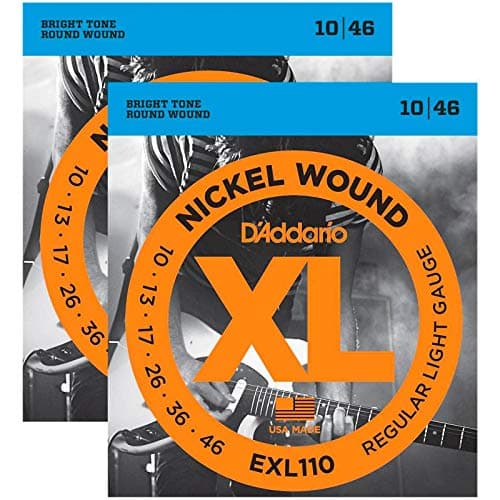
Regular light 10-46 nickel-wound, which is the gauge nearly every electric guitar leaves the factory with and the one every setup assumes.
Published specifications
- Gauge:
- 10-46, regular light
- Core:
- High carbon steel hex core
- Wrap:
- Nickel-plated steel
- Fits:
- Electric guitar, standard tuning
What it gets right
- The gauge most electrics ship with, so changing to these keeps the existing setup correct with no truss rod adjustment
- Nickel-plated steel is bright without being harsh, and it suits every style a beginner will try
- Cheap enough to keep a spare set in the case, which every guitarist should
Where it gives ground
- Nickel-wound strings dull faster than coated sets, so they need changing more often
- 10-46 is a compromise gauge: heavier players may want more tension, benders may want less
What it is not good at
Drop tunings. Tuned down, a 10-46 set goes slack and buzzes. Anyone tuning below standard should move to a heavier gauge and expect a setup afterward.
How the specs score against a beginner’s needs
Scores are our reading of the published specifications above against what a beginner physically needs. They are not test results — we have not played this instrument.
Specifications from D'Addario — EXL110 XL Nickel Wound.
Snark clip-on chromatic tuner
SnarkBest for: Tuning anything with strings
Clips to the headstock and reads pitch from the vibration of the wood, so it works in a noisy room and an adult who plays nothing can tune the instrument in twenty seconds.
Published specifications
- Type:
- Clip-on chromatic
- Sensing:
- Vibration through the headstock, not the microphone
- Fits:
- Guitar, bass, ukulele, violin, mandolin
- Display:
- Full-color rotating screen
What it gets right
- Vibration sensing means it works in a room with a television on, which a microphone tuner does not
- Chromatic, so one tuner covers every instrument in the house
- The rotating display means it reads correctly whichever way the instrument is held
Where it gives ground
- The clip is plastic and it is the part that eventually breaks
- Battery-powered, and it will be flat the one time you need it in a hurry
What it is not good at
Wind and brass instruments. It reads vibration through a solid body, so there is nothing for it to clip to on a flute or a trumpet.
How the specs score against a beginner’s needs
Scores are our reading of the published specifications above against what a beginner physically needs. They are not test results — we have not played this instrument.
Specifications from Snark tuners (retail listing with published feature set).
Questions people actually ask
How often should I change guitar strings?
For a beginner playing most days, every two to three months. Strings die from corrosion and grime rather than from playing hours, so a guitar played rarely still needs new strings roughly twice a year.
Should I loosen my guitar strings when storing it?
No, for normal storage. The neck is designed to sit under string tension and a truss rod is set against it. Detuning for a few weeks in a cupboard achieves nothing; the exception is a long journey by air, where pressure and temperature swing.
Do I need to oil my fretboard?
An unfinished rosewood or laurel board benefits from a light conditioning once or twice a year, at a string change. A maple board with a lacquer finish needs nothing but a wipe. Over-oiling is far more common than under-oiling and it does harm.
What humidity should a guitar be stored at?
Broadly 40 to 60 per cent relative humidity. Solid-wood acoustics are the sensitive ones — a winter spent in a dry, centrally heated room is the most common way a good acoustic develops a crack.
Sources
Still deciding?
Every recommendation on this site is built the same way, and the method is published in full — including what we do not do and what would get a pick dropped.
Read next
- Best guitar humidifiers
Solid top or laminate decides whether you need one at all. Two-way against refillable, why a sealed case is non-negotiable, and three humidifiers on published specifications.
- How to change guitar strings
The full sequence for electric and acoustic, the three common mistakes, and why new strings drift for a day.
- Best beginner guitar strings
Why gauge outranks brand, the default set for electric and acoustic, and when going lighter actually helps.
- Why the guitar hurts your fingers
Normal callus pain versus a badly set-up guitar, the four adjustments that reduce effort, and when to stop rather than push through.
- How to look after a ukulele
The 40 to 60 per cent rule, the early warning signs of a dry instrument, and what genuinely needs cleaning versus what does not.
- Are cheap guitars worth it?
The line between cheap and too cheap, named part by part, with what each failure does to a beginner who cannot diagnose it.