Guitars
Acoustic vs electric guitar for beginners
Both sides of this argument are usually made by someone who already plays one of them. Here is the comparison with the trade-offs left in.
By Sawyer V. · Published · Last updated
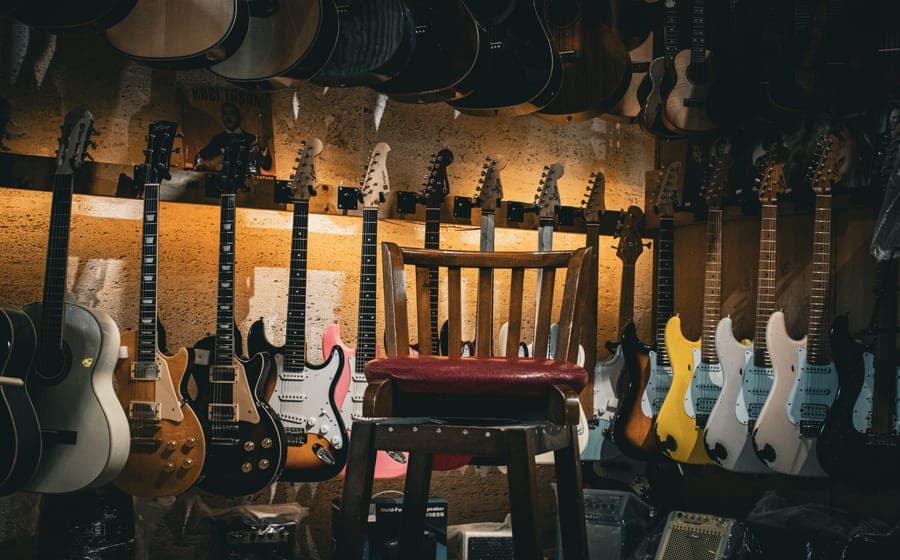
For most beginners, an electric guitar is slightly easier to play and an acoustic is slightly cheaper to own. Electrics have thinner strings and lower action, so they need less hand strength in the first month. Acoustics need no amplifier, so the whole purchase is the guitar. Neither difference matters as much as which one the player actually wants.
The comparison, with the trade-offs left in
| Acoustic | Electric | |
|---|---|---|
| Hand strength needed | More. Thicker strings, higher action | Less. Thin strings, low action |
| What completes the purchase | Guitar, tuner, spare strings | Guitar, tuner, cable, amplifier |
| Practice volume | Fixed. As loud as it is | Adjustable, and silent with headphones |
| Portability | Pick it up and play anywhere | Needs power to be useful |
| Body size problem | Real. A dreadnought is a large box | Minimal. A thin solid body |
| Weight | Lighter, typically | Heavier, typically |
| Setup sensitivity | High. A bad setup is punishing | Lower. Adjustable in more places |
The physical difference, quantified
The reason an electric is easier is action — the height of the strings above the frets — and string gauge. A standard set of electric strings is noticeably thinner than a standard set of acoustic strings, and an electric’s strings sit closer to the fingerboard because there is no acoustic top that needs to be driven hard to make volume.
What that means in practice is that pressing a string to the fret on an electric takes less force, and a barre chord — one finger flattening across all six strings — becomes achievable weeks earlier. For a beginner in month one, when hand strength is the actual limiting factor, this is not nothing.
It is also not everything. It is a few weeks of difficulty in a hobby measured in years, and plenty of people learn on acoustics without incident.
The cost difference, which is bigger than the physical one
An acoustic purchase is complete at the guitar. Add a clip-on tuner and a set of spare strings and there is nothing else you need, possibly ever.
An electric purchase is not complete at the guitar. It needs a cable and an amplifier before it makes a useful sound. A basic practice amp is a real additional line item, and it is the most commonly forgotten cost in the entire category. People budget $200, buy a $200 electric, and then discover the guitar is a quiet plank.
The consequence for a fixed budget is straightforward: at any given total spend, the acoustic route gets you a better instrument. At $250 total you can have a solid-top acoustic, or you can have an entry electric and a small amp. Both are legitimate. They are not the same instrument quality. We lay the bands out in what a first guitar should cost.
The noise question, which most people get backwards
Nearly everyone assumes the acoustic is the quiet one. It is not, in the way that matters for a household.
An acoustic guitar has exactly one volume, and that volume is loud enough to carry through a wall. There is no way to practice one quietly except to play badly on purpose.
An electric guitar unplugged is very quiet — audible to the player and almost nobody else. Plugged into a practice amp with headphones it is completely silent to the rest of the building. If the player is a teenager who wants to practice at 10pm, or the household has thin walls or a sleeping toddler, the electric is the considerate choice by a wide margin.
What actually decides it
Here is the part that other comparisons skip because it is not a specification.
The overwhelming reason beginners stop is that the first month is unrewarding. Fingers hurt, chords buzz, and nothing sounds like music yet. Every day the player picks the instrument up is a day they get closer to the point where it does. So the variable with by far the largest effect is how much they want to pick it up.
Someone who loves loud guitar music and buys an acoustic because a forum told them to learn on one first has bought an instrument that cannot make the sound they are chasing. They will practice less. Someone who wants to sit on the sofa and play folk songs and buys an electric has to plug something in to do it, and they will practice less. In both cases the mechanical advantage is swamped by the motivation disadvantage.
So: buy the one that makes the sound the player already likes. If they genuinely have no preference, take the electric for the easier first month, and expect to spend a bit more to complete the purchase.
What the myths get wrong
“Learn on acoustic and electric will feel easy.” True but backwards as advice. Yes, an acoustic builds more hand strength. It also has a higher quit rate in month one. Making the hardest part of the journey harder in order to make the easy part easier is not a plan.
“Electrics are for rock, acoustics are for singer-songwriters.” Broadly the convention, entirely not a rule, and irrelevant to a beginner who is going to spend a year on chords either way.
“Start cheap in case they quit.” The cheapest instruments are the ones most likely to cause the quitting, because they are the ones that will not stay in tune. We work through exactly where that line sits in are cheap guitars worth it.
What we would buy
Yamaha FG800
YamahaBest for: Buy once, acoustic
A solid Sitka spruce top with scalloped bracing at the entry price. Solid-versus-laminate is the one acoustic spec that changes what the instrument does over years, and this is the cheapest place to get it done right.
Published specifications
- Top:
- Solid Sitka spruce
- Back / sides:
- Nato / okume
- Neck / fingerboard:
- Nato neck, rosewood fingerboard, R400 mm (23-5/8") radius
- Scale length:
- 650 mm (25-9/16")
- Nut width:
- 43 mm (1-11/16")
- Bracing:
- Scalloped
- Body:
- Traditional Western (dreadnought), 412 mm (16-1/4") wide, 100-118 mm deep
- Hardware:
- Die-cast chrome tuners, urea nut and saddle
What it gets right
- A solid top, not a laminate — the only acoustic spec at this price that genuinely changes over time
- Scalloped bracing and die-cast tuners are specifications you normally pay considerably more for
- Yamaha's most-copied entry acoustic; parts, setups and advice are everywhere
Where it gives ground
- A full dreadnought body is a big box — 412 mm across and up to 118 mm deep
- Nato and okume back and sides are the cost saving; the top is where the money went
What it is not good at
Fitting a smaller player. The dreadnought body is wide and deep enough that a young teenager can struggle to get their arm over it comfortably. If that is the buyer, look at the JR1 or a concert-size body instead.
How the specs score against a beginner’s needs
Scores are our reading of the published specifications above against what a beginner physically needs. They are not test results — we have not played this instrument.
Specifications from Yamaha Europe — FG/FS800 series specifications.
Squier Sonic Stratocaster
Squier by FenderBest for: The honest floor, electric
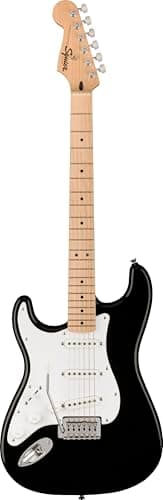
The cheapest electric that still has full-scale geometry, sealed tuners and a real 9.5 inch fingerboard radius. Nothing about it will make a beginner's first year harder.
Published specifications
- Scale length:
- 25.5" (647.7 mm) — full size
- Body / neck:
- Poplar body, maple neck, "C" profile
- Fingerboard:
- Maple or Indian laurel, 9.5" (241 mm) radius
- Frets:
- 21, narrow tall
- Nut width:
- 1.650" (42 mm), synthetic bone
- Pickups:
- Three ceramic single-coils (SSS)
- Bridge:
- 6-saddle vintage-style synchronized tremolo
What it gets right
- Full 25.5 inch scale, so nothing learned here has to be relearned later
- Synthetic bone nut rather than a soft plastic one — the part that decides whether a cheap guitar stays in tune
- Sealed-gear tuners, which is the single most important spec on a first electric
Where it gives ground
- Poplar body and ceramic pickups are exactly what you would expect at this tier
- The tremolo bridge will pull the guitar out of tune if a beginner uses it, and beginners always use it
What it is not good at
Staying in tune if you use the whammy bar. If that matters, buy the hardtail (HT) version of the same guitar instead — it is the identical instrument with the tremolo deleted.
How the specs score against a beginner’s needs
Scores are our reading of the published specifications above against what a beginner physically needs. They are not test results — we have not played this instrument.
Specifications from Squier Wiki — Sonic Stratocaster specifications.
Questions people actually ask
Is acoustic or electric guitar better for beginners?
Electric guitars are physically easier to play — thinner strings, lower action, less hand strength needed. Acoustic guitars are cheaper to complete because they need no amplifier. Both differences are real and both are smaller than whether the player actually wants the sound the instrument makes, which is what decides whether they practice.
What is the best guitar for beginners, electric or acoustic?
If the player has no strong preference, an electric with a small practice amp is marginally the easier start. If the budget is tight and fixed, an acoustic gets you a better instrument for the same total spend because there is no amplifier to fund. Both of our picks on this page are at the “enough” band, so neither is a compromise.
Should I learn on an acoustic first so electric is easier later?
This is common advice and it does not survive contact with the actual dropout data any of us have seen anecdotally: the reason people quit is that the first month is unrewarding, and starting on the harder instrument makes the first month harder. Skills transfer in both directions. Start on whichever one the player wants to hold.
Is an electric guitar louder than an acoustic?
Unplugged, no — an unamplified electric is much quieter than an acoustic and can be practiced next to a sleeping baby. Plugged in it is as loud as you set it, and with headphones it is silent to everyone else. For a household with thin walls the electric is genuinely the quieter instrument, which surprises most people.
Sources
Still deciding?
Every recommendation on this site is built the same way, and the method is published in full — including what we do not do and what would get a pick dropped.
Read next
- Best beginner acoustic guitars: solid tops from $200 to $350
Solid versus laminate tops, the dreadnought body-size problem, and picks for adults and children separately.
- Best beginner electric guitars: what's worth it from $150 to $400
Segmented by player and price band, with the three specs that actually decide whether a first electric survives its first year.
- How much should a beginner guitar cost?
Four price bands defined by specification rather than by number, plus the hidden costs that turn a $200 budget into a $270 purchase.
- Are cheap guitars worth it?
The line between cheap and too cheap, named part by part, with what each failure does to a beginner who cannot diagnose it.
- Ukulele vs guitar for beginners
Why the ukulele is genuinely easier, exactly which skills transfer to guitar, and when the stepping-stone plan is a detour.