Ukuleles
Ukulele vs guitar for beginners
The ukulele really is easier, and the reasons are physical rather than musical. Whether that makes it the right first instrument depends on where you are going.
By Sawyer V. · Published · Last updated
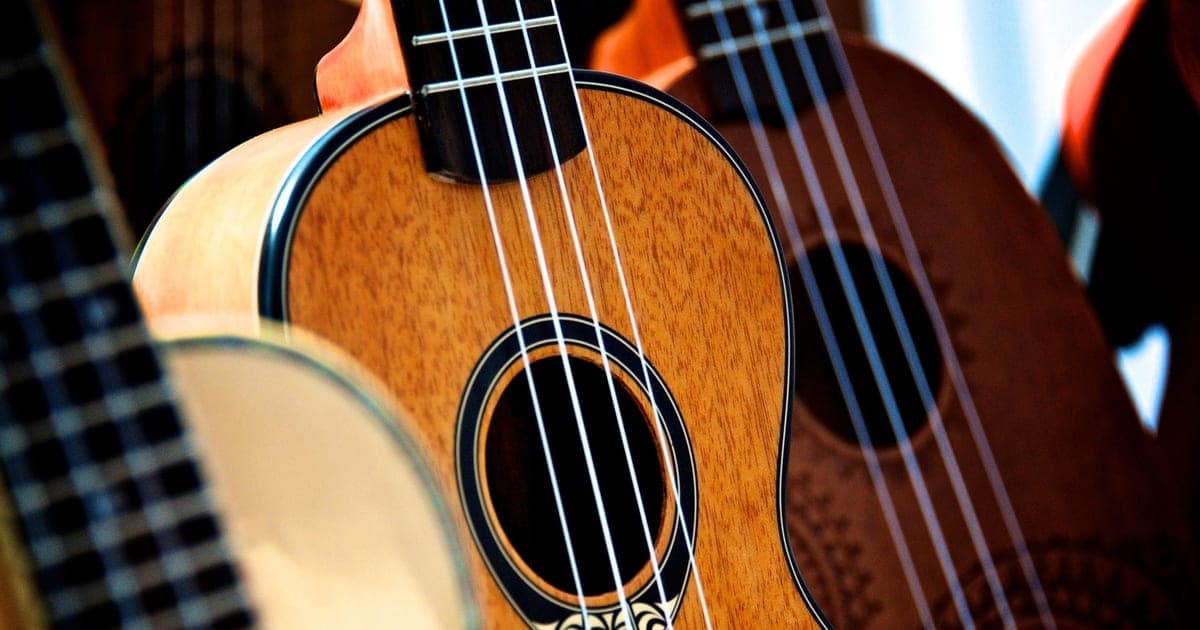
A ukulele is genuinely easier to play than a guitar: four nylon strings under low tension on a short scale, with several chords that need one finger. Strumming, rhythm and chord-change skills transfer to guitar; individual chord shapes do not, because the tuning differs. Start on ukulele if the player is young or needs an early win.
Why the ukulele is easier, specifically
Four reasons, and they compound.
String material and tension. Guitar strings are steel under considerable tension; ukulele strings are nylon under much less. Pressing a nylon string to a fret takes a fraction of the force. For a beginner — whose hands have no relevant strength yet — this is the difference between fingertips hurting after ten minutes and not hurting at all.
Number of strings. Four against six. Two fewer strings to fret, two fewer to avoid muting accidentally, two fewer to keep in tune.
Scale length. A soprano ukulele is 13.6 inches against a full acoustic guitar’s 650 mm, about 25.6 inches. Everything is closer together, so a chord shape that requires a real stretch on guitar is a comfortable reach on ukulele.
Chord shapes. The one that matters most. On a ukulele, C major is one finger. F is two. A beginner plays a recognizable song in the first sitting. On a guitar, the equivalent starter chords need three fingers placed accurately, and F major traditionally requires a barre that takes weeks to build the strength for.
The comparison
| Ukulele | Guitar | |
|---|---|---|
| Strings | 4, nylon, low tension | 6, steel or nylon, higher tension |
| Scale length | 13.6–17" | 24.75–25.6" |
| First song | First session, realistically | A few weeks |
| Finger pain | Minimal | Real, for two to three weeks |
| Entry cost | Lower | Higher |
| Suits a child from | About 4 or 5 | About 6, with a small instrument |
| Repertoire available | Large and growing | Effectively unlimited |
| Range | Limited — 12 to 18 frets, four strings | Wide |
What transfers, and what does not
This is the part the “learn ukulele first” advice usually skips.
Transfers cleanly: strumming patterns and right-hand rhythm, which is roughly half of playing either instrument. Timekeeping. The physical habit of changing between chords smoothly. Reading a chord chart. Ear training. And fingertip toughening, partially.
Does not transfer: the chord shapes themselves. Standard ukulele tuning is GCEA and standard guitar tuning is EADGBE. A C major shape on a ukulele is not a C major shape on a guitar. The player learns a new vocabulary.
The exception: a baritone ukulele is tuned DGBE, identical to a guitar’s top four strings. Every shape learned on a baritone is correct on a guitar. If the plan is explicitly to use the ukulele as a stepping stone, the baritone is the one that makes the plan work — see the size comparison.
When ukulele-first is a detour
If the player is an adult who specifically wants to play guitar, start on guitar. The extra difficulty is roughly one month, and one month of harder practice is less costly than several months learning an instrument they did not want followed by re-learning the chord vocabulary.
The exception is an adult who has tried guitar before and stopped because of the finger pain and the F chord. For them, a few months on ukulele builds fingertip toughness and, more importantly, the experience of actually sounding like music — which is the thing that was missing the first time.
When ukulele-first is clearly right
For a child under about ten. Hand size and strength make guitar a genuine struggle at that age, and a struggling child stops. Our kids ukulele picks cover this.
When the goal is singing along. Four chords on a ukulele covers an enormous amount of popular music, and it covers it well. This is not a lesser version of playing guitar; it is a complete thing in itself.
When the budget is genuinely tight. A good ukulele costs a fraction of a good guitar, and a good ukulele beats a bad guitar in every way that matters.
Either way, both answers are buyable from this page — the ukulele pick and the guitar pick above are both at the point where the specifications stop compromising.
What we would buy
Kala KA-15S
Kala Brand MusicBest for: The honest floor, soprano
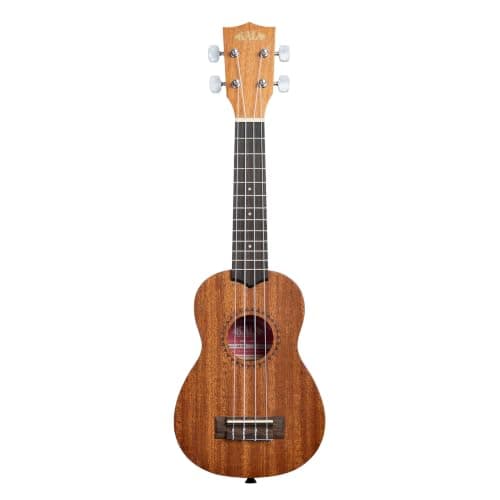
Mahogany throughout, a GraphTech NuBone nut and saddle, and Aquila strings fitted from the factory. The nut material is the spec that separates this from the pile of look-alikes.
Published specifications
- Size:
- Soprano
- Top / back / sides:
- Mahogany
- Neck / fretboard:
- Mahogany neck, rosewood fretboard
- Nut and saddle:
- GraphTech NuBone
- Scale length:
- 13.625"
- Frets:
- 12
- Nut width:
- 1.375"
- Overall length:
- 21.062"
- Strings:
- Aquila Super Nylgut
What it gets right
- NuBone nut and saddle rather than molded plastic — this is what decides whether the instrument plays in tune up the neck
- Aquila strings fitted at the factory, so the first thing you would otherwise replace is already done
- 21 inches overall and light enough for a small child to hold unsupported
Where it gives ground
- 12 frets only, and the body joint stops you well short of the high notes
- Soprano scale means less room between frets — adult fingers with wide fingertips will find it cramped
What it is not good at
Adult hands, sometimes. A 13.625 inch scale is genuinely tight. If the player is a grown-up with large hands, read our soprano-versus-concert comparison before buying this size.
How the specs score against a beginner’s needs
Scores are our reading of the published specifications above against what a beginner physically needs. They are not test results — we have not played this instrument.
Specifications from Kala Brand Music — KA-15S specifications.
Yamaha FG800
YamahaBest for: Buy once, acoustic
A solid Sitka spruce top with scalloped bracing at the entry price. Solid-versus-laminate is the one acoustic spec that changes what the instrument does over years, and this is the cheapest place to get it done right.
Published specifications
- Top:
- Solid Sitka spruce
- Back / sides:
- Nato / okume
- Neck / fingerboard:
- Nato neck, rosewood fingerboard, R400 mm (23-5/8") radius
- Scale length:
- 650 mm (25-9/16")
- Nut width:
- 43 mm (1-11/16")
- Bracing:
- Scalloped
- Body:
- Traditional Western (dreadnought), 412 mm (16-1/4") wide, 100-118 mm deep
- Hardware:
- Die-cast chrome tuners, urea nut and saddle
What it gets right
- A solid top, not a laminate — the only acoustic spec at this price that genuinely changes over time
- Scalloped bracing and die-cast tuners are specifications you normally pay considerably more for
- Yamaha's most-copied entry acoustic; parts, setups and advice are everywhere
Where it gives ground
- A full dreadnought body is a big box — 412 mm across and up to 118 mm deep
- Nato and okume back and sides are the cost saving; the top is where the money went
What it is not good at
Fitting a smaller player. The dreadnought body is wide and deep enough that a young teenager can struggle to get their arm over it comfortably. If that is the buyer, look at the JR1 or a concert-size body instead.
How the specs score against a beginner’s needs
Scores are our reading of the published specifications above against what a beginner physically needs. They are not test results — we have not played this instrument.
Specifications from Yamaha Europe — FG/FS800 series specifications.
Questions people actually ask
Is a ukulele easier to play than a guitar?
Yes, and measurably so. Four strings instead of six, nylon under low tension instead of steel under high tension, a 13.6 inch scale instead of 25.5, and several common chords that need only one finger. The gap is largest in the first month, which is when most beginners quit.
Is it easier to learn ukulele before guitar?
It makes the first month easier and adds a step. Strumming, rhythm, chord changes and reading a chord chart all transfer. Individual chord shapes do not, because the tuning is different. If guitar is the definite goal and the player is an adult, start on guitar; if the player is a child or unsure, ukulele first is a good plan.
Is it better to learn guitar or ukulele first?
Ukulele first if the player is under about ten, or if they need an early win to stay interested. Guitar first if they are an adult who specifically wants to play guitar — the extra month of difficulty is smaller than the detour.
Is ukulele harder than guitar in any way?
One way, genuinely: small fingers aside, a soprano’s tight fret spacing is harder for adult hands than a guitar’s roomy neck. Adults with large hands sometimes find a soprano ukulele more fiddly than a guitar, which is why we recommend concert size for adults.
Is baritone ukulele easier than guitar?
Yes, and it is the version of the ukulele whose skills transfer most directly. A baritone is tuned DGBE — the same as a guitar’s top four strings — so chord shapes carry across intact. It is the best stepping stone if guitar is definitely the destination.
Sources
Still deciding?
Every recommendation on this site is built the same way, and the method is published in full — including what we do not do and what would get a pick dropped.
Read next
- Best beginner ukuleles: what's worth it from $60 to $120
Segmented by hand size rather than price, with the nut-material spec that separates a real ukulele from a decoration.
- Best beginner acoustic guitars: solid tops from $200 to $350
Solid versus laminate tops, the dreadnought body-size problem, and picks for adults and children separately.
- Soprano vs concert vs tenor ukulele
Real scale lengths and fret counts across all four sizes, with the hand-size rule and buy paths for the two that matter.
- The easiest instruments to learn
Ranked by time to a first real song, with the ceiling each one trades away, and a pick for the top three.
- Acoustic vs electric guitar for beginners
The physical difference is real but small. The cost difference is larger than most people expect. Buy CTAs for both answers.