Guitars
Best guitar stands and wall hangers
The cheapest thing that increases how much you practice, and the one accessory that can damage the instrument it is holding if you buy the wrong kind.
By Sawyer V. · Published · Last updated
Three pages on this site already tell you to keep the guitar out where you can reach it, because an instrument within arm’s reach gets picked up for two minutes at a time and an instrument in a case under a bed gets picked up on Sundays. None of them says which stand to buy. This page does.
It is a small purchase with one real trap in it. A stand holds the guitar by pressing rubber or foam against the finish for months at a time, and on certain finishes certain materials leave marks. That is the axis this page is organized around, because it is the part most roundups skip.
We have not used these stands. What follows is our reading of what each maker publishes, including what they publish about finishes; the method is on how we pick.
For one guitar in a normal room, buy the Hercules GS414B PLUS: the yoke locks around the neck and the maker publishes both a load rating and a nitrocellulose position. If floor space is the constraint, or there is a toddler or a dog, buy the String Swing CC01K wall hanger instead. The On-Stage XCG-4 is the honest budget answer. Buy a rack only once there are three guitars.
Why a stand is a practice purchase, not a storage one
The case for a stand has nothing to do with protecting the instrument. A case protects better than any stand ever will.
It is about friction. Opening a case, taking the guitar out, tuning it and putting it back is four steps, and four steps is enough to turn a spare ten minutes into no practice at all. A guitar on a stand next to the sofa is zero steps. That is the whole argument, and it is the reason we list a stand among the things that genuinely speed up learning in how long it takes to learn guitar.
The counterargument is dust and knocks, and it is mostly answerable. Dust wipes off. The real risks are environmental: direct sun through a window, a radiator, a damp room. Those are placement problems rather than stand problems.
The finish question, in the makers’ own words
Worth understanding before you compare anything else, because it decides which kinds of product you should even consider.
What the risk actually is. Nitrocellulose lacquer stays slightly soft for its whole life. Held against certain rubbers and foams under pressure, it can soften, discolor or stick. Polyurethane and polyester finishes — which is what the large majority of beginner guitars wear — are much more stable. So the first thing to establish is what your guitar is finished in.
What Hercules publishes. Its contact material is named: Specially Formulated Foam, or SFF. Its FAQ answers the nitrocellulose question directly, saying the foam does not react with the large majority of popular instrument finishes on the market, including nitrocellulose. It also qualifies that: makers use differing nitrocellulose formulations, not every variation can be tested, and owners should check the instrument’s own manual about storage. A qualified claim from a named material is considerably more than most of this category offers.
What String Swing publishes. The most complete position here. It states its material will not eat into the nitro of your guitar as most foam and rubber racks do, and it maintains a separate nitrocellulose statement that declines to give an unconditional guarantee. That page is worth reading: it points out that nitro stays soft and remains vulnerable to pressure marks for life, that heat and direct sunlight make marks worse, and that chemical cleaners on the padding cause problems. It advises water only for cleaning the padding, and a cloth cradle cover for sensitive instruments, particularly aniline-dyed guitars where dye can transfer onto white finishes.
What On-Stage publishes. Nothing about finish chemistry. The padding is listed as EVA rubber and the claim is that it protects the finish from scratches. A search of its own site for nitrocellulose returns no results. That is not evidence of a problem, and it is not reassurance either — it is simply a gap, and we would rather say so than fill it with forum lore.
The practical rule. Polyurethane or polyester finish, which covers most instruments in best beginner electric guitars and best beginner acoustic guitars: any of these is fine. Nitrocellulose, which usually means a more expensive or vintage instrument: buy from a maker that publishes a position, and put a cotton cloth between the guitar and the cradle if you want certainty.
The four types, and who each suits
Tripod and yoke stands. The cheap, common design: a folding base with a lower yoke supporting the body and an upper yoke steadying the neck. Cheap, portable, and the guitar simply rests in it unless there is a strap.
Auto-grip stands. The same shape with a mechanism that closes the neck yoke under the guitar’s own weight. The instrument is held rather than balanced, which matters in a room where people walk past.
Wall hangers. The guitar hangs by its headstock from a wall-mounted cradle. Uses no floor space at all, is the safest option around children and dogs, and is a permanent drilled installation.
Racks. One frame holding three or more instruments in a row. Only sensible once the collection exists, at which point it is tidier and cheaper than a row of separate stands.
How we ranked these
Five criteria, in this order, all read from published specifications rather than from use.
Holds the guitar securely first, because the failure that matters is an instrument on the floor.
Finish safety published second — not whether we believe a stand is safe, but whether its maker has said anything accountable about it.
Space taken third, since in most homes the stand competes with furniture.
Portability fourth, then room to grow last.
The picks
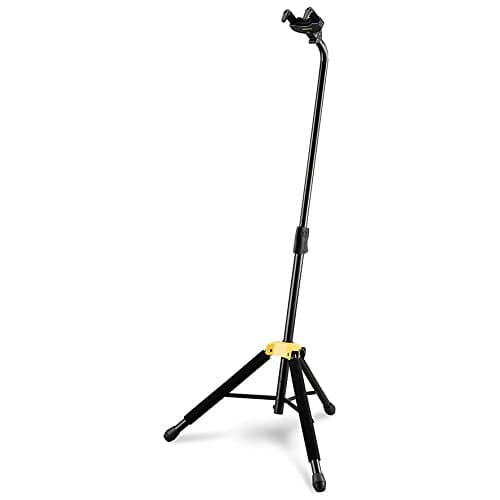
The Hercules GS414B PLUS#ad is the one we would buy for a single guitar. The Auto Grip System closes the yoke around the neck as the instrument settles, so it is locked in rather than leaning; height runs from 37.4 to 45.2 inches on a clutch with a locking pin; the load rating is a published 33 lb; and it folds to 27.9 inches at 4 lb. The neck-width window of 40 to 52 mm covers most guitars, and narrow necks are handled by the N.I.N.A. adapters in the box.
The honest costs: it holds one instrument, necks under 40 mm need the adapters fitted before the grip works properly, and 27.9 inches folded is a car-boot item rather than a gig-bag one. On finishes, Hercules qualifies its own claim rather than making a blanket promise, which we read as a point in its favor.
The String Swing CC01K wall hanger#ad is the answer when the floor is not available. A hardwood block with a deep pivoting steel cradle, wrapped in padding, that holds the guitar by the headstock and takes up no floor space whatsoever. The published limit is 15 lb, the hardware is included, it is made in the USA from North American lumber, and it carries a lifetime structural warranty.
It is also the most accountable product here on finishes, because String Swing publishes both a claim and its limits. What you give up is flexibility: it is screwed to a wall, so there is no height adjustment afterward and moving it means new holes. The 15 lb limit rules out some heavier basses, and the maker publishes no dimensions, so planning a row of several hangers takes measuring rather than reading.
The Hercules GS523B 3-piece guitar rack#ad is for the point at which guitars have started to multiply. Three yokes on a one-piece folding frame rated to a published 176 lb, expandable to six instruments with an accessory, with adjustable yoke positions so a thin electric and a deep dreadnought can share it. Folded, it is 24.8 by 4.3 by 28 inches at 7.9 lb.
Three caveats. The yokes are open, so instruments rest rather than lock. At 25.2 inches tall it supports bodies low and does not steady necks. And we could not confirm a listing whose title names this exact model — the rack usually listed is the GS523B PLUS caster variant, a different product — so its buy link is a tagged search rather than a product page. For one beginner guitar this is far more rack than the situation calls for, which is why we file it where overspending starts.
The On-Stage XCG-4 Classic Guitar Stand#ad is the budget pick, and we include it because the realistic alternative at this price is no stand at all and a guitar left flat on a bed. A tripod base — On-Stage’s own description, not an A-frame — with a height-adjustable upper yoke, a security strap across it, and a swiveling detachable lower yoke that fits acoustic, electric and bass bodies.
It is also the least documented product on this page. On-Stage publishes no load rating, no weight and no folded size, so there is nothing to compare on those numbers. The adjustment window is a narrow 19.25 to 24 inches. And the padding is EVA rubber with a scratch claim and no finish-chemistry position, which is exactly the situation where we would put a cloth between the guitar and the cradle on a lacquered instrument.
Where to put it
Not in direct sunlight. The most common way a guitar left out gets damaged is a window, not a stand. Sun fades finishes and heats the top.
Not next to a radiator or a heat vent. Dry heat shrinks wood, which is how sharp fret ends and cracks arrive. The humidity argument in full is in guitar maintenance for beginners.
Out of the walkway. A stand in a doorway will eventually be kicked. This is the main argument for a wall hanger in a small flat.
Where you actually sit. The stand only earns its keep if the guitar is within reach of the chair you use in the evening — the rest of that setup is in setting up a home practice space.
What else to know
Put a cloth in the cradle if the finish is precious. A piece of cotton between the padding and the guitar removes the question entirely, and String Swing sells a cover for exactly this reason.
Do not clean the padding with chemicals. String Swing’s own guidance is water only. Polishes and cleaners on foam are one of the documented causes of marking.
Check the neck width before buying an auto-grip stand. Classical guitars and some basses sit outside the standard window, and the adapters exist for that reason.
A stand is not a case. If the guitar leaves the house, it needs a case regardless, and if the room swings between damp and dry the case is the safer home. The rest of the kit worth buying in the first month is in guitar accessories you actually need.
Quick picks
The one to buy for one guitar
An auto-grip yoke that closes on the neck by itself, a published 33 lb rating, and a foam the maker has tested against nitrocellulose.
| # | Product | Best for | Score | Price |
|---|---|---|---|---|
| 1 | Hercules GS414B PLUSThe yoke closes on the neck by itself, so the guitar is locked in rather than leaning. | The stand to buy onceEnough | 8.2 | $49.95 · View on Amazon #ad How we’re funded |
If floor space is the problem
A hardwood wall mount with a deep pivoting cradle, and the fullest published position on lacquer finishes of any maker here.
| # | Product | Best for | Score | Price |
|---|---|---|---|---|
| 1 | 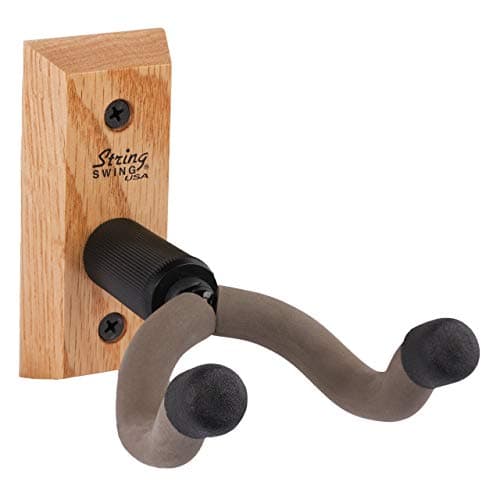 String Swing CC01K wall hangerA hardwood wall mount with a deep pivoting cradle, and the only maker here that publishes a full nitrocellulose position including what it will not guarantee. | Small rooms, toddlers and dogsEnough | 7.0 | $18.99 · View on Amazon #ad How we’re funded |
Once there are three guitars
A folding rack rated to 176 lb, expandable to six instruments, with adjustable yoke positions for mixed body depths.
| # | Product | Best for | Score | Price |
|---|---|---|---|---|
| 1 | No image Hercules GS523B 3-piece guitar rackA one-piece folding rack holding three instruments, rated to 176 lb and expandable to six. | Three guitars in one cornerWhere overspending starts | 7.0 | Check price on Amazon → #ad How we’re funded |
The cheapest stand worth owning
A tripod yoke stand with a security strap, for when the realistic alternative is leaving the guitar flat on a bed.
| # | Product | Best for | Score | Price |
|---|---|---|---|---|
| 1 | 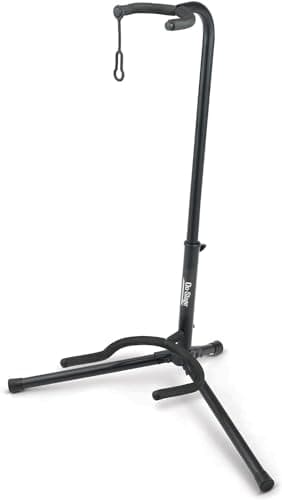 On-Stage XCG-4 Classic Guitar StandA tripod-base yoke stand with a security strap and a swiveling lower yoke, at a price where the alternative is no stand at all. | The cheapest stand worth owningThe honest floor | 5.6 | $16.95 · View on Amazon #ad How we’re funded |
The picks in full
Hercules GS414B PLUS
HerculesBest for: The stand to buy once
The yoke closes on the neck by itself, so the guitar is locked in rather than leaning. Add a published height range, a 33 lb load rating and a foam the maker has actually tested against nitrocellulose, and it is the stand we would buy.
Published specifications
- Type:
- Floor stand, folding tripod base with foot pads
- Holds the guitar:
- Auto Grip System (AGS) yoke that locks the instrument in place
- Height range:
- 950-1150 mm (37.4"-45.2"), clutch with locking pin
- Neck width:
- 40-52 mm (1.57"-2.05"); down to 28 mm with the included N.I.N.A. adapters
- Load capacity:
- 15 kg (33 lb)
- Folded / weight:
- 710 x 155 x 110 mm (27.9" x 6.1" x 4.3"); 1.8 kg (4 lb)
- Contact surface:
- Specially Formulated Foam (SFF) on all contact points
What it gets right
- The auto-grip yoke closes around the neck on its own, so a knock does not tip the guitar out of an open cradle
- Published neck-width window of 40-52 mm plus the included narrow-neck adapters covers electric, acoustic, classical, bass and mandolin necks
- Height adjusts across nearly eight inches with a locking pin, so the stand fits the instrument rather than the reverse
- Folds to 27.9 inches at 4 lb, with the folded size actually published
Where it gives ground
- One instrument only, rated to 33 lb
- Necks narrower than 40 mm need the supplied adapters fitted before the yoke grips properly
- Still 27.9 inches folded, so it travels in a car rather than in a gig bag pocket
- Hercules qualifies its own nitrocellulose testing: formulations vary between makers, and it points owners back to the instrument's manual
What it is not good at
Holding anything outside its published neck-width range, or more than one instrument at a time.
How the specs score against a beginner’s needs
Scores are our reading of the published specifications above against what a beginner physically needs. They are not test results — we have not played this instrument.
Specifications from Hercules Stands USA — GS414B PLUS, Hercules Stands — FAQ on SFF foam and nitrocellulose.
String Swing CC01K wall hanger
String SwingBest for: Small rooms, toddlers and dogs
A hardwood wall mount with a deep pivoting cradle, and the only maker here that publishes a full nitrocellulose position including what it will not guarantee. It takes no floor space at all, which is the whole point.
Published specifications
- Type:
- Wall hanger, no floor contact
- Holds the guitar:
- Deep pivoting "Guitar Keeper" cradle; padded steel yoke
- Fit:
- Pivoting yoke accommodates various sizes and headstock shapes
- Weight limit:
- 15 lb or less (String Swing's published figure)
- Materials:
- Hardwood block in cherry, oak, ash or black walnut; North American lumber, made in USA
- Mounting:
- Hardware included; drywall anchors needed where there is no stud
- Warranty:
- Lifetime structural warranty
What it gets right
- Uses no floor space, which is the only real fix for a small room or a house with a toddler or a dog
- The deep cradle is published as preventing the guitar being improperly seated, which is how shallow hooks drop instruments
- String Swing publishes a dedicated nitrocellulose statement rather than a vague scratch claim
- Mounting hardware is included and the mount carries a lifetime structural warranty
Where it gives ground
- It is screwed to a wall: no height adjustment afterward, and moving it means new holes
- Published limit is 15 lb, which is below some heavier basses and resonators
- String Swing publishes no dimensions or screw specification, so spacing several hangers cannot be planned from its page alone
- The maker itself declines to guarantee that no marking will ever occur on nitrocellulose, and warns that heat, sunlight and chemical cleaners make marks worse
What it is not good at
Temporary or traveling use. It is a drilled, permanent installation that cannot be folded or carried.
How the specs score against a beginner’s needs
Scores are our reading of the published specifications above against what a beginner physically needs. They are not test results — we have not played this instrument.
Specifications from String Swing — CC01K hardwood wall mount, String Swing — nitrocellulose statement.
Hercules GS523B 3-piece guitar rack
HerculesBest for: Three guitars in one corner
A one-piece folding rack holding three instruments, rated to 176 lb and expandable to six. For a household where the guitars have started multiplying, it replaces a row of separate stands.
Published specifications
- Type:
- Floor rack, one-piece folding design
- Holds:
- 3 instruments; expandable to 6 with the HA205 accessory
- Fit:
- Yoke position is adjustable; yokes designed for acoustic, electric and bass
- Load capacity:
- 80 kg (176 lb)
- Height:
- 640 mm (25.2")
- Folded / weight:
- 630 x 110 x 710 mm (24.8" x 4.3" x 28"); 3.6 kg (7.9 lb)
- Contact surface:
- Specially Formulated Foam padding at all contact points
What it gets right
- 176 lb across three yokes is a large margin for ordinary electrics and acoustics
- Expands to six instruments with an accessory, so it grows with a collection instead of being replaced
- One-piece folding design with a published folded size, rather than a rack that must be disassembled
- Yoke positions adjust, which matters when mixing a thin electric with a deep dreadnought
Where it gives ground
- Open yokes with no auto-grip: instruments rest rather than lock, unlike the GS414B PLUS
- At 25.2 inches it supports bodies low down and does not hold necks, so a knock has more leverage
- Its footprint makes it a fixed-corner item rather than something to move around a small room
- We could not confirm a listing whose title names this exact model — the rack commonly listed is the GS523B PLUS caster variant — so its buy link is a tagged search
What it is not good at
A single-guitar household. It is sized and priced for three to six instruments, and it is far more rack than one beginner guitar needs.
How the specs score against a beginner’s needs
Scores are our reading of the published specifications above against what a beginner physically needs. They are not test results — we have not played this instrument.
Specifications from Hercules Stands USA — GS523B, Hercules Stands — FAQ on SFF foam and nitrocellulose.
On-Stage XCG-4 Classic Guitar Stand
On-StageBest for: The cheapest stand worth owning
A tripod-base yoke stand with a security strap and a swiveling lower yoke, at a price where the alternative is no stand at all. On-Stage publishes less about it than we would like, including nothing about finish chemistry.
Published specifications
- Type:
- Tripod-base yoke stand (On-Stage's own description, not an A-frame)
- Holds the guitar:
- Height-adjustable upper yoke with security strap; swiveling, detachable lower yoke
- Height range:
- 19.25"-24"
- Upper yoke width:
- 3.3"
- Tubing:
- 17 mm and 22 mm
- Contact surface:
- EVA rubber padding; On-Stage claims scratch protection only
- Capacity / weight / folded size:
- Not published by On-Stage
What it gets right
- A security strap across the upper yoke is a published feature at this price, and it is what stops a bumped guitar stepping out of the cradle
- The swiveling, detachable lower yoke is published as fitting acoustic, electric and bass bodies
- Folding base and detachable yoke make it the easiest stand here to put in a cupboard
Where it gives ground
- On-Stage publishes no load rating, no weight and no folded size, so there is nothing to compare on those numbers
- A 19.25 to 24 inch adjustment window is short, leaving little room to tune the fit on an unusual instrument
- On-Stage publishes nothing at all about nitrocellulose or lacquer — only that the padding protects against scratches
What it is not good at
Reassuring an owner of a lacquer-finished instrument. The maker makes a scratch claim and no finish-chemistry claim either way.
How the specs score against a beginner’s needs
Scores are our reading of the published specifications above against what a beginner physically needs. They are not test results — we have not played this instrument.
Specifications from On-Stage — XCG-4 Classic Guitar Stand.
Questions people actually ask
Do guitar stands damage the finish?
Some contact materials can react with some finishes, and nitrocellulose lacquer is the vulnerable one. It is worth taking seriously and not worth panicking about: most beginner guitars are finished in polyurethane or polyester, which is far more chemically stable. Check what your guitar is finished in before worrying.
Which stand is safe for a nitrocellulose finish?
Buy from a maker that publishes a position. Hercules states its Specially Formulated Foam does not react with the large majority of popular finishes including nitrocellulose, while noting formulations vary. String Swing states its material will not eat into nitro, while declining to guarantee that no marking ever occurs. On-Stage publishes nothing either way.
Is a wall hanger safe for the guitar's neck?
Yes. A guitar hanging by its headstock is supported the same way string tension already pulls on the neck, and the weight of a guitar is small relative to what the neck handles constantly. Mount into a stud, or use the anchors the maker specifies.
Should I leave my guitar on a stand or in its case?
On a stand, for one reason: an instrument within reach gets picked up several times a day. The case is the right answer only for travel, for very dry or damp rooms, and for long storage. That trade is covered in setting up a home practice space.
Are auto-grip stands worth the extra?
In a house with children or pets, yes: the yoke closes around the neck so the guitar cannot be lifted out by a knock. In a quiet room where nobody walks past it, an open yoke with a security strap does the same job for less.
Sources
Still deciding?
Every recommendation on this site is built the same way, and the method is published in full — including what we do not do and what would get a pick dropped.
Read next
- Guitar accessories you actually need
The four accessories that change how a beginner's guitar plays, the ones that can wait, and the ones that are pure margin.
- Setting up a practice space that gets used
Why the instrument should never live in its case, the seat height that prevents wrist problems, and the two cheap accessories that matter most.
- Guitar maintenance a beginner actually needs
The four jobs that matter, the humidity problem that ruins acoustics, and an honest list of what you can safely ignore.
- How long does it take to learn guitar?
Milestones by practice hours rather than months, what gates each phase, and why the first three weeks matter most.
- Best beginner acoustic guitars: solid tops from $200 to $350
Solid versus laminate tops, the dreadnought body-size problem, and picks for adults and children separately.