Guitars
Best bass amps for beginners
A bass amp is not a guitar amp with more bass. It has to move enough air to reproduce a 41 Hz low E, and that is a speaker problem before it is a wattage problem.
By Sawyer V. · Published · Last updated
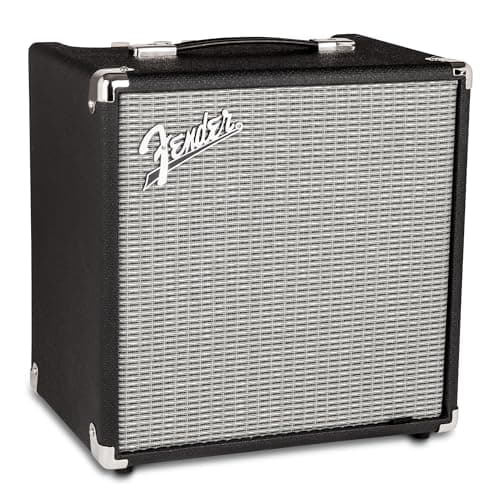
The amp question gets answered badly for bass more often than for any other instrument, and the reason is that people carry over a rule from guitar: get the cheapest small practice amp and upgrade later. For an electric guitar that works. For a bass it produces an amp that cannot make the lowest four notes of the instrument audible, which a beginner does not interpret as an equipment problem. They interpret it as the bass sounding thin, and often as themselves being bad at it.
Every pick below states its Starter Path band, and we have not played any of them — the method is on how we pick. Specifications come from published spec sheets, cited at the bottom of the page.
Buy a bass combo with at least an eight-inch speaker and a headphone jack. The Fender Rumble 25 V3 is that amp: 25 watts, one 8" speaker, three-band EQ, aux in and headphones. Step up to the Rumble 40 V3, with its ten-inch speaker and XLR output, only when there is a drummer in the room — that is the point where 25 watts stops being heard at all.
Speaker diameter is the specification that decides this
The lowest note on a standard four-string bass is E1, at roughly 41 Hz. A speaker reproduces a low frequency by moving a large volume of air, and the volume of air a cone can move is governed by its area and how far it travels. A four-inch cone has less than a quarter the area of an eight-inch one. It does not produce a quieter low E; it mostly does not produce one at all, and what you hear instead is the second harmonic an octave up plus the click of the string.
This is why the usual beginner advice fails here. On guitar, a tiny practice amp sounds small but correct. On bass, a tiny practice amp sounds like a different and worse instrument, and the beginner has no way of knowing that the problem is not their hands.
So the threshold specification on this page is not wattage. It is eight inches of speaker, and every pick meets or exceeds it.
Wattage, and why bass needs so much more of it
Human hearing is dramatically less sensitive at low frequencies than in the midrange. Producing a bass note that sounds as loud as a guitar note takes several times the acoustic power, which is why a 15-watt guitar amp is a reasonable small combo and a 15-watt bass amp is a toy.
The practical thresholds, in the order a player meets them:
Alone in a bedroom: 20 to 25 watts is plenty. You are playing at conversation volume or quieter, and almost all practice happens against a backing track through the aux input anyway.
With an acoustic drummer: 40 watts is the realistic floor, and the ten-inch speaker matters more than the extra watts. A drum kit in a small room is genuinely loud, and a bassist who cannot hear themselves will play harder and sharper rather than better.
On a stage with a PA: the amp becomes a monitor, and 40 watts with an XLR out is usually enough, because front of house is carrying the room. This is why the step from the Rumble 40 to the Rumble 100 is a smaller practical change than the price difference suggests.
The three picks, and what separates them
The Fender Rumble 25 V3#ad is the answer for the overwhelming majority of people reading this. Twenty-five watts, a single eight-inch speaker, a proper three-band EQ rather than one tone knob, a built-in overdrive, an aux input for playing along and a headphone jack for playing at midnight. Its published weight is 21.01 lb, which is heavier than it looks.
The Fender Rumble 40 V3#ad adds the ten-inch Fender special-design speaker and an XLR output, and curiously it is lighter than the 25 at 18 lb, because the cabinet is a different build rather than a scaled-up one. If there is any realistic prospect of playing with other people in the first year, start here.
The Fender Rumble 100 V3#ad is the honest ceiling: 100 watts at 8 ohms into a twelve-inch Eminence driver, a four-band EQ, Bright, Contour and Vintage voicing switches, an effects loop and an XLR line out with ground lift. All real, all useful, none of it usable by a beginner. The ground lift in particular is a feature whose value you only understand the first time a PA hums.
What we did not list, and why
The Fender Rumble 15 V3 is the obvious omission. It is the same family at a lower price with a smaller cabinet, and it is the one most beginners actually buy. It sits right on the boundary of what this page recommends, and the reason it has no buy row is that the gap to the Rumble 25 is small in money and large in speaker area. If the budget genuinely stops short, it is not a bad amp. It is simply the one you will replace first.
The Hartke HD15 is the instructive near miss. It costs about the same as the Rumble 25 and Hartke publishes it as 15 watts through a 6.5-inch HyDrive speaker. Same money, less power and a smaller cone. The HyDrive paper and aluminum hybrid cone is a genuinely interesting design and the amp is well made; it is simply the wrong trade at this price.
The Orange Crush Bass 25 matches the Rumble 25 on the two numbers that matter — 25 watts, an eight-inch speaker — and adds a built-in tuner, for noticeably more money. The tuner is nice. A clip-on tuner costs a small fraction of the difference, and our clip-on tuner roundup covers the ones worth buying.
Unbranded 20-watt bass amps and the bass amps bundled into cheap starter packs are not listed because they either publish no speaker size at all or publish a four-inch cone. The first is unverifiable and the second is the specific failure this page exists to describe.
The money you should spend before a bigger amp
A beginner bassist with the Rumble 25 and nothing else is missing three cheap things before they are missing watts. A cable that is not the one that came free with the bass, because a failing cable sounds exactly like a failing amp. A tuner, because a bass drifting flat is less obvious than a guitar drifting flat and does more harm to the band. And a strap set at the height they will actually play at, because bass right-hand technique changes with strap height and relearning it later is genuinely painful.
After that, the next purchase is almost never a larger amp. It is lessons, or a better instrument. Our page on beginner bass guitars covers the instrument side of that decision, and Squier P Bass against the Yamaha TRBX174 is the head-to-head most people arrive at.
If the amp has to live in a flat
Bass is the hardest instrument in the house to contain, because low frequencies pass through walls that stop everything else. The practical consequence is that a bass amp in a flat spends most of its life unused, and the headphone jack does the actual work.
Two things help beyond headphones. Get the amp off the floor — a cabinet sitting directly on floorboards couples into the structure and transmits bass to the flat below far more efficiently than through the air. A small stand or even a folded blanket under it makes a measurable difference at no cost. And roll the bass knob down, not up: the instinct in a quiet room is to add low end to compensate for low volume, and that is precisely the frequency range your neighbors receive.
Our cross-instrument page on instruments for small apartments covers the same problem for the rest of the house.
Quick picks
The one to buy for a bedroom
Twenty-five watts, an eight-inch speaker, an aux input and a headphone jack. That is the complete requirement for someone learning alone, and spending less means a smaller cone that cannot reproduce the bottom of the instrument.
| # | Product | Best for | Score | Price |
|---|---|---|---|---|
| 1 | Fender Rumble 25 V325 watts through an eight-inch speaker, with a three-band EQ, an aux input and a headphone jack. | The honest floor for a first bass ampThe honest floor | 7.8 | $149.99 · View on Amazon #ad How we’re funded |
If there is a drummer
Forty watts into a ten-inch speaker, with an XLR output for the PA. The ten-inch cone is the real dividing line: below it you are inaudible in a room with a drum kit, and turning up does not fix it.
| # | Product | Best for | Score | Price |
|---|---|---|---|---|
| 1 | 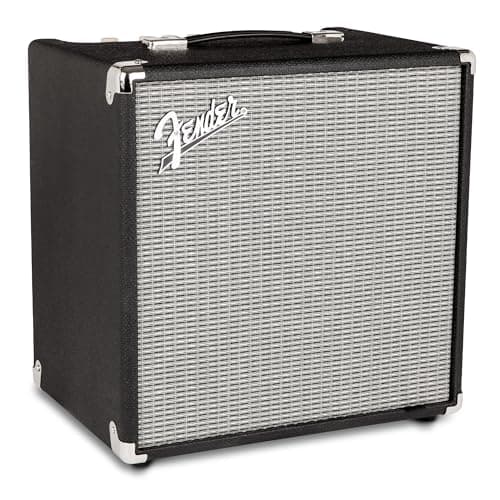 Fender Rumble 40 V340 watts into a ten-inch speaker, with an XLR output for the PA and the same aux and headphone pair as the small one. | The first amp that survives a drummerEnough | 8.6 | $262.99 · View on Amazon #ad How we’re funded |
Where overspending starts
A hundred watts, a twelve-inch Eminence driver, four-band EQ, three voicing switches, an effects loop and a ground-lift XLR. Every one of those solves a gigging problem, and a first-year bassist does not have gigging problems yet.
| # | Product | Best for | Score | Price |
|---|---|---|---|---|
| 1 | 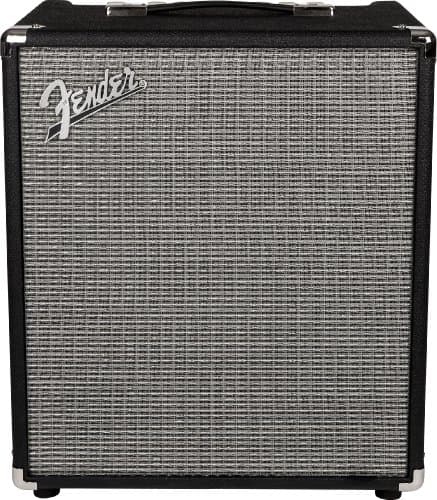 Fender Rumble 100 V3100 watts into a twelve-inch Eminence speaker, with a four-band EQ, three voicing switches, an effects loop and an XLR line out with ground lift. | Where overspending startsWhere overspending starts | 8.4 | $389.99 · View on Amazon #ad How we’re funded |
The picks in full
Fender Rumble 25 V3
FenderBest for: The honest floor for a first bass amp
25 watts through an eight-inch speaker, with a three-band EQ, an aux input and a headphone jack. That combination is the actual floor for bass: enough cone area to reproduce a low E, and a silent-practice path so the instrument is not banned from the house.
Published specifications
- Power:
- 25 watts
- Speaker:
- Single 8"
- EQ:
- Three-band: bass, mid, treble
- Overdrive:
- Built-in overdrive circuit
- Aux input:
- Yes, for playing along with a phone or laptop
- Headphone output:
- Yes
- Weight:
- 21.01 lb
What it gets right
- An 8" speaker rather than the 4" to 6" cone fitted to most sub-$100 bass amps, which is the difference between hearing the low E and hearing a click where the low E should be
- Headphone jack, so late practice is possible and the amp does not become the reason bass gets banned
- Aux input for playing along, which is how almost all beginner practice actually happens
- Three-band EQ rather than a single tone knob, so a muddy room can be corrected rather than endured
Where it gives ground
- 25 watts will not hold up against an acoustic drummer; it is a bedroom and small-room amp
- No XLR output, so it cannot feed a PA directly the way the larger Rumbles can
- The overdrive circuit is a single on/off character rather than something you dial in
- Heavier than it looks for its size at 21 lb
What it is not good at
Band rehearsal. Twenty-five watts of bass disappears under a drum kit, and turning it up to compete is how a small speaker gets destroyed. If there is a drummer in the picture, start at the Rumble 40.
How the specs score against a beginner’s needs
Scores are our reading of the published specifications above against what a beginner physically needs. They are not test results — we have not played this instrument.
Specifications from Musician's Friend — Fender Rumble 25 V3 published specifications (25W, 1x8", three-band EQ, overdrive, aux input, headphone jack, 21.01 lb).
Fender Rumble 40 V3
FenderBest for: The first amp that survives a drummer
40 watts into a ten-inch speaker, with an XLR output for the PA and the same aux and headphone pair as the small one. The ten-inch cone is the specification that matters: it is the point where a bass amp stops being a practice toy and starts being usable in a room with other people in it.
Published specifications
- Power:
- 40 watts
- Speaker:
- 1x10" Fender special design
- XLR output:
- Yes, for feeding a PA or a recording interface
- Aux input:
- Yes
- Headphone output:
- Yes
- Dimensions:
- 16.5" x 16.5" x 12"
- Weight:
- 18 lb
What it gets right
- The 10" speaker moves enough air to be heard beside an acoustic drum kit, which the 8" simply does not
- XLR output means the first rehearsal or service does not need a separate DI box bought in a panic
- Lighter than the 25-watt model at 18 lb, because the cabinet is a different build rather than a bigger version of the same one
- Keeps the aux input and headphone jack, so nothing about quiet practice is given up to get the volume
Where it gives ground
- Close to double the price of the Rumble 25 for a player who may only ever practice alone
- Still a one-speaker combo; a loud drummer in a live room will win
- No effects loop, so pedals go in front only
- Bigger footprint than a bedroom corner comfortably allows
What it is not good at
Justifying itself to a solo bedroom player. Everything this adds over the Rumble 25 is about being heard by other people, and if there are no other people yet, that money is better spent on lessons.
How the specs score against a beginner’s needs
Scores are our reading of the published specifications above against what a beginner physically needs. They are not test results — we have not played this instrument.
Specifications from Musician's Friend — Fender Rumble 40 V3 published specifications (40W, 1x10" Fender special design, XLR output, aux input, headphone output, 16.5 x 16.5 x 12 in, 18 lb).
Fender Rumble 100 V3
FenderBest for: Where overspending starts
100 watts into a twelve-inch Eminence speaker, with a four-band EQ, three voicing switches, an effects loop and an XLR line out with ground lift. All genuinely useful, and all of it addresses problems a first-year bassist has not met yet.
Published specifications
- Power:
- 100W at 8 ohms
- Speaker:
- 12" Eminence special design
- Channel:
- One, with selectable Bright, Contour, Vintage and Overdrive
- EQ:
- Four-band: bass, low-mid, high-mid, treble
- Effects loop:
- 1/4" send and return
- XLR line out:
- Yes, with ground lift
- Auxiliary input:
- 1/8" stereo
- Weight:
- 22 lb
What it gets right
- The 12" Eminence driver and 100 watts cover a rehearsal room or a small stage with headroom left over
- Ground lift on the XLR out, which is the control that fixes the hum a sound engineer would otherwise have to chase
- Effects loop, so a tuner or compressor can sit after the preamp instead of in front of the instrument
- Four-band EQ with Bright, Contour and Vintage switches gives four usable starting sounds without turning a knob
Where it gives ground
- Roughly two and a half times the Rumble 25 for capability a beginner cannot yet use
- Still only 22 lb, but physically large enough that it stops being furniture-compatible in a shared room
- The voicing switches are easy to leave engaged by accident, which a beginner hears as 'my bass sounds wrong today'
- Footswitch for the overdrive is sold separately
What it is not good at
Being a first amp. Every advantage over the Rumble 40 is a gigging advantage, and the price gap between them buys several months of lessons, which will do more for a first-year bassist than headroom.
How the specs score against a beginner’s needs
Scores are our reading of the published specifications above against what a beginner physically needs. They are not test results — we have not played this instrument.
Specifications from Musician's Friend — Fender Rumble 100 V3 published specifications (100W at 8 ohm, 12" Eminence, four-band EQ, Bright/Contour/Vintage/Overdrive, effects loop, XLR with ground lift, 22 lb).
Questions people actually ask
What size bass amp does a beginner need?
Judge it by speaker diameter first. Eight inches is the honest floor for solo practice, and ten inches is the floor for playing with a drummer. Wattage matters second: a 25-watt amp with an eight-inch speaker will sound fuller than a 30-watt amp with a four-inch one, because the small cone cannot physically move enough air to reproduce the low notes.
Can I use a guitar amp for bass?
For a few minutes at low volume, yes. As a plan, no — and not for the reason people usually give. A guitar speaker is built for a frequency range that starts around 82 Hz; a bass low E is 41 Hz, an octave below that. The cone is asked to travel further than it is designed to, and at any real volume a guitar speaker fed bass will either sound terrible or tear. Buy the cheapest bass combo rather than risk a guitar amp you already own.
Do I need an amp at all to start bass?
Not on day one. An electric bass is quiet enough unplugged to learn finger placement and basic rhythm, which is genuinely several weeks of material. But bass is a feel instrument and the feel comes from hearing the note bloom, so an amp within the first month or two is not an indulgence. Our page on whether you need an amp makes the same argument for electric guitar.
What is the XLR output on a bass amp for?
It sends a clean signal from the amp straight to a mixing desk or a recording interface, so the room microphone is not doing the work. It is the connection a sound engineer asks for at a first gig or a church service. The Rumble 40#ad has one; the Rumble 25#ad does not, and that difference is a large part of why one costs more than the other.
Is a headphone jack worth paying for?
It is the single most load-bearing feature on a beginner bass amp. Bass travels through walls and floors better than almost any other instrument, which means in a flat or a family house a bass amp with no headphone output becomes an amp that is only allowed on for an hour a day. All three picks here have one.
Should I buy a bass and amp package instead?
Usually not. Bass starter packs tend to pair a reasonable instrument with a 10-watt practice amp of about six inches, which is the exact specification this page says to avoid. The pack is cheaper because the amp is the part they saved on. Buy the bass and the amp as two decisions.
Sources
- Musician's Friend — Fender Rumble 25 V3 published specifications
- Musician's Friend — Fender Rumble 40 V3 published specifications
- Musician's Friend — Fender Rumble 100 V3 published specifications
- Andy's Music — Hartke HD15 bass combo amplifier published specifications (15W rated output, 6.5" HyDrive paper and aluminum cone, aux input, headphone output)
Still deciding?
Every recommendation on this site is built the same way, and the method is published in full — including what we do not do and what would get a pick dropped.
Read next
- Best beginner bass guitars
Why a bass is not a big guitar, the two picks worth considering, and the amplifier cost nobody budgets for.
- Squier Affinity P Bass vs Yamaha TRBX174
PJ pickups on both, 24 frets against 20, and different fingerboard radii. Which first bass suits which player.
- Guitar or bass for a first instrument?
Which one is genuinely easier, why bassists get into bands faster, and the physical differences that decide it for small hands.
- Best beginner guitar amps
Why the headphone socket outranks wattage, two picks, and the honest limits of a practice amp.
- Do you need an amp to learn electric guitar?
What playing unplugged hides, when an amp becomes necessary, and three silent routes for players who cannot make noise.
- Best instruments for an apartment
Four instruments that survive a shared wall, ranked by how quiet they are at their loudest, plus the headphones that make the difference.