Band & Orchestra
Yamaha vs Jean Paul for a first band instrument
One is the brand every school repair shop stocks parts for. The other costs considerably less. The right answer depends on whether the student will still be playing in year three.
By Sawyer V. · Published · Last updated
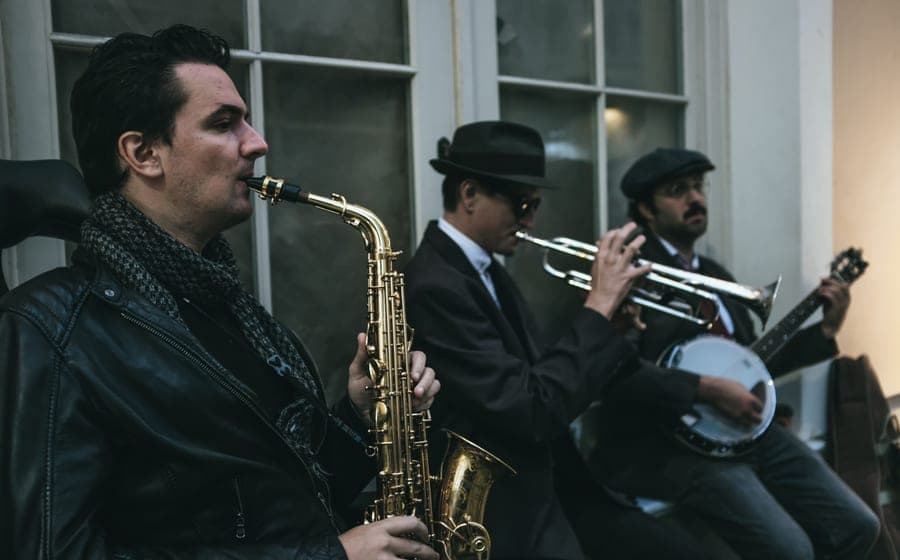
Every band parent meets this decision in the same week: the school hands out a supply list, and the instrument on it costs two or three times what a similar-looking horn costs online. The cheaper one is usually a Jean Paul. The expensive one is usually a Yamaha.
Both are real instruments, and this page exists because the honest answer is not the same for every family.
We have not played these instruments. What follows is our reading of published specifications and the practical realities of school programs; the method is on how we pick.
Rent for the first year if the school offers it. If you are buying and the student is committed, buy Yamaha for the parts, repair and resale network. If you are buying on a fixed budget for a student who may not continue, Jean Paul is a defensible purchase rather than a trap.
What the price gap actually buys
Consistency. The biggest practical difference. Two Yamahas off the same line play close to identically; budget brands vary more unit to unit, which is why buying one sight-unseen carries more risk.
Repair and parts support. School band repair shops stock Yamaha pads, corks and springs. A budget instrument may need parts ordered, and on some brands the manufacturer has no working web presence at all — something we ran into directly when researching best beginner trombones.
Resale. Yamaha student instruments have an established used market. Budget instruments lose most of their value immediately, which narrows the true gap if you plan to sell.
Director familiarity. Directors know Yamaha and can diagnose problems on one quickly. That matters more than it sounds when a twelve-year-old says the instrument is broken.
Where Jean Paul makes sense
A genuinely fixed budget. An instrument the family can afford beats a better instrument they cannot, and a student with no horn learns nothing.
A trial year. Beginning band has real attrition. If the student may switch to another instrument or stop, spending less is rational.
Published specifications. To Jean Paul’s credit, it publishes real numbers — bore sizes, bell materials, slide materials — where several cheaper marketplace brands publish nothing verifiable at all. That transparency is why its instruments appear on this site while others do not.
Instrument by instrument
Flute. The Yamaha YFL-222#ad is the standard school flute and the one directors name most often; the Jean Paul FL-220#ad is the budget alternative. On flutes the thing that fails is pad seating, and that is where consistency earns its money.
Trumpet. The Yamaha YTR-2330#ad against the Jean Paul TR-330#ad. Valve action is the daily experience of playing a trumpet, and sticky valves are the most common complaint on budget horns.
Clarinet and saxophone follow the same pattern, and both brands are covered in the per-instrument roundups: see best beginner clarinets and best beginner saxophones.
The decision, simplified
Rent if the school has a program and the student is in their first year.
Buy Yamaha if they have finished a year and want to continue, or if you want one purchase that lasts through high school.
Buy Jean Paul if the budget is the binding constraint and renting is not available — then put the savings toward lessons, which improve a player far more than the brand on the bell.
What each tier should cost is in what a band instrument should cost, and the year-two upgrade question is in step-up band instruments for year two.
What we would buy
Yamaha YFL-222
YamahaBest for: Step-up flute, year two onward
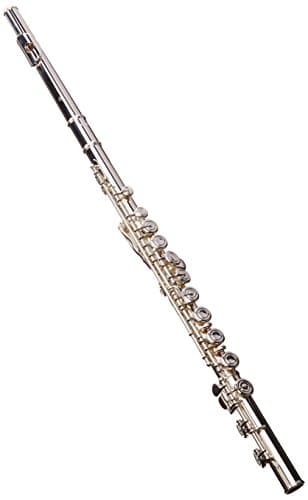
Silver-plated nickel silver throughout with pointed key arms and stainless steel springs. The flute most school programs treat as the standard once a student commits.
Published specifications
- Head / body / footjoint:
- Silver-plated nickel silver
- Keys:
- Hand-assembled silver-plated, offset G, closed hole (plateau)
- Footjoint:
- C foot
- Headjoint:
- CY, double flare taper with undercut embouchure hole
- Key arms:
- Pointed, for even pad-cup pressure
- Springs:
- Stainless steel
What it gets right
- Pointed key arms spread pressure evenly across the pad cup, which means a better seal and fewer leaks as the instrument ages
- Stainless steel springs resist the corrosion that makes cheap flute keys sluggish
- Closed-hole plateau keys give a beginner a solid platform for fingering before open holes are ever a question
Where it gives ground
- Offset G and closed holes are the right beginner choices and are also what a player eventually moves past
- Silver plate wears through at the contact points over years of daily use
What it is not good at
Being a year-one purchase. Rent through the school first — reassignment is common in the first months and this is not a cheap instrument to be stuck with.
How the specs score against a beginner’s needs
Scores are our reading of the published specifications above against what a beginner physically needs. They are not test results — we have not played this instrument.
Specifications from Yamaha YFL-222 published specifications (West Music).
Jean Paul FL-220
Jean Paul USABest for: Budget flute, if buying in year one
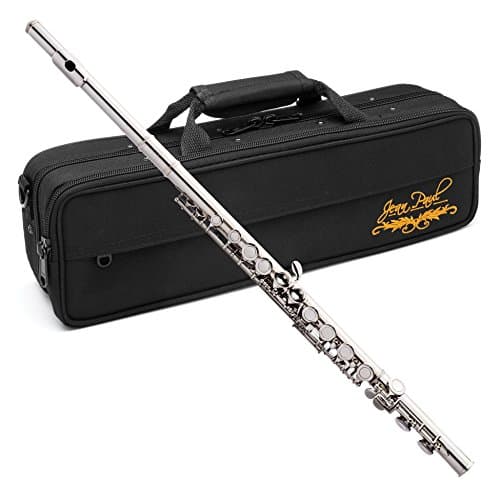
Closed-hole, offset G with a split E mechanism and power-forged keys. The split E is the notable inclusion at this price — it makes the third-octave E far easier to hit.
Published specifications
- Keys:
- Power-forged, closed hole (plateau)
- G key:
- Offset, for better hand alignment
- Mechanism:
- Split E, simplifying third-octave E
- Embouchure plate:
- Student-friendly design
- Finish:
- Silver plated
What it gets right
- A split E mechanism at this price is unusual and it removes one of the first real frustrations a flute student hits
- Offset G aligns the left hand more naturally, which matters for a smaller player
- Considerably cheaper than the Yamaha, which is the point
Where it gives ground
- Build tolerances are not the Yamaha's, and pad seating is where that shows over a year
- Resale value is low, so it is not a purchase you get much back from
What it is not good at
Lasting through a school career. It gets a student through the early years; a committed player will want the Yamaha or better by around year three.
How the specs score against a beginner’s needs
Scores are our reading of the published specifications above against what a beginner physically needs. They are not test results — we have not played this instrument.
Specifications from Jean Paul USA FL-220 published description.
Yamaha YTR-2330
YamahaBest for: Step-up trumpet, year two onward
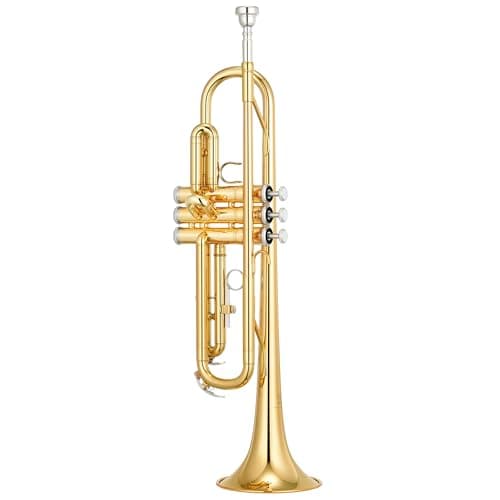
A .459 inch bore with monel pistons, a gold brass leadpipe and an adjustable third valve trigger. Yamaha's top-selling student trumpet and the one directors name first.
Published specifications
- Key:
- Bb
- Bore:
- .459"
- Bell:
- Yellow brass, two-piece, 4-7/8" diameter
- Leadpipe:
- Gold brass
- Valves:
- Monel pistons
- Third valve:
- Adjustable trigger
- Finish:
- Lacquer or silver plate
- Included:
- Mouthpiece
What it gets right
- Monel pistons are corrosion-resistant and stay smooth, which is the difference between a trumpet that stays fast and one that gums up
- The adjustable third valve trigger is how a player corrects the intonation problem every trumpet has on low D and C#
- A gold brass leadpipe warms the response slightly against plain yellow brass
Where it gives ground
- Student trumpets are all broadly similar on paper, so the case for this one is build quality rather than specification
- Lacquer wears at the contact points and looks tired long before it plays badly
What it is not good at
Being a year-one purchase. Brass reassignment is the most common kind in a band room, because embouchure suitability is unknowable in advance. Rent first.
How the specs score against a beginner’s needs
Scores are our reading of the published specifications above against what a beginner physically needs. They are not test results — we have not played this instrument.
Specifications from Yamaha Europe — YTR-2330 specifications.
Jean Paul TR-330
Jean Paul USABest for: Budget trumpet, if buying in year one
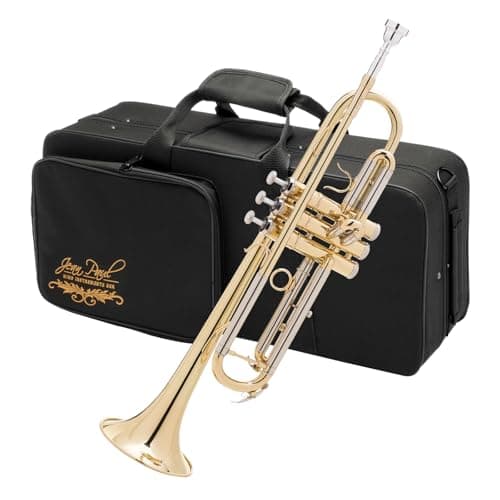
A medium-bore student trumpet with stainless steel valves and a two-piece yellow brass bell, play-tested in the US before shipping, with a 7C mouthpiece and semi-hard case.
Published specifications
- Key:
- Bb
- Bore:
- Medium
- Bell:
- Two-piece yellow brass
- Valves:
- Stainless steel
- Finish:
- Gold lacquer
- Included:
- 7C mouthpiece, semi-hard case, valve oil, polishing cloth, gloves
What it gets right
- Play-tested in the US before it ships, which for a budget brass instrument is a meaningfully better process than none
- A complete package — mouthpiece, case, oil and cloth are all things you would otherwise buy
- Deliberate breath resistance suited to a beginner, rather than the wide-open blow that leaves a new player out of air
Where it gives ground
- Stainless steel valves are durable and not as smooth as monel over time
- Resale is minimal, so the saving over a Yamaha is smaller than it looks across a few years
What it is not good at
Growing with a serious player. It gets a student through the first years honestly; beyond that the Yamaha or an intermediate horn is the step.
How the specs score against a beginner’s needs
Scores are our reading of the published specifications above against what a beginner physically needs. They are not test results — we have not played this instrument.
Specifications from Jean Paul USA TR-330 published description.
Questions people actually ask
Is Yamaha worth the extra over Jean Paul?
If the student is continuing past year one, usually yes: resale, parts and repair support are all easier, and band directors know the instruments. For a first year that might not continue, Jean Paul saves real money.
Will a band director reject a Jean Paul?
Most will not, but some programs publish an approved brand list. Ask before buying — it is a two-minute email that can save a return.
Should we rent instead of buying either?
For a first year, often yes, especially for brass and woodwind where a student may switch instruments. The maths is in renting vs buying a band instrument.
What actually differs between them?
Consistency of manufacture, key and valve action, pad and cork quality on woodwinds, and the support network around the instrument. On paper the specifications look similar; what differs is how reliably each unit matches the specification.
Which holds value better?
Yamaha, clearly. Student Yamahas have a well-established used market; budget brands depreciate much harder, which narrows the real price gap if you sell later.
Still deciding?
Every recommendation on this site is built the same way, and the method is published in full — including what we do not do and what would get a pick dropped.
Read next
- Renting vs buying a school band instrument
Why year one is a rental year, what programs cover, the maintenance nobody warns you about, and when buying starts to win.
- What a school band instrument should cost
The four Starter Path bands applied to band instruments, the specific way ultra-cheap ones fail, and the real cost of year one.
- Choosing a school band instrument
Which instrument suits which child, what school rental covers, and the honest case for not buying in year one.
- Step-up band instruments for year two
What separates a step-up from a budget instrument, the timing that makes the purchase sensible, and the pick for each section.
- Best beginner trumpets
Bore size, monel versus stainless valves, the third valve trigger, and two picks for when buying is right.