Band & Orchestra
Best clarinet books for beginners
The first clarinet problem is the squeak, and no classroom band method will tell you what causes it.
By Sawyer V. · Published · Last updated
If a school is involved, buy the method the school named — for clarinet that is more likely to be true than for any other instrument we cover. Clarinet is usually the biggest section in a beginning band, which means the method was chosen for the whole program long before you read the supply list. Outside a program, the choice is real and it comes down to two things: the Rubank#ad is the cheapest serious method in print, and Accent on Achievement#ad explains the most per page.
Every pick states its Starter Path band, and we have not played any of them — the method is on how we pick. Authors, page counts, levels and ISBNs come from Hal Leonard’s and Alfred’s own product pages, cited at the bottom.
In a school band: buy the assigned method, most often Essential Elements for Band, Bb Clarinet Book 1 (48 pages, online accompaniment). Cheapest serious method: the Rubank Elementary Method (48 pages, graded, no audio, editor N.W. Hovey). Most explanatory: Accent on Achievement Book 1 (48 pages, online audio and software, Alfred item 00-17084 — not the 64-page German edition 00-17084G). None of the three will fix a squeak: that is a reed-strength or embouchure problem, and testing a softer reed is the cheaper first move.
Clarinet is the instrument where the book is usually already decided
It is worth being explicit about this, because it changes what a buying page can usefully tell you. Beginning bands are built around clarinets: they are affordable to rent, they fit small hands better than a saxophone, and a school can put fifteen of them in a room. That means the method is a program-level decision, made by a director ordering fifteen matching books, and a parent buying a different publisher has not bought a better book — they have bought a book whose page 22 is not the page 22 being called out.
So the first action is not to buy anything. It is to find out whether a title was named. If one was, that is the answer, and the rest of this page is about what to add second.
The picks
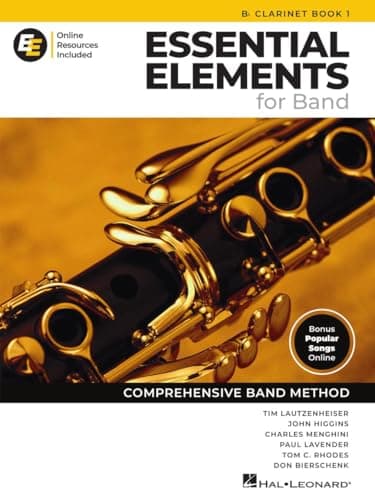
Essential Elements for Band, Bb Clarinet Book 1#ad is the statistical default. Hal Leonard publishes 48 pages at 9 by 12 inches, softcover with online EE Interactive media, six named authors, and states that new editions work side by side with previous copies — which matters when a sibling’s old copy is already in the house. Buy this if the school named Essential Elements or named nothing. Skip it if the director named Kjos or Alfred.
The Rubank Elementary Method, Clarinet#ad is 48 pages edited by N.W. Hovey and is normally the cheapest serious method you can buy for any band instrument at all. Graded, sequential, and visually bare. For an adult beginner working alone that bareness is irrelevant and the price and ordering are the point. Buy this if they are teaching themselves, or you want a second book to work through alongside the class. Skip it if the student is a child who needs the page to look like something.
Accent on Achievement, Book 1#ad is 48 pages by John O’Reilly and Mark Williams, graded by Alfred as beginning, with online audio and software included rather than sold separately. Of the three it spends the most space explaining rather than drilling, which is the right trade for a student who sees a teacher once a week. Buy this if nobody is directing and you want the book that does the most teaching. Skip it if the school runs a different method — and check the item number, because the German-insert edition 00-17084G is a different, 64-page product.
The squeak, which is what you actually came here about
Nearly every first-year clarinet household has the same complaint, and no book on this page addresses it, so here is the short version.
A clarinet squeaks for two main reasons. The first is a reed that is too stiff for the embouchure the player currently has — the single commonest cause, and the cheapest to test, because a three-reed box costs very little. The second is air escaping at the corners of the mouth, which is a technique problem and needs a person, not a page.
That is why the band method cannot help: it is written for a classroom learning in unison and assumes a director is standing in the room correcting embouchures one at a time. Our beginner reeds page covers the strength question properly, and reeds explained covers why a warped reed makes a clarinet sound suddenly bad for no visible reason.
What we did not list, and why
Klosé. The Celebrated Method for the Clarinet is a genuine reference work and completely wrong for a first year — it is a conservatory book, and a beginner opening it finds exercises they cannot play.
Standard of Excellence for clarinet. A legitimate method, and on this site: it appears as a pick on our saxophone books page. Putting a fourth interchangeable classroom method on this page would not help you choose, because the choice belongs to the director.
Unbranded “easy clarinet” songbooks. The ones we checked have no named author with a teaching credential and no publisher page to verify a page count against. We do not list what we cannot check.
Quick picks
If they are in a school band
The clarinet volume of the method most American school bands run on. Clarinet is usually the biggest section, so this is the likeliest assigned book of any on the site. For: a first-year student in a program. Skip if: the director named another publisher.
| # | Product | Best for | Score | Price |
|---|---|---|---|---|
| 1 | Essential Elements for Band — Bb Clarinet Book 1 (2025 Edition)The clarinet volume of the method most American school bands run on, in the edition currently shipping. | The school band studentThe honest floor | 7.8 | $14.99 · View on Amazon #ad How we’re funded |
The cheapest real method
Forty-eight graded pages edited by N.W. Hovey, and usually the least expensive serious method for any band instrument. For: a student practicing alone, or a second book. Skip if: they need audio to copy.
| # | Product | Best for | Score | Price |
|---|---|---|---|---|
| 1 | 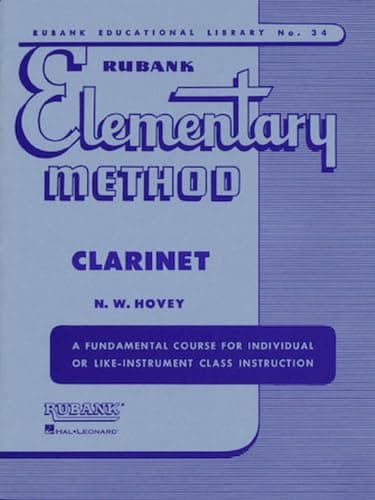 Rubank Elementary Method — ClarinetForty-eight pages of graded clarinet studies edited by N. | The cheapest real method in the band roomThe honest floor | 7.2 | $5.99 · View on Amazon #ad How we’re funded |
The one that explains the most
Forty-eight pages with online audio and software, and the most explanatory of the three. For: a student who sees a teacher once a week rather than daily. Skip if: the school assigned a different publisher.
| # | Product | Best for | Score | Price |
|---|---|---|---|---|
| 1 | 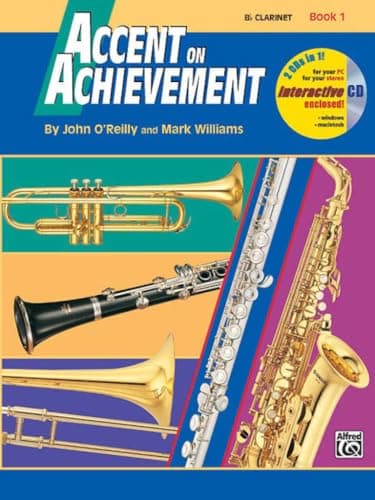 Accent on Achievement, Book 1 — Bb ClarinetForty-eight pages from John O'Reilly and Mark Williams with online audio and software, graded as a beginning book. | The student who needs a book that explains itselfEnough | 7.6 | $11.99 · View on Amazon #ad How we’re funded |
The picks in full
Essential Elements for Band — Bb Clarinet Book 1 (2025 Edition)
Hal LeonardBest for: The school band student
The clarinet volume of the method most American school bands run on, in the edition currently shipping. Clarinet is usually the biggest section in a beginning band, which makes this the single most likely book to already be on the stand.
Published specifications
- Authors:
- Tim Lautzenheiser, John Higgins, Don Bierschenk, Charles Menghini, Tom C. Rhodes and Paul Lavender
- Pages:
- 48
- Trim:
- 9.0" x 12.0"
- Format:
- Softcover with online media (EE Interactive)
- Publisher inventory:
- HL 00870246, ISBN 9798350120592
- Edition note:
- Hal Leonard states new editions still work side by side with previous copies of Essential Elements
What it gets right
- Unison with the rest of the band, which is the whole design brief of the series
- Online EE Interactive accompaniment makes practice at home sound like something
- Published as compatible with older copies, so a hand-me-down in the house still lines up
- Clarinet is the largest beginning-band section, so this is the likeliest assigned book of any in the series
Where it gives ground
- Classroom pacing; a student alone will find the explanation thin
- Almost nothing on reed choice or embouchure, which is where clarinet beginners actually stall
- Does not address the squeak, which is the complaint every first-year clarinetist has
- Assumes a director is fixing the physical problems in person
What it is not good at
Solving a squeak. The two usual causes are a reed that is too hard and a leaking embouchure, and a band method written for a mixed classroom addresses neither — which is why this page does not stop at one book.
How the specs score against a beginner’s needs
Scores are our reading of the published specifications above against what a beginner physically needs. They are not test results — we have not played this instrument.
Specifications from Hal Leonard — Essential Elements for Band, Bb Clarinet Book 1: six named authors, 48 pages, 9.0" x 12.0", softcover with online media, HL 00870246, ISBN 9798350120592.
Rubank Elementary Method — Clarinet
Rubank / Hal LeonardBest for: The cheapest real method in the band room
Forty-eight pages of graded clarinet studies edited by N.W. Hovey, and usually the least expensive serious method you can buy for any band instrument. It gives a student practicing alone a fixed order to work through, which a classroom book does not.
Published specifications
- Editor:
- N.W. Hovey
- Pages:
- 48
- Series:
- Elementary Method
- Instrumentation:
- Clarinet
- Publisher inventory:
- HL 04470000, ISBN 9781423444787
- Audio:
- None — printed method, no online media
What it gets right
- Lowest price of any book on this page, usually by a wide margin
- Graded and sequential, so there is never a question about what to practice next
- The Hovey editions are a band-room standard, so private teachers know them
- Matching volumes for saxophone, trumpet, flute, oboe and bassoon
Where it gives ground
- No audio, no online content, no accompaniment
- Visually plain; nothing about it appeals to a child
- Not aligned with what a band class plays week to week
- Teaches material rather than technique — it assumes instruction from somewhere
What it is not good at
Being a child's only clarinet book. There is no explanation of reeds, assembly or embouchure, and no audio to copy, so a beginner working entirely alone will get stuck on problems the page never mentions.
How the specs score against a beginner’s needs
Scores are our reading of the published specifications above against what a beginner physically needs. They are not test results — we have not played this instrument.
Specifications from Hal Leonard — Rubank Elementary Method, Clarinet: editor N.W. Hovey, 48 pages, Elementary Method series, HL 04470000, ISBN 9781423444787.
Accent on Achievement, Book 1 — Bb Clarinet
Alfred MusicBest for: The student who needs a book that explains itself
Forty-eight pages from John O'Reilly and Mark Williams with online audio and software, graded as a beginning book. It is the band method that spends the most page space on explanation, which makes it the best of the three for a student whose teacher they see once a week.
Published specifications
- Authors:
- John O'Reilly and Mark Williams
- Pages:
- 48
- Level:
- Beginning, per Alfred's own grading
- Format:
- Book with online audio and software
- Publisher inventory:
- Alfred 00-17084, ISBN-13 978-0-7390-0485-2
- Series:
- Accent on Achievement, a comprehensive band method
What it gets right
- The most explanatory of the three methods here, which matters for a student without daily contact with a director
- Online audio and software included rather than sold separately
- Alfred grades it beginning, so there is no ambiguity about where it starts
- Matching parts exist across the band, so it works as a program method as well as an individual one
Where it gives ground
- More expensive than the Rubank
- If the school uses a different method the student now owns two books that do not line up
- Beware the German-insert edition (00-17084G): same title, 64 pages, different product
- Still a classroom method, so reed and embouchure coverage is limited
What it is not good at
Matching a band class that was assigned something else. Band methods are chosen program-wide and the page numbers do not correspond between publishers, so buying this when the director named Essential Elements creates work rather than removing it.
How the specs score against a beginner’s needs
Scores are our reading of the published specifications above against what a beginner physically needs. They are not test results — we have not played this instrument.
Questions people actually ask
What is the best clarinet book for a beginner?
Whichever one the band director assigned, and clarinet is the instrument where that is most likely to have happened — it is usually the largest section in a beginning band, so the method is chosen program-wide before you get involved. Most often that is Essential Elements for Band#ad. Outside a program, the Rubank#ad for cost or Accent on Achievement#ad for explanation.
Why does my clarinet squeak, and will a book fix it?
The two usual causes are a reed that is too hard for the player’s embouchure and air leaking at the corners of the mouth, and a classroom band method addresses neither — which is the honest limitation of every book on this page. The reed side is cheap to test and the single most common fix. Our beginner reeds page explains strength, and reeds explained covers why it changes how hard playing feels.
Essential Elements or Accent on Achievement?
If a school is involved, the one the school uses — the page numbers do not correspond between publishers and that is the whole point of a band method. If nobody is directing, Accent on Achievement is the more explanatory book, which matters for a student seeing a teacher weekly rather than daily. Both are 48 pages and both include online media.
Is the Rubank too old-fashioned?
It looks it, and that is a fair objection for a nine-year-old: no color, no photographs, nothing but notes. What it has is a fixed graded order and the lowest price of any serious method here, which makes it the right book for a motivated adult and the wrong one for a child who needs the page to be inviting.
Watch out for the German edition?
Yes, on Accent on Achievement. Alfred publishes a German-insert edition as item 00-17084G which is 64 pages rather than 48 and a different product at a different price. The titles are nearly identical. The edition we link to is 00-17084.
Does a bass clarinet player use the same book?
No. Bass clarinet has its own volume in each of these series — Hal Leonard publishes a separate Bb Bass Clarinet Book 1, and Alfred a separate bass clarinet edition. The instrument reads in the same clef but the parts are written for the bass instrument, so a soprano clarinet book is the wrong one.
Sources
- Hal Leonard — Essential Elements for Band, Bb Clarinet Book 1: six named authors, 48 pages, 9.0" x 12.0", softcover with online media, HL 00870246, ISBN 9798350120592
- Hal Leonard — Rubank Elementary Method, Clarinet: editor N.W. Hovey, 48 pages, Elementary Method series, HL 04470000, ISBN 9781423444787
- Alfred Music — Accent on Achievement, Book 1: B-flat Clarinet Book & Online Audio/Software: John O'Reilly and Mark Williams, beginning level, 48 pages, item 00-17084, ISBN-13 978-0-7390-0485-2
Still deciding?
Every recommendation on this site is built the same way, and the method is published in full — including what we do not do and what would get a pick dropped.
Read next
- Best beginner clarinets
Why resin beats wood for a student, what a 65mm barrel does for intonation, and two picks for the year-two step-up.
- Reeds, and why they decide how hard playing feels
What reed strength means, why beginners start soft, how to rotate a set, and the signs a reed is finished.
- Best reeds for beginners
Strength 2.5 is the usual school default, student-cut reeds are easier than professional ones at the same number, and clarinet and sax reeds are not interchangeable. Four boxes.
- Clarinet vs trumpet for beginners
Sound production, fingering load, home volume, running costs and reassignment risk, compared for a student choosing a first band instrument.
- Best flute books for beginners
The band-class method and the specialist tone method do different jobs, and a flute beginner needs the second one more than any other wind player. Three books on published details.
- How to clean a band instrument
The two-minute after-playing routine per family, what happens when it is skipped, and the jobs that belong to a technician.