Band & Orchestra
Best saxophone books for beginners
Saxophone is the instrument beginners most want and the one where the first month is decided by a reed, not a book.
By Sawyer V. · Published · Last updated
Buy the method the band director named; if nobody named one, buy the Rubank — and spend the difference on a box of reeds. That last clause is the part other pages leave out. Saxophone is the instrument beginners most want to play because it makes a sound on day one, and the things that go wrong in month one are almost all reed and embouchure problems that no method book addresses. The book keeps a student moving; the reed decides whether the instrument feels playable.
Every pick states its Starter Path band, and we have not played any of them — the method is on how we pick. Page counts, editors, editions and publisher codes come from Hal Leonard’s and Kjos’s own pages, cited at the bottom.
This page is alto saxophone, which is what beginners play; tenor is in a different key and takes different books. In a school band: buy the assigned method — most often Essential Elements for Band, Eb Alto Saxophone Book 1 (48 pages, online accompaniment), or Standard of Excellence Book 1 (W21XE) if the program is a Kjos one (48 pages, no online media in that original edition). Learning alone: the Rubank Elementary Method (48 graded pages, editor N.W. Hovey, no audio, cheapest here). And the real first-month fix is usually a softer reed, not a different book.
Alto, not tenor — check this before buying anything
Beginners play alto saxophone. It is smaller, lighter, cheaper and the instrument school programs are built around, and every book on this page is an alto book. Alto is pitched in E flat and tenor in B flat, which means the parts are transposed differently: a tenor book handed to an alto player produces the wrong note on every line, and the mistake is invisible until somebody plays along with a recording.
If you are not certain which instrument is in the case, the bell on an alto curves forward at roughly waist height and the neck has a gentle bend; a tenor is noticeably bigger with a pronounced loop in the neck. Our page on beginner saxophones covers the sizing question properly.
The picks
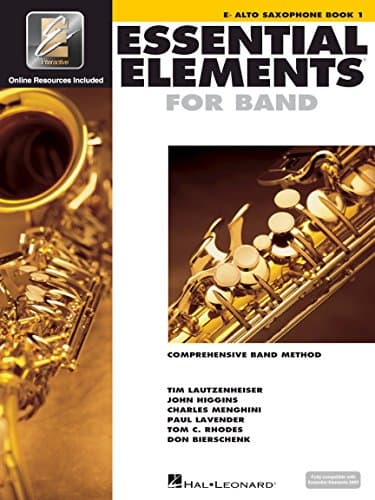
Essential Elements for Band, Eb Alto Saxophone Book 1#ad is the default because it is the most-assigned band method in the country. Hal Leonard publishes 48 pages at 9 by 12 inches under six named authors, softcover with online access. One honest note on editions: the paperback that is reliably in stock is the earlier “with EEi” printing, while Hal Leonard’s live listing now documents the 2025 edition as HL 00870249. Hal Leonard states the editions work side by side. Buy this if the school named Essential Elements or named nothing. Skip it if the director specified Kjos, or specified the 2025 edition by number.
The Rubank Elementary Method, Saxophone#ad is 48 pages edited by N.W. Hovey, graded and sequential, with no audio and nothing on the page but music. It is the cheapest serious saxophone method in print and the book a private teacher is most likely to hand a student who arrived with nothing. Buy this if they are teaching themselves, or you want a second book for the weeks when the class is between units. Skip it if the student needs a recording to copy.
Standard of Excellence Book 1, Eb Alto Saxophone#ad is the main alternative method, Kjos code W21XE, 48 pages, in print since 1993. Kjos makes a point worth repeating: it describes these as expanded 48-page part books instead of the 32 pages usual in the category, so there is simply more material per book. Be aware the original edition has no online media — the Enhanced PW21XE is the version with that. Buy this if the school runs Standard of Excellence. Skip it if it runs Essential Elements, because mixing publishers in one classroom defeats the purpose.
Why the reed matters more than the book in month one
This is the part of the saxophone question that gets answered badly, so here it is plainly. A saxophone tone is produced by a thin cane reed vibrating against a mouthpiece. How hard that reed is to make vibrate is graded by strength, and a reed that is too stiff for a beginner’s embouchure produces exactly the symptoms people blame on the instrument: an airy sound, no low notes, and a player who runs out of breath in four bars.
A box of reeds costs a fraction of what a method book does, and testing a softer one is the single highest-return action available in a first month. No book on this page mentions it, because a classroom band method is written for a room of mixed instruments and assumes the director is sorting it out in person. Our beginner reeds page is the companion to this one, and reeds explained covers the physics.
What we did not list, and why
Saxophone For Dummies. We would have considered it — the For Dummies format genuinely suits adults teaching themselves, and we recommend the banjo one elsewhere on the site. The listing is marked out of print with limited availability, so it fails the test that every pick has to be a specific, currently purchasable item.
Rubank Intermediate and Advanced. Correct books, wrong year. They are for a player who has finished the elementary volume.
Jazz method books. Almost every beginner saxophonist wants to play jazz, and almost none of them should start there: the improvisation books assume you can already play scales cleanly across the range. This is a case where the thing you want and the thing that gets you there are a year apart.
Unbranded beginner songbooks. Several are cheap and in stock; none we checked names an author with a teaching background or has a publisher page to verify a page count against.
Quick picks
If they are in a school band
The alto saxophone volume of the most-assigned band method, in the printing that is currently the in-stock paperback. For: a first-year student in a program. Skip if: the director named Kjos or Alfred instead.
| # | Product | Best for | Score | Price |
|---|---|---|---|---|
| 1 | Essential Elements for Band — Eb Alto Saxophone Book 1The alto saxophone volume of the method most American school bands assign, in the earlier EEi printing that is currently the in-stock paperback. | The school band studentThe honest floor | 7.7 | $12.99 · View on Amazon #ad How we’re funded |
The cheapest real method, and the one for practicing alone
Forty-eight graded pages edited by N.W. Hovey. No audio, no pictures, lowest price here. For: self-teaching, or a second book alongside the class. Skip if: the student needs something to copy.
| # | Product | Best for | Score | Price |
|---|---|---|---|---|
| 1 | 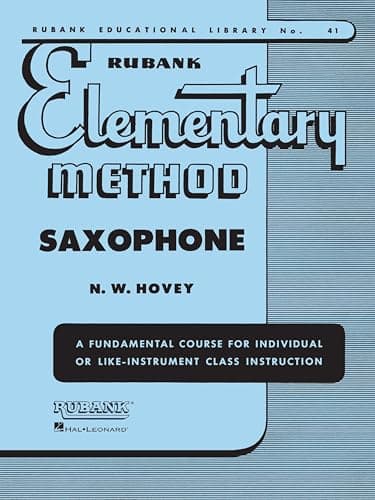 Rubank Elementary Method — SaxophoneForty-eight pages of graded saxophone studies edited by N. | Working alone, or alongside the band bookThe honest floor | 7.2 | $8.99 · View on Amazon #ad How we’re funded |
If the school uses Kjos
Forty-eight pages, which Kjos notes is expanded from the 32 that part books in this category usually run to. For: a student in a Standard of Excellence program. Skip if: the school runs Essential Elements, because the page numbers will not match.
| # | Product | Best for | Score | Price |
|---|---|---|---|---|
| 1 | 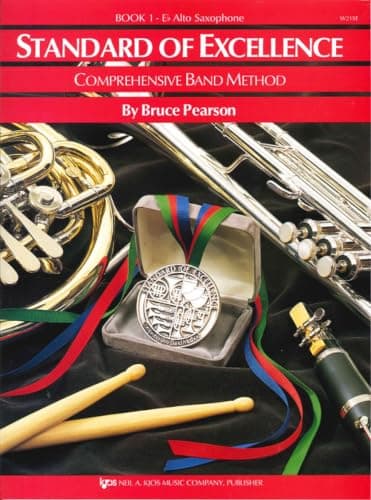 Standard of Excellence Book 1 — Eb Alto SaxophoneForty-eight pages, which Kjos points out is expanded from the thirty-two that part books in this category usually run to. | The second-biggest band method in the countryThe honest floor | 7.3 | $9.95 · View on Amazon #ad How we’re funded |
The picks in full
Essential Elements for Band — Eb Alto Saxophone Book 1
Hal LeonardBest for: The school band student
The alto saxophone volume of the method most American school bands assign, in the earlier EEi printing that is currently the in-stock paperback. Buy this one if the director named Essential Elements, because the point of a band method is that everybody is on the same page number.
Published specifications
- Authors:
- Tim Lautzenheiser, John Higgins, Don Bierschenk, Charles Menghini, Tom C. Rhodes and Paul Lavender
- Pages:
- 48 — the figure Hal Leonard publishes for Alto Saxophone Book 1
- Trim:
- 9.0" x 12.0"
- Format:
- Softcover with EEi online access
- Printing pinned here:
- The earlier "with EEi" printing, ISBN-10 0634003178. Hal Leonard's live listing documents the current 2025 edition as HL 00870249 / ISBN 9798350120622
- Compatibility:
- Hal Leonard states new editions still work side by side with previous copies
What it gets right
- Unison with the rest of the band, which is the only reason a band method exists
- EEi online access gives accompaniment for home practice
- The in-stock paperback printing, where the 2025 alto edition is not reliably available
- Hal Leonard publishes cross-edition compatibility, so a mixed classroom still functions
Where it gives ground
- Classroom pacing and thin explanation for a student working alone
- Almost nothing on reeds or embouchure, which is exactly where sax beginners stall
- Two printings are in circulation under near-identical titles, which makes buying confusing
- Assumes a director is present to fix the physical problems
What it is not good at
Teaching a saxophone embouchure or choosing a reed. Those are the first two things that go wrong on this instrument and a classroom band method covers neither.
How the specs score against a beginner’s needs
Scores are our reading of the published specifications above against what a beginner physically needs. They are not test results — we have not played this instrument.
Rubank Elementary Method — Saxophone
Rubank / Hal LeonardBest for: Working alone, or alongside the band book
Forty-eight pages of graded saxophone studies edited by N.W. Hovey. Cheap, sequential and completely unglamorous, and the book a private teacher is most likely to produce in a first lesson if the student arrived with nothing.
Published specifications
- Editor:
- N.W. Hovey
- Pages:
- 48
- Series:
- Elementary Method
- Instrumentation:
- Saxophone
- Publisher inventory:
- HL 04470030, ISBN 9781423444817
- Audio:
- None — printed method, no online media
What it gets right
- Cheapest serious saxophone method here
- Fixed, graded order — the thing a student practicing alone most needs
- A long-standing standard, so teachers know exactly where the student is in it
- Sibling volumes for clarinet, trumpet and flute use the same layout
Where it gives ground
- No audio of any kind
- Plain to the point of being off-putting for a child
- Will not match what a band class is working through
- Supplies material, not instruction
What it is not good at
Being the only book a beginner owns. Nothing in it explains assembling the instrument, choosing a reed or forming an embouchure, and there is no recording to copy.
How the specs score against a beginner’s needs
Scores are our reading of the published specifications above against what a beginner physically needs. They are not test results — we have not played this instrument.
Specifications from Hal Leonard — Rubank Elementary Method, Saxophone: editor N.W. Hovey, 48 pages, Elementary Method series, HL 04470030, ISBN 9781423444817.
Standard of Excellence Book 1 — Eb Alto Saxophone
Neil A. Kjos Music CompanyBest for: The second-biggest band method in the country
Forty-eight pages, which Kjos points out is expanded from the thirty-two that part books in this category usually run to. It is the main alternative to Essential Elements, and if your school uses Kjos this is the book, not a supplement.
Published specifications
- Publisher code:
- Kjos W21XE
- Pages:
- 48 — Kjos describes the series as expanded 48-page part books instead of the usual 32
- Instrumentation:
- Eb Alto Saxophone
- First published:
- 1993
- Publisher inventory:
- ISBN 849759323 as listed by Kjos
- Enhanced edition:
- A separate PW21XE Enhanced edition exists (Bruce Pearson, 2004, also 48 pages)
What it gets right
- Fifty percent more page space than the 32-page part books this category usually ships
- The standard alternative method, so a Kjos school will name this one
- Long in print and widely stocked second-hand
- Clear, uncluttered engraving that a young player can read across a stand
Where it gives ground
- No online media in this original edition — the Enhanced PW21XE is the version with the added content
- Useless if the school runs Essential Elements, because the page numbers do not correspond
- Two Kjos editions with near-identical names is an easy buying mistake
- 1993 material; the repertoire reads older than the Hal Leonard and Alfred equivalents
What it is not good at
Mixing with another publisher's method in the same classroom. Band methods are chosen program-wide and a director calling page numbers is calling them from one book.
How the specs score against a beginner’s needs
Scores are our reading of the published specifications above against what a beginner physically needs. They are not test results — we have not played this instrument.
Questions people actually ask
What is the best saxophone book for a beginner?
The one the band director named. If nobody has named one, the Rubank Elementary Method#ad is 48 graded pages at the lowest price here and is ordered to be worked through alone. But the honest answer for a first-month saxophone player is that the reed matters more than the book, which is why this page links straight to our reeds page.
Alto or tenor saxophone — does the book differ?
Yes, and this page is alto. Alto is in E flat and tenor in B flat, so the parts are transposed differently and the books are printed separately. Beginners are almost always on alto: it is smaller, lighter and cheaper, and school programs are built around it. Buying a tenor book for an alto player means every note is wrong.
Which edition of Essential Elements am I buying?
Two printings circulate under near-identical titles. Hal Leonard’s live listing documents the current 2025 edition (HL 00870249), while the paperback reliably in stock is the earlier “with EEi” printing, which is the one we have pinned. Hal Leonard states that new editions still work side by side with previous copies, so a mixed classroom functions either way — but if a director specifies the 2025 edition, buy that.
Why does my saxophone sound airy or refuse to play low notes?
Usually a reed that is too hard, a leaking embouchure, or a mouthpiece pushed on unevenly — and not a book problem. A softer reed is the cheapest thing to test and resolves it more often than anything else. See best reeds for beginners.
Is Standard of Excellence better than Essential Elements?
Neither is better; they are alternatives, and the deciding factor is which one the program uses. Kjos does make one point worth knowing: it describes the Standard of Excellence part books as expanded to 48 pages rather than the 32 that is usual in the category. Note that the original W21XE has no online media — the Enhanced edition PW21XE is the version with the added content.
Can an adult learn saxophone from a book alone?
More realistically than on trumpet, yes. A saxophone makes a sound almost immediately, which is exactly why it is the instrument beginners most want. The problems that follow — tone, tuning, the low register — are reed and embouchure problems, so budget for a few lessons rather than a fourth book.
Sources
- Hal Leonard — Essential Elements for Band, Alto Sax Book 1: six named authors, 48 pages, 9.0" x 12.0", softcover with online media, HL 00870249, ISBN 9798350120622 (the current 2025 edition; the printing pinned on this page is the earlier EEi paperback of the same Book 1)
- Hal Leonard — Rubank Elementary Method, Saxophone: editor N.W. Hovey, 48 pages, Elementary Method series, HL 04470030, ISBN 9781423444817
- Neil A. Kjos Music Company — Standard of Excellence Book 1, Eb Alto Saxophone (W21XE): 48 pages, published 01/01/1993, ISBN listed as 849759323; Kjos describes the series as expanded 48 page part books instead of the usual 32
Still deciding?
Every recommendation on this site is built the same way, and the method is published in full — including what we do not do and what would get a pick dropped.
Read next
- Best beginner saxophones
Why alto is the beginner size, the ergonomic details that matter at eleven, and two picks for when buying is right.
- Is the saxophone hard to learn?
Why the first note comes easily, the three things that actually take time, and a realistic stage-by-stage timeline.
- Best reeds for beginners
Strength 2.5 is the usual school default, student-cut reeds are easier than professional ones at the same number, and clarinet and sax reeds are not interchangeable. Four boxes.
- Saxophone or clarinet to start on?
Weight and reach, the register break, cost per instrument, and why starting on clarinet makes the saxophone easier later.
- Best flute books for beginners
The band-class method and the specialist tone method do different jobs, and a flute beginner needs the second one more than any other wind player. Three books on published details.
- Reeds, and why they decide how hard playing feels
What reed strength means, why beginners start soft, how to rotate a set, and the signs a reed is finished.