Strings
Best violin strings for beginners
The strings on a student violin outfit are a consumable, not a feature. Which set you replace them with decides how the instrument sounds and how often you tune it.
By Sawyer V. · Published · Last updated
Strings are the part of a violin that wears out, and on a student outfit they are usually the cheapest component fitted. That makes them the first honest upgrade, and it makes this a decision every violin family faces within a year of buying the instrument.
Unusually for this site, the manufacturers here publish real numbers: tensions in kilograms and pounds, core materials, winding metals per string. So this page is less about our judgment than about laying those numbers side by side.
We have not played these strings. The method, and what we refuse to claim, is on how we pick.
A first-year or school player should use D’Addario Prelude: the maker’s own student standard, stable in heat and humidity. When the player outgrows that sound, move to a synthetic-core set — Thomastik-Infeld Dominant is the usual next step, and Pirastro Tonica is the alternative with published per-string tensions and a choice of E.
The one decision: steel or synthetic
Everything else on this page follows from it.
Steel core is a single wire running the length of the string. D’Addario describes the category as bright and direct with quick bow response, and — the part that matters for students — unaffected by temperature and humidity changes. A steel-core set goes in tune and stays there.
Synthetic core uses a polymer filament instead. Thomastik-Infeld publishes the term as synthetic core, and Pirastro states plainly that Tonica has a core made from nylon. These are generally warmer and more complex, and they take longer to settle after fitting.
Which one is the student standard is not our opinion. D’Addario labels Prelude as ideal for students and the educator’s preferred choice. Neither Thomastik-Infeld nor Pirastro markets its set as a student string at all — their pages are pure specification. That is a useful signal about who each set is for.
What else is on the packet
Winding material. The metal wrapped around the core: aluminum on most A and D strings, silver on many G strings. It changes the tone and it changes how quickly the string corrodes against a player’s hand.
Tension, in kilograms or pounds. Higher tension is usually louder and more resistant under the bow; lower tension speaks more easily. Thomastik-Infeld and Pirastro publish these numbers; D’Addario does not publish them for Prelude.
Gauge. Light, medium or heavy. Medium is the default and the right answer for essentially every beginner.
The E string end. Ball end or loop end, depending on your tailpiece and fine tuner. Check the violin before ordering.
Size. Student violins come in fractional sizes and so do strings. A 3/4 instrument needs 3/4 strings. Sizing itself is in violin sizes by age.
How we ranked these
Tone for the price first, then tuning stability, then whether the set survives a school year of lockers and car boots, then bow response, then room to grow.
The picks
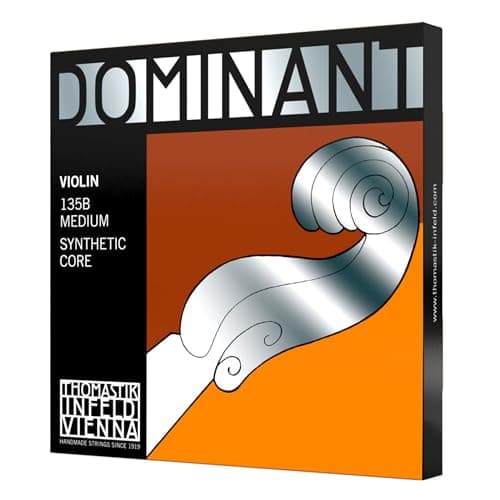
Thomastik-Infeld Dominant violin set 135B (4/4)#ad is the set a teacher most often names when a student is ready to move on. The 135B set pairs a synthetic core on the A, D and G — aluminum wound on the A and D, silver on the G — with a stainless steel E that has a removable ball end, so it fits either tailpiece style. Thomastik-Infeld publishes the tension of the whole set at each gauge: 21.8 kg, or 48 lb, at medium.
The complication is that Thomastik-Infeld sells four Dominant sets that differ only in the E and D strings, so ordering by name alone is ambiguous — check the set number. It is also considerably more expensive than a student steel set, for a difference a first-year player may not yet hear.
Pirastro Tonica violin set (4/4 medium)#ad is the synthetic alternative, and its strongest practical feature is the E string choice: ball end and loop end are separate article numbers at the same 22.4 kg set tension, so switching tailpiece style does not change the load on the instrument. Pirastro publishes per-string tensions and states the set is insensitive to temperature and humidity variation, which is unusual for a synthetic core.
Its limits: medium is the only gauge Pirastro publishes for Tonica on violin, so there is no lighter or heavier option, and several set variants exist with different E and D strings, which makes ordering by name unreliable.
D'Addario Prelude violin set (4/4 medium)#ad is the one we would put on a first violin, and the reason is the environment rather than the sound. It is solid steel core, ball end, available in every fractional size from 1/16 to 4/4, and D’Addario states it is unaffected by temperature and humidity changes. For an instrument carried to school and back, that stability is worth more than tonal complexity.
The honest limits, in D’Addario’s own framing: it is the warmest sound available in a solid steel core design, which is a claim about steel rather than about strings in general, and the company routes players wanting synthetic-core color to a different line. D’Addario also publishes no gauge or tension figures for it, and the per-string winding materials on our card come from a named retailer rather than from D’Addario.
Fitting them without damaging the violin
One string at a time. Not negotiable. Taking all four off at once releases the pressure holding the bridge and the soundpost in place, and a fallen soundpost is a trip to a luthier.
Watch the bridge lean. Winding a string pulls the top of the bridge toward the fingerboard. Check from the side as you go: the back of the bridge should stay at a right angle to the top of the violin.
Expect synthetic strings to stretch. A steel set is close to stable immediately; a synthetic set can take several days of retuning before it settles.
Wipe them after playing. Rosin dust on the strings and under them is what shortens their life. The rest of that routine is in how to care for a violin, and the tuning procedure itself is in how to tune a violin.
Quick picks
The step up from school strings
Synthetic core on the A, D and G with a steel E, and tension published in kilograms and pounds for every gauge. What a teacher usually names next.
| # | Product | Best for | Score | Price |
|---|---|---|---|---|
| 1 | Thomastik-Infeld Dominant violin set 135B (4/4)Synthetic-core A, D and G with a steel E, and published tension figures in both kilograms and pounds. | The step up from student steelEnough | 8.6 | $55.95 · View on Amazon #ad How we’re funded |
A synthetic set that tolerates weather
Nylon core with per-string tensions published, sold with either a ball-end or loop-end E at the same set tension.
| # | Product | Best for | Score | Price |
|---|---|---|---|---|
| 1 | 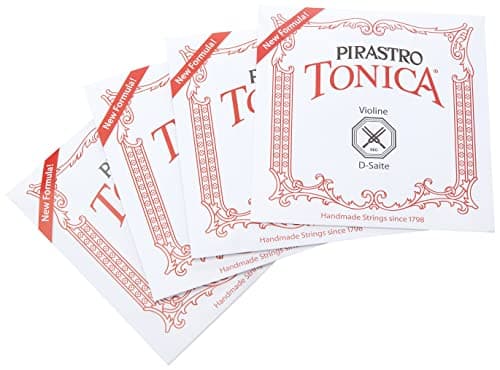 Pirastro Tonica violin set (4/4 medium)Nylon-core strings with published per-string tensions and a stated insensitivity to temperature and humidity changes, sold with either a ball-end or loop-end E at the same set tension. | A synthetic set that tolerates weatherEnough | 8.4 | $42.12 · View on Amazon #ad How we’re funded |
The school and first-year standard
The steel-core set D'Addario itself calls the educator's choice, unaffected by temperature and humidity swings.
| # | Product | Best for | Score | Price |
|---|---|---|---|---|
| 1 | 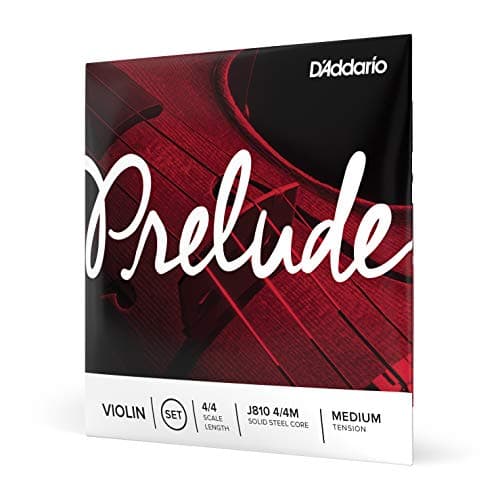 D'Addario Prelude violin set (4/4 medium)The steel-core set D'Addario itself calls the educator's choice. | School and first-year playersThe honest floor | 7.8 | $25.99 · View on Amazon #ad How we’re funded |
The picks in full
Thomastik-Infeld Dominant violin set 135B (4/4)
Thomastik-InfeldBest for: The step up from student steel
Synthetic-core A, D and G with a steel E, and published tension figures in both kilograms and pounds. The set a teacher usually names when a student outgrows school strings.
Published specifications
- Set contents:
- 135B = 129 (E), 131 (A), 132 (D), 133 (G)
- Cores:
- Synthetic core A, D and G; stainless steel E
- Windings:
- Aluminum-wound A and D; silver-wound G
- End type:
- Ball end; the E has a removable ball end
- Tension (135B):
- Light 19.7 kg / 43.4 lb, medium 21.8 kg / 48.0 lb, heavy 25.3 kg / 55.8 lb
- Sizes:
- 4/4 down to 1/16; gauges light, medium and heavy in 4/4
- Vibrating length:
- 32.5 cm (12.8") at 4/4
What it gets right
- Exact tension published in kilograms and pounds for every gauge, so it can be matched numerically against other sets
- Synthetic core on three of four strings, which is the material change students hear as warmth
- The E string has a removable ball end, so one string fits both ball-end and loop-end tailpieces
Where it gives ground
- Thomastik-Infeld publishes four Dominant sets that differ only in the E and D strings, so ordering by name alone is ambiguous
- The 135B E is a plain steel string; a player who wants the aluminum-wound E needs a different set number
- Noticeably more expensive than a student steel set, for a difference a first-year player may not yet hear
What it is not good at
A drop-in replacement when the E string spec matters — the four Dominant sets are not interchangeable.
How the specs score against a beginner’s needs
Scores are our reading of the published specifications above against what a beginner physically needs. They are not test results — we have not played this instrument.
Specifications from Thomastik-Infeld — Dominant violin technical tables.
Pirastro Tonica violin set (4/4 medium)
PirastroBest for: A synthetic set that tolerates weather
Nylon-core strings with published per-string tensions and a stated insensitivity to temperature and humidity changes, sold with either a ball-end or loop-end E at the same set tension.
Published specifications
- Core:
- Nylon (synthetic) core
- Per-string build:
- E silvery steel; A synthetic/aluminum; D and G synthetic/silver
- Gauge:
- Medium only
- End options:
- E-Ball (412021) or E-Loop (412025), same set tension
- Tension:
- Set 22.4 kg; E 7.5, A 5.5, D 4.5, G 4.9 kg
- Sizes:
- 4/4, 3/4-1/2, 1/4-1/8, 1/16-1/32
- Stability:
- Pirastro: insensitive to variations in temperature and humidity
What it gets right
- Ball-end and loop-end E are separate published article numbers at the same 22.4 kg set tension, so the tailpiece choice does not change the load
- Per-string tension published in kilograms for all four strings
- Pirastro states the set is insensitive to temperature and humidity variation, unusual for a synthetic core
Where it gives ground
- Medium is the only gauge published, so there is no lighter or heavier option
- Several set variants exist with different E and D strings, so ordering by name alone is ambiguous
- Size bands each carry their own article numbers and tension totals
What it is not good at
A player who needs to dial tension up or down, since Pirastro publishes Tonica for violin in medium only.
How the specs score against a beginner’s needs
Scores are our reading of the published specifications above against what a beginner physically needs. They are not test results — we have not played this instrument.
Specifications from Pirastro — Tonica violin.
D'Addario Prelude violin set (4/4 medium)
D'AddarioBest for: School and first-year players
The steel-core set D'Addario itself calls the educator's choice. It is unaffected by temperature and humidity swings, which is the specification that matters for an instrument living in a school locker.
Published specifications
- Core:
- Solid steel core
- Windings:
- Aluminum-wound A; nickel-wound D and G; solid steel E (retailer spec sheet)
- End type:
- Ball end
- Size / tension:
- 4/4, medium (light and heavy also offered)
- Set:
- Four strings, E-A-D-G, also sold singly
- Stability:
- D'Addario: unaffected by temperature and humidity changes
- Gauges / tension in lb:
- Not published by D'Addario
What it gets right
- D'Addario states the steel core is unaffected by temperature and humidity swings — the reason school programs standardize on it
- Labeled by the maker as ideal for students and the educator's preferred choice
- Ball end and available in every fractional size from 1/16 to 4/4, so a whole section can run one brand
Where it gives ground
- Steel core is brighter and simpler than a synthetic-core set; D'Addario's own wording is the warmest sound available in a solid steel core design, not the warmest available
- No gauge figures or tension in pounds are published, so it cannot be tension-matched against other brands numerically
- Per-string winding materials are not on D'Addario's own page — the figures above come from a named retailer
What it is not good at
Tonal complexity. D'Addario positions Prelude as its student steel line and routes players wanting synthetic-core color to a different range.
How the specs score against a beginner’s needs
Scores are our reading of the published specifications above against what a beginner physically needs. They are not test results — we have not played this instrument.
Specifications from D'Addario — Prelude violin string set, 4/4 medium, D'Addario — orchestral string comparison guide (core types), Shar Music — Prelude per-string winding (retailer spec sheet).
Questions people actually ask
What strings should a beginner violinist use?
For a first year, and especially for a school player, a steel-core student set such as D’Addario Prelude. D’Addario calls it the educator’s preferred choice and states it is unaffected by temperature and humidity changes, which matters for an instrument that lives in a locker and a car.
What is the difference between steel core and synthetic core?
The core is the wire or filament inside the winding. Steel is direct, bright and very stable. Synthetic, which makers describe as a synthetic or nylon core, is generally warmer and more complex, and it is what most players move to after the student stage.
Ball end or loop end?
It is about how the E string attaches to the tailpiece. A tailpiece with a built-in fine tuner may need a loop end; most student setups take a ball end. Some makers sell both: Pirastro publishes separate article numbers for a ball-end and a loop-end Tonica E at the same set tension.
How often do violin strings need changing?
Every six to twelve months of regular playing, and sooner if a string frays, goes false so it will not tune cleanly, or the winding unravels. Change them one at a time so the bridge and soundpost are never left unsupported.
Will better strings fix a cheap violin?
They help, and they do not work miracles. A student outfit with a decent setup will sound noticeably better on good strings. An instrument with a badly cut bridge or a poor setup needs a luthier, not a purchase.
Sources
Still deciding?
Every recommendation on this site is built the same way, and the method is published in full — including what we do not do and what would get a pick dropped.
Read next
- How to tune a violin
Fine tuners versus pegs, the correct order, how to stop a peg slipping, and the two mistakes that cause real damage.
- Violin accessories you actually need
The shoulder rest and tuner that outfits leave out, what to upgrade first, and which popular accessories to skip.
- How to look after a violin
The after-playing routine, why bow hair must be loosened, how much rosin is too much, and the bridge check nobody is taught.
- Best beginner violins: measure first, then buy
Arm-length sizing chart, why workshop setup is the spec that matters most, and one pick available in five sizes.
- What a beginner violin should cost
Four price bands for a first violin, the workshop setup that decides everything, and why renting usually beats buying in year one.