Strings
Violin accessories you actually need
A violin outfit looks complete and is missing two things nearly every player needs. Here is the honest list, in order.
By Sawyer V. · Published · Last updated
A violin outfit arrives looking complete: instrument, bow, rosin, case. It is missing two things that nearly every player needs, and it includes one thing that will be the first upgrade.
Here is the list in the order that matters. What is actually in the box is covered in what comes with a violin outfit.
1. A shoulder rest — almost never included
The most important missing item, and the one with the biggest effect on posture.
There is a gap between the back of a violin and a human collarbone, and the instrument has to be held stable across it. A shoulder rest bridges that gap so the violin sits level and secure with only light contact from the chin.
Without one, the player closes the gap the only other way available: by clamping the instrument between jaw and shoulder, and lifting the left shoulder up to meet it. That is tiring within minutes, it tenses the whole left side, and it restricts the left hand’s freedom to move along the fingerboard. It is one of the most common posture problems a teacher has to unpick.
Buy one sized for the instrument — they are size-specific, so a 4/4 rest does not fit a 1/2 violin. Adjustable ones are worth the small premium because the correct height depends on the player’s neck, not the violin.
2. A clip-on chromatic tuner
A violin has four strings tuned in fifths, held by friction pegs, on an instrument with no frets. It goes out of tune constantly, and a beginner cannot correct it by ear because their ear is exactly what they are trying to build.
A clip-on chromatic tuner#ad clips to the scroll or the body and reads pitch through the wood, so an adult who plays nothing can tune the instrument in under a minute before each practice.
That last point is the important one. An out-of-tune violin teaches a child that the notes they are carefully finding are wrong, when in fact their fingers are in the right place and the instrument is not.
One caveat specific to violin: fine tuners. Many student violins have small adjusters on the tailpiece for each string, which are far easier to use than the pegs and are what you should use for small corrections. If the instrument has only one fine tuner (on the E string), a set of four is a cheap and genuinely worthwhile addition.
3. Rosin — included, and worth understanding
The outfit comes with a cake, and it works. Rosin is what gives the bow hair grip; a bow with none on it slides across the strings almost silently.
Two things a beginner should know. A brand-new bow needs a lot of rosin the first time — considerably more strokes than feels reasonable — before it grips at all. And too much rosin makes a scratchy sound and leaves white dust on the instrument, which should be wiped off after every session or it hardens onto the varnish.
The first real upgrade: the bow
The bow in any beginner outfit, including the Stentor Student II#ad’s wooden bow with natural horsehair, is functional rather than good.
It is worth understanding why this matters more than upgrading the violin. The bow is the part actually producing the sound — it is the equivalent of the player’s breath on a wind instrument. A better bow is straighter, better balanced and more responsive, and at the beginner level it makes a larger audible difference than a better instrument would.
Ask the teacher when. Typically somewhere inside the first year, once the player is producing a consistent tone and the bow’s limitations start showing.
What to skip
Practice mutes, initially. A heavy rubber mute drops the volume a lot and makes the instrument sound dead, which makes practice unrewarding. There are situations that call for one; month one is not it.
Fingerboard tapes, unprompted. Ask the teacher first. Methods differ, and some deliberately avoid them because they train the eye instead of the ear.
Expensive strings, at first. The factory steel-core set is bright and durable and perfectly serviceable while a beginner builds tone. Synthetic-core strings are a worthwhile upgrade after the bow, not before it.
Decorative accessories. Coloured chin rests, patterned cases, novelty bow grips. None affect whether the player progresses.
The one that is not a product
A teacher, and on violin more than anywhere else on this site. Bow hold and posture are close to impossible to self-correct, because the player cannot see what they are doing and there are no frets to tell them when a note is wrong. An hour of instruction is worth more here than any accessory on this page.
What we would buy
Stentor Student II Violin Outfit
StentorBest for: First violin, every size
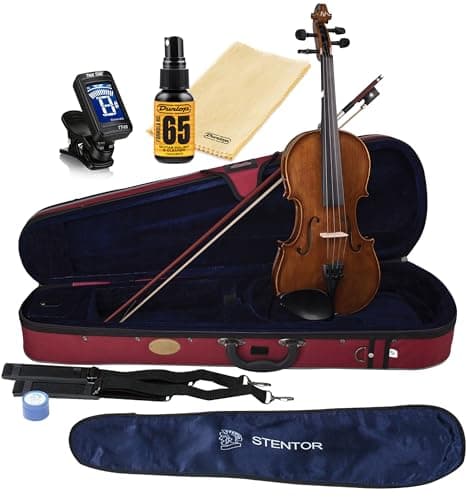
Solid carved spruce and maple with an ebony fingerboard, set up in a workshop before shipping, and made in five fractional sizes. The workshop setup is the specification that matters most on a beginner violin.
Published specifications
- Top:
- Solid carved spruce
- Back / sides:
- Solid figured maple
- Fingerboard:
- Ebony
- Pegs:
- Ebony or rosewood
- Sizes:
- 4/4, 3/4, 1/2, 1/4, 1/8
- Strings:
- Steel core, factory fitted
- Outfit:
- Wooden bow with ebony frog and natural horsehair, rosin, shaped lightweight case with music pocket and rucksack straps
What it gets right
- Ebony fingerboard and pegs, not stained hardwood — a stained fingerboard wears through and a soft peg will not hold a tuning
- Individually set up in a workshop before it ships, which is the single biggest variable on a cheap violin
- Available in five fractional sizes, so the same instrument family covers a child from about age five to adult
Where it gives ground
- The supplied steel-core strings are the first upgrade most teachers suggest
- The bow is functional rather than good; it is the second upgrade
What it is not good at
Being bought without measuring. Violin size is set by the player's arm length, not their age, and a violin one size too big is genuinely unplayable rather than merely awkward. Measure first.
How the specs score against a beginner’s needs
Scores are our reading of the published specifications above against what a beginner physically needs. They are not test results — we have not played this instrument.
Specifications from Stentor Music — Student II violin outfit.
Snark clip-on chromatic tuner
SnarkBest for: Tuning anything with strings
Clips to the headstock and reads pitch from the vibration of the wood, so it works in a noisy room and an adult who plays nothing can tune the instrument in twenty seconds.
Published specifications
- Type:
- Clip-on chromatic
- Sensing:
- Vibration through the headstock, not the microphone
- Fits:
- Guitar, bass, ukulele, violin, mandolin
- Display:
- Full-color rotating screen
What it gets right
- Vibration sensing means it works in a room with a television on, which a microphone tuner does not
- Chromatic, so one tuner covers every instrument in the house
- The rotating display means it reads correctly whichever way the instrument is held
Where it gives ground
- The clip is plastic and it is the part that eventually breaks
- Battery-powered, and it will be flat the one time you need it in a hurry
What it is not good at
Wind and brass instruments. It reads vibration through a solid body, so there is nothing for it to clip to on a flute or a trumpet.
How the specs score against a beginner’s needs
Scores are our reading of the published specifications above against what a beginner physically needs. They are not test results — we have not played this instrument.
Specifications from Snark tuners (retail listing with published feature set).
Questions people actually ask
Do I need a shoulder rest for violin?
Almost certainly, and it is almost never included in an outfit. It fills the gap between the instrument and the collarbone so the violin sits level without being clamped down with the jaw. Without one, most players grip with the chin and hunch the left shoulder.
What rosin should a beginner use?
The cake included with the outfit is fine to start. Rosin is graded roughly as dark (softer, grippier, better in cool dry conditions) or light (harder, cleaner, better in warm humid ones). It is a cheap thing to experiment with later and not something to agonise over now.
Do violinists need a tuner?
A beginner does, and so does the adult helping them. A violin has four strings tuned in fifths held by friction pegs, and it goes out of tune constantly. A clip-on chromatic tuner means an adult who plays nothing can tune it before every practice.
Are fingerboard tapes a good idea?
Ask the teacher. Some methods use them as a temporary visual guide and some avoid them deliberately, because they train the eye rather than the ear — and the ear is what a fretless instrument ultimately requires. Do not add them unprompted.
Sources
Still deciding?
Every recommendation on this site is built the same way, and the method is published in full — including what we do not do and what would get a pick dropped.
Read next
- Best gifts for violin players
Strings and shoulder rests are both sized to the instrument, which is why so many violin gifts go wrong. Rosin is size-free. Four picks, ranked by how much you need to know first.
- What comes with a violin outfit, and what doesn't
What an outfit contains, what each part is worth bought separately, and the two items nearly everyone still needs.
- Best beginner violins: measure first, then buy
Arm-length sizing chart, why workshop setup is the spec that matters most, and one pick available in five sizes.
- Violin sizes by age and arm length
The full fractional chart by arm length, how to measure, and why a violin one size too big cannot be played correctly.
- Best beginner cellos
Why outfit completeness is the spec that matters on a cello, sizing by height, and the setup cost to budget for.
- Ukulele accessories you actually need
The three items that genuinely matter, the best cheap upgrade, and what a bundle is really padding with.