Strings
How to look after a violin
Most student violins that stop working were not damaged. They were left with the bow tightened, the rosin uncleaned and the bridge slowly leaning forward.
By Sawyer V. · Published · Last updated
A violin needs more routine attention than anything else on this site, and almost all of it takes under five minutes. The problem is that the routine is rarely taught, so student instruments accumulate small neglects that turn into repairs.
Three of the five items below cost nothing at all.
After every session: loosen the bow, wipe the rosin dust off the strings and the top, and put the instrument back in its case. Weekly: check the bridge is standing upright. Yearly: new strings, and new bow hair if the old is glazed. That is the complete routine.
1. Loosen the bow, every single time
This is the most important thing on the page and the most commonly skipped.
A bow stick is carved with a curve, called the camber, that bends toward the hair. The hair, tightened, pulls against that curve. That opposition is what gives a bow its spring and its response.
Left tight in a case for weeks, the stick gradually gives up its camber. It becomes straight, then eventually bows the wrong way, and the bow loses its response permanently. On a student bow that is a replacement rather than a repair.
Loosen until the hair is slack but not flapping — a few turns of the screw. Tighten before playing until there is roughly a pencil’s width between the hair and the stick at the middle. Never tighten so far that the stick is straight.
2. Wipe the rosin off
Rosin is a sticky resin, and bowing sheds it as fine dust that lands on the strings and on the top of the violin under the strings.
Fresh, it wipes off with a dry cloth in fifteen seconds. Left for weeks, it hardens and bonds to the varnish, and removing it then is a job for a luthier because the solvents that shift rosin also shift varnish.
Wipe the strings along their length — rosin build-up there makes the bow grab unevenly and dulls the sound — and wipe the top under the strings. Use a dry soft cloth and nothing else. No polish, no cleaner, no water.
3. Use less rosin than you think
Beginners over-rosin, consistently, because a new bow needs a lot to get started and the habit sticks.
A new bow with fresh hair does need thorough initial application — the hair has nothing on it and will not grip at all. After that, a few passes along the hair before a session is enough.
Too much rosin sounds gritty and harsh, makes the bow feel like it is dragging, and produces clouds of dust that end up on the instrument. If a visible cloud comes off the strings when you play, that is the sign.
Rosin comes in dark and light grades. Dark is softer and grippier, generally preferred in warmer conditions; light is harder and cleaner. For a student either is fine and the one in the case with a Stentor Student II Violin Outfit#ad outfit is perfectly adequate. What is in a complete outfit is set out in what comes with a violin outfit.
4. Watch the bridge
The bridge is not glued to anything. It stands upright held by string tension alone, and that same tension slowly pulls its top edge toward the fingerboard every time the instrument is tuned upward.
Over months the bridge leans. A leaning bridge warps, and a warped bridge eventually falls — and when it falls, the soundpost inside the violin, which is also held only by tension, can drop. That is a luthier job and it is the most common avoidable repair on student instruments.
Check every week or two. Look at the bridge from the side: the face toward the tailpiece should be at roughly a right angle to the top of the violin, not leaning forward. If it is leaning, slacken the strings a little, grip the bridge at both top corners with thumbs and forefingers, and ease it upright.
If it is already warped into a curve, it needs replacing. Do not try to bend it back.
5. Humidity, the slow killer
A violin is a thin wooden box under permanent tension, and wood moves with the moisture in the air. Broadly 40 to 60 per cent relative humidity keeps it stable.
Too dry and seams open, cracks appear, and pegs shrink so they stop holding — which is why so many people find their violin will not stay tuned in midwinter. Too damp and the instrument sounds dull and glue joints can soften.
The practical version: keep it in its case when not being played, not next to a radiator, not in direct sun, never in a car boot in summer or an unheated room in winter. In a dry heated house, a case humidifier is inexpensive insurance.
The case is doing real work here. Unlike a guitar or a ukulele, where we argue for keeping the instrument out on a stand, a violin genuinely belongs in its case — it is small, it is fragile, it is easy to knock, and the case is a controllable environment. The same physics from the other direction is in ukulele care and humidity.
Strings and bow hair
Strings last roughly six to twelve months of regular student playing. Replace them when one starts unwinding, when the winding discolors where the fingers sit, or when a string will no longer play in tune with itself along its length.
Change them one at a time, never all at once. All four off together and the bridge is held by nothing, which brings you back to the soundpost problem above. Tune with a Snark clip-on chromatic tuner#ad as you go, and expect several days of settling — the method is in how to tune a violin.
Bow hair wears out and needs rehairing roughly once a year for a regular player. The signs are hair that no longer grips even with fresh rosin, a noticeably thinned ribbon, or so many broken hairs that the tension is uneven side to side. On a student instrument a rehair sometimes costs a meaningful fraction of the bow, so compare before committing.
What not to do
Never use furniture polish, alcohol or water on the body. Violin varnish is soft and solvents damage it permanently.
Never touch the bow hair with your fingers. Skin oils stop rosin adhering, and the affected section will not grip until the bow is rehaired.
Never leave it in a car. Heat softens glue joints, and violins are assembled with hide glue on purpose.
Never force a peg that will not turn. Pegboxes crack, and that is a serious repair. The rest of the kit worth owning is in violin accessories you actually need.
What we would buy
Stentor Student II Violin Outfit
StentorBest for: First violin, every size
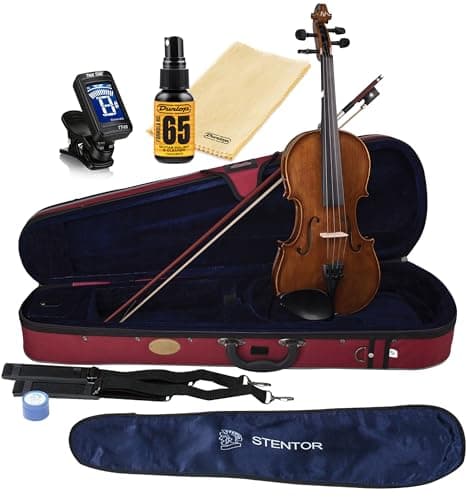
Solid carved spruce and maple with an ebony fingerboard, set up in a workshop before shipping, and made in five fractional sizes. The workshop setup is the specification that matters most on a beginner violin.
Published specifications
- Top:
- Solid carved spruce
- Back / sides:
- Solid figured maple
- Fingerboard:
- Ebony
- Pegs:
- Ebony or rosewood
- Sizes:
- 4/4, 3/4, 1/2, 1/4, 1/8
- Strings:
- Steel core, factory fitted
- Outfit:
- Wooden bow with ebony frog and natural horsehair, rosin, shaped lightweight case with music pocket and rucksack straps
What it gets right
- Ebony fingerboard and pegs, not stained hardwood — a stained fingerboard wears through and a soft peg will not hold a tuning
- Individually set up in a workshop before it ships, which is the single biggest variable on a cheap violin
- Available in five fractional sizes, so the same instrument family covers a child from about age five to adult
Where it gives ground
- The supplied steel-core strings are the first upgrade most teachers suggest
- The bow is functional rather than good; it is the second upgrade
What it is not good at
Being bought without measuring. Violin size is set by the player's arm length, not their age, and a violin one size too big is genuinely unplayable rather than merely awkward. Measure first.
How the specs score against a beginner’s needs
Scores are our reading of the published specifications above against what a beginner physically needs. They are not test results — we have not played this instrument.
Specifications from Stentor Music — Student II violin outfit.
Snark clip-on chromatic tuner
SnarkBest for: Tuning anything with strings
Clips to the headstock and reads pitch from the vibration of the wood, so it works in a noisy room and an adult who plays nothing can tune the instrument in twenty seconds.
Published specifications
- Type:
- Clip-on chromatic
- Sensing:
- Vibration through the headstock, not the microphone
- Fits:
- Guitar, bass, ukulele, violin, mandolin
- Display:
- Full-color rotating screen
What it gets right
- Vibration sensing means it works in a room with a television on, which a microphone tuner does not
- Chromatic, so one tuner covers every instrument in the house
- The rotating display means it reads correctly whichever way the instrument is held
Where it gives ground
- The clip is plastic and it is the part that eventually breaks
- Battery-powered, and it will be flat the one time you need it in a hurry
What it is not good at
Wind and brass instruments. It reads vibration through a solid body, so there is nothing for it to clip to on a flute or a trumpet.
How the specs score against a beginner’s needs
Scores are our reading of the published specifications above against what a beginner physically needs. They are not test results — we have not played this instrument.
Specifications from Snark tuners (retail listing with published feature set).
Questions people actually ask
Should you loosen a violin bow after playing?
Always. A bow left tight has permanent tension on a wooden stick that is designed to curve the other way, and over months the camber flattens. A warped bow stick is not economically repairable on a student instrument.
How much rosin should you put on a bow?
A few passes along the hair before playing, and less than most beginners apply. Too much gives a gritty, harsh sound and coats the strings and the top of the violin in dust that hardens into the varnish.
How do I clean rosin off a violin?
Wipe the strings and the top with a dry soft cloth after every session. Fresh rosin dust comes off easily; rosin that has been left for weeks bonds to the varnish and needs a luthier to remove safely.
How often do violin strings need changing?
Roughly every six to twelve months for a student playing regularly, and sooner if a string is unwinding, discolored under the fingers, or will not play in tune with itself along its length.
Sources
Still deciding?
Every recommendation on this site is built the same way, and the method is published in full — including what we do not do and what would get a pick dropped.
Read next
- Violin accessories you actually need
The shoulder rest and tuner that outfits leave out, what to upgrade first, and which popular accessories to skip.
- How to tune a violin
Fine tuners versus pegs, the correct order, how to stop a peg slipping, and the two mistakes that cause real damage.
- What comes with a violin outfit, and what doesn't
What an outfit contains, what each part is worth bought separately, and the two items nearly everyone still needs.
- Best beginner violins: measure first, then buy
Arm-length sizing chart, why workshop setup is the spec that matters most, and one pick available in five sizes.
- How to look after a ukulele
The 40 to 60 per cent rule, the early warning signs of a dry instrument, and what genuinely needs cleaning versus what does not.