Strings
Best violin humidifiers
A violin is glued together so the seams open before the wood cracks. Dry winter air is what makes that happen.
By Sawyer V. · Published · Last updated
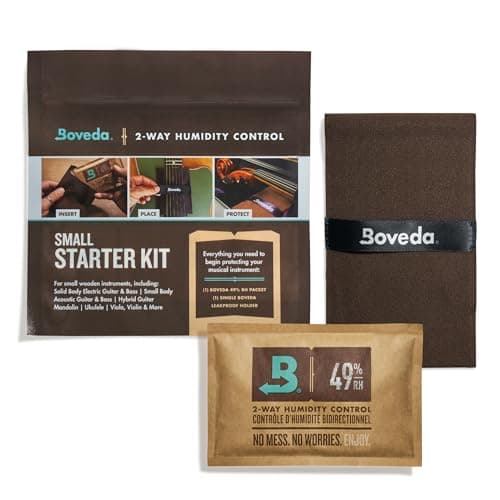
Buy a two-way case pack and put it in the case. If you buy nothing else from this page, buy that. A violin is a thin shell of carved wood held together with hide glue, and that is a deliberate design: the glue is weaker than the wood so that when the instrument contracts, a seam opens rather than the top cracking. An open seam is an inexpensive repair. A crack through the top is not. Dry air is what decides which one you get, and the timing is predictable — heating comes on in October, indoor humidity falls through November, and instruments arrive at repair shops in January.
Every pick states its Starter Path band, and we have not tested any of them — the method is on how we pick. Target ranges, replacement intervals and shelf lives come from the makers’ own pages, cited at the bottom.
Target 40 to 60 percent relative humidity inside the case — the range Boveda publishes as the industry recommendation for wooden instruments. The default buy is a two-way 49% pack with its fabric holder: it adds moisture when the case is dry and removes it when the case is damp, there is no water to add so it cannot be over-filled, and Boveda specifies replacement every three months with a two-year unopened shelf life. A one-way refillable sponge is cheaper to run and only adds moisture, so it suits a reliably dry heated winter and is the wrong tool in a humid month. We do not recommend an f-hole tube — nothing in that category publishes a specification, and it puts a wet sponge inside the instrument. If the violin’s top and back are laminate rather than solid wood, you can skip all of this.
Check this first: is it solid wood?
The whole argument on this page applies to solid carved wood. It barely applies to laminate.
Solid spruce and maple move with moisture: they take up water from humid air and give it back to dry air, swelling and shrinking across the grain as they do. Laminate — thin layers glued in alternating directions — moves far less, because the layers restrain each other. That is why laminate instruments are more robust and why they sound less alive.
Most violin outfits, including inexpensive student ones, have a solid spruce top; the very cheapest sometimes do not. If you do not know, the honest answer is that a fifteen-dollar pack is cheap insurance either way, which is a different argument from the one we make about guitar humidifiers, where laminate tops are common enough that we tell a lot of readers to buy nothing.
One-way against two-way, which is the only real decision
Everything in this category is one of two things, and the difference is not marketing.
One-way devices hold water and release it. You fill them, they humidify, they run dry, you fill them again. They can only push humidity up. If the case is already damp, a one-way humidifier makes the problem worse.
Two-way devices are a salt solution in a vapor-permeable sachet. They release moisture into dry air and absorb it from damp air, settling at a target humidity. There is nothing to fill, nothing to over-fill, and no way to put liquid water near the instrument. They are consumables and the running cost is the trade.
For a student violin in a house, two-way is the right default: it covers a dry January and a humid July with the same object, and it removes the only real failure mode — a person adding too much water.
The picks
The Boveda 49% kit for small instruments#ad is the one to buy first, because it is a pack and the fabric holder together. Boveda publishes the whole specification, which is rare in this category: two-way control maintaining 40 to 60 percent inside the case, replacement every three months, up to two years unopened shelf life, and a holder that acts as a liquid barrier if a pack is punctured while its interior material lets water vapor through. The holder is not an accessory — it is part of how the system is specified to work. Buy this if you are starting from nothing. Skip it if you already own holders, in which case buy refills.
The Boveda 49% Size 8 ten-pack#ad is the refill, and the right buy for a household with more than one case. Size 8 is the sachet Boveda specifies for small instruments and bows, so it fits a violin case properly rather than being a guitar pack squeezed in. Ten packs is a couple of years for one violin or a single year across an instrument case and a bow case. Buy this if you have the holder from the kit, or several cases. Skip it if this is your first purchase — without the holder you lose the puncture barrier Boveda specifies.
The MusicNomad Case Humitar (MN303)#ad is the one-way alternative and it has a real argument: after the purchase, the running cost is distilled water. It is a refillable sponge in a holder that sticks inside the case, so nothing goes inside the instrument. MusicNomad publishes the distilled-water instruction and the shared-sponge compatibility across its MN300 and MN303 products. Buy this if your winter is reliably dry, you will remember to refill it, and you would rather not buy a consumable every quarter. Skip it if your climate swings humid, or nobody in the house will remember — a dry sponge does nothing at all. Use distilled water: tap water leaves mineral deposits.
What we did not list, and why
The f-hole tube — Dampit and its many copies. This is the most recognizable product in the category and it does not get a buy row here, for two reasons. The sourcing one: no manufacturer publishes a specification we can verify, and retailer listings for what appears to be the same product disagree on the model number and the barcode, with one major dealer marking it discontinued. The design one: it is a wet sponge in a rubber sleeve inserted through the f-hole into the body, and every set of instructions warns you not to over-soak it, because the failure mode is liquid water inside the instrument — which is the damage the thing was bought to prevent. A pack that sits in the case cannot fail that way. Plenty of experienced players use tubes successfully; we are not willing to put a beginner’s first humidity purchase on a product whose main risk is user error and whose specification we cannot check.
The Stretto case humidifier. The best-known branded alternative to a tube and a genuine product. It was down to two units when we checked, and a pick nobody can buy is not a pick.
A standalone hygrometer. Wanted, and deliberately left as prose. At the price that makes sense alongside a fifteen-dollar pack, the market is unbranded with no published accuracy figure, and recommending an unspecified measuring instrument on a page arguing against guesswork would contradict itself.
Room humidifiers. They work, and they are a different purchase — a general household appliance, sized to a room rather than a case, and only useful while the instrument is out of the case in that room. Our concern here is the case, which is where a student violin spends most of its life.
Winter, in the order it happens
October. Heating comes on. Indoor relative humidity starts falling, because warming air without adding water lowers its relative humidity.
November and December. The case interior spends most of the day well below forty percent. Nothing visible happens yet. This is when a pack should already be in there.
January. Pegs that fitted now slip, because the pegbox has shrunk around them. Seams open — typically along the edge of the top — and the instrument may buzz or sound suddenly dead. A fingerboard can lift. This is the month repair shops fill up.
Spring. Humidity comes back and some of it reverses. Cracks do not.
Slipping pegs in midwinter are the useful early warning: they mean the instrument is drier than it should be, and it is worth acting on rather than working around. Our page on how to care for a violin covers the rest of the routine.
Quick picks
Buy this one first
A two-way pack with its holder, which both adds and removes moisture to hold the case between 40 and 60 percent. Nothing to fill, so nothing to over-fill. For: anybody with a solid-wood violin in a heated house. Skip if: nothing — this is the default.
| # | Product | Best for | Score | Price |
|---|---|---|---|---|
| 1 | Boveda 49% Instrument Humidifier Kit, 1 Pack + 1 Holder (small instruments)A two-way pack that both adds and removes moisture to hold the case between roughly 40 and 60 percent relative humidity, which is the range the industry recommends for wooden instruments. | The two-way pick, and the one to buy firstThe honest floor | 8.8 | $15.99 · View on Amazon #ad How we’re funded |
The refills, or a household with several cases
Ten of the smaller Size 8 sachets, which Boveda specifies for small instruments and bows. For: a second winter, or a violin case and a bow case together. Skip if: you do not already own a holder.
| # | Product | Best for | Score | Price |
|---|---|---|---|---|
| 1 |  Boveda 49% Instrument Humidifier, Size 8, 10-Pack (small woodwinds and bows)The same two-way chemistry in a ten-pack of the smaller Size 8 sachets. | A year of refills, or a household with several casesEnough | 8.6 | $14.99 · View on Amazon #ad How we’re funded |
The one-way option, if you know your winter is dry
A refillable sponge that sticks inside the case and only adds moisture. Cheaper to run, and useless in a damp month. For: a reliably dry heated winter. Skip if: your climate swings humid.
| # | Product | Best for | Score | Price |
|---|---|---|---|---|
| 1 | 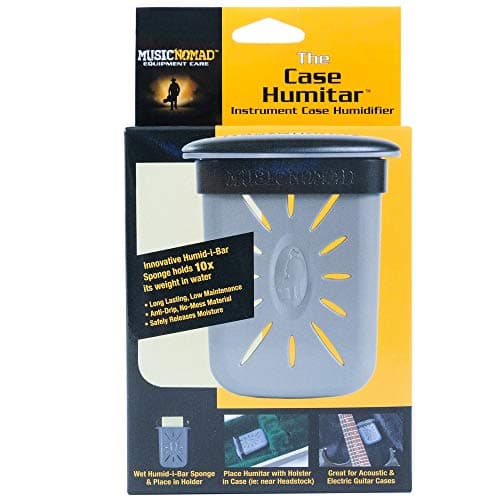 MusicNomad Case Humitar with holster (MN303)A refillable sponge humidifier that sticks to the inside of the case rather than going inside the instrument. | The one-way option, if you know your winter is dryThe honest floor | 7.2 | $16.99 · View on Amazon #ad How we’re funded |
The picks in full
Boveda 49% Instrument Humidifier Kit, 1 Pack + 1 Holder (small instruments)
BovedaBest for: The two-way pick, and the one to buy first
A two-way pack that both adds and removes moisture to hold the case between roughly 40 and 60 percent relative humidity, which is the range the industry recommends for wooden instruments. It is the only option on this page where you cannot make things worse by over-filling it, because there is nothing to fill.
Published specifications
- Type:
- Two-way — Boveda publishes that it adds or removes moisture as conditions require
- Target:
- 49% RH packs, maintaining 40-60% RH inside the case
- Kit contents:
- 1 pack plus 1 fabric holder
- Holder function:
- Boveda publishes it as a liquid barrier if a pack is punctured, with an interior material that lets water vapor through
- Replacement:
- Boveda recommends swapping packs every 3 months (90 days)
- Shelf life:
- Up to 2 years unopened
What it gets right
- Two-way, so it protects against a damp spring as well as a dry winter — nothing else here does both
- No water to add, so there is no way to over-soak it and put liquid near the instrument
- Boveda publishes the target range, the replacement interval and the shelf life, which almost nobody in this category does
- Sits in the case rather than inside the instrument
Where it gives ground
- Consumable — a replacement every ninety days is a running cost, not a one-off
- No hygrometer, so you are trusting the pack rather than measuring the case
- Boveda warns against mixing different RH levels in one case, which makes top-ups fiddly
- The High-Absorbency B49HA version is a different product for permanently humid climates
What it is not good at
Telling you what the humidity actually is. It regulates and does not measure, and if you want a number you need a hygrometer, which is a separate purchase we are not recommending a specific model of.
How the specs score against a beginner’s needs
Scores are our reading of the published specifications above against what a beginner physically needs. They are not test results — we have not played this instrument.
Specifications from Boveda — Boveda for Wooden Instruments: music industry experts recommend wooden instruments be stored between 40 and 60% RH, and Boveda's patented 2-way humidity control automatically maintains 40 to 60% RH inside the instrument case by adding or removing moisture as conditions require, Boveda — How To Use Boveda For Wood Instruments: packs go into a fabric holder that acts as a liquid barrier if punctured while its interior material allows water vapor to pass through, replace packs every 3 months, unopened shelf life up to 2 years, and do not mix different Boveda RH levels including B49HA in the same case.
Boveda 49% Instrument Humidifier, Size 8, 10-Pack (small woodwinds and bows)
BovedaBest for: A year of refills, or a household with several cases
The same two-way chemistry in a ten-pack of the smaller Size 8 sachets. If one case needs a pack every ninety days, ten packs is a couple of years for one violin or a year for a family with three instruments — and it costs about what a single starter kit does.
Published specifications
- Type:
- Two-way — adds or removes moisture as conditions require
- Target:
- 49% RH, maintaining 40-60% RH inside the case
- Size:
- Size 8, Boveda's small-instrument and bow sachet
- Pack:
- 10 sachets
- Replacement:
- Every 3 months per pack, per Boveda
- Holder:
- Not included — Boveda sells the fabric holder separately and recommends using one
What it gets right
- Far cheaper per pack than buying the starter kit repeatedly
- Size 8 is the sachet Boveda specifies for small instruments and bows, so it fits a violin case properly
- Ten packs covers a bow case and an instrument case at the same time
- Two-year unopened shelf life, so buying ahead is not waste
Where it gives ground
- No holder included, and Boveda's own guidance is to use one as a liquid barrier
- Pointless as a first purchase if you do not already have a holder
- Still a consumable with a ninety-day cycle
- Not to be mixed with other Boveda RH levels in the same case
What it is not good at
Being somebody's first humidity purchase. Without the fabric holder the kit includes, you lose the puncture barrier Boveda specifies, so this is the refill rather than the starting point.
How the specs score against a beginner’s needs
Scores are our reading of the published specifications above against what a beginner physically needs. They are not test results — we have not played this instrument.
MusicNomad Case Humitar with holster (MN303)
MusicNomadBest for: The one-way option, if you know your winter is dry
A refillable sponge humidifier that sticks to the inside of the case rather than going inside the instrument. It is cheaper to run than a two-way pack because you refill it with distilled water, and it only adds moisture — which is fine through a heated winter and useless in a damp spring.
Published specifications
- Type:
- One-way refillable case humidifier — you add water, it releases it
- Sponge:
- Humid-i-Bar, the same sponge MusicNomad specifies for the MN300 sound-hole humidifier
- Replacement sponge:
- MN301, shared with the MN300 and MN311
- Water:
- Distilled water only, per the maker
- Mounting:
- Supplied case holster with adhesive backing
- Hygrometer:
- None — measuring the case humidity is a separate purchase
What it gets right
- Refillable, so the running cost after purchase is distilled water
- Sits in the case with the holster, so nothing goes inside the instrument
- MusicNomad publishes the distilled-water instruction and the shared-sponge compatibility
- Cheaper over a winter than replacing two-way packs every ninety days
Where it gives ground
- One-way only: it cannot pull moisture out, so it is the wrong tool in a humid month
- You have to remember to refill it, and a dry sponge does nothing
- The adhesive holster is a permanent fixture in a case you may not own
- Distilled water only is a real constraint — tap water leaves mineral deposits in the sponge
What it is not good at
A damp climate or a humid summer. It only adds water, so in a case already sitting above sixty percent relative humidity it makes the problem worse rather than better.
How the specs score against a beginner’s needs
Scores are our reading of the published specifications above against what a beginner physically needs. They are not test results — we have not played this instrument.
Questions people actually ask
Does a student violin really need a humidifier?
If it is solid carved wood and it lives in a house with central heating, yes — and most violin outfits, even inexpensive ones, have a solid spruce top. A two-way case pack costs less than one seam repair. The exception is an instrument whose top and back are laminate or plywood, which some of the very cheapest outfits are: laminate is far less reactive and the argument mostly goes away.
What humidity should a violin be kept at?
Boveda publishes 40 to 60 percent relative humidity as the range the industry recommends for wooden instruments, and that is the figure we would work to. A heated room in winter frequently sits in the twenties, which is well outside it.
What is the difference between a one-way and a two-way humidifier?
A one-way device only adds moisture: you fill it with water and it releases it. A two-way device also absorbs, so it pulls humidity down when the case is too damp as well as pushing it up when the case is too dry. In a climate with a dry heated winter and a humid summer, that difference is the entire reason to pay the running cost of a two-way pack.
Why do you not recommend a Dampit or an f-hole tube?
Two reasons, and the first is sourcing: no maker publishes a specification we can check, and retailer listings for the same product disagree on the model number and even the barcode. The second is design: it is a wet sponge in a rubber sleeve that goes inside the instrument, and the standard warning with all of them is not to over-soak it, because squeezing water out inside a violin is exactly the damage you were trying to prevent. A pack that sits in the case has no equivalent failure mode.
How often do Boveda packs need replacing?
Boveda recommends swapping them every three months, so roughly one pack per winter quarter per case. Unopened, they publish a shelf life of up to two years, which makes buying the ten-pack ahead of a season sensible rather than wasteful. They also warn against mixing different RH levels in one case.
Do I need a hygrometer as well?
It would be ideal and we are not recommending a specific one. At the prices relevant here the market is almost entirely unbranded with no published accuracy figure, and on a page whose argument is to stop guessing at humidity, recommending an unspecified measuring instrument would undercut itself. If your case already has one, use it.
Sources
- Boveda — Boveda for Wooden Instruments: music industry experts recommend wooden instruments be stored between 40 and 60% RH, and Boveda's patented 2-way humidity control automatically maintains 40 to 60% RH inside the instrument case by adding or removing moisture as conditions require
- Boveda — How To Use Boveda For Wood Instruments: packs go into a fabric holder that acts as a liquid barrier if punctured while its interior material allows water vapor to pass through; replace packs every 3 months; unopened shelf life up to 2 years; do not mix different Boveda RH levels including B49HA in the same case
- MusicNomad — Humid-i-Bar replacement sponge page, which names the Case Humidifier (MN303) alongside the Soundhole Humidifier (MN300) as the products the sponge fits, and publishes the distilled-water-only instruction
Still deciding?
Every recommendation on this site is built the same way, and the method is published in full — including what we do not do and what would get a pick dropped.
Read next
- How to look after a violin
The after-playing routine, why bow hair must be loosened, how much rosin is too much, and the bridge check nobody is taught.
- Violin accessories you actually need
The shoulder rest and tuner that outfits leave out, what to upgrade first, and which popular accessories to skip.
- Best beginner violins: measure first, then buy
Arm-length sizing chart, why workshop setup is the spec that matters most, and one pick available in five sizes.
- What comes with a violin outfit, and what doesn't
What an outfit contains, what each part is worth bought separately, and the two items nearly everyone still needs.
- Best guitar humidifiers
Solid top or laminate decides whether you need one at all. Two-way against refillable, why a sealed case is non-negotiable, and three humidifiers on published specifications.
- How to look after a ukulele
The 40 to 60 per cent rule, the early warning signs of a dry instrument, and what genuinely needs cleaning versus what does not.