Ukuleles
How to look after a ukulele
The crack that appears in February started in November, and every sign it was coming was visible if you knew what to look at.
By Sawyer V. · Published · Last updated
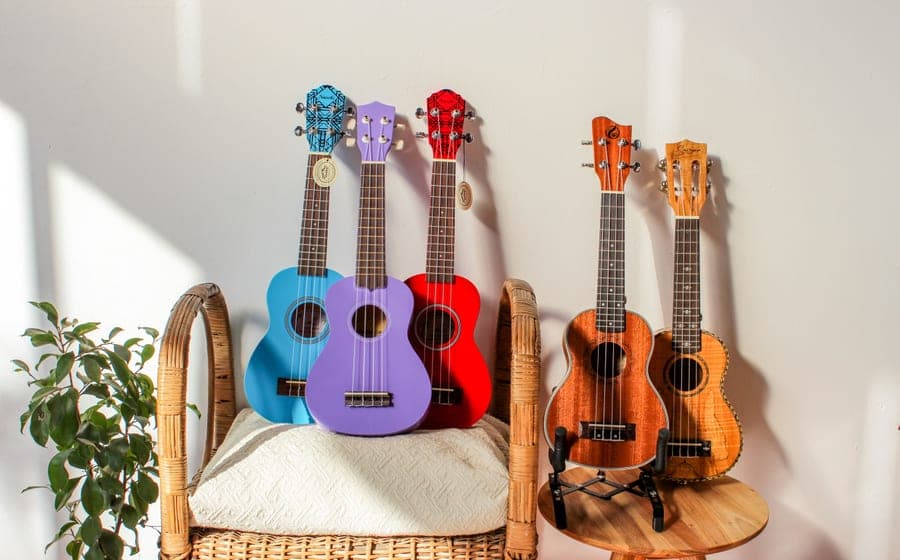
Ukuleles very rarely die from accidents. They die from a winter in a centrally heated room, and the owner finds out in February when a hairline split appears along the top.
The good news is that the damage is slow, the warning signs are unambiguous, and the prevention costs almost nothing.
Keep a wooden ukulele between roughly 40 and 60 per cent relative humidity, away from radiators, direct sun and unheated rooms. Wipe the strings after playing. Watch for sharp fret ends and new buzzing — those are the instrument telling you it is drying out, weeks before it cracks.
Why wood moves at all
The soundboard of a ukulele is a thin sheet of wood, and wood is hygroscopic: it takes on and gives up moisture from the air continuously, expanding and contracting across the grain as it does.
Underneath it are braces, glued at right angles to that grain, which do not move nearly as much. When the top shrinks in dry air, the braces hold it and something has to give. What gives is the top, and it splits along the grain.
The reverse is less dramatic but still a problem. In damp air the top swells and rises, the string height climbs, and the instrument becomes noticeably harder to play. That one usually reverses; a crack does not.
This is the same physics that governs acoustic guitars, and the same rules apply — see guitar maintenance.
The warning signs, in the order they appear
Sharp fret ends. Run a hand down the side of the neck. If the fret ends catch, the fretboard has shrunk in width while the metal frets have not. This is the earliest and most reliable sign of an instrument that is too dry, and it appears weeks before anything worse.
The action drops and buzzes appear. As the top sinks, the strings sit closer to the frets and start rattling on notes that used to sound clean. Most people read this as needing a setup. It is not; it is the instrument being dry, and a setup done at that moment will be wrong again in spring.
The top looks slightly sunken. Sight across the soundboard from the side. A healthy top is subtly domed, not dished.
Then the crack. Usually along the grain, usually on the top, often starting near the bridge or the edge. It is repairable by a luthier and it will always be visible.
Damp shows the opposite pattern: the action climbs, the instrument feels stiff and dull, and in extreme cases the glue joints soften.
Keeping it in the safe range
Buy a cheap hygrometer. Guessing at humidity is genuinely unreliable and a small digital one costs very little. Put it in the room the instrument lives in.
Do not stand it next to a radiator. The single most common mistake. The air directly above a radiator is dramatically drier than the rest of the room.
Not in direct sunlight. Heat plus ultraviolet, and a sunbeam that moves across the room finds the instrument for an hour a day all summer.
Not in a loft, garage, shed or car. All four swing further than any instrument tolerates.
In a dry winter, use a case humidifier. A small sponge-based or gel-based humidifier that sits in the case is inexpensive and is the standard solution. The case matters here: it is a small enclosed volume you can actually control, which a living room is not.
Case or stand?
There is a genuine tension in this, and we come down on the side of the stand for most people.
An instrument on a stand within reach of where you sit gets picked up during a spare five minutes. An instrument in a case under a bed gets picked up when a practice session has been decided upon, which happens far less often. Frequency of practice beats almost every other variable for a beginner, and this is the cheapest way to buy it — the wider version of the argument is in setting up a practice space.
The exception is a house at the extremes. If your winter humidity sits in the twenties, a case with a humidifier is the safer home and worth the friction. Likewise a household with a toddler or a large dog, where a wall hanger is the compromise that keeps the instrument both safe and visible.
Cleaning, briefly
Wipe the strings after playing. Nylon does not corrode the way steel does, but skin oils still build up and dull the sound. A dry cloth, ten seconds.
Wipe the body. Fingerprints and dust come off with the same cloth. A satin finish, which is what most beginner ukuleles have, should not be polished — polish makes it patchy and glossy in the places you rub most.
Clean the fretboard at a string change. It is the only time it is properly accessible. If the board is unfinished and looks gray, a very small amount of conditioner once a year is fine. More than that is actively harmful, because oil swells the wood around the fret slots.
Change strings about once a year. They do not corrode but they do go false, which means they will not play in tune with themselves up the neck no matter how carefully tuned. A fresh set of Aquila Super Nylgut ukulele strings#ad is the cheapest thing you can do for the tone of a cheap instrument. The method is in how to change ukulele strings.
What kind of ukulele do you have?
The rules above apply hardest to solid-wood instruments. Most beginner ukuleles, including the Kala KA-15S#ad, use laminate construction, which is considerably more stable because the layers are glued with alternating grain direction. Laminate is not immune, and it is much more forgiving.
A composite instrument like the Enya Nova U Mini#ad is immune to all of it. There is no grain to split and no glued brace to separate, which is exactly why we recommend it for children and for travel in best travel ukuleles. The cost is tone, and for the right owner that is a trade worth making.
If you are still choosing, what you should expect in the box is set out in what comes with a ukulele.
What we would buy
Kala KA-15S
Kala Brand MusicBest for: The honest floor, soprano
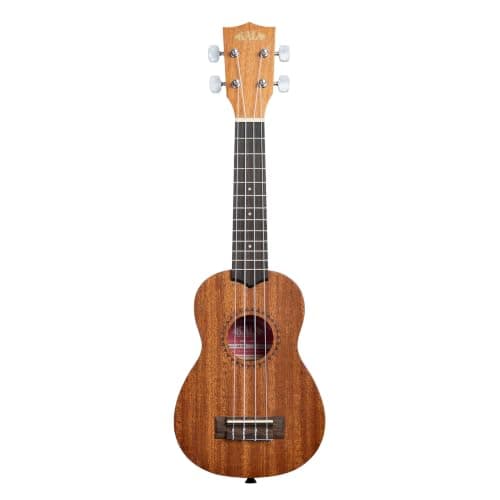
Mahogany throughout, a GraphTech NuBone nut and saddle, and Aquila strings fitted from the factory. The nut material is the spec that separates this from the pile of look-alikes.
Published specifications
- Size:
- Soprano
- Top / back / sides:
- Mahogany
- Neck / fretboard:
- Mahogany neck, rosewood fretboard
- Nut and saddle:
- GraphTech NuBone
- Scale length:
- 13.625"
- Frets:
- 12
- Nut width:
- 1.375"
- Overall length:
- 21.062"
- Strings:
- Aquila Super Nylgut
What it gets right
- NuBone nut and saddle rather than molded plastic — this is what decides whether the instrument plays in tune up the neck
- Aquila strings fitted at the factory, so the first thing you would otherwise replace is already done
- 21 inches overall and light enough for a small child to hold unsupported
Where it gives ground
- 12 frets only, and the body joint stops you well short of the high notes
- Soprano scale means less room between frets — adult fingers with wide fingertips will find it cramped
What it is not good at
Adult hands, sometimes. A 13.625 inch scale is genuinely tight. If the player is a grown-up with large hands, read our soprano-versus-concert comparison before buying this size.
How the specs score against a beginner’s needs
Scores are our reading of the published specifications above against what a beginner physically needs. They are not test results — we have not played this instrument.
Specifications from Kala Brand Music — KA-15S specifications.
Enya Nova U Mini
EnyaBest for: Young kids, survives anything
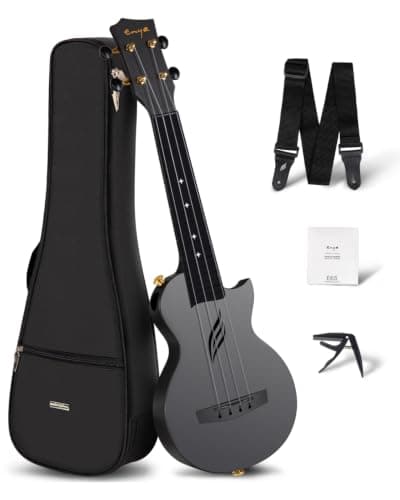
A 21 inch carbon-fiber-and-polycarbonate body weighing 430 grams. It is water resistant and it does not care about humidity, which is the honest reason to buy it for a six-year-old.
Published specifications
- Size:
- Soprano, 21"
- Top / back / sides:
- 30% carbon fiber and polycarbonate composite
- Weight:
- 430 g (0.9 lb)
- Overall length:
- 22"
- Nut width:
- 1-3/8"
- Body:
- Arched back, radius fretboard, cutaway
- In the box:
- Semi-hard case, strap, capo, spare strings
What it gets right
- Composite body — it does not crack in a dry house or swell in a damp one, which is what actually kills cheap wooden ukuleles
- 430 grams; a five-year-old can carry it around by the neck all day, and they will
- Case, strap, capo and spare strings included
Where it gives ground
- It does not sound like wood, and no amount of playing will change that
- The composite body is a fixed quantity — there is no breaking-in and no improvement over time
What it is not good at
Tone. A mahogany Kala sounds warmer and fuller, plainly. You are buying survivability, and that is a legitimate thing to buy for a young child, but be clear that is the trade.
How the specs score against a beginner’s needs
Scores are our reading of the published specifications above against what a beginner physically needs. They are not test results — we have not played this instrument.
Specifications from Enya Music — Nova carbon fiber ukulele collection.
Aquila Super Nylgut ukulele strings
AquilaBest for: The cheapest real upgrade
The string set most good ukuleles ship with from the factory, and the single most transformative thing you can do to an inexpensive one that did not.
Published specifications
- Material:
- Super Nylgut synthetic
- Tuning:
- Standard GCEA
- Fits:
- Soprano, concert or tenor — buy the set for your size
What it gets right
- Louder and brighter than the generic nylon fitted to cheap ukuleles, with far more sustain
- They settle and hold pitch faster than plain nylon, which shortens the miserable first week of constant retuning
- Cheap enough that it is the obvious first upgrade on any instrument that did not come with them
Where it gives ground
- Sets are size-specific, and a soprano set on a tenor will not reach
- New strings of any kind stretch for a few days before they settle
What it is not good at
Fixing a bad instrument. New strings cure a dull sound; they do nothing for intonation error, which is built into the bridge position and cannot be strung out.
How the specs score against a beginner’s needs
Scores are our reading of the published specifications above against what a beginner physically needs. They are not test results — we have not played this instrument.
Specifications from Kala Brand Music — KA-15S, fitted with Aquila Super Nylgut from the factory.
Questions people actually ask
What humidity should a ukulele be kept at?
Broadly 40 to 60 per cent relative humidity. Below about 35 per cent for a sustained period is where solid-wood instruments start to crack; above about 70 per cent the top swells and the action climbs.
How do I know if my ukulele is too dry?
The action drops and the strings start buzzing on frets they never buzzed on before, the top looks slightly sunken, and the fret ends begin to feel sharp against the side of your hand. That last one is the clearest early warning there is.
Should I keep my ukulele in its case?
In a stable room, a stand is better because an instrument you can reach gets played far more. In a very dry or very damp house, the case plus a humidifier is the safer choice — a case is a controllable environment and a room is not.
How do I clean a ukulele?
A dry microfiber cloth for the body and the strings after playing. Fretboard grime comes off at a string change while the board is clear. Polishes and specialist cleaners are almost never necessary.
Sources
Still deciding?
Every recommendation on this site is built the same way, and the method is published in full — including what we do not do and what would get a pick dropped.
Read next
- How to change ukulele strings
Tie-bar and slotted bridges step by step, why new strings drift for days, and the stretching trick that halves the settling time.
- Best travel ukuleles
Composite versus wood for a knockabout ukulele, what actually breaks in a backpack, and the two picks worth taking anywhere.
- What comes with a ukulele, and what you still need
What is really in the box, what the bundle accessories are worth, and the three things you genuinely need.
- Guitar maintenance a beginner actually needs
The four jobs that matter, the humidity problem that ruins acoustics, and an honest list of what you can safely ignore.
- Are cheap ukuleles worth it?
The intonation failure that cannot be repaired, what causes it, and the two specs that tell you whether an instrument has it.