Guitars
Best guitar humidifiers
Central heating through winter is what cracks acoustic guitars. Whether yours is at risk depends on one specification, and most guitars are not.
By Sawyer V. · Published · Last updated
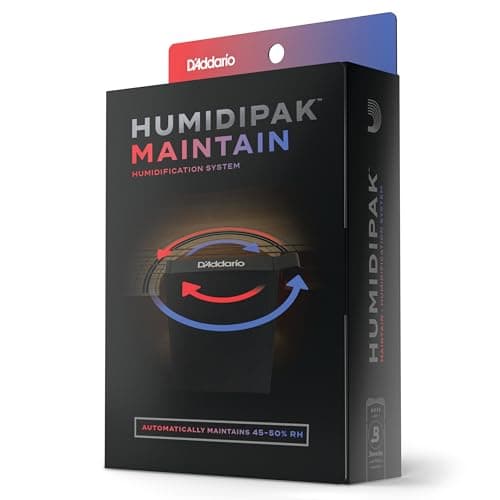
If your acoustic has a solid top and it lives in a hard case in a centrally heated house, buy the D'Addario Humidipak Maintain kit: it holds the case around 45 to 50 per cent relative humidity, works in both directions, and there is no water to remember. If the guitar has a laminate top, buy nothing — you do not have this problem. That is the whole decision, and the rest of this page is the reasoning plus the gauge nobody buys.
Every pick states its Starter Path band, and we have not tested any of them — the method is on how we pick. Humidity targets, packet lifespans and material claims are the makers' published figures, cited at the bottom, not measurements of ours.
Solid top: buy the D'Addario Humidipak Maintain kit. Two-way regulation, about 45 to 50 per cent in the case, packets swapped every two to six months, no water to add. Laminate top: buy nothing. Laminate barely responds to humidity and that is why it is recommended for beginners. Either way, a humidifier only works in a closed case — on a stand it does nothing — and you need a hygrometer to know whether any of it is working.
First: check whether you have the problem at all
This category sells a lot of humidifiers to people who do not need one, so it is worth being blunt about who does.
A solid wood top is a single piece of timber. Wood gives up moisture to dry air, and as it does it shrinks across the grain. The top is glued to braces and to the sides, so it cannot shrink freely — and when the shrinkage exceeds what the glue joints and the wood can absorb, something gives. That is a crack, usually running with the grain, usually beside the fingerboard or between braces. It is repairable and it is expensive and it is entirely preventable.
A laminate top is thin plies glued with the grain alternating direction. Each ply wants to move, and the ply above and below it will not let it. The result is a top that is less responsive musically and almost inert to humidity. This is not a compromise you suffer as a beginner — for an instrument that will live in a car, a dorm or a child's bedroom, it is the correct choice.
Electric guitars sit in a middle category. Solid-body electrics do not crack the way acoustics do, but a very dry winter can shrink a fingerboard enough to leave fret ends proud of the edge, which you feel as sharp fret ends under the hand. That is a setup problem rather than a humidifier problem, and our page on what a guitar setup is covers it.
Three mechanisms, and what each gets wrong
One-way refillable sponge. A sponge or gel in a vented housing that hangs in the sound hole or sits in the case. You add distilled water; it evaporates out. Cheapest, simplest, and it has two failure modes: you forget to refill it for a month in February, or it leaks liquid water onto the top. The anti-drip materials the better makers use are specifically about the second one.
Two-way packets. A salt solution in a vapor-permeable sachet that holds a target humidity by absorbing when the case is wet and releasing when it is dry. No water to add; the packets are swapped when they go firm. More expensive over time and much harder to get wrong.
Room humidification. A household humidifier and a hygrometer, managing the whole room rather than the case. This is the right answer if the guitar lives on a stand, and it is a furniture-and-electricity purchase rather than a music accessory, so it has no buy row here. Worth knowing it exists, because for a player who keeps the guitar out — which we recommend — it is the only approach that works.
The picks
The D'Addario Humidipak Maintain kit#ad is the recommendation. Dealers publish the target band at about 45 to 50 per cent relative humidity, the packets last roughly two to six months depending on how dry the house is, and the whole thing is maintenance-free in the sense that matters: there is no water, so there is nothing to spill and nothing to forget. Buy this if you have a solid-top acoustic and a hard case. Skip it if the guitar lives in a gig bag or on a stand, because it needs a sealed volume to regulate, or if the guitar is already noticeably dry — D'Addario's Restore product is the one for that, and it comes first.
The MusicNomad Humitar MN300#ad is the honest floor. It is a sound-hole unit built on the Humid-i-Bar sponge, published as holding ten times its weight in water in an anti-drip, no-mess material, and it takes distilled water only. Replacement sponges are a named part shared across the MusicNomad range, so it stays serviceable for years. Buy this if the budget is tight and the guitar is worth protecting. Skip it if you know yourself well enough to know you will not re-wet it on schedule.
The Oasis OH-5#ad solves the problem the other two share, which is that they are silent about their own state. Its fabric body passes water vapor but not liquid, and as the water leaves, the body visibly shrinks. That shrinkage is the refill gauge, and it is the only one in this category. The Humigel crystals inside are published as capturing up to 500 times their weight in water, which is the second line of defense against a leak. Buy this if you would rather glance at it than diary it. Skip it if you live somewhere genuinely arid — Oasis specifies this unit for rooms at roughly 25 to 40 per cent and sells a Plus version for drier conditions.
The accessory that makes all of this work
A hygrometer. None of the three picks tells you the humidity in the case except indirectly, and managing a number you cannot see is guesswork.
This matters in both directions. Under-humidify and the top cracks, which is the risk everybody has heard of. Over-humidify and the top swells, the action rises, the tone goes dull and muddy, and in a bad case the bridge begins to lift — which is a more expensive repair than a crack. A sponge that somebody keeps enthusiastically wet in a damp summer causes the second problem.
A cheap digital hygrometer that sits in the case costs a fraction of any guitar and turns this from a ritual into a measurement. We have not listed a specific model because the ones at this price are largely unbranded with no published accuracy specification, and on a page about not guessing, recommending an instrument with no stated tolerance would be inconsistent.
What we did not list, and why
Sub-five-dollar sound-hole humidifiers. Widely sold and widely reviewed. None publishes a material claim, a capacity or an anti-drip specification, and the failure mode of a cheap humidifier is liquid water on a solid spruce top. This is the one accessory category where the cheapest option risks damaging the thing it is protecting.
Combined humidifier-and-hygrometer units. MusicNomad makes one and it is an appealing idea. We left it off because the hygrometer's accuracy is not published anywhere we could find, and the entire argument for owning a hygrometer is that it tells you something true.
Case humidifiers that sit in the accessory compartment rather than the sound hole are a legitimate format and mostly a packaging difference. One sound-hole unit and one two-way system cover the actual decision.
Room humidifiers. The right answer for a guitar kept on a stand, and not a guitar accessory — it is an appliance, chosen on room size and noise, and recommending one here would be drift.
The seasonal version of this, in one paragraph
Humidity damage is a winter problem in heated climates and it is a slow one. The heating comes on in October, the indoor humidity falls through November, and the cracks show up in January and February. Which means the useful time to deal with it is now rather than when something has already gone wrong, and it is also why this page exists in October rather than in spring.
Our page on guitar maintenance for beginners puts humidity in order against the other three maintenance jobs that matter, and ukulele care and humidity covers the same problem on the smaller instrument, where the solid-versus-laminate question works exactly the same way.
Quick picks
The one to buy
A two-way system that both releases and absorbs moisture to hold the case around 45 to 50 per cent, with no water to add. For: anyone with a solid-top acoustic and a hard case. Skip if: the guitar lives on a stand, where it does nothing.
| # | Product | Best for | Score | Price |
|---|---|---|---|---|
| 1 | D'Addario Humidipak Maintain KitA two-way system: the packets both release and absorb moisture to hold the case around 45 to 50 per cent relative humidity, and there is no water to add. | The one to buyEnough | 8.8 | $25.99 · View on Amazon #ad How we’re funded |
Cheapest thing that works
A sound-hole sponge in anti-drip material, for about half the two-way price. For: a solid-top guitar on a tight budget. Skip if: you know you will forget to re-wet it, which is the usual failure.
| # | Product | Best for | Score | Price |
|---|---|---|---|---|
| 1 | 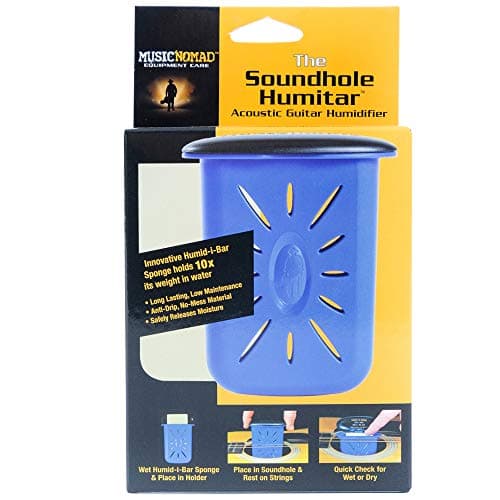 MusicNomad Humitar (MN300)A sound-hole humidifier built around the Humid-i-Bar sponge, published as holding ten times its weight in water in an anti-drip material. | The honest floorThe honest floor | 7.0 | $14.99 · View on Amazon #ad How we’re funded |
If you want to see the water level
A refillable unit whose body visibly shrinks as it empties, which is the only refill indicator in this category. For: someone who would rather check at a glance than diary it. Skip if: you live somewhere very dry — Oasis specifies this one for rooms at 25 to 40 per cent.
| # | Product | Best for | Score | Price |
|---|---|---|---|---|
| 1 | 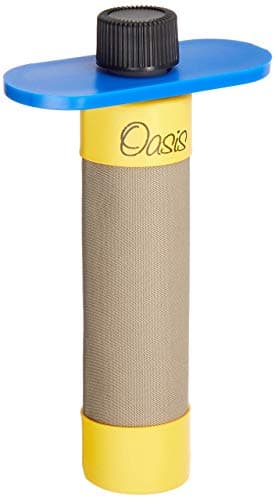 Oasis OH-5 Guitar HumidifierA refillable sound-hole humidifier whose fabric body passes water vapor but not liquid, and which visibly shrinks as the water leaves. | If you want to see the water levelEnough | 7.6 | $23.95 · View on Amazon #ad How we’re funded |
The picks in full
MusicNomad Humitar (MN300)
MusicNomadBest for: The honest floor
A sound-hole humidifier built around the Humid-i-Bar sponge, published as holding ten times its weight in water in an anti-drip material. It is the cheapest thing on this page that actually works, and the anti-drip claim is the one that matters because the failure mode here is water on a soundboard.
Published specifications
- Type:
- One-way sound-hole humidifier — you add water, it releases it
- Sponge:
- Humid-i-Bar, published as holding ten times its weight in water
- Material claim:
- Anti-drip, no-mess sponge material
- Water:
- Distilled water only, per the maker
- Replacement sponge:
- MN301
- Hygrometer:
- None — measuring the humidity is a separate purchase
What it gets right
- Cheapest working option here by a wide margin, so there is no excuse for leaving a solid-top guitar unhumidified
- The anti-drip sponge material addresses the actual risk, which is liquid water reaching the top
- Replacement sponges are a named part (MN301) shared across the MusicNomad line, so it stays serviceable
- Hangs between the strings in the sound hole, so nothing is clamped to the instrument
Where it gives ground
- One-way: it adds moisture and cannot remove it, so it does nothing in a humid summer
- Needs re-wetting on a schedule you have to remember, and distilled water you have to buy
- No hygrometer, so you are humidifying blind unless you own one separately
- Needs the guitar kept in a closed case to hold any humidity at all
What it is not good at
Telling you whether it is working. There is no gauge and no indicator; you re-wet it on a guess unless you buy a hygrometer, and over-humidifying a guitar is its own problem.
How the specs score against a beginner’s needs
Scores are our reading of the published specifications above against what a beginner physically needs. They are not test results — we have not played this instrument.
D'Addario Humidipak Maintain Kit
D'AddarioBest for: The one to buy
A two-way system: the packets both release and absorb moisture to hold the case around 45 to 50 per cent relative humidity, and there is no water to add. That removes the two ways people get humidification wrong — forgetting to re-wet it, and over-humidifying.
Published specifications
- Type:
- Two-way — adds and removes moisture on demand
- Target humidity:
- Around 45 to 50 per cent relative humidity inside the case, as published by dealers
- Water:
- None. Packets are replaced, not refilled
- Packet life:
- Published as roughly two to six months depending on conditions
- Requires:
- A closed case — the maker specifies a sealed environment such as a hard-shell case
- Not for:
- Dehumidifying a genuinely humid environment; and if the guitar is already dry, D'Addario's separate Restore product comes first
- In the kit:
- Holders plus three replaceable packets
What it gets right
- Two-way regulation means it is as hard to over-humidify as to under-humidify, which no refillable sponge can claim
- Nothing to add, so the commonest failure — forgetting about it for six weeks in February — mostly stops mattering
- A published target band (about 45 to 50 per cent) rather than a vague promise of moisture
- No liquid water anywhere near the instrument
Where it gives ground
- Only works in a sealed case; in a gig bag or on a stand it is close to useless
- Packets are a consumable on a two-to-six-month cycle, so there is an ongoing cost a sponge does not have
- D'Addario states it is not intended for dehumidification in a genuinely humid climate
- If the guitar has already dried out, this is the wrong product and the Restore version is the right one
What it is not good at
Rescuing a guitar that is already dry. D'Addario is explicit that this is for restoring and maintaining, and that an instrument in a known dry condition should be brought back with the Restore product first.
How the specs score against a beginner’s needs
Scores are our reading of the published specifications above against what a beginner physically needs. They are not test results — we have not played this instrument.
Oasis OH-5 Guitar Humidifier
OasisBest for: If you want to see the water level
A refillable sound-hole humidifier whose fabric body passes water vapor but not liquid, and which visibly shrinks as the water leaves. That shrinkage is the feature: it is the only product here that tells you when it needs attention without a separate gauge.
Published specifications
- Type:
- One-way refillable sound-hole humidifier
- Body:
- Fabric that transmits water vapor but not liquid water
- Refill indicator:
- The body shrinks as water is released, which is how you judge when to refill
- Humigel crystals:
- Published as capturing up to 500 times their weight in water, as a second barrier against leaks
- Fit:
- Hangs between the strings in the sound hole
- Recommended conditions:
- Oasis publishes the standard unit for rooms at roughly 25 to 40 per cent relative humidity; a Plus version exists for drier climates
What it gets right
- The shrink-as-it-empties behavior is a genuine usability advantage: you can see at a glance whether it needs water
- Two barriers against leaks — the vapor-permeable body plus the gel crystals — rather than relying on a sponge alone
- Oasis publishes a room-humidity range it is designed for, which almost nobody else in this category does
- Refillable indefinitely rather than consuming replacement packets
Where it gives ground
- One-way: it cannot remove moisture, so it is useless in a humid season
- Still needs refilling on a cycle, with distilled water, and that is still a thing to remember
- Crystals degrade over a few seasons and user reports of eventual leaking are common enough to take seriously
- No hygrometer, so the room-humidity range it is specified for is something you cannot verify without one
What it is not good at
Very dry climates. Oasis specifies the standard unit for rooms at roughly 25 to 40 per cent and sells a Plus version for drier conditions, so in a hard winter climate this is the wrong model in the range.
How the specs score against a beginner’s needs
Scores are our reading of the published specifications above against what a beginner physically needs. They are not test results — we have not played this instrument.
Questions people actually ask
Does my guitar actually need a humidifier?
Only if it has a solid top. Laminate tops are thin layers glued with alternating grain, which makes them nearly indifferent to humidity swings — that stability is a large part of why laminate is recommended for beginners. A solid top is one piece of wood that shrinks as it dries, and that is what cracks. If the spec sheet says “spruce top” it is laminate; “solid spruce top” means solid. Our page on solid top against laminate explains why that omission is deliberate.
What humidity should a guitar be kept at?
Broadly 40 to 60 per cent relative humidity, and the D'Addario two-way system targets about 45 to 50 inside the case. The danger is sustained time outside that band rather than brief excursions — a centrally heated house in midwinter can sit in the twenties for weeks, which is the situation this whole category exists for.
Two-way or refillable?
Two-way for most people. A refillable sponge can only add moisture, so it does nothing in a humid season and can over-humidify if you are enthusiastic. A two-way system absorbs as well as releases and has no water to add, which removes both of the common mistakes. The trade is an ongoing packet cost every few months.
Does it work if the guitar is on a stand?
Essentially no, and this is the point most buyers miss. All of these work by conditioning the small sealed volume of a closed case. In an open room they are trying to humidify the whole house. D'Addario specifies a sealed environment such as a hard-shell case. If the guitar lives on a stand — which we otherwise recommend, because a visible guitar gets played — then room humidity is the thing to manage, not case humidity.
Do I need a hygrometer as well?
Yes, and almost nobody buys one. Every product here manages humidity and none of them except the Oasis tells you anything about the current state. Without a gauge you are re-wetting a sponge on a guess, and over-humidification is its own problem — swollen tops and a raised action. A cheap digital hygrometer in the case is the accessory that makes the rest of this meaningful.
My guitar has already dried out. Will a humidifier fix it?
Carefully and slowly, and with the right product. D'Addario is explicit that the Maintain system is for maintaining, and that an instrument in a known dry condition should be brought back with its separate Restore product first. Rushing moisture back into a dry top is its own risk. If there is already a visible crack, that is a repair-shop conversation, not an accessory one.
Sources
- Woodsy's Music — D'Addario Humidipak Maintain System published details (two-way, 45 to 50 per cent target RH, packets replaced not refilled, two-to-six-month life, sealed hard-case requirement, not for dehumidification, Restore first on a dry instrument)
- MusicNomad — Humid-i-Bar sponge page (ten times its weight in water, anti-drip material, distilled water only, MN300 compatibility)
- Alamo Music Center — Oasis guitar humidifier published details (vapor-permeable body, shrink-as-it-empties indicator, Humigel crystals at up to 500 times their weight, 25 to 40 per cent room recommendation)
Still deciding?
Every recommendation on this site is built the same way, and the method is published in full — including what we do not do and what would get a pick dropped.
Read next
- Guitar maintenance a beginner actually needs
The four jobs that matter, the humidity problem that ruins acoustics, and an honest list of what you can safely ignore.
- Solid top or laminate for a first acoustic?
What a solid top does that a laminate cannot, when laminate is the smarter buy, and how to tell which one you are looking at.
- How to look after a ukulele
The 40 to 60 per cent rule, the early warning signs of a dry instrument, and what genuinely needs cleaning versus what does not.
- Best guitar cases and gig bags for beginners
Padding depth in millimeters, interior dimensions that tell you whether your guitar fits, and five cases across acoustic, electric and hard-case duty.
- Best guitar stands and wall hangers
Why a stand raises practice time, the finish-safety question nobody covers, and four picks across floor stands, wall hangers and racks.
- What a guitar setup actually is
The four adjustments in a setup, why budget guitars need one most, and which parts of it a beginner can safely do at home.