Start Here
What age should a child start an instrument?
There is no universal right age, because the answer is set by the instrument's physical demands rather than by a developmental milestone.
By Sawyer V. · Published · Last updated

The usual answer to this question is a number, and a number is the wrong shape of answer. What gates a child starting an instrument is not a developmental milestone. It is whether their hands and arms can do what that specific instrument requires.
Realistically: junior drums from about three, ukulele from four or five, keyboard from five, guitar from six with a correctly sized instrument, violin from four or five with a measured fractional size, and school band instruments from about ten or eleven when those programs start.
Starting ages, and what gates each one
| Instrument | Realistic start | What is actually gating it |
|---|---|---|
| Junior drums | 3–4 | Leg length to reach the pedal on a 16" bass drum |
| Ukulele | 4–5 | Almost nothing — nylon strings need very little strength |
| Keyboard | 5 | Sitting still at a fixed station, not hand strength |
| Violin | 4–5 | Arm length for a measured fractional size, plus posture tolerance |
| Guitar (3-string) | 6 | Hand strength for steel strings, even on a short scale |
| Guitar (6-string) | 6–7 | Hand span for a three-finger chord shape |
| School band | 10–11 | When programs start; brass also needs adult-ish teeth |
| Full-size anything | 11–12 | Reaching around a full-size instrument |
Why the gate is physical, not cognitive
A four-year-old can understand “press here and strum” perfectly well. What they cannot do is press a steel string hard enough to fret it cleanly, or reach a bass drum pedal eighteen inches in front of them, or span four frets on a full-size neck.
This matters because of what a child concludes when they fail at something physically impossible. They do not think “this instrument is too big for me.” They think they are bad at music. That conclusion is sticky, and it is the single most preventable failure in this whole category.
Which is why the sizing pages on this site exist and why we keep pointing at them: guitar sizes, drum sizes by age, and violin sizing by arm length. Get the size right and the age question mostly answers itself.
Why the ukulele is the earliest real instrument
Three things line up, and no other instrument has all three.
Nylon strings under low tension need almost no finger strength — a four-year-old can press them. A soprano body is about 21 inches long and can be held on a lap without help. And several usable chords need only one finger, which means a real, recognizable song within the first week.
That last point does the work. The strongest predictor of a young child continuing is whether they made something that sounded like music early, and a soprano ukulele#ad delivers it in days. A six-string guitar takes weeks, and the weeks in between are when children decide they are not musical.
The three-string guitar#ad is the same idea for a child who specifically wants a guitar — manufacturer guidance puts it from age six, and because it uses standard guitar strings and tuning, everything learned transfers.
The keyboard exception
Keys have the lowest physical barrier of anything we cover. Press a key, get the correct note — no strength, no intonation, no tuning, no posture to hold.
What gates keyboard is different: sitting still at a fixed station for a sustained period. Some five-year-olds manage it easily and some genuinely cannot yet, and that varies far more between children than hand size does.
If a child is ready in that sense, a 61-key full-size touch-sensitive board#ad is an excellent early start. Full-size keys matter more at this age rather than less, for reasons set out in best keyboards for kids.
Why earlier is not automatically better
More years of practice does produce a better musician, all else equal. All else is rarely equal.
Starting a child before the instrument physically fits produces frustration, and frustration produces a quit. A child who starts guitar at five on a full-size instrument, fails, and stops has not gained two years — they have acquired a belief about themselves that a child starting fresh at seven does not have.
The age that produces the most accumulated practice hours is the age at which the instrument fits and the child is enjoying it. Frequently that is later than the earliest possible date.
What to do while waiting
If a child is keen and the instrument they want is a year or two away, the waiting period is not wasted.
Rhythm and singing. Clapping games, keeping time to music, singing along. These build the ear and the sense of pulse that every instrument later depends on, and they need no equipment at all.
A smaller instrument in the meantime. A ukulele at five for a child who wants guitar at seven is not a detour — strumming, rhythm and chord-change skills all transfer, as set out in ukulele versus guitar.
Listening, deliberately. A child who has heard a lot of the music they eventually want to play arrives with a reason to practice, which is worth more than an extra year of early lessons.
What we would buy
Kala KA-15S
Kala Brand MusicBest for: The honest floor, soprano
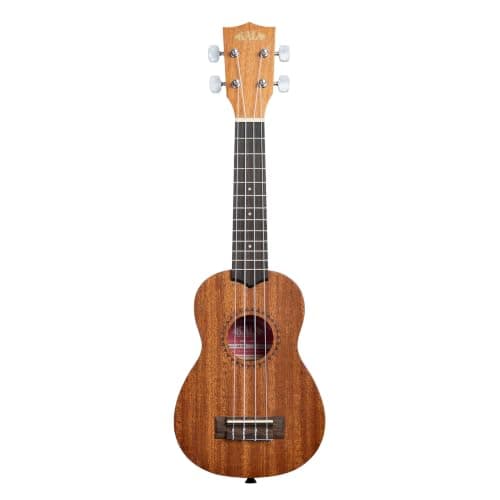
Mahogany throughout, a GraphTech NuBone nut and saddle, and Aquila strings fitted from the factory. The nut material is the spec that separates this from the pile of look-alikes.
Published specifications
- Size:
- Soprano
- Top / back / sides:
- Mahogany
- Neck / fretboard:
- Mahogany neck, rosewood fretboard
- Nut and saddle:
- GraphTech NuBone
- Scale length:
- 13.625"
- Frets:
- 12
- Nut width:
- 1.375"
- Overall length:
- 21.062"
- Strings:
- Aquila Super Nylgut
What it gets right
- NuBone nut and saddle rather than molded plastic — this is what decides whether the instrument plays in tune up the neck
- Aquila strings fitted at the factory, so the first thing you would otherwise replace is already done
- 21 inches overall and light enough for a small child to hold unsupported
Where it gives ground
- 12 frets only, and the body joint stops you well short of the high notes
- Soprano scale means less room between frets — adult fingers with wide fingertips will find it cramped
What it is not good at
Adult hands, sometimes. A 13.625 inch scale is genuinely tight. If the player is a grown-up with large hands, read our soprano-versus-concert comparison before buying this size.
How the specs score against a beginner’s needs
Scores are our reading of the published specifications above against what a beginner physically needs. They are not test results — we have not played this instrument.
Specifications from Kala Brand Music — KA-15S specifications.
Loog Pro Acoustic
LoogBest for: Ages 6-9, first chords fast
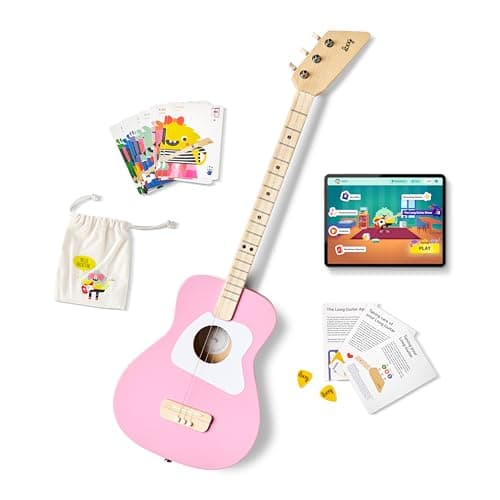
Three strings, a 20.4 inch scale and two pounds. It uses standard guitar strings and standard tuning, so everything learned on it transfers directly to a six-string.
Published specifications
- Strings:
- 3, standard guitar strings and tuning
- Scale length:
- 20.4" (520 mm)
- Dimensions:
- 29.2" long, 8.8" wide, 2.6" deep
- Weight:
- 2.0 lb (0.9 kg)
- Body / neck:
- Basswood body, maple neck and fingerboard
- Frets:
- 18
- Age guidance:
- Manufacturer states from age 6
What it gets right
- Three strings means a real chord on the first day, which is the single biggest predictor of a child continuing
- Standard tuning and standard strings — this is not a proprietary instrument that teaches a dead end
- Two pounds and 29 inches long; a six-year-old can pick it up unaided
Where it gives ground
- Three strings, so full six-string chord shapes are not available
- Basswood and a short scale mean a quiet, thin voice compared with any full acoustic
What it is not good at
Being the guitar for long. It is a deliberate bridge to a six-string, and if the child is already 9 or 10 you should probably skip straight to a 3/4 six-string instead.
How the specs score against a beginner’s needs
Scores are our reading of the published specifications above against what a beginner physically needs. They are not test results — we have not played this instrument.
Specifications from Loog Guitars — Pro Acoustic specifications.
Casio Casiotone CT-S200
CasioBest for: Kids, full-size keys
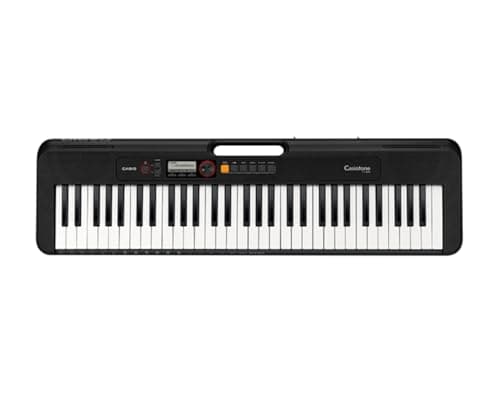
61 full-size keys, 400 tones and a power supply in the box, at the price where most keyboards still ship with narrow mini keys. That one specification is why it is here.
Published specifications
- Keys:
- 61, full-size
- Polyphony:
- 48 notes
- Tones:
- 400
- Rhythms:
- 77
- Display:
- LCD
- Connectivity:
- USB-MIDI
- In the box:
- Power supply, music rest
What it gets right
- Full-size keys at a price where mini keys are the norm — this is the specification that decides whether a child learns a hand span they can keep
- Power supply included, which is not a given and turns a cheap keyboard into an expensive paperweight when it is missing
- Light and simple enough that a child can set it up themselves, which means it gets used
Where it gives ground
- Unweighted keys, so it will not build the finger strength an acoustic piano needs
- 400 tones is a lot of browsing for a child who is meant to be practicing
What it is not good at
Preparing anyone for a real piano. It is a first keyboard for a young child, not a piano substitute — read our weighted-versus-unweighted comparison before assuming otherwise.
How the specs score against a beginner’s needs
Scores are our reading of the published specifications above against what a beginner physically needs. They are not test results — we have not played this instrument.
Specifications from Casio Casiotone CT-S200 published specifications.
Questions people actually ask
What age is best to learn an instrument?
It depends on the instrument rather than the child. Ukulele works from about four, keyboard from five, junior drums from about three, guitar from six with a correctly sized instrument, and school band instruments from about ten or eleven when the programs start.
Is my child too old to start an instrument?
Almost certainly not. The idea that music has to start in early childhood is folklore — older children and adults learn differently, with better attention and better reasoning, and frequently progress faster in the first year.
Can a three-year-old learn an instrument?
A three-year-old can do rhythm and singing games, and can play a junior drum kit sized so the pedal is reachable. Formal instrumental lessons at three are usually frustrating for everyone, because the physical requirements outrun what the hands can do.
Does starting earlier make a better musician?
Starting earlier means more accumulated hours, which helps. Starting before the child can physically manage the instrument means frustration and a quit, which does not. The instrument-appropriate age is the one that maximises hours actually played.
Sources
Still deciding?
Every recommendation on this site is built the same way, and the method is published in full — including what we do not do and what would get a pick dropped.
Read next
- The best first instrument for a child
Instrument by instrument, the real starting age set by hand size and reach, with a pick for each and the noise column filled in.
- What instrument should I learn?
Four practical constraints instead of a personality quiz, each one routing straight to the instrument that fits.
- What size guitar does a child need?
Age and height chart with real scale lengths, the ten-second fit check, and why height beats age every time.
- Drum set sizes by age
Bass drum diameter by age with a reach test, and the throne-height problem that no chart can capture.
- Should you rent or buy a first instrument?
Rent-or-buy answered per instrument family, with the two questions that decide it and the maintenance cost people miss.