Start Here
What instrument should I learn?
Every version of this question gets answered with a personality quiz. Here it is answered with the four practical constraints that actually decide.
By Sawyer V. · Published · Last updated
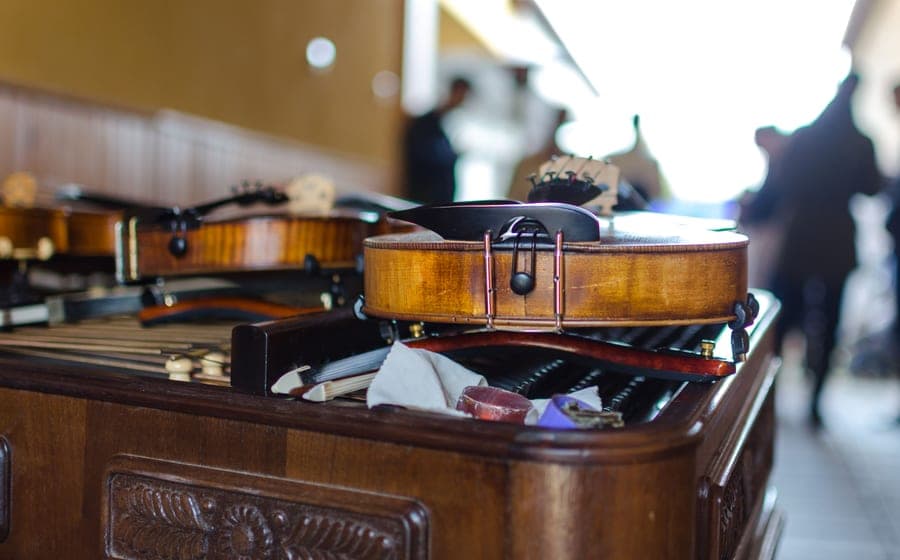
Most answers to this question are a personality quiz. Are you outgoing? Try drums. Introspective? Try piano. This is entertaining and it does not survive contact with a real purchase, because it ignores every constraint that actually determines whether someone is still playing in six months.
Four things decide it. Work through them in order.
Pick the instrument whose sound the player already likes, then check it against four constraints: can they physically reach it, can it be played in the house at the hours they are free, does the complete purchase fit the budget, and will the first month be rewarding enough to reach the second.
Question 1: what does the player actually want to hear?
This one goes first because it swamps everything else.
The reason beginners stop is almost never that the instrument was too hard. It is that the first month was unrewarding — nothing sounds like music yet, fingers hurt, progress is invisible. Every day they pick the instrument up is a day closer to the point where it does sound like music. So the variable with the largest effect on the outcome is how much they want to pick it up.
Someone who loves loud guitar music and buys a keyboard because it is more transferable has bought an instrument that cannot make the sound they are chasing. They will practice less. Every ergonomic advantage in the world does not compensate.
So: what music does this person put on? Whatever is carrying the tune in it is the honest starting answer, and the remaining questions are filters rather than overrides.
Question 2: can they physically reach it?
This is the filter that disqualifies rather than the one that chooses, and it is absolute rather than a matter of degree.
Small hands and short arms. Ukulele works from about four or five. Keyboard works from about five. Guitar needs a correctly sized instrument and realistically starts around six. Drums need the child to reach the pedals, which means a junior kit until roughly eleven. Violin needs a measured fractional size, which is set by arm length rather than age.
Hand strength. Nylon strings on a ukulele need almost none. Steel strings on an acoustic guitar need a real amount and hurt for two to three weeks. Weighted piano keys need more than a young child has. Drums need none at all.
If an instrument fails this test, it is out, regardless of question 1. A child who cannot form a chord shape does not conclude the guitar is too big; they conclude they are bad at guitar.
Question 3: can it be played in the house?
The constraint people discover after buying.
| Instrument | Can it be practiced quietly? |
|---|---|
| Keyboard / digital piano | Yes — headphones, completely silent to others |
| Electric guitar | Yes — unplugged is very quiet, headphones are silent |
| Electronic drums | Mostly — pads are quiet, the kick pedal thumps the floor |
| Ukulele | Fairly — genuinely quiet, one fixed volume |
| Acoustic guitar | No — one volume, carries through a wall |
| Violin | No — and a beginner violin is a specific kind of loud |
| Acoustic drums | No — and not by a small margin |
The consequence is arithmetic. Twenty minutes every evening is around two and a half hours a week across seven sessions. Two hours on a Saturday afternoon is two hours, once, when the player may not feel like it. The first schedule produces a musician; the second one often does not. An instrument that can be played whenever the player is free beats a better instrument they can only use on weekends. See how loud are drums for the numbers on the extreme case.
Question 4: what is the complete purchase?
Not the instrument — the total, which varies far more than the sticker prices suggest.
Ukulele is the instrument plus a $15 tuner, and that is genuinely the whole list.
Acoustic guitar is the instrument, a tuner and a setup.
Electric guitar adds an amplifier and a cable, which is the most commonly forgotten cost in the whole category.
Keyboard adds a stand, a bench, a pedal and headphones — and those are not optional extras, they are what makes the instrument usable at the right height.
Drums is about fifteen items, and a kit sold without hardware cannot be played at all.
Each of those has its own cost page here — guitar, keys, ukulele, drums — and they all use the same four-band framework, so reading one teaches you how to read the rest.
Where the answers land
Ukulele if the player is young, the budget is tight, or an early win matters more than a high ceiling.
Keyboard or digital piano if there is a teacher, if the house is quiet-sensitive, or if the player wants the most transferable musical foundation.
Guitar if the player specifically wants to play guitar. It has the hardest first month of the four and the largest repertoire of anything, and wanting it is enough of a reason.
Drums if the player is rhythmic and physical and the building can take it — or if it cannot, and an electronic kit is in budget.
If the player is a child, our guide for a child’s first instrument goes deeper on the physical constraints. If the player is an adult starting from scratch, learning as an adult covers what is genuinely different.
If you already know the context you are playing into, start there instead: worship and church music, songwriting, or the two physical-fit cases — small hands and left-handed players.
What we would buy
Kala KA-15S
Kala Brand MusicBest for: The honest floor, soprano
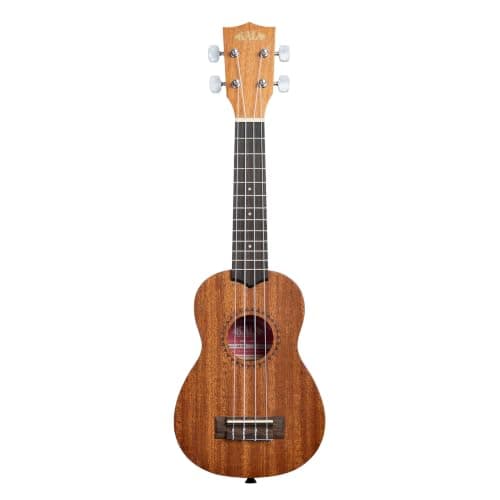
Mahogany throughout, a GraphTech NuBone nut and saddle, and Aquila strings fitted from the factory. The nut material is the spec that separates this from the pile of look-alikes.
Published specifications
- Size:
- Soprano
- Top / back / sides:
- Mahogany
- Neck / fretboard:
- Mahogany neck, rosewood fretboard
- Nut and saddle:
- GraphTech NuBone
- Scale length:
- 13.625"
- Frets:
- 12
- Nut width:
- 1.375"
- Overall length:
- 21.062"
- Strings:
- Aquila Super Nylgut
What it gets right
- NuBone nut and saddle rather than molded plastic — this is what decides whether the instrument plays in tune up the neck
- Aquila strings fitted at the factory, so the first thing you would otherwise replace is already done
- 21 inches overall and light enough for a small child to hold unsupported
Where it gives ground
- 12 frets only, and the body joint stops you well short of the high notes
- Soprano scale means less room between frets — adult fingers with wide fingertips will find it cramped
What it is not good at
Adult hands, sometimes. A 13.625 inch scale is genuinely tight. If the player is a grown-up with large hands, read our soprano-versus-concert comparison before buying this size.
How the specs score against a beginner’s needs
Scores are our reading of the published specifications above against what a beginner physically needs. They are not test results — we have not played this instrument.
Specifications from Kala Brand Music — KA-15S specifications.
Yamaha PSR-E383
YamahaBest for: Learning tools, 61 keys
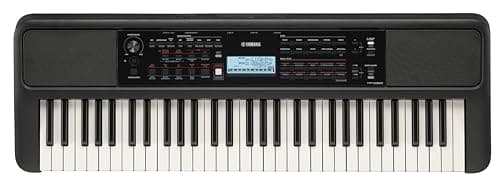
61 touch-sensitive keys and 125 lesson songs with hand-separate practice and scoring. The touch response is the spec that matters; the 650 tones are the spec that sells it.
Published specifications
- Keys:
- 61, organ-style (unweighted), touch-sensitive
- Touch response:
- Soft / medium / hard / off
- Polyphony:
- 48 notes
- Tones:
- 650 (258 panel, 25 drum/SFX, 20 arpeggio, 347 XGlite)
- Lessons:
- 125 lesson songs, right/left/both-hand practice with evaluation
- In the box:
- Music rest, PA130 power adapter
What it gets right
- Touch-sensitive keys — playing harder makes it louder, which is the thing a beginner has to learn early and a non-touch keyboard cannot teach
- The lesson mode with hand-separate practice and scoring is genuinely useful, not a gimmick
- Power adapter included, which is not a given at this tier
Where it gives ground
- Unweighted organ-style keys — this will not build the finger strength a piano needs
- 61 keys, so a method book that assumes 88 will eventually run out of instrument
What it is not good at
Preparing anyone for an acoustic piano. If there is a real piano in the child's future, the unweighted action is a habit to unlearn later. Read our 61-versus-88 comparison before deciding.
How the specs score against a beginner’s needs
Scores are our reading of the published specifications above against what a beginner physically needs. They are not test results — we have not played this instrument.
Specifications from Yamaha — PSR-E383 specifications.
Squier Sonic Stratocaster
Squier by FenderBest for: The honest floor, electric
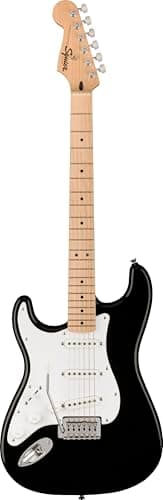
The cheapest electric that still has full-scale geometry, sealed tuners and a real 9.5 inch fingerboard radius. Nothing about it will make a beginner's first year harder.
Published specifications
- Scale length:
- 25.5" (647.7 mm) — full size
- Body / neck:
- Poplar body, maple neck, "C" profile
- Fingerboard:
- Maple or Indian laurel, 9.5" (241 mm) radius
- Frets:
- 21, narrow tall
- Nut width:
- 1.650" (42 mm), synthetic bone
- Pickups:
- Three ceramic single-coils (SSS)
- Bridge:
- 6-saddle vintage-style synchronized tremolo
What it gets right
- Full 25.5 inch scale, so nothing learned here has to be relearned later
- Synthetic bone nut rather than a soft plastic one — the part that decides whether a cheap guitar stays in tune
- Sealed-gear tuners, which is the single most important spec on a first electric
Where it gives ground
- Poplar body and ceramic pickups are exactly what you would expect at this tier
- The tremolo bridge will pull the guitar out of tune if a beginner uses it, and beginners always use it
What it is not good at
Staying in tune if you use the whammy bar. If that matters, buy the hardtail (HT) version of the same guitar instead — it is the identical instrument with the tremolo deleted.
How the specs score against a beginner’s needs
Scores are our reading of the published specifications above against what a beginner physically needs. They are not test results — we have not played this instrument.
Specifications from Squier Wiki — Sonic Stratocaster specifications.
Questions people actually ask
What instrument should I learn first?
The one whose sound you already like, filtered through four practical constraints: can the player physically reach it, can it be played in the house at the times they are free, does the complete purchase fit the budget, and will they enjoy the first month enough to reach the second.
What instruments are good for beginners?
Ukulele, keyboard, guitar and drums are all reasonable first instruments and each fails for a different reason. Ukulele is easiest and has the smallest ceiling. Keyboard is the most transferable and needs the most sitting still. Guitar is the most popular and the hardest first month. Drums are the most immediately satisfying and the loudest.
Does it matter which instrument I start on?
Less than most people think. Reading, rhythm, ear training and the habit of daily practice transfer between all of them. What does not transfer is enthusiasm for an instrument you did not want, which is why we put the sound question first.
Should I pick an instrument based on what is easiest?
Only if the alternative is not starting at all. Ease matters in the first month and stops mattering after that; wanting to play the thing matters forever. If the two conflict, follow the want.
Sources
Still deciding?
Every recommendation on this site is built the same way, and the method is published in full — including what we do not do and what would get a pick dropped.
Read next
- The easiest instruments to learn
Ranked by time to a first real song, with the ceiling each one trades away, and a pick for the top three.
- The best first instrument for a child
Instrument by instrument, the real starting age set by hand size and reach, with a pick for each and the noise column filled in.
- Learning an instrument as an adult
What genuinely changes for an adult starter, which instruments suit it, and the three mistakes that end most attempts.
- Best beginner guitars: one pick each for adults, teens and kids
Acoustic and electric in one place, segmented by player rather than price, with a single clear pick for each situation.
- Best beginner keyboards: 61 keys that suit real lessons
Touch response over tone count, segmented for children and adult learners, with the 61-key ceiling stated plainly.